Valley Temple of Khafre
Part ofGiza Necropolis
The threshold where pharaohs became gods—granite walls, alabaster floors, and the weight of 200-ton stones
Understand sacred places, explore living traditions, and learn how to engage respectfully with Pilgrim Map.
Access has not been verified. Check current local guidance before planning a visit.
Giza, Giza, Egypt
Read the sources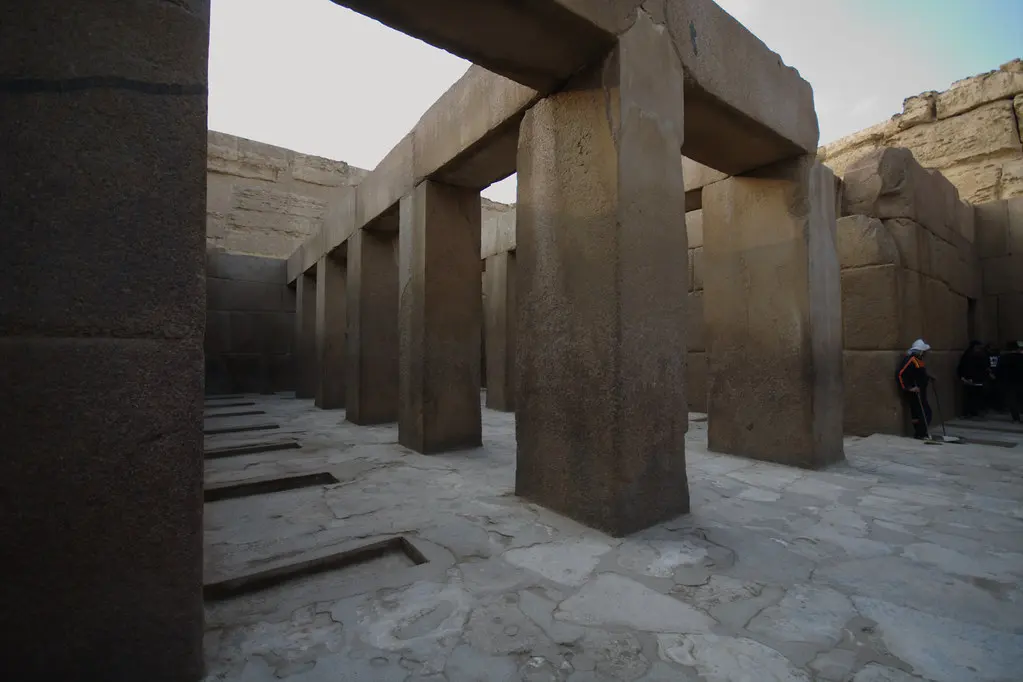
Visit essentials
A quick read before you go
- Duration
- Allow 30-45 minutes for thoughtful exploration of the temple interior.
- Etiquette
- Standard heritage site protocols apply.
Overview
Khafre's Valley Temple preserves a 4,500-year-old threshold where his body arrived by boat from Memphis, priests washed and anointed him, and the Opening of the Mouth restored his senses for eternity. Sixteen monolithic granite pillars rise from white alabaster under clerestory light. Uninscribed and unpainted, the hall was built for a dead king's passage into divinity.
Limestone core blocks exceed 200 tons, with some estimated at 400, fitted by methods that remain unexplained. Twenty-three floor pits held Khafre's Ka statues; Mariette discovered the famous diorite example, now in Cairo, here in 1858. The statues have gone, but the granite-walled temple remains the pyramid age's best-preserved interior after dynasties, a shifting Nile, and burial and re-emergence from desert sand.
Why this place is sacred
Where Giza's pyramids are experienced mainly from outside, the Valley Temple turns attention inward. Its polished-granite exterior weathered to exposed limestone, but Fourth Dynasty granite walls, alabaster floor, and monolithic pillars remain much as priests used them 4,500 years ago. Sand preserved the temple after the Old Kingdom while exposed monuments suffered weather, vandalism, and quarrying. When Auguste Mariette began excavating in 1852, he found the T-shaped hall essentially intact, with sixteen pillars, architraves, reflective floor, and Ka-statue pits.
No inscriptions, painted scenes, or carved reliefs interrupt stone, light, and shadow. Visitors stand where priests restored the dead pharaoh's sight, hearing, speech, and appetite for eternity. That threshold remains palpable four and a half millennia after the rites ended.
The temple served as the first station in Khafre's resurrection. His body arrived by boat from Memphis, entering through eastern doors that once faced the Nile. Priests performed purification rituals: washing the body, anointing it with sacred oils, beginning the complex process of mummification. The Opening of the Mouth ceremony, conducted with specialized adze-like implements, magically restored the pharaoh's senses. The 23 Ka statues provided eternal backup vessels for his life force should anything happen to the mummy.
The body then began its journey along the 494-meter causeway to the mortuary temple and pyramid for final interment. The temple was a machine for transformation, designed not for the living to worship but for the dead to pass through changed.
After Khafre's funeral and the establishment of his mortuary cult, the temple continued to receive offerings and rituals for generations. Eventually, as the Old Kingdom declined and resources shifted, the cult faded. The temple was abandoned. Sand accumulated. For millennia, only the upper portions of the walls remained visible—leading some medieval writers to mistake it for a tomb or prison. Auguste Mariette's 1852-1858 excavation revealed the intact interior that sand had preserved.
His discovery of the diorite Khafre statue in a pit beneath the floor provided crucial evidence linking the temple, the pyramid, and most likely the Great Sphinx to this pharaoh. Archaeological work continues today through Mark Lehner's Ancient Egypt Research Associates, whose geological analysis confirms that temple blocks were quarried from the same bedrock layers as the Sphinx.
Experience and orientation
From the east, a weathered limestone exterior and modest entrance conceal a T-shaped hall. Sixteen single-block pillars of dark red-pink Aswan granite rise from luminous white alabaster. Clerestory light filters between massive architraves and shifts with the sun. The hall measures roughly 45 by 35 metres, yet its mass overwhelms.
Granite sheaths limestone core blocks exceeding 200 tons, some estimated at 400; no recorded ramp or mechanism explains their transport and lifting. Twenty-three shallow pits show where Ka statues waited to receive the pharaoh's eternal life force. Often quieter than the pyramids, the temple can leave visitors alone or in small groups with the stone.
Begin by approaching from the east, the original entrance direction, to understand the temple's relationship to the Nile and the rising sun. Before entering, look at the adjacent Great Sphinx—most scholars believe Khafre commissioned both, the Sphinx carved from quarry stone that helped build this temple. Inside, allow eyes to adjust to the dim interior. Notice how light enters from above, how it plays across the granite pillars, how the alabaster floor seems to glow. Walk the T-shaped hall slowly.
Find the pits in the floor where Ka statues once stood. Imagine 23 stone images of Khafre, each slightly larger than life, each a potential vessel for his eternal soul. Exit through the passage leading toward the causeway, even if you don't walk the full 494 meters to the pyramid. This was the pharaoh's path from transformation to burial.
After exiting, take time with the Sphinx Temple directly adjacent—it shares the Valley Temple's megalithic construction style, the two structures likely built together.
Context and lineage
Khafre, fourth king of the Fourth Dynasty, son of Khufu who built the Great Pyramid, commissioned this temple as part of his own funerary complex. His architects selected a site at the plateau's eastern edge where the Nile's flood waters once reached—boats carrying the royal body could dock directly at the temple entrance. The construction required moving limestone blocks of unprecedented size, some exceeding 200 tons, then sheathing them in red granite transported 500 miles from Aswan.
Sixteen monolithic granite pillars were erected to support massive architraves. The floor was paved in white alabaster. Twenty-three pits were carved to hold Ka statues of the pharaoh—eternal vessels for his life force should the mummy be damaged. The causeway ascending 494 meters to the mortuary temple and pyramid completed the sacred landscape. Most scholars also attribute the Great Sphinx to Khafre's reign; geological analysis confirms the Sphinx bedrock was quarried for the temple's construction.
The complex formed an integrated machine for resurrection: arrival by water, transformation in the temple, ascent along the causeway, burial in the pyramid, and eternal existence among the imperishable stars.
The Valley Temple stands within a three-generation family necropolis at Giza: Khufu (the Great Pyramid), Khafre (second pyramid with this temple), and Menkaure (third pyramid). Valley temples were standard components of pyramid complexes, but Khafre's is uniquely preserved. His father Khufu's valley temple is destroyed, buried beneath modern Cairo. Menkaure's valley temple was excavated by Reisner but is far more ruined. This makes Khafre's Valley Temple irreplaceable—the only window into what these structures looked like when functioning.
The adjacent Sphinx Temple shares the same megalithic construction style, suggesting both were built as part of a unified project. After Khafre, valley temples continued to be built but on smaller scales. The Fourth Dynasty represented the apex of this architectural form, and Khafre's Valley Temple preserves that achievement better than any other structure.
Khafre (Chephren)
Auguste Mariette
Mark Lehner
Traditions and practice
The temple functioned as Egypt's most significant threshold space, where mortality ended and divinity began. When Khafre died, his body was transported by boat from Memphis to the temple's eastern entrance. Priests received the royal corpse and conducted purification rituals in the T-shaped hall. The body was washed with water from the Nile—itself connected to the primordial waters of creation—and anointed with sacred oils.
The Opening of the Mouth ceremony followed, performed with specialized adze-like implements that magically restored the pharaoh's senses. Now he could see, hear, speak, and eat in the afterlife. The body was prepared for the journey along the 494-meter causeway to the mortuary temple, where additional rites occurred before interment in the pyramid. The 23 Ka statues received their own offerings, maintaining the pharaoh's life force eternally.
A mortuary cult continued these offerings for generations, though eventually the temple was abandoned and buried by sand.
No formal religious ceremonies continue at the Valley Temple. The site is administered by Egypt's Ministry of Tourism and Antiquities as part of the UNESCO World Heritage Site. Individual visitors may engage in private contemplation—the temple's austere interior and filtered light naturally invite reflection—but this represents personal practice rather than any transmitted tradition.
The temple rewards unhurried attention. Spend time letting your eyes adjust to the dim interior. Notice how light filters through clerestory openings and plays across the granite pillars. Walk the T-shaped hall slowly, feeling the transition from entrance to inner chamber. Find the pits in the alabaster floor where Ka statues once stood; contemplate what it meant to create 23 stone vessels for a single soul.
If the space feels meditative, allow it to be so—the temple was designed for profound transition, and that quality persists even when the specific rituals have ended.
Ancient Egyptian Religion
HistoricalThe Valley Temple served as the gateway to eternal life for Pharaoh Khafre. Here, priests received the royal body arriving by boat from Memphis, conducted purification and embalming rituals, and performed the Opening of the Mouth ceremony that restored the pharaoh's senses for the afterlife. The 23 Ka statues that once stood in floor pits provided eternal vessels for his life force should the mummy be damaged. The temple's position at the Nile's edge connected it to the primordial waters of creation. The causeway ascending 494 meters to the pyramid symbolized the soul's ascent to the imperishable stars. Every architectural element served the transformation from mortal to divine.
Upon Khafre's death, his body was transported by boat from Memphis to the temple's eastern entrance. Priests received the corpse and began purification rituals: washing with Nile water, anointing with sacred oils, preparing for mummification. The Opening of the Mouth ceremony, performed with specialized adze-like implements, magically restored the pharaoh's ability to see, hear, speak, and eat in the afterlife. The body then processed along the causeway to the mortuary temple and pyramid. The 23 Ka statues received ongoing offerings, maintaining the pharaoh's life force through a mortuary cult that continued for generations.
Perspectives and open questions
The Valley Temple invites interpretation as gateway, as engineering achievement, as preserved witness, and as ongoing mystery—the how of its construction remaining unexplained after millennia of study.
Scholarly perspective
Egyptologists agree the temple was built during Khafre's reign (c. 2558-2532 BCE) as part of his funerary complex. It served as the site for purification rituals and the Opening of the Mouth ceremony before the body's journey to the pyramid. The structure's core is massive limestone blocks—some exceeding 200 tons, a few estimated at 400—sheathed in Aswan granite. The 16 monolithic granite pillars and alabaster floor create the best-preserved Old Kingdom temple interior.
The 23 pits in the floor held Ka statues of Khafre; Mariette's 1858 discovery of the famous diorite statue provided key evidence for the temple's attribution. Recent geological work by Mark Lehner and Thomas Aigner confirms that temple blocks were quarried from the same layers as the Sphinx bedrock, demonstrating coordinated construction and supporting scholarly consensus that both structures belong to Khafre's reign.
Living and traditional perspectives
Ancient Egyptians understood the Valley Temple as the place where mortal kings became divine beings. The temple's position at the Nile's edge connected it to the primordial waters of creation—the body arriving by boat echoed Ra's daily solar journey. The stark, undecorated interior was not an aesthetic choice but a functional one: this was a space for the dead to pass through, not for the living to admire. The 23 Ka statues provided eternal vessels for the pharaoh's life force.
The causeway ascending toward the pyramid represented the soul's ascent to join the imperishable circumpolar stars. Every element served the single purpose of ensuring resurrection and eternal existence.
Alternative interpretations
Some alternative researchers point to the megalithic construction as evidence of advanced ancient technology or an earlier civilization. The 200-400 ton blocks and 'bent' stones that wrap around corners suggest engineering capabilities difficult to explain with conventional reconstruction theories. Comparisons are drawn to the Osireion at Abydos, the only other Egyptian structure with similar megalithic post-and-lintel construction. A few propose the Valley Temple predates the Fourth Dynasty or represents inherited knowledge from a lost civilization.
Physical evidence of weathering patterns on the limestone has been cited by some as suggesting greater antiquity, though this interpretation is rejected by mainstream Egyptology. The construction methods remain genuinely mysterious—no ancient texts describe how such massive blocks were transported and lifted.
Open questions
Several mysteries remain unsolved. How were 200-ton blocks—some estimated at 400 tons—transported and lifted to heights of 40 feet? No definitive answer exists. What was the precise sequence of construction: Valley Temple, Sphinx, or Sphinx Temple first? Evidence supports various sequences, and debate continues. What was the original arrangement of the 23 Ka statues, and did more exist? Only fragments and the famous diorite statue survive. Why were the interior surfaces left without decoration—unique among major Egyptian temples?
The austere granite walls have prompted speculation but no confirmed explanation.
Plan your visit
Access and arrival
The Marriott Mena House offers luxury accommodation with pyramid views and proximity to the plateau. Budget options are available in central Cairo with transport to Giza. Staying near the plateau allows for multiple visits at different times of day.
Respectful visit
Conservative dress is recommended out of respect for Egyptian culture. Comfortable shoes are helpful for walking on ancient, uneven flooring. The interior is cooler than outside; a light layer may be welcome.
Photography is generally permitted inside the temple. Flash may be restricted to protect ancient surfaces—verify current policy on arrival. The dim interior makes photography challenging without additional equipment; tripods may not be allowed.
No offering tradition continues at the temple. Unlike active shrines, leaving offerings is not expected or appropriate.
Do not touch the granite walls or pillars. Do not climb on any stones. Do not attempt to enter restricted areas or approach the causeway beyond designated points. Follow all instructions from site staff. Respect other visitors' experience of this contemplative space.
The interior is dim; allow time for eyes to adjust. The alabaster floor can be uneven and slippery. No special physical demands, but the site requires walking and standing. The temple is included in general Giza admission without additional ticket.
Current practical details
Address
X4FQ+V8X, Al Haram, Giza Governorate 3512201, Egypt
Hours
Hours, fees, and access can change — verify on the official source before you travel. Practical details last checked Jun 2026.
Location
Map loads as you approach this section.
Pilgrim reflections
A portrait of encounter, not a score
Pilgrims describe what they felt, how present they could become, and whether the place would shape a journey. There are no stars and no ranking of traditions.
No reviewed reflections yet
The first pilgrims can help describe the character of being here.
Share a reflection
Available after an account-backed “Been there.” Every reflection is reviewed before publication.
Watch deeper
Films, episodes, and recorded talks for visitors who want more context before or after a visit. Speculative and alternative-history entries are labelled as perspectives, not as sources for established claims.
Streaming episode
Alternative-history media
Ancient Apocalypse: Legacy of the Sages
Graham Hancock's Giza/Sphinx-focused episode in Ancient Apocalypse season 1.
Perspective note: Highly contested by mainstream archaeology; included as a perspective, not as evidence.
Open on NetflixVideo resource
Alternative-history media
The Revelation of the Pyramids (La Revelation des Pyramides)
Influential 2010 French documentary on pyramid geometry, alignments, and ancient-site pattern claims.
Perspective note: Controversial and not a source for established archaeological claims.
Open on JustWatch MegalithomaniaUK / YouTube
Alternative-history media
Revelations Beneath Khafre's Pyramid FULL UPDATE
Gaia panel discussion connected to Ancient Civilizations and claims beneath Khafre's Pyramid.
Perspective note: Very speculative; pair with mainstream context before treating any claim as factual.
Open on MegalithomaniaUK / YouTubeNearby sacred places
Explore other sacred places in the region. Proximity does not establish access or travel time; check each place’s guidance.



References
Sources consulted for this page. Source categories describe the publication, not a guarantee that every claim is verified. Traditional accounts and outside interpretations may differ.
- 01Valley temple | Egyptian architecture — Encyclopaedia BritannicaencyclopediaAcademic overview of valley temple architecture
- 02Khafre Valley Temple — Digital Giza (Harvard)academicArchaeological database with detailed documentation
- 03Pyramid of Khafre and the Great Sphinx — SmarthistoryacademicArt historical analysis of the complex
- 04Statue of Khafre — The Egyptian Museum in CairoofficialOfficial museum documentation
- 05Khafre Enthroned — American Research Center in EgyptacademicScholarly analysis of the statue
- 06Khafre's Monuments as a Unit — Ancient Egypt Research AssociatesacademicMark Lehner's research organization
- 07Pyramid of Khafre — Wikipedia contributorsencyclopediaComprehensive overview including valley temple section
- 08Khafre Enthroned — Wikipedia contributorsencyclopediaDetails on the famous diorite statue
- 09Valley Temple At Giza: Great Masterwork Testifies To Remarkable Engineering Skills — Ancient PagesSource contextConstruction details and megalithic context
Share a photo
Help visitors recognize Valley Temple of Khafre. Every submission is reviewed before publication.