Tōshun-ji
Mōri Motonari's bodhi-temple beside two surviving Muromachi halls in central Yamaguchi
Understand sacred places, explore living traditions, and learn how to engage respectfully with Pilgrim Map.
Access has not been verified. Check current local guidance before planning a visit.
Yamaguchi, Yamaguchi Prefecture, Japan
Read the sources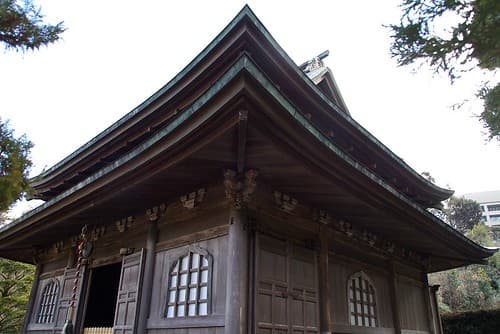
Station 16 of 33
Chūgoku 33 Kannon PilgrimageVisit essentials
A quick read before you go
- Duration
- 30–45 minutes (smaller precinct than its neighbours).
- Access
- Address: 6-2 Suetake-chō, Yamaguchi City, Yamaguchi Prefecture.
Overview
Shōshū-zan Tōshun-ji, a Kennin-ji-branch Rinzai temple in central Yamaguchi, names 'Shōshū Mountain' for the surrounding hills and 'Tōshun-ji'—literally 'Cave Spring Temple'—for the temple's classical name. It began in 1572 as Mōri Terumoto's bodhi-temple for his grandfather Mōri Motonari (1497–1571). Its moves after Sekigahara and the current precinct's inherited buildings remain fully traced in the origin account. The c.1400 four-pillared Sanmon and 1430 Kannon-dō, moved here in 1915, are National Important Cultural Properties and rare pre-1500 survivors.
On the Chūgoku 33 Kannon route it is #16: Shō-Kannon is the pilgrimage honzon in the Kannon-dō, while the main honzon is Eleven-Faced Kannon. The small mossy precinct also holds Mōri graves. Resident Kishū-Inu Maru is treated as honorary jūshoku and welcomes pilgrims at his own pace.
Why this place is sacred
Tōshun-ji joins Mōri political memory to accidental architectural survival. Founded in 1572 for Motonari, whose three-arrows parable teaches that one arrow breaks easily but three together cannot be broken, it followed the Mōri to Hagi and later Yamaguchi. Here it inherited Kokusei-ji's c.1400 shikyaku-mon, built by Ōuchi Moriharu / Morimi. Four free-standing pillars support the gate frame, a Muromachi structural type now rarely preserved. In 1915 the temple received Kannon-ji's 1430 Kannon-dō with Karayō kantō-mado and sankarado details.
Both are National Important Cultural Properties and carry pre-1500 timber into a later temple. Beside busier Rurikō-ji, the mossy precinct, limited English signage, and Maru create a warm, slow pilgrimage stop.
Founded in 1572 (Genki 3) inside Yoshida (Aki, modern Hiroshima) by Mōri Terumoto as the bodhi-temple of his grandfather Mōri Motonari (1497–1571). The current Yamaguchi precinct itself dates from 1400 as the site of Kokusei-ji; the Sanmon (c.1400) was built for that earlier temple.
The temple's institutional course shows successive relocations: 1572 founding inside Yoshida (Aki, modern Hiroshima) for Mōri Motonari's memorial; relocation to Hagi after the Mōri's transfer to Hagi-han in 1604; relocation to the current Yamaguchi precinct in the late Edo / early Meiji period, inheriting the c.1400 Sanmon from the predecessor temple Kokusei-ji; 1915 (Taishō 4) relocation of the 1430 Kannon-dō from Takinokannon-ji to Tōshun-ji. Sectarian affiliation has settled as Rinzai-shū Kennin-ji-ha (臨済宗建仁寺派).
Experience and orientation
Reach JR Kami-Yamaguchi Station from JR Yamaguchi Station by a short Kabe Line train, then walk 12 minutes through former castle-town streets; the sightseeing bus to Kōzan-Kōen also stops near Rurikō-ji, on the same path. The c.1400 Sanmon is the first encounter and looks visibly older than most Muromachi gates. Pass it to the main hall, relocated Kannon-dō, and Mōri graves among moss and old maples.
The Kannon-dō's Karayō details include kantō-mado windows and sankarado doors; pilgrims receive Chūgoku 33 #16 stamps there. At the main hall, offer incense and a coin and recite or hear the Heart Sutra before the Eleven-Faced Kannon. Maru, the honorary jūshoku, may greet visitors at his own pace.
Walk 12 minutes from JR Kami-Yamaguchi Station, using Rurikō-ji as a landmark. Visit the Sanmon, main hall, 1430 Kannon-dō, Mōri graves, and temple office for the #16 nōkyō; greet Maru only if he chooses.
Context and lineage
In 1572 (Genki 3), Mōri Terumoto (1553–1625) — head of the Mōri clan and grandson of the great warlord Mōri Motonari (1497–1571), who had died the previous year — founded Tōshun-ji inside Yoshida (Aki, modern Hiroshima Prefecture) as his grandfather's bodhi-temple. Motonari is one of the most celebrated 16th-century figures of western Japan; his three-arrows parable, told to his three sons (Takamoto, Motoharu, and Takakage), has become a foundational image of clan unity in Japanese political memory.
After the Mōri's defeat at Sekigahara in 1600, the clan was relocated to Hagi-han in present-day Yamaguchi Prefecture. Tōshun-ji was relocated with them, moving to Hagi in 1604. In the late Edo / early Meiji period, the temple moved again to its current Yamaguchi-City precinct.
The Yamaguchi precinct itself has its own pre-history. The c.1400 Sanmon at the gate was built for the predecessor temple Kokusei-ji (国清寺) by Ōuchi Moriharu / Morimi during the Ōuchi-clan domination of the region. When Tōshun-ji arrived, it inherited the Sanmon — one of only a handful of medieval four-pillared (shikyaku-mon) gates surviving in Japan.
In 1915 (Taishō 4), the 1430 Kannon-dō was relocated to Tōshun-ji from the temple Kannon-ji (Takinokannon-ji), where it had been built during the early Muromachi period. Both the Sanmon and the relocated Kannon-dō are National Important Cultural Properties.
Tōshun-ji is a parish temple of the Kennin-ji branch of Rinzai Zen Buddhism — Rinzai-shū Kennin-ji-ha (臨済宗建仁寺派) — headquartered at Kennin-ji in Kyoto, Japan's oldest Zen temple, founded by Eisai. The temple's daily liturgy follows classical Rinzai forms; Mōri-clan memorial rites continue across the centuries since the temple's founding.
Mōri Motonari (1497–1571)
The figure for whom the temple was founded
16th-century warlord who became the most powerful figure of western Japan, governing the Chūgoku region from his castle at Yoshida-Kōriyama. His three-arrows parable to his three sons (Takamoto, Motoharu, Takakage) remains a foundational image of clan unity in Japanese political memory. Tōshun-ji was founded the year after his death as his bodhi-temple.
Mōri Terumoto (1553–1625)
Founding patron
Grandson of Mōri Motonari and head of the Mōri clan from 1571. Founded Tōshun-ji in 1572 inside Yoshida as his grandfather's bodhi-temple. Following the Mōri's defeat at Sekigahara (1600) and relocation to Hagi-han, he relocated Tōshun-ji to Hagi in 1604.
Ōuchi Moriharu / Morimi
c.1400 Sanmon builders
Members of the powerful Ōuchi clan who dominated western Honshū in the medieval period. Built the c.1400 four-pillared Sanmon for the predecessor temple Kokusei-ji at the Yamaguchi site that Tōshun-ji would later inherit. The Sanmon is now a National Important Cultural Property.
Early-Muromachi builders of the 1430 Kannon-dō
Kannon-dō builders
Anonymous early-Muromachi craftsmen who built the Karayō-style Kannon-dō for the temple Kannon-ji (Takinokannon-ji) in 1430 (Eikyō 2). The hall was relocated to Tōshun-ji in 1915 and is now a National Important Cultural Property; its kantō-mado windows and sankarado paneled doors mark it as a rare regional survival of Muromachi Zen architecture.
Postwar resident clergy and Maru
Contemporary stewards
The community responsible for daily Rinzai Kennin-ji-branch liturgy, Mōri family memorial rites, the maintenance of the two National ICP buildings, and pilgrim stamping for Chūgoku 33 #16. The resident Kishū-Inu dog Maru is treated as honorary jūshoku (chief priest) — a folk-Zen reading of an ordinary animal whose intuitive welcome has become part of the temple's contemporary character.
Traditions and practice
The temple's liturgy follows classical Rinzai Kennin-ji-branch forms — silent zazen, recitation of the Hannya Shingyō, and the daily Rinzai service. Mōri family memorial rites continue across the centuries since 1572. Annual Bon and equinox memorial services mark the seasonal devotional calendar. Kannon-kō recitations are held at the relocated 1430 Kannon-dō.
Pilgrims arrive year-round for the Chūgoku 33 #16 stamp at the Kannon-dō. The small precinct is consistently uncrowded — Rurikō-ji's National Treasure pagoda next door draws most visitors past Tōshun-ji entirely. Bookable zazen sessions with the assistant priest Sōsen Fukano can be arranged in advance. Mid- to late November brings autumn maple foliage along the path between Tōshun-ji and the adjacent Rurikō-ji and Kōzan-Kōen Park.
Allow 30–45 minutes. View the c.1400 Sanmon and the 1430 Kannon-dō’s kantō-mado and sankarado from outside; those Karayō details are most legible from the side. Visit the main hall and Mōri graves, and request the #16 stamp. Let Maru choose whether to greet you.
Buddhism
ActiveTōshun-ji is a parish temple of the Kennin-ji branch of Rinzai Zen Buddhism, headquartered at Kennin-ji in Kyoto — Japan's oldest Zen temple, founded by Eisai. From its 1572 founding by Mōri Terumoto for his grandfather Motonari, the temple has been the bodaiji (family/funerary temple) of the Mōri lineage. As Chūgoku 33 #16, the temple's pilgrimage honzon (Shō-Kannon) is enshrined at the relocated 1430 Kannon-dō; the temple's primary honzon is the Eleven-Faced Kannon. The c.1400 Sanmon and the 1430 Kannon-dō are both National Important Cultural Properties, making Tōshun-ji an accidental architectural conservatory of two pre-1500 buildings.
Chūgoku 33 Kannon Pilgrimage
Active#16 of the Chūgoku 33 Kannon Pilgrimage. The pilgrimage honzon is Shō-Kannon (Ārya-Avalokiteśvara), enshrined at the relocated 1430 Kannon-dō.
Mōri-clan funerary tradition
ActiveTōshun-ji is the bodaiji (family/funerary temple) of the Mōri lineage, which ruled Chōshū until the Meiji Restoration. Mōri Motonari's three-arrows parable continues to be invoked annually in clan-related memorial events.
Perspectives and open questions
Tōshun-ji is a temple where Mōri-clan political memory and accidental architectural conservation meet in a small, quiet precinct. The site rewards visitors who hold all three layers — funerary purpose, National-ICP buildings, and resident dog — open at once.
Scholarly perspective
Tōshun-ji's importance is double: a Mōri-clan funerary temple and an architectural conservatory of two pre-1500 buildings — the c.1400 Sanmon and the relocated 1430 Kannon-dō — both nationally important and rare in the region. The Sanmon is one of only a handful of medieval four-pillared (shikyaku-mon) gates surviving in Japan; the Kannon-dō's Karayō details (kantō-mado windows, sankarado paneled doors) are unusual in this region.
The Kannon-dō's exact construction sequence prior to its 1915 relocation is incompletely documented; the original site history at Takinokannon-ji is fragmentary.
Living and traditional perspectives
Local devotion remembers Mōri Motonari's three-arrows parable here even more than at Hiroshima, since this was his explicit funerary temple. Mōri family memorial rites continue across the centuries since 1572. Pilgrim devotion to Shō-Kannon at the Kannon-dō continues alongside the family-temple liturgy.
Alternative interpretations
Modern visitors often describe Maru the temple dog as a soft 'Jizō' presence, attributing intuition and mood-reading to him — a folk-Zen reading of an ordinary animal that has become part of the temple's contemporary character. The combination of a 600-year-old gate, a relocated medieval Kannon hall, and the gentle presence of a dog-priest creates an unusually warm and modest pilgrimage stop.
Open questions
{"The Kannon-dō's exact construction sequence prior to its 1915 relocation is incompletely documented","Original site history at Takinokannon-ji (the pre-1915 home of the Kannon-dō) is fragmentary","Detailed liturgical content of internal Rinzai Kennin-ji-branch ritual at this site is not documented in retrieved English sources"}
Plan your visit
Access and arrival
Address: 6-2 Suetake-chō, Yamaguchi City, Yamaguchi Prefecture. From JR Kami-Yamaguchi Station: 12-minute walk; or Yamaguchi-City sightseeing bus from JR Yamaguchi Station to Kōzan-Kōen — Tōshun-ji is on the same path as Rurikō-ji's National Treasure pagoda. Phone: 083-922-1029. Mobile phone signal is reliable on most major Japanese carriers in central Yamaguchi City.
Yamaguchi City offers a range of business hotels and ryokan within walking or transit distance of JR Yamaguchi Station; many pilgrims base themselves in Yamaguchi for two days to combine Tōshun-ji, Rurikō-ji, and Ryūzō-ji.
Respectful visit
Modest casual; comfortable walking shoes. Pilgrim coat (hakui), sedge hat (sugegasa), and walking stick (kongō-zue) appropriate for those on the Chūgoku 33 circuit.
Permitted on grounds and of the National-ICP buildings from the exterior. Ask before photographing the dog Maru or services in progress. No flash inside any hall. Tripods discouraged in the small precinct.
Coin offerings at the main hall and Kannon-dō saisen boxes; goshuin fee paid at the temple office. Free entry; the temple is supported by offerings.
Do not enter the inner Kannon-dō floor | Do not touch the c.1400 Sanmon or 1430 Kannon-dō timbers; do not step onto their base platforms | Do not feed the dog Maru without explicit permission | Quiet voice expected throughout the small precinct | Observe the Mōri family graves quietly; do not move offerings
Do not touch, climb, or step onto the c.1400 Sanmon or 1430 Kannon-dō, or enter the inner floor. Maru is on a controlled diet; do not feed him without clergy permission. Ask before photographing him or services. Few signs are in English, so proceed patiently.
Current practical details
Address
Japan, 〒753-0082 Yamaguchi, Mizunouechō, 5−27 洞春寺
Phone
Hours, fees, and access can change — verify on the official source before you travel. Practical details last checked Jun 2026.
Location
Map loads as you approach this section.
Pilgrim reflections
A portrait of encounter, not a score
Pilgrims describe what they felt, how present they could become, and whether the place would shape a journey. There are no stars and no ranking of traditions.
No reviewed reflections yet
The first pilgrims can help describe the character of being here.
Share a reflection
Available after an account-backed “Been there.” Every reflection is reviewed before publication.
Nearby sacred places
Explore other sacred places in the region. Proximity does not establish access or travel time; check each place’s guidance.


References
Sources consulted for this page. Source categories describe the publication, not a guarantee that every claim is verified. Traditional accounts and outside interpretations may differ.
- 01洞春寺 — Chūgoku Kannon Reijō #16 — Chūgoku 33 Kannon Pilgrimage AssociationofficialConfirms #16 and pilgrimage honzon
- 02洞春寺山門・観音堂 — Yamaguchi City Tourism — Yamaguchi City TourismofficialAuthoritative for Sanmon and Kannon-dō ICP details and dates (1400 / 1430)
- 03Toshunji Temple — Yamaguchi Tourism (visit-jy.com) — Yamaguchi Prefecture TourismofficialSanmon dimensions, ICP status, history
- 04洞春寺 — 山口市の歴史文化資源 — Yamaguchi City Cultural HeritageofficialList of designated cultural properties
- 05Toshunji Temple — Yamaguchi City English — Yamaguchi City TourismofficialEnglish overview, Mōri Motonari connection
- 06Toshunji Temple, Yamaguchi — TripAdvisor + visit-jy — Yamaguchi DMOguideVisitor info, dog priest 'Maru'
- 07Rurikoji & Toshunji Temples in Fall — Japan Travel — Japan Travelguide'Maru' dog priest, autumn atmosphere
Pilgrim glossary
- Honzon
- The principal Buddhist deity enshrined as a temple's central object of worship.
- Kannon
- The bodhisattva of compassion, central to many East Asian pilgrimage routes.
- Sutra
- A canonical Buddhist scripture, often chanted as part of practice.
- Zen
- A Japanese Buddhist school emphasizing seated meditation and direct insight.
Share a photo
Help visitors recognize Tōshun-ji. Every submission is reviewed before publication.