Ryūzō-ji
Yamaguchi's oldest temple — a 1,300-year mountain training ground of waterfall and great ginkgo
Understand sacred places, explore living traditions, and learn how to engage respectfully with Pilgrim Map.
Access has not been verified. Check current local guidance before planning a visit.
Yamaguchi, Yamaguchi Prefecture, Japan
Read the sources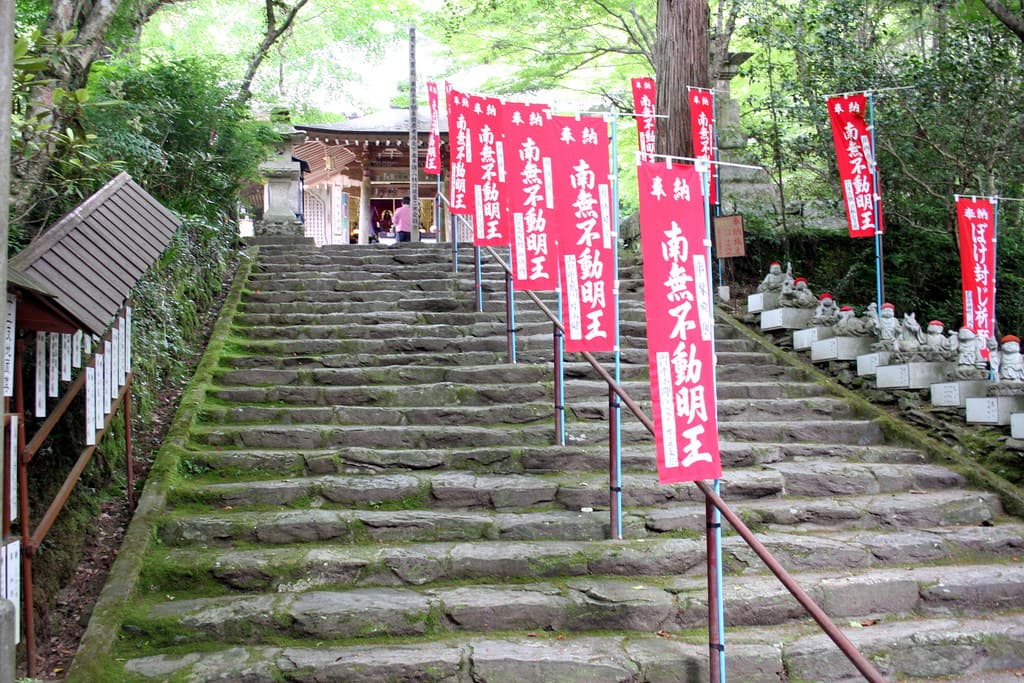
Image of Ryūzō-ji (龍蔵寺). Image source
Station 17 of 33
Chūgoku 33 Kannon PilgrimageVisit essentials
A quick read before you go
- Duration
- 60–90 minutes for self-guided visit; 3–4 hours including takigyō and shōjin-ryōri.
- Access
- Address: 1750 Kichiki, Yamaguchi City, Yamaguchi Prefecture.
Overview
Takitōzan Ryūzō-ji occupies a steep wooded ravine in Yoshiki on Yamaguchi City's northern edge. Takitōzan, “Waterfall-Pagoda Mountain,” names the three-tier Tsuzumi-no-Taki and the temple's pagoda-like silhouette; Ryūzō-ji, “Dragon Treasury Temple,” recalls the luminous cave traditionally consecrated to Kumano Gongen. The waterfall drops 16 m, 3 m, and 18 m, is one of Yamaguchi's three famous falls, and still hosts supervised takigyō under its lower tier.
The National Natural Monument great ginkgo is nearly 60 m tall and about 9.7 m around its base, ranking second among Japan's 26 designated ginkgos; local tradition treats it as a yorishiro that glows gold in late November. The main hall enshrines Amida Nyorai, while Senju Kannon at the Kannon-dō serves pilgrims as Chūgoku 33 station #17. Ryūzō-ji is also #5 of the San'yō Hana-no-Tera 24 and #33 of the Suō Province Kannon Pilgrimage.
Why this place is sacred
Ryūzō-ji's quality of thinness is best understood through the natural triad of cave, waterfall, and tree. Local tradition treats these as three sacrals — water-rock-tree — onto which Buddhist veneration was later layered. The cave shrine, retained from pre-Buddhist Kumano Gongen worship, is the temple's oldest devotional element; visitors approach it as a small natural sanctuary set into the rock above the falls.
The three-tier 37 m Tsuzumi-no-Taki — its name 'Drum Waterfall' encoding the rhythmic sound of falling water — has a lower tier of 18 m where takigyō is performed by trained practitioners under the supervision of resident clergy.
The great ginkgo dominates the precinct. Nearly 60 m tall, with a base circumference of around 9.7 m, it is one of the largest ginkgos in Japan and ranks second nationally among the 26 designated ginkgos. In mid- to late November the canopy turns brilliant gold, and the drop-carpet of fallen leaves is photographed widely. Local tradition reads the tree as a yorishiro (kami-dwelling tree); some practitioners describe its golden state as a moment of natural offering.
The annual ginkgo light-up evenings in mid-November formalize the contemporary devotional attention to the tree.
The temple's institutional course shows continuous mountain-training activity from the early 8th century, when En no Gyōja's Shugendō asceticism and Gyōki's Senju Kannon were first layered on the site. Sectarian affiliation has settled within the broader Shingon world (sources differ between Kōyasan-shū and Omuro-ha; the temple is securely Shingon). Pre-Meiji shinbutsu-shūgō linked the cave Kumano Gongen with the Buddhist altars; the 1868 separation administratively distinguished the two but devotional continuity is locally maintained.
Contemporary Ryūzō-ji offers booked spiritual experience programs combining takigyō, zazen, and shōjin-ryōri vegetarian meals.
By tradition, the cave shrine was consecrated in 698 CE by En no Ozunu (En no Gyōja) to Kumano Gongen as a Shugendō mountain training ground; the Buddhist temple proper was founded in 741 CE (Tenpyō 13) by Gyōki, who is said to have carved a Senju Kannon statue and named the temple Ryūzō-ji.
The temple's institutional course shows successive phases: traditional 698 founding of the cave shrine by En no Gyōja for Kumano Gongen; 741 founding of the Buddhist temple proper by Gyōki with the Senju Kannon honzon; documentary record beginning with the 1778 Chōshū-domain submission; 1868 Meiji shinbutsu-bunri separation of the cave Kumano Gongen from the Buddhist altars; modern designation of the great ginkgo as a National Natural Monument; contemporary spiritual-experience programs combining takigyō, zazen, and shōjin-ryōri.
Sectarian affiliation remains within the Shingon world (sources cite both Kōyasan-shū and Omuro-ha).
Experience and orientation
The wooded ravine opens with stone steps lined by rakan and Jizō figures and an immediate view of the great ginkgo. From mid- to late November, its canopy and carpet of fallen leaves make the lower precinct seem gold in every direction. The Kannon-dō houses the pilgrimage Senju Kannon; the main hall holds Amida Nyorai.
A short side path reaches the quiet cave shrine associated with En no Gyōja, while a steeper route descends toward Tsuzumi-no-Taki and the lower pool used by supervised takigyō practitioners. The falls' roar carries throughout the precinct. Pilgrims can receive the Chūgoku 33 #17, San'yō Hana-no-Tera 24 #5, and Suō Province Kannon #33 stamps at the office; a 200-yen donation supports the grounds. Advance-booked takigyō, zazen, and shōjin-ryōri programs provide white robes and resident-clergy supervision.
From JR Ōtoshi Station, take a 30-minute taxi to Ryūzō-ji at 1750 Kichiki, Yamaguchi City. Walk up the stone steps lined with rakan and Jizō figures. Pause beneath the great ginkgo — the precinct's defining presence. Light incense at the Kannon-dō for the Senju Kannon and at the main hall for the Amida Nyorai. Visit the cave shrine retained from En no Gyōja's tradition. Descend to Tsuzumi-no-Taki for the falls view (do not enter the basin).
Pilgrims request the Chūgoku 33 #17 nōkyō at the temple office. Bookable spiritual-experience programs (takigyō, zazen, shōjin-ryōri) are arranged in advance.
Context and lineage
Tradition holds that in 698 CE (Monmu 2), En no Ozunu (En no Gyōja, 634–701) — the legendary Asuka-period mountain ascetic and foundational figure of Shugendō — fled from Mt. Hiko in Bungo and traveled the western mountains. He found a luminous cave above a three-tier waterfall in what is now northern Yamaguchi City, enshrined Kumano Gongen there, and named the site 'Dragon's Treasury' (Ryū-no-Kura). The cave shrine remains in the precinct.
Some four decades later, in 741 CE (Tenpyō 13, during the Tenpyō era of Emperor Shōmu), the wandering priest Gyōki (668–749) is said to have visited the site and carved a Senju Kannon statue. He named the Buddhist temple Ryūzō-ji ('Dragon Treasury Temple') and established it as a continuation of the Shugendō mountain-training tradition under Buddhist institutional structure. Both the 698 and 741 dates are devotional tradition; the founders' personal involvement is not independently corroborated.
The 1778 record submitted to the Chōshū domain is the earliest surviving documentation of the temple. Through the medieval and Edo periods, the temple continued as a mountain-training ground combining Shingon ritual life with the older Shugendō asceticism. Pre-1868 shinbutsu-shūgō linked the cave Kumano Gongen with the Buddhist altars; the 1868 Meiji shinbutsu-bunri policy administratively separated them but devotional continuity is locally maintained.
In the modern period, the great ginkgo (Ryūzō-ji-no-Ōichō) was designated a National Natural Monument (天然記念物) — nearly 60 m tall, base circumference around 9.7 m, ranked second nationally among the 26 designated ginkgos. Tsuzumi-no-Taki was recognized as one of Yamaguchi's three famous waterfalls. The temple's contemporary character combines pilgrimage, takigyō, and ginkgo-viewing as a layered devotional life.
Ryūzō-ji is a Shingon temple — sources differ on the exact branch (Kōyasan-shū or Omuro-ha) but the temple is securely Shingon. Its esoteric ritual program (mantras, hand-seals, periodic goma fire offerings) frames the daily and annual liturgy. The Shugendō ascetic heritage descending from En no Ozunu remains active alongside the Buddhist liturgy, with takigyō (waterfall meditation) as the most visible continuing practice. Pre-Meiji shinbutsu-shūgō linked the cave Kumano Gongen worship with the Buddhist altars.
En no Ozunu (En no Gyōja, 役行者, c. 634–701)
Traditional founder of the cave shrine
Legendary Asuka-period mountain ascetic and foundational figure of Shugendō. Tradition holds that in 698 CE he fled from Mt. Hiko in Bungo, found the luminous cave above the falls at the Ryūzō-ji site, enshrined Kumano Gongen there, and named the site 'Dragon's Treasury.' Personal involvement is devotional tradition rather than corroborated history.
Gyōki (668–749)
Traditional founder of the Buddhist temple
Nara-period itinerant priest later venerated as a bodhisattva. Temple tradition places his founding visit at 741 CE (Tenpyō 13), with the carving of the Senju Kannon honzon and the naming of the Buddhist temple Ryūzō-ji. Personal involvement is devotional tradition; broader Nara-period mountain-temple founding activity is well-attested.
Pre-Meiji Shugendō practitioners
Continuous mountain-training lineage
The shugenja (mountain-ascetic practitioners) who maintained Ryūzō-ji's takigyō and cave-shrine traditions from the Asuka period through 1868. Their continuous activity is the basis of the temple's claim to be Yamaguchi City's oldest active religious site.
1778 Chōshū-domain documentation
Earliest surviving documentary attestation
The 1778 record submitted to the Chōshū domain is the earliest surviving documentation of the temple's tradition and operation, providing the historical anchor for the otherwise legendary founding narratives.
Postwar resident clergy and takigyō practitioners
Contemporary stewards
The community responsible for daily Shingon liturgy, the maintenance of the National-Natural-Monument great ginkgo and the cave shrine, the supervision of takigyō practice at Tsuzumi-no-Taki, and the bookable spiritual-experience programs combining takigyō, zazen, and shōjin-ryōri vegetarian meals.
Traditions and practice
The temple's liturgy follows Shingon esoteric forms — recitation of the Hannya Shingyō, the Senju Kannon mantra, the Amida mantra at the main hall, and the Kumano-gongen prayers at the cave shrine. Goma fire rituals (homa) are performed periodically.
Takigyō at Tsuzumi-no-Taki — standing or seated meditation under the lower tier's flowing water — continues the Shugendō ascetic heritage descending from En no Ozunu; participants undergo the practice under the supervision of resident clergy and prepare with white robes provided by the temple. Shōjin-ryōri (Buddhist vegetarian) meals are offered as part of the spiritual-experience programs.
Pilgrims arrive year-round for the multiple pilgrimage stamps. Bookable spiritual-experience programs — combining takigyō, zazen, and shōjin-ryōri — are arrangeable in advance through the temple. Mid- to late November brings the great ginkgo to peak gold, with annual light-up evenings in mid-November drawing the largest visitor crowds of the year. Takigyō programs run year-round but are most accessible May to October; the lower tier's pool can be very cold in winter.
Allow 60 to 90 minutes for a self-guided visit; 3 to 4 hours including takigyō and shōjin-ryōri. Pause beneath the great ginkgo before entering the halls — its scale registers most clearly when given uninterrupted attention. Light incense at the main hall (for Amida Nyorai) and the Kannon-dō (for Senju Kannon). Visit the cave shrine retained from En no Gyōja's tradition. Descend to Tsuzumi-no-Taki for the falls view; do not enter the basin or behind the falls.
Pilgrims should bring their nōkyō-chō to the temple office for the multiple pilgrimage stamps. Practitioners describing the three tiers as a natural triple-jewel symbol may treat the falls as a single mandala practice.
Buddhism with Shugendō ascetic heritage
ActiveRyūzō-ji is regarded as the oldest temple in Yamaguchi City, traditionally founded in 698 by En no Gyōja (cave shrine) and 741 by Gyōki (Buddhist temple proper). The temple combines Shingon esoteric Buddhism with a continuous Shugendō ascetic heritage descending from En no Ozunu. As Chūgoku 33 #17, San'yō Hana-no-Tera 24 #5, and Suō Province Kannon #33, the temple is a hereditary mountain training ground continuing waterfall asceticism (takigyō) under the supervision of resident clergy. The great ginkgo is a National Natural Monument; Tsuzumi-no-Taki is one of Yamaguchi's three famous waterfalls.
Chūgoku 33 Kannon Pilgrimage
Active#17 of the Chūgoku 33 Kannon Pilgrimage. The pilgrimage honzon is Senju Kannon (Thousand-Armed Avalokiteśvara) at the Kannon-dō.
San'yō Hana-no-Tera 24 Pilgrimage
Active#5 of the San'yō Hana-no-Tera 24 (山陽花の寺二十四ヶ寺) — a flower-temple pilgrimage circuit linking 24 sites across the San'yō region. Ryūzō-ji's great ginkgo makes it a defining station on this route.
Suō Province Kannon Pilgrimage
Active#33 of the Suō Province Kannon Pilgrimage — the regional Kannon circuit covering historical Suō Province (now southern Yamaguchi Prefecture).
Perspectives and open questions
Ryūzō-ji is a temple where Asuka-period Shugendō asceticism, Nara-period Buddhist Kannon devotion, and modern National-Natural-Monument tree veneration meet on a single ravine. The site rewards visitors who hold all three layers — cave, falls, ginkgo — open at once.
Scholarly perspective
Ryūzō-ji is an archaeologically and documentarily ancient mountain temple whose 1778 Chōshū-domain record places its tradition firmly in the early 8th century. The surviving cave shrine and great ginkgo make it one of Yamaguchi's most significant continuous sacred sites. The 698 and 741 founding dates are devotional tradition only; archaeological evidence for continuous use before the Heian period is limited. The great ginkgo's National Natural Monument designation reflects its biological scale and significance.
Living and traditional perspectives
Local devotion treats the cave, falls, and ginkgo as a triad of natural sacrals (water-rock-tree) onto which Buddhist veneration is layered. Pre-1868 shinbutsu-shūgō linked the cave Kumano Gongen worship with the Buddhist altars under a single institutional roof; the devotional continuity is locally maintained even after the 1868 administrative separation. Pilgrim devotion to Senju Kannon at the Kannon-dō continues alongside the older Shugendō ascetic tradition.
Alternative interpretations
Modern Shugendō practitioners read Tsuzumi-no-Taki's three tiers as a natural triple-jewel (Buddha-Dharma-Sangha) practice, with takigyō as a rite of self-resetting. Some practitioners describe the great ginkgo's golden state in late November as a moment of natural offering — the tree as a yorishiro making its annual gift visible to those willing to slow down beneath it.
Open questions
{"The 698 and 741 founding dates are traditional only; archaeological evidence for continuous use before the Heian period is limited","The exact Shingon branch affiliation is uncertain — sources cite both Kōyasan-shū and Omuro-ha","Detailed liturgical content of internal Shingon goma rituals at this site is not documented in retrieved English sources","The full extent of pre-1868 Shugendō ritual at the cave shrine is reconstructable only from fragmentary sources"}
Plan your visit
Access and arrival
Address: 1750 Kichiki, Yamaguchi City, Yamaguchi Prefecture. From JR Ōtoshi Station: ~30-minute taxi (the most reliable transport); alternatively, Yamaguchi-City sightseeing bus from JR Yamaguchi Station to Yoshiki area. Phone: 083-924-1158. Mobile phone signal is reliable on most major Japanese carriers in Yoshiki, though may be weaker in pockets within the ravine.
Yamaguchi City offers a range of business hotels and ryokan within walking or transit distance of JR Yamaguchi Station; many pilgrims base themselves in Yamaguchi for two days to combine Tōshun-ji, Ryūzō-ji, and Rurikō-ji. Some takigyō participants stay overnight at the temple by special arrangement.
Respectful visit
Sturdy hiking footwear required for the precinct's stone steps and waterfall paths. Takigyō participants change into white robes provided by the temple. Pilgrim coat (hakui), sedge hat (sugegasa), and walking stick (kongō-zue) appropriate for those on the Chūgoku 33, San'yō Hana-no-Tera 24, or Suō Province Kannon circuits.
Permitted on grounds. Do not photograph takigyō participants without explicit consent. No flash at the cave shrine. The great ginkgo in autumn is a popular subject — no flash or tripods near worshippers, especially during the November light-up evenings.
200-yen donation supports the precinct; coin offerings at the main hall and Kannon-dō saisen boxes; candles and incense at the dedicated stands; takigyō and zazen programs are paid (advance booking required).
Do not climb behind the falls or enter the waterfall basin | Do not approach the great ginkgo's roots or peel any bark | Quiet voice expected in the cave shrine; no flash photography | Takigyō programs require advance booking; not a tourist activity | Sturdy hiking footwear required for the precinct
Takigyō (waterfall standing meditation) is a serious Shugendō practice requiring physical preparation, supervised participation, and weather-dependent scheduling — it is not a tourist activity. Bookings must be made in advance. Do not enter the waterfall basin or climb behind the falls without supervision. Do not approach the great ginkgo's roots or peel bark; it is a National Natural Monument. Quiet voice is requested in the cave shrine. Sturdy hiking footwear is required for the precinct's stone steps.
The 30-minute taxi ride from JR Ōtoshi Station is the most reliable transport; check schedules carefully.
Current practical details
Address
1750 Yoshiki, Yamaguchi, 753-0811, Japan
Phone
Hours
Hours, fees, and access can change — verify on the official source before you travel. Practical details last checked Jun 2026.
Location
Map loads as you approach this section.
Pilgrim reflections
A portrait of encounter, not a score
Pilgrims describe what they felt, how present they could become, and whether the place would shape a journey. There are no stars and no ranking of traditions.
No reviewed reflections yet
The first pilgrims can help describe the character of being here.
Share a reflection
Available after an account-backed “Been there.” Every reflection is reviewed before publication.
Nearby sacred places
Explore other sacred places in the region. Proximity does not establish access or travel time; check each place’s guidance.


References
Sources consulted for this page. Source categories describe the publication, not a guarantee that every claim is verified. Traditional accounts and outside interpretations may differ.
- 01龍蔵寺 — Chūgoku Kannon Reijō #17 — Chūgoku 33 Kannon Pilgrimage AssociationofficialConfirms #17, Senju Kannon as pilgrimage honzon
- 02龍蔵寺 — Yamaguchi City Tourism — Yamaguchi City TourismofficialOfficial municipal description
- 03龍蔵寺 鼓の滝 — Yamaguchi City Cultural Heritage — Yamaguchi City governmentofficialTsuzumi-no-Taki waterfall details (16m + 3m + 18m)
- 04Ryuzoji Temple — Yamaguchi City English Tourism — Yamaguchi City TourismofficialSpiritual practices (takigyō, zazen) experience program
- 05龍蔵寺 (山口市) — Wikipedia (JA) — WikipediaofficialFounder, Senju Kannon by Gyōki, Bashō Kannon
- 06Ryuzoji ginkgo — National Natural Monument record — Agency for Cultural Affairs (Japan)officialGinkgo dimensions and natural-monument designation
- 07Ryuzoji Temple — Tali Landsman pilgrimage diary — Tali LandsmanguideFirst-person pilgrim experience
Pilgrim glossary
- Honzon
- The principal Buddhist deity enshrined as a temple's central object of worship.
- Kannon
- The bodhisattva of compassion, central to many East Asian pilgrimage routes.
- Mandala
- A symbolic diagram of the cosmos used in meditation and ritual.
- Sutra
- A canonical Buddhist scripture, often chanted as part of practice.
- Mantra
- A sound, word, or phrase repeated as part of meditation or ritual.
- Sangha
- The community of Buddhist practitioners, traditionally monks and nuns.
- Dharma
- The teachings of the Buddha; also the universal law underlying them.
- Shingon
- An esoteric Japanese Buddhist school emphasizing ritual, mantra, and mandala practice.
Share a photo
Help visitors recognize Ryūzō-ji. Every submission is reviewed before publication.