Kōzan-ji
Japan's oldest dated Zen-style hall — and the precinct where Takasugi Shinsaku launched the 1865 Chōshū uprising
Understand sacred places, explore living traditions, and learn how to engage respectfully with Pilgrim Map.
Access has not been verified. Check current local guidance before planning a visit.
Shimonoseki, Yamaguchi Prefecture, Japan
Read the sources
Image of Kōzan-ji. Image source · CC-BY-SA-3.0
Station 19 of 33
Chūgoku 33 Kannon PilgrimageVisit essentials
A quick read before you go
- Duration
- 60–90 minutes including the surrounding Chōfu precinct.
- Access
- Address: 1-2-3 Chōfu-Kawabata, Shimonoseki, Yamaguchi Prefecture.
Overview
Kōzan-ji stands in Chōfu, Shimonoseki's old castle town at the western tip of Honshū. Its full name, Kinzan Kōzan-ji—“Gold Mountain, Merit-Mountain Temple”—joins the surrounding hills to its contemporary identity. The institution began as Rinzai Chōfuku-ji in 1327, became the Sōtō temple Shōzan-ji in 1602, and adopted Kōzan-ji in 1650.
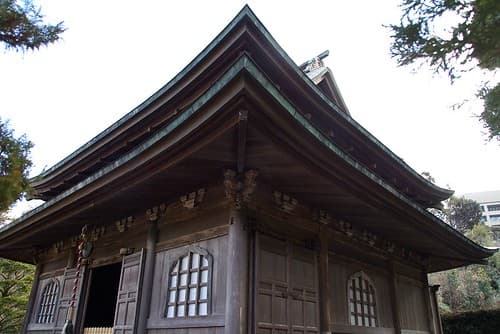
Kyō'an Genjaku founded Chōfuku-ji in 1327, but the surviving Butsuden bears a 1320 pillar inscription; its earlier builder is undocumented. Mōri Hidemoto reorganized it under Sōtō Zen in 1602, the affiliation retained today. The Butsuden is Japan's oldest dated Zenshūyō hall and a National Treasure. Its 13th-century Song-Chinese vocabulary includes a mokoshi sub-roof, irimoya roof, and tight brackets; it ranks with Zenpuku-in's Shaka-dō and Anraku-ji's pagoda among Japan's three foremost Kamakura-period Zenshūyō buildings.
In January 1865, Takasugi Shinsaku rallied 80 Kiheitai-led volunteers here for the uprising that toppled Chōshū's conservative faction and helped enable the 1868 Meiji Restoration. His forward-pointing equestrian statue stands in the precinct. Kōzan-ji is Chūgoku 33 Kannon station 19, with seated Senju Kannon in the Butsuden.
Why this place is sacred
Kōzan-ji layers Kamakura Zen architecture, Edo daimyō rule, and Restoration history in one quiet courtyard. Its 1320 Butsuden, Japan's oldest dated Zenshūyō hall, predates Kyō'an Genjaku's 1327 Chōfuku-ji foundation; the builder and possible earlier activity remain undocumented. Surviving timber and the pillar inscription secure its Song-derived architectural significance. Mokoshi, irimoya roof, and compressed brackets preserve that design. Emperor Go-Daigo designated it an imperial temple in 1333, and Ashikaga Takauji donated land in 1336.
Mōri Hidemoto reorganized it as Sōtō Shōzan-ji in 1602; it became Kōzan-ji in 1650.
In January 1865, Takasugi Shinsaku (1839–1867) rallied 80 Kiheitai-led volunteers here. Their uprising toppled Chōshū's conservatives, secured its pro-Restoration alignment, and made the 1868 Meiji Restoration possible. His statue and January 14 memorial events sustain that memory.
The temple is the Chōfu-Mōri branch's bodhi-temple. That family governed the Chōfu sub-domain under Hagi-han until 1868; its graves share the precinct. Moss, old plums, maples, and the enclosed courtyard prompt an attributed sense of walking three centuries of Japanese history.
Originally founded 1327 (Karyaku 2) by Zen master Kyō'an Genjaku as the Rinzai temple Chōfuku-ji. The surviving Butsuden is dated by pillar inscription to 1320 (Genō 2), four years older than the institutional founding — its pre-1327 builder is undocumented. Reorganized 1602 (Keichō 7) as the Sōtō temple Shōzan-ji by Mōri Hidemoto, lord of Chōfu domain; renamed Kōzan-ji in 1650 (Keian 3).
The temple's institutional course shows successive phases: 1320 Butsuden construction (institution undocumented); 1327 founding as Rinzai Chōfuku-ji by Kyō'an Genjaku; 1333 designation as Imperial temple by Emperor Go-Daigo; 1336 land donation by Ashikaga Takauji; 1602 reorganization as Sōtō Zen Shōzan-ji by Mōri Hidemoto; 1650 renaming to Kōzan-ji; January 1865 Takasugi Shinsaku uprising at the temple; ongoing role as Chōfu-Mōri bodaiji and Bakumatsu memorial site. Sectarian affiliation since 1602: Sōtō Zen.
Experience and orientation
From JR Chōfu Station, reached from JR Shimonoseki on the Sanyō Line, Kōzan-ji is about 12 minutes by taxi or 25 minutes on foot. The Sanden bus from JR Shimonoseki to Jōkamachi Chōfu leaves a five-minute walk. Narrow streets, earth-walled merchant houses, and Mōri-Tei garden shape the castle-town approach.
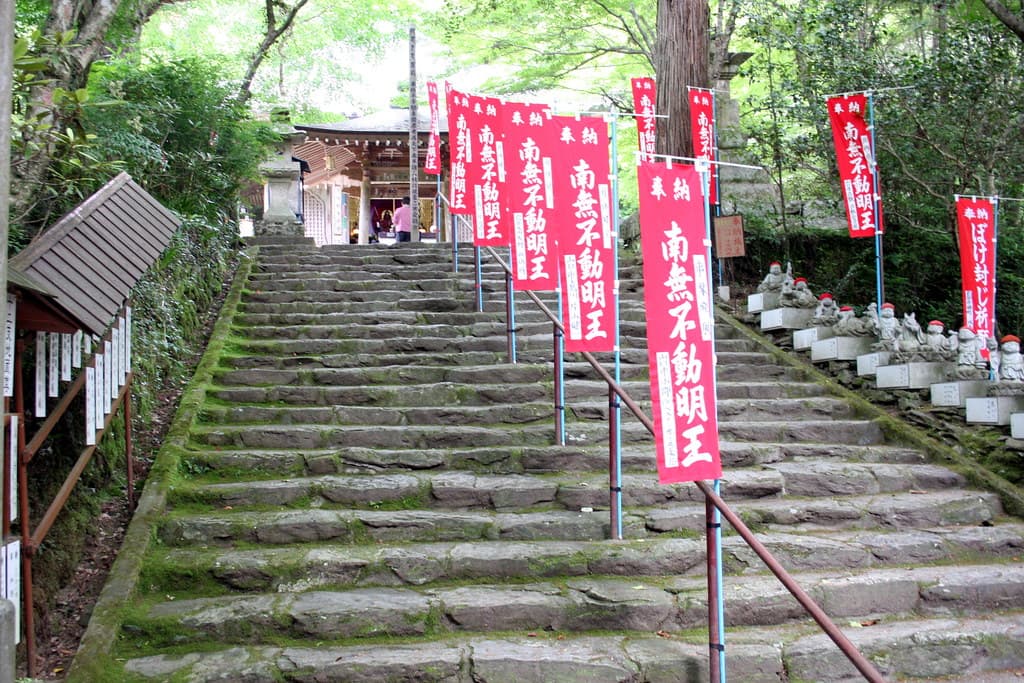
A mossy path under old plums and maples opens to the 1320 Butsuden. Its low mokoshi, compressed brackets, and tight proportions carry an explicit Song-Chinese inheritance that distinguishes it from later Edo halls. Interior access is generally restricted: worship the seated Senju Kannon from the front, bow at the gate, light incense, offer saisen, and recite or hear the Heart Sutra. Chūgoku 33 pilgrims receive station 19's stamp at the office.
Takasugi Shinsaku's forward-pointing equestrian statue draws many visitors for the Bakumatsu connection rather than pilgrimage. A short side path reaches the Chōfu-Mōri graves. The modest, free precinct opens year-round. Autumn color peaks around November 20–December 5; Takasugi memorial visitors gather on January 14.
From JR Chōfu Station, take a 12-minute taxi or 25-minute walk to the temple gate. Pause at the mossy approach. Through the gate, walk into the small enclosed courtyard and pause at the 1320 Butsuden — give it time to register. Approach the front for the Senju Kannon altar. Light incense, offer at the saisen box, and recite the Heart Sutra if equipped. Visit Takasugi Shinsaku's bronze statue and the Chōfu-Mōri family graves.
Pilgrims request the Chūgoku 33 #19 nōkyō at the temple office. Many visitors combine the temple with a walking tour of Chōfu castle town and the Mōri-Tei garden.
Context and lineage
In 1320 (Genō 2), an undocumented institution built a Zen-style Buddhist hall — the Butsuden — at the Kōzan-ji site in Chōfu. The pre-1327 builder is not securely identified, but the hall's pillar inscription dates the construction firmly. Seven years later, in 1327 (Karyaku 2), Zen master Kyō'an Genjaku (虚庵玄寂) — recently returned from training in Yuan China — accepted Hōjō patronage to found a Rinzai Zen temple at the site, named Chōfuku-ji.
The pre-existing Butsuden was incorporated into the new institution. Local memory frames the Butsuden as a 'rare survivor' that already stood when Kyō'an arrived.
The medieval temple flourished. Emperor Go-Daigo designated Chōfuku-ji an Imperial temple in 1333; Ashikaga Takauji donated lands in 1336. Through the medieval centuries the temple continued as a Rinzai establishment.
In 1602 (Keichō 7), the Mōri clan was relocated to Hagi-han following Sekigahara, and the Chōfu sub-domain was given to Mōri Hidemoto (毛利秀元, 1579–1650). Hidemoto reorganized Chōfuku-ji as a Sōtō Zen temple, renamed Shōzan-ji, and made it the bodhi-temple of the Chōfu-Mōri branch. In 1650 (Keian 3), the temple was renamed Kōzan-ji; sectarian affiliation has remained Sōtō Zen since the 1602 reorganization.
The Bakumatsu period brought the temple to national historical attention. In January 1865, Takasugi Shinsaku (1839–1867) — the Chōshū samurai-revolutionary who had organized the irregular Kiheitai militia in 1863 — rallied 80 Kiheitai-led volunteers at Kōzan-ji and launched the uprising that toppled the Chōshū conservative faction. The uprising secured Chōshū's pro-Restoration alignment and made the 1868 Meiji Restoration possible. Takasugi died of tuberculosis in 1867, before the Restoration he had made possible.
His bronze equestrian statue at Kōzan-ji and the annual January 14 memorial keep his memory alive.
Kōzan-ji is a parish temple of Sōtō Zen Buddhism (曹洞宗), the Japanese Zen school founded by Dōgen at Eihei-ji. Its zazen-centered ritual program (silent seated meditation, sutra chanting, periodic Kannon-kō observances) frames the daily and annual liturgy. From the 1602 Mōri Hidemoto reorganization, the temple has been continuously Sōtō Zen. The pre-1602 Rinzai phase under Kyō'an Genjaku is the institutional basis for the Butsuden's incorporation into Sōtō Zen architectural inheritance.
Kyō'an Genjaku (虚庵玄寂)
Founding abbot
14th-century Zen master returning from training in Yuan-dynasty China. Accepted Hōjō patronage to found Chōfuku-ji at the Kōzan-ji site in 1327 (Karyaku 2). The pre-existing Butsuden (1320) was incorporated into his new Rinzai institution.
Pre-1327 Butsuden builder (undocumented)
Original 1320 Butsuden builder
The institution responsible for building the 1320 Butsuden — Japan's oldest dated Zenshūyō hall — is not securely documented. The hall's pillar inscription dates it to 1320 (Genō 2), four years before Kyō'an Genjaku's 1327 founding of Chōfuku-ji.
Mōri Hidemoto (毛利秀元, 1579–1650)
Sōtō reorganizer
Lord of Chōfu sub-domain under Hagi-han following Sekigahara. Reorganized Chōfuku-ji as the Sōtō Zen temple Shōzan-ji in 1602 (Keichō 7) and made it the bodhi-temple of the Chōfu-Mōri branch. The temple has been continuously Sōtō Zen since.
Takasugi Shinsaku (1839–1867)
Bakumatsu uprising leader
Chōshū samurai-revolutionary who organized the irregular Kiheitai militia in 1863 and, in January 1865, rallied 80 Kiheitai-led volunteers at Kōzan-ji to launch the uprising that toppled the Chōshū conservative faction. The uprising secured Chōshū's pro-Restoration alignment. Takasugi died of tuberculosis in 1867 before the 1868 Meiji Restoration he had made possible. His bronze equestrian statue stands in the Kōzan-ji precinct.
Postwar resident clergy and Chōfu civic memory
Contemporary stewards
The community responsible for daily Sōtō Zen liturgy, maintenance of the National Treasure Butsuden, Chōfu-Mōri family memorial rites, the annual January 14 Takasugi Shinsaku memorial, and pilgrim stamping for Chūgoku 33 #19. The temple's combined Bakumatsu-historical and devotional significance is a quasi-civic Chōfu identity.
Traditions and practice
The temple's liturgy follows classical Sōtō Zen forms — silent zazen, recitation of the Hannya Shingyō, the Sōtō morning service (chōka), and Senju Kannon recitation in the Butsuden. Mōri family memorial rites continue across the centuries since 1602; the Chōfu-Mōri family graves on the precinct receive continuous care. Annual Kannon-kō observances mark the seasonal devotional calendar.
Pilgrims arrive year-round for the Chūgoku 33 #19 stamp. The annual Takasugi Shinsaku memorial in mid-January (January 14, the anniversary of his death) draws devotees and admirers to the precinct; the gathering is solemn and not primarily ceremonial. The precinct is free and open year-round. Mid- to late November brings autumn foliage at the Butsuden, with maple peak around November 20 to December 5; early March brings plum blossoms.
The temple is easily combined with a walking tour of Chōfu castle town and the Mōri-Tei garden. Bookable zazen sessions can be arranged in advance with the temple.
Allow 60 to 90 minutes including the surrounding Chōfu precinct. Walk through the mossy approach unhurriedly. Pause at the gate. Give the 1320 Butsuden time to register — its proportions are most legible after a few minutes' attention. Light incense at the front and approach the Senju Kannon altar. Recite or listen to the Heart Sutra. Visit Takasugi Shinsaku's bronze equestrian statue and the Chōfu-Mōri family graves. Pilgrims should bring their nōkyō-chō to the temple office for the #19 stamp.
Combine with a walking tour of Chōfu castle town for a fuller day.
Buddhism
ActiveKōzan-ji is a parish temple of Sōtō Zen Buddhism, the Japanese Zen school founded by Dōgen at Eihei-ji. From the 1602 Mōri Hidemoto reorganization, the temple has been continuously Sōtō Zen, and the bodaiji (family/funerary temple) of the Chōfu branch of the Mōri clan. As Chūgoku 33 #19, the temple's pilgrimage honzon is Senju Kannon, a seated statue enshrined in the National Treasure Butsuden. The 1320 Butsuden is Japan's oldest dated Zenshūyō ('Zen-style') Buddhist hall — one of the three most important Zenshūyō buildings of the Kamakura period, alongside Zenpuku-in's Shaka-dō and Anraku-ji's pagoda — making the temple canonical in Japanese architectural history.
Chūgoku 33 Kannon Pilgrimage
Active#19 of the Chūgoku 33 Kannon Pilgrimage. The pilgrimage honzon is Senju Kannon (Thousand-Armed Avalokiteśvara), a seated statue enshrined in the 1320 Butsuden.
Bakumatsu memorial tradition
ActiveKōzan-ji is the precise site of Takasugi Shinsaku's January 1865 Kiheitai uprising that toppled the Chōshū conservative faction and secured the road to the 1868 Meiji Restoration. Takasugi's bronze equestrian statue stands in the precinct, and an annual memorial in mid-January (the anniversary of his death, January 14) draws devotees and admirers each year.
Perspectives and open questions
Kōzan-ji is a temple where Kamakura-period Zen architecture, Edo daimyō rule, and Meiji-Restoration history overlap in a single quiet courtyard. The site rewards visitors who hold all three layers — the 1320 Butsuden, the Chōfu-Mōri lineage, and the Takasugi uprising — open at once.
Scholarly perspective
The Butsuden of Kōzan-ji is canonical in Japanese architectural history as the earliest dated example of Zenshūyō ('Zen-style') and the closest surviving evocation of Song-dynasty Chinese Chan architecture. It is one of the three most important Zenshūyō buildings of the Kamakura period in Japan, alongside Zenpuku-in's Shaka-dō (Wakayama) and Anraku-ji's pagoda (Nagano). The pillar inscription dating the building to 1320 — four years before the temple's institutional founding — is a documented anchor that makes the hall's age secure.
The institution that built the Butsuden in 1320 is not securely identified; pre-1320 site activity remains a question. The temple is also a key Bakumatsu-Restoration historic site.
Living and traditional perspectives
Local Chōfu identity is deeply tied to Kōzan-ji as the bodhi-temple of the former lords and as the cradle of Takasugi's uprising — visited annually as a quasi-civic pilgrimage every January. Pilgrim devotion to Senju Kannon at the Butsuden continues alongside the family-temple liturgy and the Bakumatsu memorial. Chōfu-Mōri family memorial rites have been continuously held at the temple since 1602.
Alternative interpretations
Some Zen practitioners describe the Butsuden's exact proportions (mokoshi sub-roof, irimoya hipped-and-gabled roof) as having a meditative effect on viewers — architecture as Dharma. The combination of National Treasure Zen architecture and Bakumatsu memorial gives some visitors a sense of standing at multiple historical thresholds at once.
Open questions
{"The institution that built the Butsuden in 1320 (i.e. before Kōzan-ji's 1327 founding) is not securely documented","Pre-1320 site activity remains a question","Detailed liturgical content of internal Sōtō Kannon-kō observances at this site is not documented in retrieved English sources","The exact circumstances of Kyō'an Genjaku's 1327 incorporation of the pre-existing Butsuden into Chōfuku-ji are partially reconstructable from fragmentary records"}
Plan your visit
Access and arrival
Address: 1-2-3 Chōfu-Kawabata, Shimonoseki, Yamaguchi Prefecture. From JR Chōfu Station: ~12-minute taxi or 25-minute walk; alternatively, Sanden bus from JR Shimonoseki Station to 'Jōkamachi Chōfu' stop (5-minute walk). Phone: 083-245-0258. Mobile phone signal is reliable on all major Japanese carriers in central Chōfu.
Shimonoseki offers a range of business hotels and ryokan within walking or transit distance of JR Shimonoseki Station; some pilgrims base themselves in central Shimonoseki and treat Kōzan-ji and Chōfu castle town as a half-day trip. Chōfu itself offers small ryokan within walking distance of the temple.
Respectful visit
Modest casual; comfortable walking shoes for the mossy approach. Pilgrim coat (hakui), sedge hat (sugegasa), and walking stick (kongō-zue) appropriate for those on the Chūgoku 33 circuit.
Permitted of the Butsuden exterior, Takasugi's bronze statue, the Chōfu-Mōri graves, and the precinct generally. No flash inside any open hall. Do not photograph past the closed inner sanctuary of the Butsuden. Respect worshippers near the Butsuden honzon; keep voices low. Tripods discouraged during peak autumn-foliage weekends to avoid blocking other visitors.
Coin offerings at the Butsuden saisen box; goshuin fee paid at the temple office. Free precinct entry; the temple is supported by offerings.
Do not touch the 1320 Butsuden timbers or photograph pillar inscriptions | Do not step onto the Butsuden's base platform | Interior Butsuden viewing is generally restricted; do not enter the inner sanctuary | Remain on stone paths through the precinct | Quiet voice expected near the Butsuden honzon and at the Chōfu-Mōri family graves
The 1320 Butsuden is a National Treasure with restricted interior access; do not attempt to enter or photograph past the closed inner sanctuary. Do not touch the Butsuden timbers or photograph pillar inscriptions. Remain on the stone paths through the precinct. Photography of the Butsuden exterior, Takasugi's statue, and the Chōfu-Mōri graves is permitted; no flash inside any open hall. Quiet voice is requested near the Butsuden honzon.
The annual January 14 Takasugi memorial is a solemn gathering — observe with quiet attention.
Current practical details
Address
1-chōme-2-3 Chōfukawabata, Shimonoseki, Yamaguchi 752-0979, Japan
Phone
Hours
Hours, fees, and access can change — verify on the official source before you travel. Practical details last checked Jun 2026.
Location
Map loads as you approach this section.
Pilgrim reflections
A portrait of encounter, not a score
Pilgrims describe what they felt, how present they could become, and whether the place would shape a journey. There are no stars and no ranking of traditions.
No reviewed reflections yet
The first pilgrims can help describe the character of being here.
Share a reflection
Available after an account-backed “Been there.” Every reflection is reviewed before publication.
Nearby sacred places
Explore other sacred places in the region. Proximity does not establish access or travel time; check each place’s guidance.


References
Sources consulted for this page. Source categories describe the publication, not a guarantee that every claim is verified. Traditional accounts and outside interpretations may differ.
- 01曹洞宗 功山寺 公式ホームページ — Kōzan-ji TempleofficialAuthoritative for sect (Sōtō), founder, history
- 02功山寺 — Chūgoku Kannon Reijō #19 — Chūgoku 33 Kannon Pilgrimage AssociationofficialConfirms #19 and Senju Kannon as honzon
- 03功山寺仏殿 — 文化遺産オンライン — Agency for Cultural Affairs (Japan)officialAuthoritative for 1320 date and National Treasure designation
- 04Kozanji — Yamaguchi Tourism (visit-jy.com) — Yamaguchi Prefecture TourismofficialTourism overview, Mōri connection
- 05功山寺 — 下関長府観光協会 — Chōfu Tourism AssociationofficialLocal Chōfu tourism office
- 06Kozanji Temple — Japan Tourism Agency multi-language db — Japan Tourism AgencyofficialGovernment tourism description
- 07Kōzan-ji (Shimonoseki) — Wikipedia (EN) — WikipediaofficialButsuden National Treasure, history
Pilgrim glossary
- Kannon
- The bodhisattva of compassion, central to many East Asian pilgrimage routes.
- Sutra
- A canonical Buddhist scripture, often chanted as part of practice.
- Dharma
- The teachings of the Buddha; also the universal law underlying them.
- Zen
- A Japanese Buddhist school emphasizing seated meditation and direct insight.
Share a photo
Help visitors recognize Kōzan-ji. Every submission is reviewed before publication.