Kanyō-ji
Six Mirei Shigemori gardens fed by an Edo water tunnel in highland Yamaguchi
Understand sacred places, explore living traditions, and learn how to engage respectfully with Pilgrim Map.
Access has not been verified. Check current local guidance before planning a visit.
Shunan, Yamaguchi Prefecture, Japan
Read the sources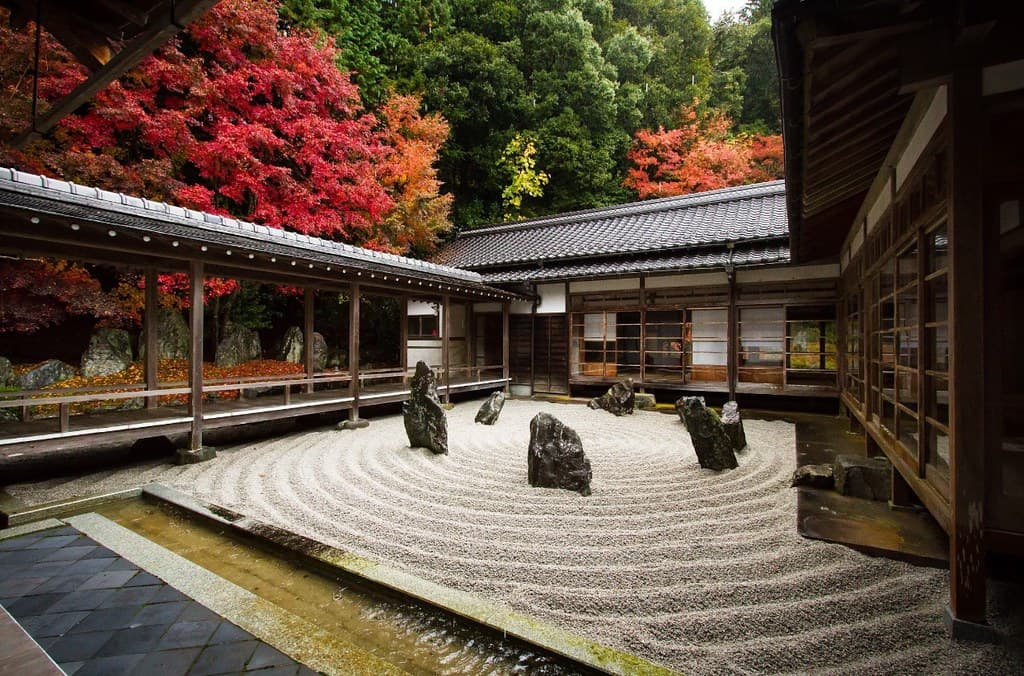
Image of Kanyō-ji. Image source
Station 15 of 33
Chūgoku 33 Kannon PilgrimageVisit essentials
A quick read before you go
- Duration
- 60–90 minutes for the gardens and the main hall.
- Access
- Address: 2882 Kanokami, Shunan, Yamaguchi Prefecture.
Overview
Kanyō-ji occupies the highland Kano (Shikano) basin of northern Shunan, Yamaguchi Prefecture — far inland from the Setouchi coast and well off the main San'yō tourist routes. The temple's full mountain-and-temple name, Rokuon-zan Kanyō-ji, names two things: 'Deer Garden Mountain' for the surrounding hills, and 'Kanyō-ji' for the temple's own classical name.
Founding tradition is documented. In 1374 (Ōan 7), Zen master Yodō Meiki Zenji (用堂明機禅師) established the temple under early Muromachi patronage in the Kano district, then under Ōuchi-clan domain. The temple was built as a Rinzai Zen establishment of the Nanzen-ji branch (臨済宗南禅寺派), and it has remained Rinzai Nanzen-ji-ha — now holding bekkakuji (special-rank temple) status — through the centuries since.
The temple's contemporary identity is shaped by water and gardens. In the early 17th century, the Choon-dō ('Tide-Sound Cave') water tunnel was cut through the back mountain to bring stream-water for irrigating Kano's rice paddies; the tunnel still functions and now also feeds the temple gardens.
Between 1969 and 1973, modernist garden master Mirei Shigemori (1896–1975) — nicknamed 'the Sesshū of the Shōwa era' — designed six distinct gardens at Kanyō-ji, each in a different historical Japanese garden vocabulary (Heian, Kamakura, Momoyama, and others). The six gardens were collectively registered as a National Registered Memorial (国登録記念物) in October 2021.
For pilgrims on the Chūgoku 33 Kannon route, Kanyō-ji is #15. It is also #4 of the San'yō Hanazono 24 Pilgrimage, a flower-pilgrimage circuit. The pilgrimage honzon is Shō-Kannon. The temple hosts zazen and shakyō (sutra copying) experiences for visitors and is widely described as 'Kyoto-quality gardens with no crowds.'
Why this place is sacred
Kanyō-ji's quality of thinness is best understood through the encounter between water tunnel, garden vocabulary, and inland silence. The Choon-dō ('Tide-Sound Cave') water tunnel, cut through the back mountain in the early Edo period to irrigate Kano's rice paddies, continues to flow today; its stream-water feeds the temple gardens audibly throughout the precinct. The 'Tide-Sound' name encodes a meditation cue: the constant sound of water as a natural sutra recitation.
The six Mirei Shigemori gardens — designed and constructed between 1969 and 1973 — form the temple's most architecturally significant feature. Shigemori was a deliberate historian of Japanese garden traditions, and at Kanyō-ji he composed each of the six gardens in a different historical vocabulary: kyokusui-no-niwa (winding-water garden, reviving the Heian aristocratic kyokusui-no-en poetic ritual within a Zen frame), hōrai garden, kuyama-hakkai garden, gyokugan-shiki karesansui (dry-landscape with jeweled-eye stones), and others.
The cumulative effect is a deliberate textbook of Heian–Momoyama garden vocabularies, more demonstratively 'historical' than Shigemori's more famous Tōfuku-ji work.
The gardens were collectively registered as a National Registered Memorial (国登録記念物) in October 2021 — relatively recent recognition that consolidated Kanyō-ji's place in modern landscape architecture. The Choon-dō tunnel itself is a Yamaguchi Prefecture historic asset.
The temple's institutional course is straightforward: 1374 founding by Yodō Meiki under early Muromachi Ōuchi-clan patronage; continuous Rinzai Nanzen-ji-branch identity through the medieval, Edo, and modern periods; bekkakuji (special-rank) status; modern integration of zazen and shakyō for visitors. Across all these layers, the highland inland location — far from coastal tourism — keeps Kanyō-ji consistently uncrowded, and the visit takes the contemplative pace its garden composition was meant to support.
Founded in 1374 (Ōan 7) by Zen master Yodō Meiki Zenji under early Muromachi patronage as a Rinzai Zen temple of the Nanzen-ji branch in the Kano district, then under Ōuchi-clan domain.
The temple's institutional course shows successive phases: 1374 founding under Yodō Meiki and early Muromachi Ōuchi-clan patronage; medieval continuation as a Rinzai Nanzen-ji-branch establishment; early-Edo construction of the Choon-dō water tunnel for paddy irrigation, later integrated into the temple's hydraulic landscape; 1969–1973 design and construction of the six Mirei Shigemori gardens; October 2021 National Registered Memorial designation of the gardens. Sectarian affiliation has remained Rinzai Nanzen-ji-ha throughout, now holding bekkakuji (special-rank temple) status.
Experience and orientation
Kanyō-ji is in the highland Kano basin of northern Shunan, Yamaguchi Prefecture. It is difficult to reach without a car: from the San'yō Expressway Tokuyama-Higashi IC, the drive is about 40 minutes; alternatively, JR Shinan-yōno line plus bus to Kano. The address is 2882 Kanokami, Shunan, Yamaguchi.
From the parking area, the precinct gate opens onto the first garden. The temple's six gardens are arranged in dialogue with the temple buildings — some viewable from the hōjō veranda, some encountered along the inner paths, all fed by the Choon-dō water source. The kyokusui-no-niwa (winding-water garden) revives the Heian aristocratic kyokusui-no-en poetic ritual within a Zen frame; visitors can watch water move along the stone channel as the gardens of medieval emperors did.
The hōrai garden composes the legendary Mt. Hōrai of Daoist immortality in stone. The dry-landscape gardens use raked gravel and standing stones in classical karesansui vocabulary.
The main hall houses the principal honzon Shō-Kannon, the pilgrimage focus. Worship follows standard Rinzai Zen form: bow at the entrance, light incense, drop a saisen coin in the offertory box, and recite or quietly listen to the Heart Sutra. Pilgrims bring their nōkyō-chō to the temple office for the Chūgoku 33 #15 stamp and the San'yō Hanazono 24 #4 stamp.
Many visitors describe slowing down and walking each garden as a moving meditation; Shigemori's juxtaposition of historical styles invites a reflective visit. The sound of running water is audible throughout the precinct, and the inland silence — far from Setouchi coastal tourism — gives the visit its distinctive quality.
Drive (or take JR plus bus) to Kano in northern Shunan, Yamaguchi Prefecture. From the parking area, enter the precinct slowly; the first garden is encountered immediately. Walk each of the six gardens in turn — kyokusui-no-niwa, hōrai, dry-landscape, and others — pausing at the hōjō veranda for the formal viewing angles. Light incense at the main hall, offer at the saisen box, and recite the Heart Sutra if equipped.
Pilgrims request the Chūgoku 33 #15 and San'yō Hanazono 24 #4 nōkyō at the temple office. Bookable zazen and shakyō are arranged in advance.
Context and lineage
In 1374 (Ōan 7), Zen master Yodō Meiki Zenji (用堂明機禅師) established Kanyō-ji in the Kano (Shikano) district of what is now northern Shunan, under early Muromachi patronage of the Ōuchi clan, then the dominant power in western Honshū. The temple was founded as a Rinzai Zen establishment of the Nanzen-ji branch — a branch headquartered at Nanzen-ji in Kyoto — and has remained Rinzai Nanzen-ji-ha throughout its history.
The early-Edo period brought a transformation that would later define the temple's identity. The Choon-dō ('Tide-Sound Cave') water tunnel was cut through the back mountain in the early 17th century to bring stream-water for irrigating Kano's rice paddies. The tunnel was a working agricultural infrastructure — Kano was a productive paddy district — but it also became part of Kanyō-ji's hydraulic landscape, feeding the temple gardens with audible flowing water.
The defining 20th-century intervention came between 1969 and 1973, when modernist garden master Mirei Shigemori (1896–1975) — nicknamed 'the Sesshū of the Shōwa era' for his synthesis of historical and modern garden vocabularies — designed six gardens at Kanyō-ji. Each garden adopted a different historical Japanese garden vocabulary: kyokusui-no-niwa (Heian winding-water style), hōrai (Daoist immortal-island style), kuyama-hakkai (eight-views style), gyokugan-shiki karesansui (jeweled-eye dry-landscape), and others.
The gardens form a deliberate textbook of Heian–Momoyama garden traditions in dialogue with the Choon-dō water source. They were collectively registered as a National Registered Memorial (国登録記念物) on October 7, 2021.
Kanyō-ji is a bekkakuji (special-rank temple) of the Nanzen-ji branch of Rinzai Zen Buddhism — Rinzai-shū Nanzen-ji-ha (臨済宗南禅寺派) — headquartered at Nanzen-ji in Kyoto. Its zazen-centered ritual program (silent seated meditation, sanzen kōan practice, sutra chanting, periodic Kannon-kō observances) frames the daily and annual liturgy. From its 1374 founding, the temple has been continuously Nanzen-ji-branch.
Yodō Meiki Zenji (用堂明機禅師)
Founding abbot
14th-century Zen master who established Kanyō-ji in 1374 (Ōan 7) under early Muromachi Ōuchi-clan patronage. Founded the temple as a Rinzai Zen establishment of the Nanzen-ji branch.
The Ōuchi clan
Medieval patrons
Powerful clan that dominated western Honshū through the medieval period, headquartered at Yamaguchi. The Kano district was an Ōuchi domain at the time of Kanyō-ji's founding; the clan's patronage supported the temple's establishment and early development.
Early Edo Choon-dō builders
17th-century hydraulic engineers
Anonymous early-Edo workers who cut the Choon-dō ('Tide-Sound Cave') water tunnel through the back mountain to bring stream-water for Kano's rice paddies. The tunnel still functions and now also feeds the temple gardens.
Mirei Shigemori (1896–1975)
Garden designer
Modernist Japanese garden master, nicknamed 'the Sesshū of the Shōwa era' for his synthesis of historical and modern garden vocabularies. Designed the six gardens at Kanyō-ji between 1969 and 1973, composing each in a different historical Japanese garden style. Best known for his Tōfuku-ji garden in Kyoto; the Kanyō-ji work is more demonstratively historical.
Postwar resident clergy
Contemporary stewards
The community responsible for daily Rinzai Nanzen-ji-branch liturgy, maintenance of the six gardens (now a National Registered Memorial), pilgrim stamping for Chūgoku 33 #15 and San'yō Hanazono 24 #4, and bookable zazen and shakyō experiences for visitors.
Traditions and practice
The temple's liturgy follows classical Rinzai forms — silent zazen, recitation of the Hannya Shingyō, sanzen kōan practice with the abbot, and the daily Rinzai service. Annual Kannon-kō observances mark the seasonal devotional calendar. Garden contemplation is treated as practice in itself — Shigemori's six gardens were composed in dialogue with the Zen tradition's emphasis on aesthetic-as-discipline.
Pilgrims arrive year-round for the Chūgoku 33 #15 and San'yō Hanazono 24 #4 stamps. Bookable drop-in zazen and shakyō (sutra copying) sessions can be arranged through the temple office. Autumn-leaves and red-tea (kōcha) pop-up events are held in November. The gardens are open during posted hours (typically 09:00–16:00; closed irregularly), with a small admission fee. The 2021 National Registered Memorial designation has slowly raised the temple's profile, but visitor numbers remain modest by national-tourism standards.
Allow 60 to 90 minutes for the gardens and the main hall. Walk each of the six gardens in turn, pausing at the hōjō veranda for the formal viewing angles of the karesansui compositions and at the kyokusui-no-niwa for the slow water flow. Light incense at the main hall, offer at the saisen box, and recite or listen to the Heart Sutra. Pilgrims should bring their nōkyō-chō to the temple office for both stamps.
Mid- to late November rewards an unhurried visit with autumn foliage on top of the formal compositions. Rainy days are especially atmospheric in the moss gardens.
Buddhism
ActiveKanyō-ji is a bekkakuji (special-rank temple) of the Nanzen-ji branch of Rinzai Zen Buddhism, headquartered at Nanzen-ji in Kyoto. From its 1374 founding under Yodō Meiki Zenji and Ōuchi-clan patronage, the temple has been continuously Rinzai Nanzen-ji-ha. As Chūgoku 33 #15 and San'yō Hanazono 24 #4, the temple is an institutionally significant Yamaguchi Zen site. The six Mirei Shigemori gardens — designed 1969–1973 and registered as a National Registered Memorial in 2021 — span 800 years of Japanese garden vocabulary and make Kanyō-ji one of the most architecturally sophisticated modern Zen gardens in Japan.
Chūgoku 33 Kannon Pilgrimage
Active#15 of the Chūgoku 33 Kannon Pilgrimage. The pilgrimage honzon is Shō-Kannon (Ārya-Avalokiteśvara).
San'yō Hanazono 24 Pilgrimage
Active#4 of the San'yō Hanazono 24 (山陽花の寺二十四ヶ寺) — a flower-pilgrimage circuit linking 24 temples across the San'yō region known for their flowers and gardens. Kanyō-ji's six Shigemori gardens make it a defining station on this route.
Perspectives and open questions
Kanyō-ji is a temple where 14th-century Rinzai Zen, early-Edo agricultural hydraulics, and 20th-century historicist garden design meet in a single highland precinct. The site rewards visitors who hold all three open at once.
Scholarly perspective
An academically important late-20th-century landscape architecture site: Mirei Shigemori's six gardens at Kanyō-ji are a deliberate textbook of Heian–Momoyama garden vocabularies, more demonstratively 'historical' than his more famous Tōfuku-ji work. The 2021 National Registered Memorial designation consolidated the gardens' place in modern landscape architecture history. The 1374 founding under Ōuchi-clan patronage is documented; the temple's continuous Rinzai Nanzen-ji-branch identity is similarly attested.
Living and traditional perspectives
Local devotion is tied to the Choon-dō water — the same water that brought Kano its rice harvests now sustains a Buddhist contemplative garden. Pilgrim devotion to Shō-Kannon as the route honzon continues alongside the temple's broader Rinzai Zen practice. The bekkakuji (special-rank) status of the temple within the Nanzen-ji branch reflects its institutional standing.
Alternative interpretations
The kyokusui-no-niwa (winding-water garden) revives a Heian aristocratic poetic ritual (kyokusui-no-en) within a Zen frame, producing a hybrid devotional aesthetic not common elsewhere. Some practitioners read the six gardens as a single composite mandala — each garden a different aspect of awakened seeing, the visitor walking from style to style as a kind of contemplative iconographic instruction.
Open questions
{"Pre-1374 use of the site is not documented; the precinct may have had earlier hermitage status given its water resources","The exact early-Edo dates of the Choon-dō tunnel construction are partially undocumented","Detailed liturgical content of internal Rinzai Nanzen-ji-branch ritual at this site is not documented in retrieved English sources"}
Plan your visit
Access and arrival
Address: 2882 Kanokami, Shunan, Yamaguchi Prefecture. Difficult without a car. By car: from San'yō Expressway Tokuyama-Higashi IC ~40 minutes; alternatively, JR Shinan-yōno line plus bus to Kano. Phone: 0834-68-2222. Mobile phone signal is reliable on most major Japanese carriers in the highland basin, though may be weaker in pockets along the back mountain road.
Tokuyama (the urban centre of Shunan, ~40 km south) offers business hotels and ryokan; some pilgrims base themselves in Yamaguchi City or Tokuyama and treat Kanyō-ji as a half-day trip. No on-site accommodations are offered at Kanyō-ji itself.
Respectful visit
Modest casual; comfortable walking shoes for the garden paths. Pilgrim coat (hakui), sedge hat (sugegasa), and walking stick (kongō-zue) appropriate for those on the Chūgoku 33 or San'yō Hanazono 24 circuits.
Permitted in gardens. No flash inside any hall. Do not photograph zazen sessions in progress. Tripods are tolerated in the gardens but not encouraged at peak autumn-leaves periods to avoid blocking other visitors.
Coin offerings at the main hall saisen box; admission fee at the entrance (typically modest). Pilgrim stamp fee paid at the temple office.
Do not touch garden stones or step off the marked paths | Do not walk across the gravel of karesansui compositions | Stay quiet during zazen sessions; no photography of zazen in progress | Hours typically 09:00–16:00; closed irregularly — check before traveling | Photography of altars inside halls is generally discouraged
Do not touch garden stones, step off the marked paths, or walk across the gravel of the karesansui compositions. Stay quiet during zazen sessions. The gardens are protected as a National Registered Memorial. Reaching the temple without a car is difficult; check transportation carefully. Winter snow closures are rare but possible at this elevation. Photography is permitted in the gardens; no flash inside halls.
Current practical details
Address
2872 Kanokami, Shunan, Yamaguchi 745-0302, Japan
Phone
Hours
Hours, fees, and access can change — verify on the official source before you travel. Practical details last checked Jun 2026.
Location
Map loads as you approach this section.
Pilgrim reflections
A portrait of encounter, not a score
Pilgrims describe what they felt, how present they could become, and whether the place would shape a journey. There are no stars and no ranking of traditions.
No reviewed reflections yet
The first pilgrims can help describe the character of being here.
Share a reflection
Available after an account-backed “Been there.” Every reflection is reviewed before publication.
Nearby sacred places
Explore other sacred places in the region. Proximity does not establish access or travel time; check each place’s guidance.


References
Sources consulted for this page. Source categories describe the publication, not a guarantee that every claim is verified. Traditional accounts and outside interpretations may differ.
- 01鹿苑山 漢陽寺 — official site — Kanyō-ji TempleofficialAuthoritative for sect, founder, gardens
- 02Kanyoji Temple — Yamaguchi Tourism (visit-jy.com) — Yamaguchi Prefecture TourismofficialTourism overview, six-garden description
- 03漢陽寺(かんようじ)— Shunan City — Shunan City governmentofficialOfficial municipal description
- 04Kanyoji Temple — Setouchi Tourism Authority — Setouchi Tourism AuthorityguideSetouchi DMO description
- 05漢陽寺 — Wikipedia (JA) — WikipediaofficialFounding 1374, honzon, pilgrimage status
- 06漢陽寺庭園 — Oniwa.garden — OniwaofficialDetailed garden documentation including Choon-dō water source
- 07Kanyoji — Into You (Chugoku Region Tourism Guide) — Chugoku Region Tourism GuideguideZen / shakyō visitor experiences
Pilgrim glossary
- Honzon
- The principal Buddhist deity enshrined as a temple's central object of worship.
- Kannon
- The bodhisattva of compassion, central to many East Asian pilgrimage routes.
- Mandala
- A symbolic diagram of the cosmos used in meditation and ritual.
- Sutra
- A canonical Buddhist scripture, often chanted as part of practice.
- Zen
- A Japanese Buddhist school emphasizing seated meditation and direct insight.
- Koan
- A paradoxical question used in Zen training to break conceptual thinking.
Share a photo
Help visitors recognize Kanyō-ji. Every submission is reviewed before publication.