The Giants' Tomb of Su Mont'e s'Abe
One of Sardinia's longest tombs rises minutes from Olbia airport, shaped like a sacred bull's head
Understand sacred places, explore living traditions, and learn how to engage respectfully with Pilgrim Map.
Access has not been verified. Check current local guidance before planning a visit.
Olbia, Sassari, Italy
Read the sources
Image of The Giants' Tomb of Su Mont'e s'Abe. Image source · CC-BY-SA-4.0
Visit essentials
A quick read before you go
- Duration
- 30 minutes to 1 hour.
- Etiquette
- Respect the ancient burial site through careful movement and contemplative behavior.
Overview
Minutes from Olbia Costa Smeralda Airport, Su Mont'e s'Abe is one of Sardinia's longest discovered Giants' Tombs: twenty-eight meters of Bronze Age architecture shaped like a sacred bull's head at the foot of Pedres Castle hill, overlooking the Gulf of Olbia.
Archaeological analysis indicates that the form replicated a bull, the Nuragic divinity of life, fertility, and divine power. Burial placed the dead within the god's body, transforming death into participation in sacred renewal.
The tomb developed in two phases. Around 1800-1600 BC, during the Bonnanaro cultural period, builders created a simpler dolmen corridor or allee couverte. Around 1600 BC, a monumental exedra and four-meter granite stele produced the Giants' Tomb form, reflecting changing Nuragic beliefs about death and collective identity.
Editta Castaldi's 1968 excavation documented this history and enabled restoration. The stele is now partly missing, but the corridor behind remains one of Sardinian prehistory's longest burial chambers. Sharing parking with medieval Pedres Castle, tomb and fortification occupy the same strategically important hilltop across millennia. Set back from the road, the monument remains easy to miss on the airport route, though the landscape still bears Bronze Age devotion to the divine bull.
Why this place is sacred
The thinness at Su Mont'e s'Abe manifests through form. The tomb's bull's-head shape was not decorative but theological—the dead were placed within the body of a god. The Nuragic bull divinity represented life, fertility, and the power of transformation. Burial within this sacred form meant participation in divine renewal.
This is architecture as theology. The builders did not merely inter their dead; they created cosmological container for death's transformation into something else. The bull's horns of the exedra embraced the corridor tomb where bones accumulated across generations. Each burial added to the sacred community gathered within the god's body.
The two construction phases document theological evolution. The earlier allee couverte (1800-1600 BC) served burial purpose without elaborate sacred symbolism. The transformation around 1600 BC added the monumental exedra and four-meter stele, creating recognizable Giants' Tomb form. The community decided their dead deserved more—or their understanding of death required more elaborate expression.
The modern context creates its own dimension of thinness. Jets descend to Olbia airport while below, at Pedres hill, four-thousand-year-old architecture maintains its witness. The passage of planes becomes backdrop for contemplation of how perspectives shift across millennia. The Nuragic builders could not imagine air travel; modern travelers often cannot imagine Bronze Age spiritual sophistication. The tomb stands at the intersection.
The proximity to Pedres Castle adds temporal layers. Medieval fortification rises above Bronze Age tomb—different purposes, different eras, same landscape. Sardinian history compresses at this hilltop, offering visitors the chance to traverse millennia in a single walk.
Su Mont'e s'Abe's accessibility—free, close to the airport, sharing parking with another historical site—makes it available to those who might not seek out more remote monuments. The thinness here lies partly in availability: sacred encounter possible within minutes of landing.
First phase (1800-1600 BC): allee couverte for burial. Second phase (around 1600 BC): transformation into bull's-head Giants' Tomb with monumental exedra and stele. Used through Late Bronze Age (1300-900 BC) for collective burial.
Excavated by Editta Castaldi in 1968. Restoration completed in 1960s. Four-meter stele now partially missing. Freely accessible site sharing parking with Pedres Castle.
Experience and orientation
The approach to Su Mont'e s'Abe startles with accessibility. Minutes from Olbia Costa Smeralda Airport, following signs to Pedres Castle, you find parking and a gate that opens onto four thousand years of history.
Enter through the gate and walk toward the tomb. The landscape opens with Pedres Castle hill above and the Giants' Tomb below—medieval and Bronze Age occupying the same territory. The Gulf of Olbia lies in the distance, waters that Nuragic sailors may have navigated.
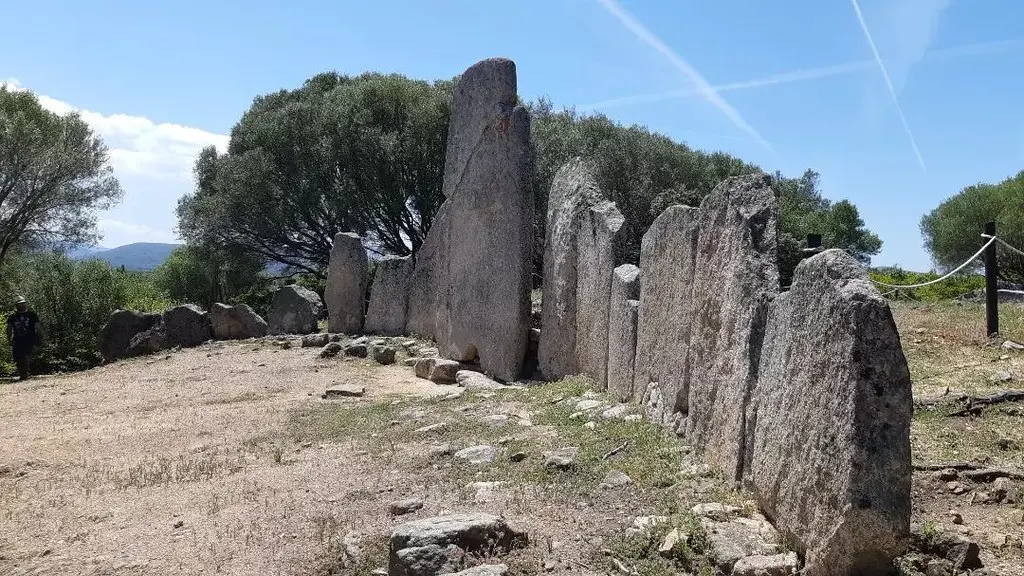
The tomb's scale becomes apparent as you approach. Twenty-eight meters of corridor—among the longest in Sardinia—extend from the curved exedra. The bull's-head shape requires imagination to perceive now, but the architectural intention was to place the dead within a sacred form.
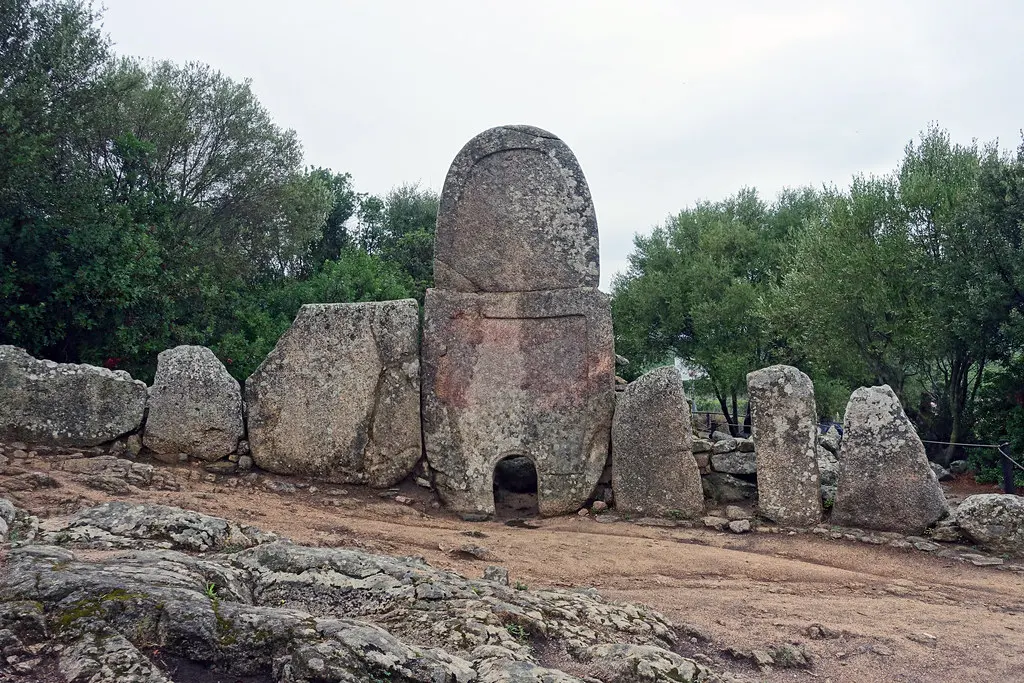
The four-meter stele is partially missing, but what remains still conveys monumentality. Notice the small opening at the base—the spirit portal that allowed passage between worlds of living and dead. The exedra curves away on either side, the bull's horns that once complete the sacred form.
Spend time considering the two construction phases visible in the architecture. The earlier allee couverte underlies the Giants' Tomb form, documenting the community's evolving beliefs. Around 1600 BC, they decided simple burial was insufficient; their dead required grander container.
The proximity of Pedres Castle invites exploration of layered history. The medieval fortification served different purposes than the Bronze Age tomb, but both responded to the same landscape—strategic, visible, commanding.
Returning to the parking area, the airport may be visible in the distance. Modern travel and ancient burial occupy the same Sardinian territory. The transit from one to the other—from jet to Giants' Tomb—takes only minutes.
Minutes from Olbia Costa Smeralda Airport. Search Google Maps for 'Tomba dei Giganti Su Monte 'e S'Abe'. Shares parking with Pedres Castle. Free access through gate during daylight hours.
Context and lineage
The Giants' Tomb of Su Mont'e s'Abe was built in two phases that document the evolution of Nuragic burial practices in the Gallura region of northeastern Sardinia.
The first phase, around 1800-1600 BC during the Bonnanaro cultural period, created an allee couverte—a simpler dolmen corridor tomb that served the community's burial needs without elaborate architectural symbolism.
Around 1600 BC, transformation occurred. The community added a monumental exedra and four-meter granite stele, creating the characteristic Giants' Tomb form. The overall design replicated a bull's head—the Nuragic divinity symbolizing life, fertility, and divine power. This transformation reflects changing beliefs about death and the proper housing of the dead.
Use continued through the Late Bronze Age (1300-900 BC). Multiple generations were interred in the twenty-eight-meter corridor, making Su Mont'e s'Abe one of the longest Giants' Tombs in Sardinia.
Archaeologist Editta Castaldi's 1968 excavation documented the two-phase construction history and enabled restoration. The four-meter stele is now partially missing, but the site remains comprehensible and accessible.
The location at the foot of what would later become Pedres Castle creates layered history. The hill's strategic significance attracted both Bronze Age burial and medieval fortification.
First phase Bonnanaro culture (1800-1600 BC), second phase Giants' Tomb transformation (around 1600 BC), continued use through Late Bronze Age (1300-900 BC). Excavated 1968, restored 1960s.
Editta Castaldi
Archaeologist
Traditions and practice
Two-phase burial practice evolved from simpler allee couverte to monumental Giants' Tomb with bull's-head sacred design. Collective burial within the body of the divine bull symbolized participation in sacred renewal.
Archaeological appreciation and cultural tourism. The site's proximity to Olbia airport makes it convenient for visitors arriving or departing.
Approach with awareness of the two construction phases and the bull's-head design. Contemplate what it meant to place the dead within a sacred form. Visit Pedres Castle to experience layered Sardinian history.
Gallura Nuragic Burial Traditions
HistoricalSu Mont'e s'Abe represents the burial traditions of Gallura, northeastern Sardinia. The two construction phases document evolution from simple burial to elaborate sacred architecture. The bull's-head design placed the dead within the body of a divinity.
Collective burial in twenty-eight-meter corridor—among Sardinia's longest. Bull's-head architecture symbolizing divine power and fertility. Multiple construction phases reflecting evolving beliefs. Spirit portal at stele base.
Perspectives and open questions
Su Mont'e s'Abe can be understood as evidence of evolving Nuragic burial practices, as sacred architecture shaped like a divine bull, or as accessible heritage that makes Bronze Age spirituality available to modern visitors.
Scholarly perspective
Editta Castaldi's 1968 excavation established the two-phase construction history. Scholars recognize Su Mont'e s'Abe as one of Sardinia's longest Giants' Tombs and an example of Gallura burial architecture. The bull's-head design is accepted as intentional sacred symbolism.
Living and traditional perspectives
Sardinian folklore associates Giants' Tombs with supernatural builders. The bull symbolism connects to broader Mediterranean fertility and power imagery.
Alternative interpretations
The bull's-head design attracts interest from those studying sacred geometry. The proximity to the sea and strategic landscape invites sacred geography research.
Open questions
The complete contents of the burial corridor remain partially documented. The full appearance of the original four-meter stele is uncertain. The specific rituals performed at this particular tomb are not recorded.
Plan your visit
Access and arrival
Extensive accommodation available in Olbia and Costa Smeralda area.
Respectful visit
No specific requirements. Comfortable walking shoes recommended.
Photography permitted.
Not appropriate at archaeological sites.
Enter through designated gate. Respect the ancient structures. Do not climb on stones.
Some uneven terrain. Site shares parking with Pedres Castle.
Current practical details
Address
Via Caterina Longa, 07026 Olbia OT, Italy
Hours
Hours, fees, and access can change — verify on the official source before you travel. Practical details last checked Jun 2026.
Location
Map loads as you approach this section.
Pilgrim reflections
A portrait of encounter, not a score
Pilgrims describe what they felt, how present they could become, and whether the place would shape a journey. There are no stars and no ranking of traditions.
No reviewed reflections yet
The first pilgrims can help describe the character of being here.
Share a reflection
Available after an account-backed “Been there.” Every reflection is reviewed before publication.
Nearby sacred places
Explore other sacred places in the region. Proximity does not establish access or travel time; check each place’s guidance.
References
Sources consulted for this page. Source categories describe the publication, not a guarantee that every claim is verified. Traditional accounts and outside interpretations may differ.
- 01The Tomb of the Giants of Su Monte 'e S'Abe in Olbia — La Sardegna verso l'UnescoSource contextUNESCO candidacy documentation
- 02Giants' tomb of Mont'e s'Abe - Sardegna Turismo — Sardegna TurismoofficialOfficial tourism information
- 03Olbia, Tomb of Giants On Monte de S'Ape - Sardegna Cultura — Sardegna CulturaofficialOfficial cultural information
- 04Giants' grave of Su Mont'e s'Abe - Wikipedia — Wikipedia contributorsencyclopediaOverview with construction phases
- 05Tomb of the Giants of Su Mont'e s'Abe - Estate in Sardegna — Estate in SardegnaguideVisitor-oriented information
Share a photo
Help visitors recognize The Giants' Tomb of Su Mont'e s'Abe. Every submission is reviewed before publication.