Coddu Vecchiu Grave
A doorway to the afterlife carved in granite four millennia ago
Understand sacred places, explore living traditions, and learn how to engage respectfully with Pilgrim Map.
Access has not been verified. Check current local guidance before planning a visit.
Alzachèna/Arzachena, Sassari, Italy
Read the sources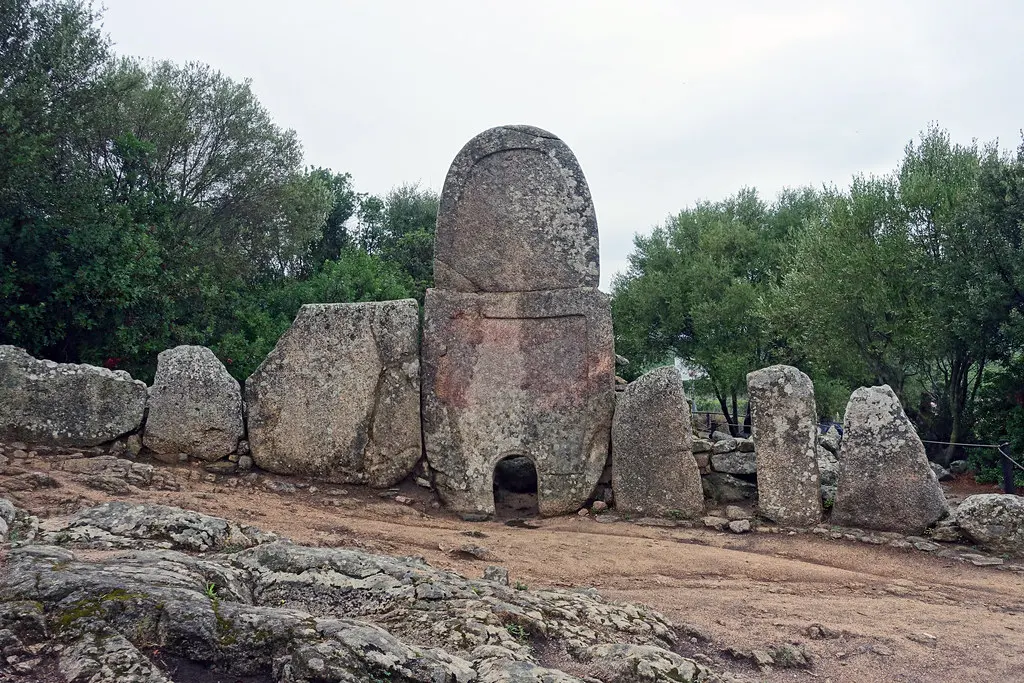
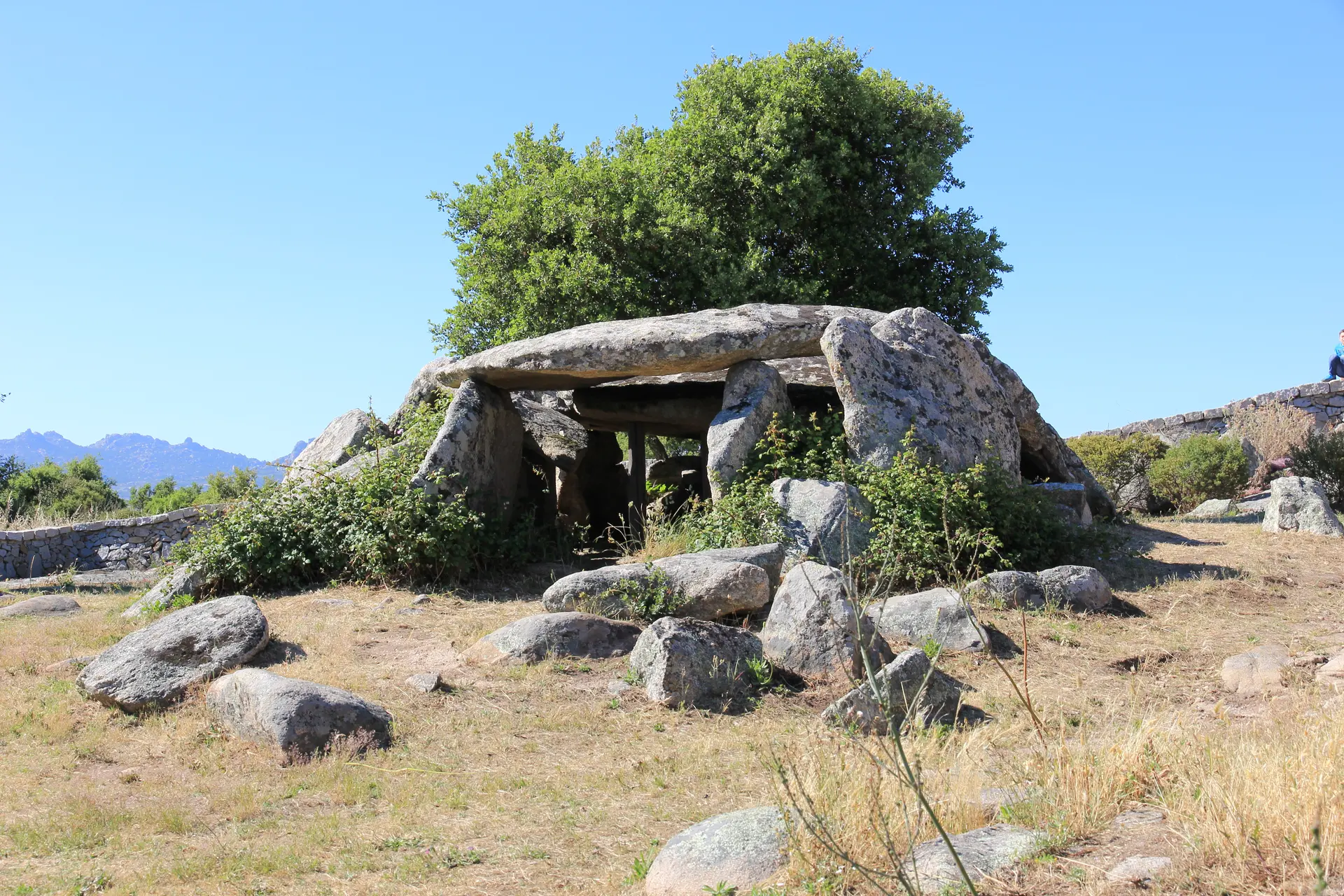
Image of Coddu Vecchiu Grave. Image source
Visit essentials
A quick read before you go
- Duration
- 30-45 minutes.
- Access
- By car from Arzachena via SS 427, then towards Luogosanto and Capichera.
Overview
For nearly four thousand years, Coddu Vecchiu's four-meter granite stele has risen from Sardinia, its small carved doorway symbolizing passage for the dead rather than a living entrance. This is a Giants' Tomb—Tomba dei Giganti in Italian, Tumbas de sos gigantes in Sardinian. Later observers imagined that only giants could have built such structures, but they were collective burial chambers where a Nuragic Bronze Age settlement's dead rested together.
The tomb began as an allée-couverte gallery grave between the 21st and 19th centuries BCE. Between the 18th and 17th centuries BCE, builders added a semicircular ritual forecourt, an exedra of eleven granite stones, and the great central stele, transforming a burial chamber into sacred architecture.
Why this place is sacred
The doorway commands attention. Carved into the face of a four-meter granite stele, it is too small for a living person to pass through. This was deliberate. The door was not meant for the living but for the dead—the threshold through which souls would pass into whatever afterlife the Nuragic people envisioned.
We do not know what the Nuragic civilization believed about death. They left no written records, no texts describing their cosmology or their hopes for existence beyond the grave. But they built these massive tombs, and they carved these doorways, and they gathered their community's dead together in collective burial. The architecture speaks even when words are silent.
The collective nature of the burial carries its own significance. This was not a tomb for kings or heroes, not a monument to individual achievement. The entire community was buried here—generation after generation, laid to rest together. The living would bring their dead to the exedra, perform whatever rituals their tradition required, and consign the body to the gallery behind the stele. Death did not separate the community; it reunited it.
The evolution of the tomb across centuries reflects changing practices or beliefs. The original allée couverte tomb—a covered gallery—was constructed between the 21st and 19th centuries BCE. Four or five centuries later, between the 18th and 17th centuries BCE, the tomb was transformed with the addition of the exedra and the great stele. Whether this transformation represented religious change, cultural evolution, or simply architectural refinement, we cannot know.
But the elaboration speaks of continuing significance—the community kept investing in its tomb.
Near the entrance, obelisks called betili have been found at many Giants' Graves. These may have symbolized the regenerative cycle of rebirth after death—a suggestion that the Nuragic people believed in continuation rather than ending. The doorway was not a closure but a passage.
The association with nearby La Prisgiona nuraghe grounds the tomb in daily life. The people who lived in that tower complex—farming, herding, crafting, trading—were the people buried here. The cemetery was not distant from the settlement but visible from it. Death was not hidden but acknowledged as part of the community's landscape.
Some modern visitors report sensing unusual energies at Giants' Graves, speaking of 'telluric forces' concentrated at these locations. Whether this reflects genuine properties of the sites or projection of contemporary spiritual expectations, it speaks to the continuing power of these places to evoke response. Something about standing before a four-thousand-year-old doorway to the afterlife stirs response in human hearts.
Collective burial monument for Nuragic community. Gallery grave (21st-19th century BCE) later transformed into Giants' Tomb with exedra and stele (18th-17th century BCE). Served as cemetery for nearby La Prisgiona nuraghe settlement.
21st-19th century BCE: Allée couverte tomb constructed. 18th-17th century BCE: Transformed with exedra and stele. 1966: Excavated by Editta Castaldi. Modern era: Preserved as archaeological heritage site.
Experience and orientation
The approach to Coddu Vecchiu leads through the Sardinian countryside—the landscape of the Gallura region that the Nuragic people would have known. The tomb stands in the Capichera locality, surrounded by the pastoral scenery of northern Sardinia. The isolation creates natural contemplation; there is time to prepare before encountering the ancient monument.
The stele appears first—four meters of granite rising from the earth, its weathered surface marked by four millennia of exposure. The carved doorway faces the exedra, its dimensions too small for living passage, its purpose symbolic rather than functional. This is the threshold between worlds, the passage that the dead would cross.
The exedra surrounds the entrance to the burial chamber—eleven granite stones arranged in a semicircle spanning twelve meters. This was the ritual space where mourners gathered, where ceremonies were performed, where the living said farewell to the dead. The curve of the stones creates an embracing quality, a gathering rather than a barrier.
Behind the stele lies the gallery grave itself—the burial chamber where the community's dead were laid. The chamber stretches approximately ten meters, modest by modern standards but representing significant labor for a Bronze Age community. The gallery is too low for standing; one would have to crouch or crawl to enter. This may have been intentional—the living were not meant to linger among the dead.
Just 700 meters away stands La Prisgiona nuraghe, one of Gallura's most important Nuragic sites. Visiting both creates a fuller picture: the settlement where life was lived, the tomb where death was honored. Combined tickets are available, and the short walk between sites allows reflection on the relationship between living space and burial ground.
Coddu Vecchiu is located in the Capichera locality, approximately 6km from Arzachena in the Province of Olbia-Tempio, northern Sardinia. The nearby La Prisgiona nuraghe is 700 meters away.
Context and lineage
Between the 21st and 19th centuries BCE, the people of a Bronze Age Sardinian community constructed a gallery grave in the Capichera locality—a covered passageway for their collective dead. Several centuries later, between the 18th and 17th centuries BCE, their descendants transformed the tomb. They added a semicircular exedra of eleven granite stones and erected a central stele exceeding four meters in height.
Into this stele they carved a doorway—the symbolic passage between the world of the living and the realm of the dead. The Giants' Tomb of Coddu Vecchiu was complete. Just 700 meters away, the settlement of La Prisgiona would continue to bury its dead here for generations.
Built by the Nuragic civilization of Bronze Age Sardinia. Artifacts from the Bonnanaro culture (early Nuragic) found during excavation. No descendant tradition preserves the original beliefs.
Editta Castaldi
Traditions and practice
Collective burial of community members. Offerings left at tomb entrance. Use of betili (obelisks) possibly symbolizing rebirth.
Archaeological site visitation. Guided tours available. Combined visits with nearby La Prisgiona nuraghe.
Approach the stele and contemplate the carved doorway—the threshold between worlds. Walk the curve of the exedra, the ritual space where mourners gathered. Consider visiting La Prisgiona nuraghe (700m) to understand the relationship between settlement and cemetery.
Nuragic Civilization
HistoricalCoddu Vecchiu is one of approximately 800 Giants' Graves in Sardinia—collective burial monuments of the Bronze Age Nuragic civilization. The 4-meter stele with carved doorway symbolized passage to the afterlife. The exedra provided ritual space for mourning ceremonies. The tomb served the nearby La Prisgiona nuraghe settlement.
No longer practiced. Archaeological evidence suggests collective burial, offerings at entrance, and mortuary rituals.
Perspectives and open questions
Coddu Vecchiu offers encounter with Bronze Age beliefs about death and the afterlife—a threshold carved in stone four millennia ago, still marking the passage between worlds.
Scholarly perspective
The site is recognized as one of the largest and best-preserved Giants' Graves in Sardinia. The two construction phases are documented through archaeological analysis. The Bonnanaro culture artifacts provide dating. The association with La Prisgiona nuraghe is established.
Living and traditional perspectives
No living tradition preserves Nuragic beliefs. The name 'Giants' Graves' comes from later folk tradition, not Nuragic culture. The doorway symbolism is inferred from architecture.
Alternative interpretations
Some interpret Giants' Graves as locations of concentrated natural energies—'telluric forces' and 'magnetic fields.' The exedra shape has been connected to bull's horn symbolism and fertility/regeneration.
Open questions
The specific Nuragic beliefs about death and afterlife. The rituals performed at the tomb. Why the transformation from gallery grave to Giants' Tomb occurred. The full significance of the doorway symbolism.
Plan your visit
Access and arrival
By car from Arzachena via SS 427, then towards Luogosanto and Capichera. Short path from parking. Limited public transport; car recommended.
Accommodations in Arzachena and along the Costa Smeralda. Agriturismos in the Gallura countryside.
Respectful visit
No dress code. Comfortable walking shoes recommended.
Photography permitted throughout the site.
None; archaeological site.
Admission fee required | Do not climb on stones | Stay on designated paths
Admission fee required. Short walk from parking. Summer can be hot; mornings recommended.
Current practical details
Address
07021 Arzachena, Province of Gallura North-East Sardinia, Italy
Phone
Hours
Hours, fees, and access can change — verify on the official source before you travel. Practical details last checked Jun 2026.
Location
Map loads as you approach this section.
Pilgrim reflections
A portrait of encounter, not a score
Pilgrims describe what they felt, how present they could become, and whether the place would shape a journey. There are no stars and no ranking of traditions.
No reviewed reflections yet
The first pilgrims can help describe the character of being here.
Share a reflection
Available after an account-backed “Been there.” Every reflection is reviewed before publication.
Nearby sacred places
Explore other sacred places in the region. Proximity does not establish access or travel time; check each place’s guidance.
References
Sources consulted for this page. Source categories describe the publication, not a guarantee that every claim is verified. Traditional accounts and outside interpretations may differ.
- 01Giants' Tomb of Coddu Vecchiu | SardegnaTurismo — Regione Sardegna TourismofficialOfficial Sardinia tourism information
- 02Tomba di Giganti Coddu 'Ecchju – GE.SE.CO. Arzachena — GE.SE.CO. ArzachenaofficialOfficial site management information
- 03Giants' grave of Coddu Vecchiu - Wikipedia — Wikipedia contributorsencyclopediaComprehensive archaeological overview
- 04The Coddu Vecchiu Tombs of Giants: Nuragic Burials and Sardinian Secrets — Ancient OriginsSource contextArchaeological context and interpretation
- 05The Giants' Grave of Coddu Vecchiu - Atlas Obscura — Atlas ObscuraguideVisitor-oriented description
Share a photo
Help visitors recognize Coddu Vecchiu Grave. Every submission is reviewed before publication.