Tempio di Portuno, Rome, Italy
Rome's best-preserved Republican temple, honoring the god of thresholds
Understand sacred places, explore living traditions, and learn how to engage respectfully with Pilgrim Map.
Access has not been verified. Check current local guidance before planning a visit.
Rome, Rome, Italy
Read the sources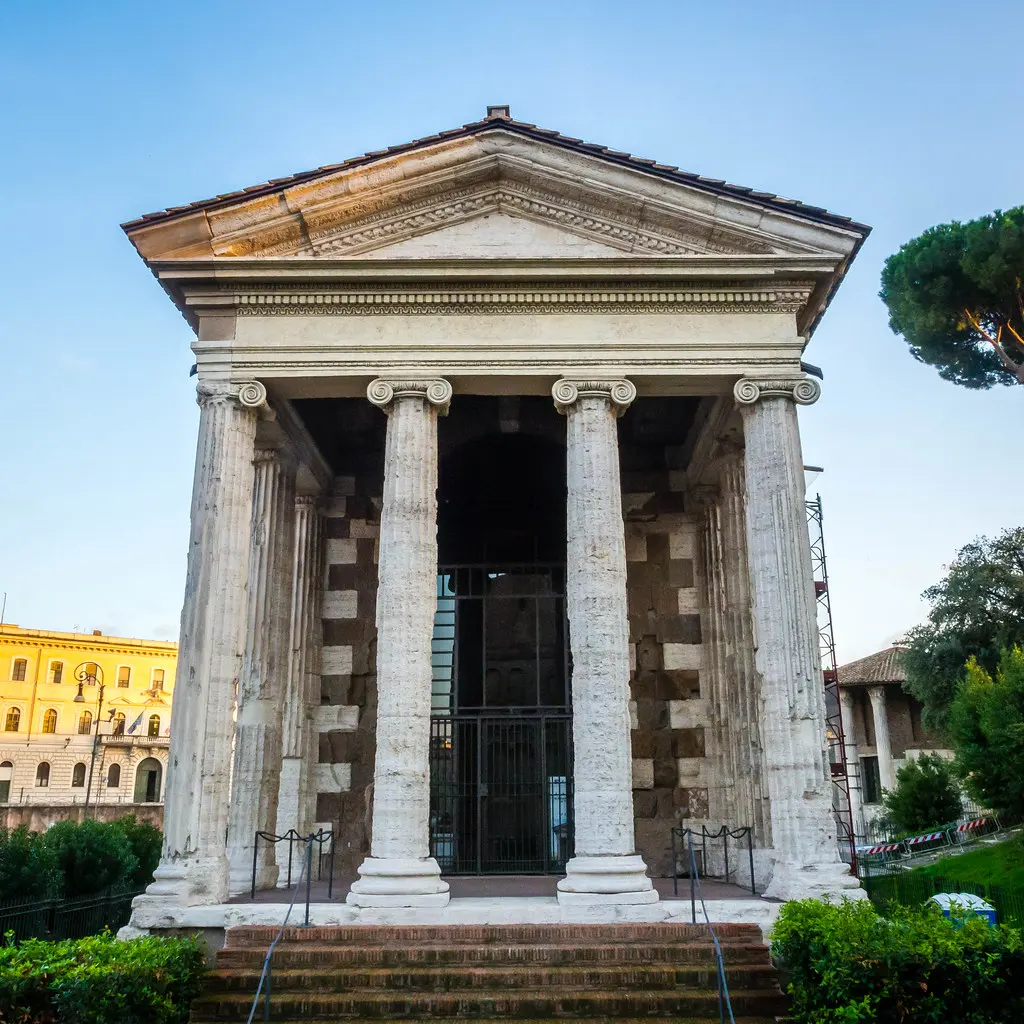
Image of Tempio di Portuno, Rome, Italy. Image source
Visit essentials
A quick read before you go
- Duration
- 15-30 minutes for exterior viewing; longer if joining guided tour
- Access
- Metro Line B to Circo Massimo, then 10-minute walk.
Overview
Where the Tiber bends toward Rome's oldest river harbor, a small rectangular temple has stood for over two thousand years. Four Ionic columns mark the entrance, engaged columns line the sides, and a high podium raises the sacred space above the ancient market floor. The Temple of Portunus honors the Roman god of doorways, harbors, and keys, a threshold deity guarding passages and transitions.
While other Roman temples were demolished for materials or left to collapse after Christianity's triumph, this one became a church. For a thousand years Santa Maria Egiziaca (St. Mary of Egypt) sheltered Christian worship: frescoes covered the interior, altars replaced Portunus's cult statue, and the conversion preserved the structure. The church was deconsecrated only in 1916, when the temple was restored to its Roman appearance.
Republican Rome's religious architecture remains largely intact. Ionic capitals interpreting Greek forms support a Roman-carved entablature; travertine and tufa once covered in gleaming stucco show how ancient temples appeared. World Monuments Fund conservation sustains that survival.
Why this place is sacred
Portunus was a peculiarly Roman deity—the god of keys, doors, ports, and livestock. His Latin name connects to porta (door) and portus (harbor). He protected all who passed through thresholds: the doorways of houses, the gates of cities, the harbors where ships arrived. His festival, the Portunalia on August 17, saw worshippers throw keys into fires as offerings. At his temple beside Rome's oldest river port, commerce and devotion intersected.
The temple's location was deliberate. The Forum Boarium—ancient Rome's cattle market—lay nearby. The Portus Tiberinus received ships from the Mediterranean. The Pons Aemilius, Rome's oldest stone bridge, crossed the Tiber just downstream. Merchants, traders, and travelers passed this spot constantly. Portunus, guardian of passages, received their offerings as they transitioned between worlds: from sea to land, from outside to inside, from stranger to citizen.
The building itself embodies Roman sacred architecture in its Republican phase. The high podium, accessible only by frontal steps, distinguished the temple from Greek practice. The deep portico with four free-standing Ionic columns recalled Greece while asserting Roman identity. The engaged half-columns along the sides—pseudoperipteral design—created the appearance of Greek temple surroundings while maintaining Roman frontal emphasis. This architectural hybrid demonstrates Rome's creative transformation of inherited forms.
Preservation came through Christian use. When the temple became the church of Santa Maria de Gradellis in the 9th century (later Santa Maria Egiziaca in the 15th), the structure was maintained rather than demolished. Medieval frescoes covered the interior; altars replaced the cult statue; but the walls, columns, and podium remained. Only with the 1916 deconsecration and archaeological restoration did the temple return to (approximate) Roman appearance.
What visitors see today is nearly two thousand years of survival: the oldest substantial temple in Rome still standing in recognizable form.
Temple to Portunus, Roman god of keys, doors, harbors, and livestock, built 120-80 BCE (on site of earlier 4th-3rd century BCE temple). Located at Rome's oldest river port to protect commercial transitions.
Rebuilt c. 120-80 BCE. Converted to church of Santa Maria de Gradellis (9th century), then Santa Maria Egiziaca (15th century). Deconsecrated 1916 and archaeologically restored. Conserved by World Monuments Fund with American Express support (1990s-2000s).
Experience and orientation
The approach to the Temple of Portunus takes visitors through the Forum Boarium area, past the medieval church of Santa Maria in Cosmedin with its famous Bocca della Verità, and into a quieter space where two ancient temples stand preserved. The rectangular Temple of Portunus and the circular Temple of Hercules Victor occupy their ancient positions as if Rome had simply frozen around them.
The Temple of Portunus appears first—a small but perfectly formed Roman temple on its high podium. Four Ionic columns rise at the entrance, their capitals showing the Roman interpretation of Greek forms. Along the sides and rear, engaged half-columns continue the rhythm, attached to the cella wall in the pseudoperipteral design that Romans preferred. The stone is travertine and tufa—once covered with gleaming white stucco that would have made the temple appear nearly marble.
The podium elevates the entire structure, creating the frontal emphasis that distinguished Roman from Greek sacred architecture. The single flight of steps leads to the portico; the sides and rear have no access. This is a temple meant to be approached and entered from one direction only—the worshipper's path carefully choreographed.
Exterior viewing is always possible; the temple stands in a small park area accessible from the surrounding streets. Interior access requires a guided tour, which reveals the cella space once occupied by Portunus's cult statue. The 1916 restoration removed the medieval Christian additions, returning the interior to (approximate) ancient appearance.
Nearby, the circular Temple of Hercules Victor offers contrast: a rare survival of the circular peripteral form. Together, these two temples—one rectangular, one circular—demonstrate the range of Republican temple architecture. The church of Santa Maria in Cosmedin, with its medieval tower and the Bocca della Verità tourist attraction, provides context for how the area evolved while the temples remained.
The Temple of Portunus stands in the Forum Boarium area of Rome, near the Tiber River between the Capitoline and Aventine hills. The church of Santa Maria in Cosmedin (Bocca della Verità) is immediately nearby. The Circus Maximus lies to the south; the Theater of Marcellus to the north.
Context and lineage
The Temple of Portunus was built beside Rome's earliest river harbor, where ships from across the Mediterranean unloaded their goods. Portunus, the god of keys, doors, and ports, protected all who passed through thresholds—from harbors, through doorways, across boundaries. His festival, the Portunalia on August 17, featured the throwing of keys into ritual fires. The temple that honored him stands where commerce and devotion intersected at Rome's most ancient commercial site.
For centuries after Christianity's triumph, the temple survived as the church of Santa Maria Egiziaca, until 1916 when archaeological restoration returned it to approximately its ancient appearance.
The Temple of Portunus is an archaeological monument administered by the Soprintendenza Speciale per i Beni Archeologici di Roma. It was included on the World Monuments Watch in 1996 and 2006, receiving conservation with American Express support. It is part of the UNESCO-inscribed Historic Centre of Rome.
Portunus
Mary of Egypt
Traditions and practice
Roman worship of Portunus at this temple included offerings during the Portunalia (August 17), when worshippers threw keys into ritual fires. The god's protection was sought by merchants, travelers, and all who passed through thresholds. Christian worship as Santa Maria Egiziaca continued from the 9th century until 1916.
Archaeological monument. Exterior viewing freely accessible. Interior by guided tour (variable hours). No active worship.
View the temple's exterior in morning light when the Ionic columns are best illuminated. Study the pseudoperipteral design—free-standing columns at the front, engaged columns along the sides. Compare with the nearby circular Temple of Hercules Victor to understand the variety of Republican temple forms. If a guided tour is available, explore the interior. Combine with a visit to Santa Maria in Cosmedin (Bocca della Verità).
Roman Paganism
HistoricalTemple dedicated to Portunus, god of keys, doors, harbors, and livestock. Built c. 120-80 BCE at Rome's oldest river port. The Portunalia festival (August 17) involved throwing keys into fires. One of the best-preserved Roman Republican temples.
Ancient worship ended with Christianization of Rome (4th century CE). No modern practice.
Roman Catholicism
HistoricalServed as church of Santa Maria de Gradellis (9th century), then Santa Maria Egiziaca (15th century) until deconsecration in 1916. Dedicated to St. Mary of Egypt, a desert hermit saint. Church function preserved the ancient temple structure.
Christian worship ended in 1916 with deconsecration. The temple was archaeologically restored.
Perspectives and open questions
The Temple of Portunus offers encounter with Republican Rome's sacred architecture in exceptional preservation—the god of thresholds still guarding his ancient space after two millennia.
Scholarly perspective
Architectural historians recognize the Temple of Portunus as one of the best-preserved examples of Roman Republican temple architecture. The pseudoperipteral design—free-standing portico columns, engaged columns along the sides—demonstrates the Roman adaptation of Greek forms. The temple was misidentified as the Temple of Fortuna Virilis from the Renaissance until modern scholarship; it remains better known by this incorrect name in some sources.
Living and traditional perspectives
Catholic tradition honored this space as the church of Santa Maria Egiziaca (St. Mary of Egypt) from the 15th century until 1916. The saint, a desert hermit who lived for 47 years in the wilderness, was venerated here. The church function preserved the ancient structure through the medieval period.
Alternative interpretations
The temple's dedication to Portunus—god of keys, doors, and thresholds—has attracted interest from those studying liminal spaces and transition symbolism. The god's association with passages between states (inside/outside, arrival/departure) creates meanings that extend beyond Roman paganism.
Open questions
The exact appearance of the earlier temple on this site (4th-3rd century BCE). The specific rituals performed for Portunus at this location. The medieval frescoes removed during the 1916 restoration. The appearance and disposition of the original cult statue.
Plan your visit
Access and arrival
Metro Line B to Circo Massimo, then 10-minute walk. Various buses to Bocca della Verità or Teatro Marcello.
Central Rome location with various accommodation options. The area between Aventine and Capitoline hills offers hotels in all categories.
Respectful visit
No dress code; archaeological site.
Photography freely permitted from exterior.
None; no active worship.
Interior access by guided tour only | No climbing on monument | No touching columns or structure
Interior access only by guided tour with variable hours—check before visiting. No climbing on the monument.
Current practical details
Address
Piazza della Bocca della Verità, 00186 Roma RM, Italy
Hours, fees, and access can change — verify on the official source before you travel. Practical details last checked Jun 2026.
Location
Map loads as you approach this section.
Pilgrim reflections
A portrait of encounter, not a score
Pilgrims describe what they felt, how present they could become, and whether the place would shape a journey. There are no stars and no ranking of traditions.
No reviewed reflections yet
The first pilgrims can help describe the character of being here.
Share a reflection
Available after an account-backed “Been there.” Every reflection is reviewed before publication.
Nearby sacred places
Explore other sacred places in the region. Proximity does not establish access or travel time; check each place’s guidance.

References
Sources consulted for this page. Source categories describe the publication, not a guarantee that every claim is verified. Traditional accounts and outside interpretations may differ.
- 01Temple of Portunus, Rome – Smarthistory — SmarthistoryacademicArt historical analysis
- 02The Temple of Portunus | Turismo Roma — Roma Capitale Tourism OfficeofficialOfficial Rome tourism information
- 03Rome's Forum Boarium | World Monuments Fund — World Monuments FundSource contextConservation project information
- 04Temple of Portunus - Wikipedia — Wikipedia contributorsencyclopediaComprehensive historical and architectural overview
- 05Temples of the Forum Boarium - History and Facts — History HitSource contextHistorical context
Share a photo
Help visitors recognize Tempio di Portuno, Rome, Italy. Every submission is reviewed before publication.