Basilica di Santa Cecilia in Trastevere, Rome, Italy
Where music's patron saint lies as she was found after thirteen centuries
Understand sacred places, explore living traditions, and learn how to engage respectfully with Pilgrim Map.
Access has not been verified. Check current local guidance before planning a visit.
Rome, Rome, Italy
Read the sources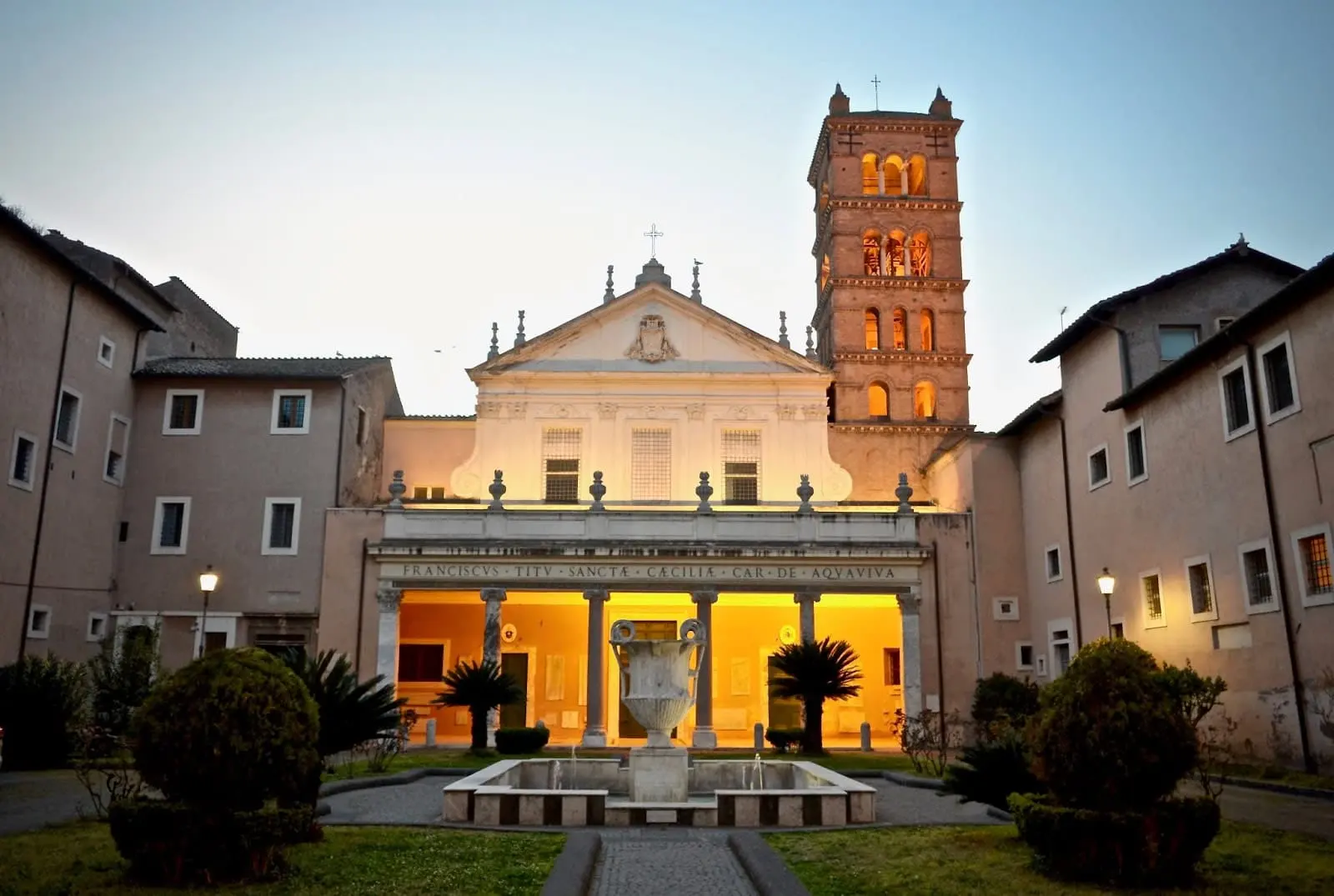
Image of Basilica di Santa Cecilia in Trastevere, Rome, Italy. Image source · CC-BY-SA-4.0
Visit essentials
A quick read before you go
- Duration
- 45 minutes to 1.5 hours depending on whether crypt and frescoes are visited.
- Access
- Tram 8 from Largo di Torre Argentina to Piazza Sonnino, then 5-minute walk.
Overview
On a quiet Trastevere piazza, beyond a bird-filled courtyard fountain, the basilica stands over Cecilia's family home, where she lived, married, converted her husband, and was martyred in her bath's steam room. Since the third century, tradition has remembered the young noblewoman who vowed virginity, was forced to marry, told her pagan husband on their wedding night that an angel guarded her, and sent him for baptism so he could see the angel.
During Jubilee preparations in 1599, workers opened Cecilia's sarcophagus and reportedly found her body uncorrupted; Pope Clement VIII came to view it, and Stefano Maderno was summoned to sculpt what lay before him. His marble Cecilia curls with her face turned away, extending three right-hand fingers and one left-hand finger for the Trinity—three persons in one God—and remains one of Rome's most affecting religious images.
In the choir of the Benedictine nuns who have kept the church since 1527 survive fragments of Pietro Cavallini's Last Judgment. Plastered over in 1724 and rediscovered in 1900, the frescoes mark Byzantine formalism's turn toward something more human. Cecilia's own transformations—from forced marriage to conversion, attempted murder to witness, and death to incorruptibility—give the church its evidence of change.
Why this place is sacred
The discovery of 1599 created the icon that defines this church. When Cardinal Sfondrati's workmen opened Cecilia's sarcophagus beneath the high altar, they found—according to reports—a young woman's body lying on its side, dressed in gold-threaded robes, a wound visible on her neck. The body reportedly remained in this state for several weeks while crowds came to view it, until it began to deteriorate and was re-interred.
Stefano Maderno was twenty-three years old when he received the commission to sculpt what he had witnessed. His testimony, inscribed in the floor before the altar, affirms that he depicted the body exactly as it appeared. Art historians debate whether this is literally true—the composition bears similarity to ancient sculptures Maderno would have known. But the debate matters less than the result: a figure of extraordinary pathos, simultaneously vulnerable and transcendent.
The sculpture's power derives partly from what it does not show. Cecilia's face is turned away, hidden by the cloth around her head. Viewers cannot meet her eyes. She lies not in the posture of death but of sleep or perhaps prayer—the curl of the body suggesting intimacy rather than display.
The wound on her neck recalls the legend: three blows of an executioner's axe failed to decapitate her, and she lived for three days, converting those who came to witness.
Deeper than the sculpture lies the crypt, redesigned in neo-Byzantine splendor in the late nineteenth century. Here, in gilded mosaics and glowing light, the relics of Cecilia and her companions rest in ornate urns. The aesthetic is entirely different from the medieval basilica above—a reminder that each generation reimagines the sacred according to its own vision.
Higher still, in the choir accessible only through the Benedictine convent, survive the Cavallini frescoes. Once covering nine hundred square meters, now fragmentary, the Last Judgment they depict marks a revolution. The figures have weight and expression; the angels possess individual character; the damned writhe with recognizable human emotion. Here, before Giotto, Western art began its long journey toward naturalism. The saint who sang in her heart presides over a church where art itself learned new ways to speak.
The first church on this site was founded in the third century, possibly by Pope Urban I, on the location of Cecilia's family home—the very rooms where she was martyred. Her relics were moved here from the Catacombs of San Callisto in 822 after Pope Paschal I received a vision revealing her burial place.
The basilica was substantially rebuilt by Pope Paschal I in 822, receiving its ninth-century apse mosaics depicting Christ with saints including Cecilia. The thirteenth century added Arnolfo di Cambio's Gothic ciborium and Cavallini's revolutionary frescoes. Major renovations under Cardinal Sfondrati in 1597-1600 coincided with the discovery of Cecilia's apparently incorrupt body and the commission of Maderno's sculpture. Eighteenth-century Baroque interventions unfortunately covered the Cavallini frescoes, which were only rediscovered in 1900.
The late nineteenth century brought the neo-Byzantine redesign of the crypt. Throughout, Benedictine nuns have maintained the church since 1527.
Experience and orientation
The approach to Santa Cecilia passes through Trastevere's narrow streets, whose noise and bustle give way suddenly to a peaceful courtyard. A large ancient cantharus—a type of Roman vessel repurposed as a fountain—stands amid a garden. The transition prepares visitors for interior quiet.
The basilica's facade is eighteenth century; the interior retains its medieval proportions despite later modifications. The eye is drawn immediately forward to the high altar, sheltered by Arnolfo di Cambio's thirteenth-century ciborium—a delicate Gothic canopy that frames the altar without obscuring what lies beneath.
Beneath the altar, within a glass case, reclines Maderno's sculpture. Cecilia lies on her right side, knees slightly bent, arms extended before her. A cloth wraps around her head, covering her face. The wound on her neck is visible but not graphic. Her right hand extends three fingers, her left one—the Trinity, three in one. The marble has a luminous quality, particularly under the church's soft lighting.
Viewers often spend extended time before this image. The posture invites meditation on vulnerability, on faith maintained to the point of death, on the mystery of bodily preservation. A marble slab in the floor quotes Maderno's sworn statement that he depicted the body as he saw it.
Beyond this central experience, the church offers secondary encounters. The ninth-century apse mosaics, while less renowned than those at other Roman churches, depict Christ flanked by saints including Cecilia, Peter, Paul, and Paschal I (who holds a model of this church, indicating his role as builder). The colors remain vibrant after twelve centuries.
For additional fees, visitors may descend to the crypt—a surprisingly ornate neo-Byzantine space designed in the late nineteenth century. Golden mosaics, columns, and bright lighting create an atmosphere entirely different from the medieval basilica above. The relics of Cecilia and companion saints rest in urns beneath a small altar.
The Cavallini frescoes require ascending to the nuns' choir, accessed through the convent. The fragmentary Last Judgment survives on one wall—Christ enthroned, surrounded by apostles and rainbow-winged angels, the blessed and damned receiving their eternal fate. Though only a portion of the original remains, art historians consider it foundational to Western painting's development. Photography is not permitted, requiring visitors to hold the images in memory.
Santa Cecilia stands on its own piazza in Trastevere, the historic neighborhood west of the Tiber. The approach from Piazza Sonnino or from Tiber Island passes through characteristic Trastevere streets. The Museum of Rome in Trastevere lies nearby, as does the church of Santa Maria in Trastevere.
Context and lineage
According to tradition, Cecilia was a young Roman noblewoman who had vowed virginity to God but was forced by her family to marry a pagan named Valerian. On their wedding night, she told him that an angel guarded her virtue. Valerian demanded to see the angel; Cecilia sent him to be baptized by Pope Urban I, after which he could perceive the angel. Both Valerian and his brother Tiburtius converted and were eventually martyred. Cecilia too was condemned.
Officials locked her in the caldarium (steam room) of her own bath, hoping to suffocate her, but she survived. An executioner was sent to behead her; after three axe blows he fled, leaving her wounded but alive. She lived for three days, continuing to preach and requesting that her home become a church.
Her body was buried in the Catacombs of San Callisto until Pope Paschal I, guided by a dream in which Cecilia appeared and pointed to her burial place, translated her relics to this basilica in 822.
Benedictine nuns have maintained the basilica since 1527. Their presence ensures continuity of prayer and preservation of the church's treasures, including the Cavallini frescoes in their choir. The church has served as a cardinal titular church since the fifth century.
Saint Cecilia
Pope Paschal I
Pietro Cavallini
Stefano Maderno
Traditions and practice
Devotion to Cecilia's relics began immediately upon their translation in 822. Her patronage of musicians, established by the fifth century, derived from the belief that she 'sang to God in her heart' during her wedding feast. The church became a pilgrimage destination for singers and musicians seeking her intercession. The 1599 discovery of her apparently incorrupt body intensified devotion.
Benedictine nuns maintain the liturgical life of the basilica. The feast of Saint Cecilia (November 22) brings special celebrations; musicians and choirs from around the world gather to honor their patron. Visitors may venerate at Maderno's sculpture, descend to the crypt to view relics, and ascend to the choir to see the Cavallini frescoes (limited hours, small fee to the nuns).
Begin in the courtyard, allowing the transition from Trastevere's bustle to prepare for interior encounter. Spend time before Maderno's sculpture—the core of the pilgrimage experience. If time and interest allow, descend to the crypt (€2.50) to see the ornate neo-Byzantine space housing the relics. The Cavallini frescoes (€2.50, morning hours only) require ascending to the nuns' choir but reward with encounter with revolutionary medieval art. Musicians may wish to pray before Cecilia's image, honoring their patron.
Roman Catholicism
ActiveSanta Cecilia is a minor basilica and cardinal titular church housing the relics of Saint Cecilia, patron of musicians. The Benedictine community has maintained the church since 1527, preserving its liturgical life and artistic treasures including the Cavallini frescoes.
Daily Mass, veneration of Cecilia's relics via Maderno's sculpture, access to crypt and frescoes. The feast of Saint Cecilia (November 22) draws musicians, choirs, and pilgrims from around the world. Benedictine nuns maintain the choir and convent.
Perspectives and open questions
Santa Cecilia offers multiple levels of encounter: the patron saint of music, the haunting sculpture, the revolutionary frescoes, the mystery of bodily preservation. Different visitors engage different dimensions.
Scholarly perspective
Art historians recognize the Cavallini frescoes as pivotal in Western painting's development—the moment when Byzantine formalism began yielding to naturalistic representation. Cavallini's figures have weight, expression, and individual character that anticipate Giotto's later innovations. The Maderno sculpture is studied for its compositional innovation (the turned-away face, the curled posture) and its relationship to actual observation versus artistic convention. Scholars continue to debate whether Maderno truly saw Cecilia's incorrupt body or worked from written descriptions and classical precedent.
Living and traditional perspectives
Catholic tradition holds Cecilia as patron of musicians because she 'sang to God in her heart' during her wedding feast—maintaining interior devotion while external circumstances demanded compliance. Her story exemplifies the priority of spiritual vows over social obligations, the possibility of converting one's persecutors, and courage under mortal threat. The incorrupt body, discovered after thirteen centuries, was understood as evidence of sanctity.
Alternative interpretations
Some interpretations emphasize Cecilia as a model of feminine autonomy within patriarchal systems. Rather than simply refusing marriage, she navigated impossible circumstances—accepting the marriage while maintaining her vow, converting her husband rather than being converted by him, ultimately transforming her own home into a church. Her story has particular resonance for those who have had to find ways to maintain integrity within constraining structures.
Open questions
Several mysteries remain. The exact date of Cecilia's martyrdom is debated (second or third century). Whether Maderno actually saw her incorrupt body or worked from description cannot be determined with certainty. Why the body reportedly remained preserved for thirteen centuries but deteriorated rapidly after 1599 exposure is unexplained. The historical accuracy of fifth-century accounts of her martyrdom—the steam room, the three axe blows, the three days of preaching—cannot be verified.
Plan your visit
Access and arrival
Tram 8 from Largo di Torre Argentina to Piazza Sonnino, then 5-minute walk. Buses 23 and 280 serve the area. Metro Line B to Circo Massimo, then 20-minute walk. Trastevere train station is nearby.
Trastevere offers abundant hotels, B&Bs, and apartments. The neighborhood retains local character while providing easy access to central Rome.
Respectful visit
Shoulders and knees must be covered, as in all Roman churches.
Photography for personal use is permitted in the basilica. Flash and tripods are prohibited. No photography is allowed of the Cavallini frescoes.
Standard church offerings. Candles may be lit. Fees for crypt (€2.50) and frescoes (€2.50) support maintenance.
No entry during Mass | Limited hours for Cavallini frescoes | No photography of frescoes | Crypt and choir may have accessibility limitations (stairs)
The Cavallini frescoes have limited viewing hours (Monday-Saturday 10:00-12:30, Sunday 11:30-12:30). The crypt and convent choir have stairs that may present accessibility challenges. No photography is permitted of the Cavallini frescoes.
Current practical details
Address
Piazza di Santa Cecilia, 22, 00153 Roma RM, Italy
Phone
Hours
Hours, fees, and access can change — verify on the official source before you travel. Practical details last checked Jun 2026.
Location
Map loads as you approach this section.
Pilgrim reflections
A portrait of encounter, not a score
Pilgrims describe what they felt, how present they could become, and whether the place would shape a journey. There are no stars and no ranking of traditions.
No reviewed reflections yet
The first pilgrims can help describe the character of being here.
Share a reflection
Available after an account-backed “Been there.” Every reflection is reviewed before publication.
Nearby sacred places
Explore other sacred places in the region. Proximity does not establish access or travel time; check each place’s guidance.

References
Sources consulted for this page. Source categories describe the publication, not a guarantee that every claim is verified. Traditional accounts and outside interpretations may differ.
- 01Basilica of Santa Cecilia in Trastevere - Turismo Roma — Roma Capitale Tourism OfficeofficialOfficial Rome tourism information
- 02Santa Cecilia in Trastevere - Wikipedia — Wikipedia contributorsencyclopediaComprehensive overview with historical and architectural detail
- 03Saint Cecilia (Stefano Maderno) - Wikipedia — Wikipedia contributorsencyclopediaDetailed analysis of the famous sculpture
- 04This is my Body: Stefano Maderno and the Miraculous Corpse of Saint Cecilia — Through Eternity ToursSource contextArt historical analysis with theological context
- 05St. Cecilia, martyr and patron saint of music, rests in Roman basilica named for her — Catholic News AgencynewsContemporary pilgrimage coverage
- 06Santa Cecilia in Trastevere - Churches of Rome Wiki — Churches of Rome WikiSource contextDetailed architectural and liturgical information
- 07Santa Cecilia in Trastevere - Visiting Hours, Tickets, and Historical Significance — AudialaguidePractical visitor information
Photo gallery
3 curated photos
Share a photo
Help visitors recognize Basilica di Santa Cecilia in Trastevere, Rome, Italy. Every submission is reviewed before publication.