Basilica of St. Mary of Minerva, Rome, Italy
Where Rome's only Gothic vault shelters mystic, painter, and the memory of Galileo
Understand sacred places, explore living traditions, and learn how to engage respectfully with Pilgrim Map.
Access has not been verified. Check current local guidance before planning a visit.
Rome, Rome, Italy
Read the sources
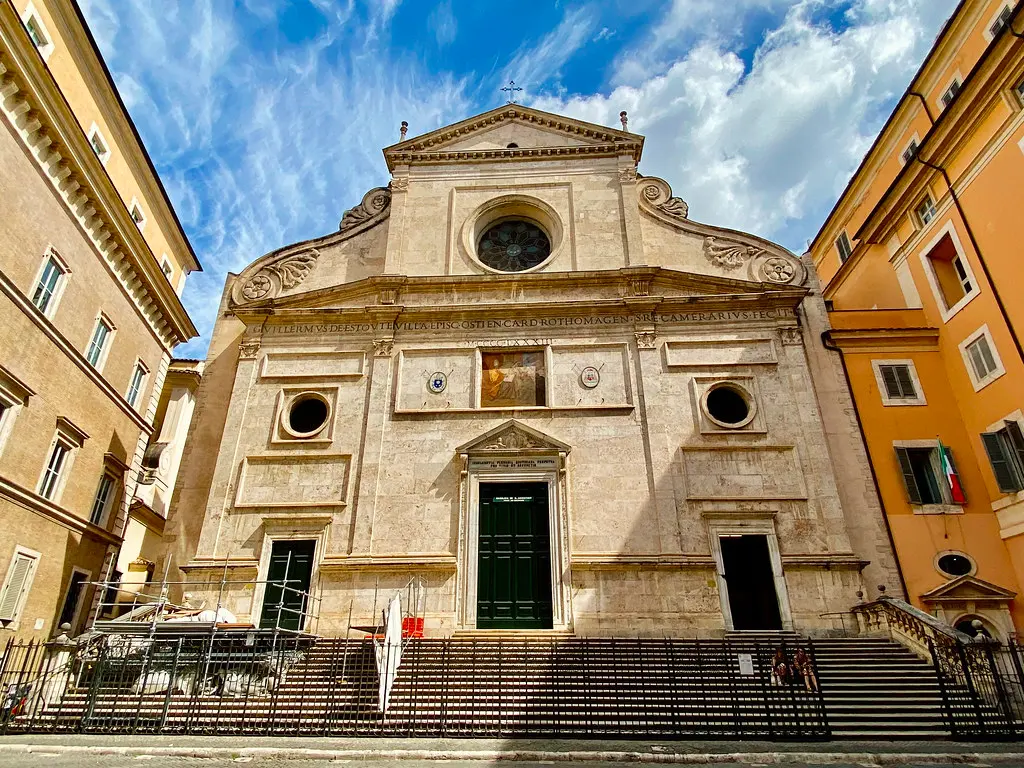
Image of Basilica of St. Mary of Minerva, Rome, Italy. Image source · CC-BY-SA-4.0
Visit essentials
A quick read before you go
- Duration
- 30-45 minutes for the church.
- Access
- Metro Line A to Barberini (15-minute walk).
Overview
Sopra Minerva means 'above Minerva': in ancient Rome a temple stood here, probably dedicated to Isis but mistaken for Minerva. Beginning in 1280, Dominicans raised Rome's only Gothic church over those pagan foundations, giving Europe's pointed arches and ribbed vaults their sole Roman expression.
Saint Catherine of Siena rests beneath the main altar. The mystic's letters wore out popes, and she altered papal history by persuading Gregory XI to return from Avignon to Rome. A Doctor of the Church and patron of Italy and Europe, her presence draws pilgrims; her body lies here, while her head remains in Siena where her visions began.
In the Frangipane Chapel, Blessed Fra Angelico awaits resurrection. The Dominican whose San Marco frescoes seem to glow with divine light spent his final years in the monastery here and died in 1455; his open-eyed tombstone leaves the visionary painter still seeing. Here too, on June 22, 1633, Galileo Galilei knelt before the Inquisition and recanted Copernican theory. No one knows whether he muttered 'Eppur si muove'—'and yet it moves'—but the earth continued orbiting despite the tribunal.
Why this place is sacred
Few churches gather such disparate testimony. Catherine of Siena entered public life as a mystic whose visions gave her authority kings and popes could not ignore. She dictated hundreds of letters—barely literate herself, she spoke and others wrote—and bent the course of history. The papacy's return from Avignon owes much to her insistence. The Church eventually named her Doctor, joining Thomas Aquinas and Augustine among those whose teaching shapes faith.
Her body beneath the altar draws pilgrims who seek what she found: direct encounter with the divine that transforms how one lives.
Fra Angelico represents another form of witness. His frescoes do not merely depict sacred scenes; they seem to participate in them. The luminosity of his work at San Marco in Florence has led some to call him the most 'spiritual' of painters—not in vague sentiment but in technique that makes visible what faith perceives.
He died in the monastery here, and his tomb shows him not sleeping but watching, eyes open, the painter whose seeing was itself a form of prayer.
Galileo's presence is different—not a tomb but a memory. In the convent adjoining the church, the Inquisition required him to deny what his telescopes had shown. The heliocentrism he championed would eventually become scientific consensus; the Church that condemned him would eventually apologize. But on that June day in 1633, institutional authority and empirical observation collided. The tension between faith and knowledge that Galileo embodied has not entirely resolved.
The Gothic architecture contains these witnesses in space unique to Rome. While other medieval Roman churches were refurbished in Baroque style, the Minerva retained its pointed arches and ribbed vaults. The nineteenth-century restoration painted the ceiling blue with golden stars—imaginative reconstruction, perhaps, but creating an atmosphere distinct from Baroque exuberance. Here is medieval devotion, still breathing.
Built 1280 onward as a Dominican church, intentionally Gothic in a city that would largely embrace Baroque. The site had held earlier churches going back to the eighth century, and Roman temples before that.
The Gothic structure took nearly two centuries to complete, with the façade finished only in 1725. The nineteenth-century restoration enhanced Gothic elements. Through the same period the convent housed the Inquisition and Catherine's relics arrived, and Dominican presence continues.
Experience and orientation
The approach to Santa Maria sopra Minerva passes Bernini's elephant, the playful sculpture bearing an Egyptian obelisk discovered in the Dominicans' garden. The animal seems to smile, supporting ancient mystery with Baroque delight. The elephant is 'pulcino'—a pun combining 'chick' and 'flea'—Rome's affection embodied in nickname.
The façade gives little indication of what waits within. Renaissance restraint conceals Gothic ambition. Stepping inside, the difference registers immediately. These are not the Baroque curves and painted illusions of Rome's famous churches. Pointed arches march toward the altar. Ribbed vaults overhead form a ceiling painted deep blue and studded with gilded stars—a sky above rather than a ceiling, the heaven toward which Gothic architecture yearns.
Michelangelo's Cristo della Minerva stands to the left of the high altar. Christ bears the Cross, his body powerful, the instruments of Passion in his arms rather than inflicting suffering. The statue has been altered over centuries—a bronze drapery added for modesty, the face possibly reworked—but the conception remains Michelangelo's: Resurrection already present in the Passion's midst.
To the right of the altar, the Carafa Chapel holds Filippino Lippi's frescoes from the 1480s-90s, rich in color and narrative detail. The Annunciation, the Assumption, scenes from the life of Saint Thomas Aquinas—Dominican theology rendered visible.
The main altar marks Saint Catherine's tomb; her body rests below the marble. Near the altar choir, Fra Angelico's gravestone shows the painter with open eyes, created by Isaia of Pisa. Behind the altar, the Medici popes Leo X and Clement VII occupy grand tombs—Renaissance patronage in death as in life.
The reconstructed room of Saint Catherine's death, beyond the sacristy, was an early experiment in 'period rooms'—the space where she died, transplanted here by Cardinal Barberini in 1637. Whether authentic in detail or not, it speaks to the reverence her memory commanded.
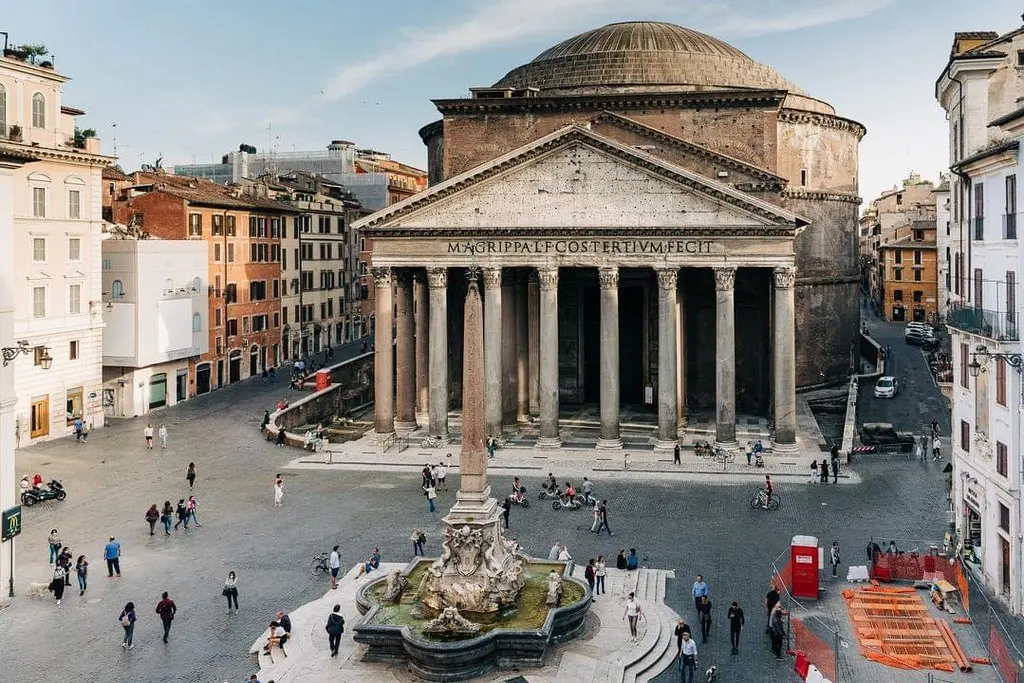
Santa Maria sopra Minerva stands in Piazza della Minerva, one block from the Pantheon in Rome's historic center. The Pigna neighborhood takes its name from a giant ancient pine cone now in the Vatican. The area was part of the Campus Martius in Roman times.
Context and lineage
The name 'sopra Minerva' (above Minerva) derives from the belief that a temple to Minerva stood on this site. Modern scholarship suggests the primary temple was actually dedicated to Isis, with a nearby temple to Minerva creating the confusion. An eighth-century church stood here before the Dominicans arrived. When the Order received the property in 1255-56, they began planning a Gothic church modeled on Santa Maria Novella in Florence. Construction began in 1280 and continued for nearly two centuries.
Santa Maria sopra Minerva is a minor basilica and major Dominican church. It served at various periods as the Order's headquarters. The adjoining convent housed the Holy Office (Inquisition) from 1628. The church remains an active Dominican parish and pilgrimage site.
Saint Catherine of Siena
Fra Angelico
Galileo Galilei
Pope Leo X
Pope Clement VII
Michelangelo Buonarroti
Traditions and practice
Dominican liturgical observances since the thirteenth century. Veneration at Saint Catherine's tomb since her reburial. The convent served the Inquisition, conducting trials that included Galileo's. Catherine's reconstructed death chamber has drawn pilgrims since 1637.
Daily Mass is celebrated. The Feast of Saint Catherine of Siena (April 29) and the Feast of Blessed Fra Angelico (February 18) draw pilgrims. The church participates in Dominican liturgical observances. The cloister opens to visitors on weekday mornings.
Enter through the main portal, allowing eyes to adjust to the Gothic interior. Note the blue-starred vault above. Approach the main altar to honor Saint Catherine below. View Michelangelo's Cristo della Minerva to the left of the altar. Visit the Carafa Chapel for Filippino Lippi's frescoes. Seek Fra Angelico's tomb near the choir. If time permits, visit the cloister (weekday mornings).
Roman Catholicism (Dominican Order)
ActiveRome's only Gothic church and historically a major Dominican center. Contains the body of Saint Catherine of Siena, Doctor of the Church and patron of Italy and Europe. Burial place of Blessed Fra Angelico. Houses Michelangelo's Cristo della Minerva. Site of Galileo's 1633 abjuration. Tombs of Medici popes Leo X and Clement VII.
Daily Mass, Dominican liturgical observances, veneration of Saint Catherine and Fra Angelico, Feast of Saint Catherine (April 29), Feast of Blessed Fra Angelico (February 18).
Perspectives and open questions
Santa Maria sopra Minerva gathers multiple significances: Rome's sole Gothic church, the tomb of a mystic Doctor, the grave of a blessed painter, the site of science's confrontation with institutional religion, and temple foundations linking to ancient Rome.
Scholarly perspective
Art historians recognize the church as Rome's only surviving Gothic interior. The Carafa Chapel frescoes by Filippino Lippi rank among his finest. Michelangelo's Cristo della Minerva has a complex history of modifications, including added drapery and possible rework of the face. The nineteenth-century Gothic restoration created the blue-and-gold ceiling. Archaeological investigation confirms ancient temple foundations beneath.
Living and traditional perspectives
Catholic tradition honors this as the resting place of Saint Catherine of Siena, the mystic Doctor, and the burial place of Fra Angelico, whose works embody Dominican spirituality—contemplation expressed through color and light. The Dominican Order maintains this as one of their most significant Roman churches.
Alternative interpretations
The layering of ancient temple beneath Christian church exemplifies Rome's characteristic sacred site continuity. Some observers note that Isis, like Mary, represented divine feminine presence—the continuity perhaps more than coincidental. Galileo's story here has become emblematic of tensions between institutional authority and empirical discovery.
Open questions
The exact nature of the ancient temples remains incompletely documented. The original Gothic interior's appearance before nineteenth-century restoration cannot be fully reconstructed. What precisely transpired during Galileo's abjuration—whether he truly muttered 'Eppur si muove'—remains uncertain.
Plan your visit
Access and arrival
Metro Line A to Barberini (15-minute walk). Buses 62, 116, 492. One block east of the Pantheon.
Central Rome offers abundant hotels at various price points. The Pantheon area is busy with tourists; quieter options exist in nearby Trastevere or Monti.
Respectful visit
Shoulders and knees must be covered, as in all Roman churches.
Photography without flash is allowed. Tripods require permission.
Standard church offerings. Candles may be lit.
Quiet especially during services | Appropriate dress required | Midday closure | Cloister limited to weekday mornings
Midday closure (typically 1:00-3:30 PM). The cloister has limited hours (weekday mornings only). Crowds can gather near the Pantheon entrance—approach from the piazza.
Current practical details
Address
Piazza della Minerva, 42, 00186 Roma RM, Italy
Hours
Hours, fees, and access can change — verify on the official source before you travel. Practical details last checked Jun 2026.
Location
Map loads as you approach this section.
Pilgrim reflections
A portrait of encounter, not a score
Pilgrims describe what they felt, how present they could become, and whether the place would shape a journey. There are no stars and no ranking of traditions.
No reviewed reflections yet
The first pilgrims can help describe the character of being here.
Share a reflection
Available after an account-backed “Been there.” Every reflection is reviewed before publication.
Nearby sacred places
Explore other sacred places in the region. Proximity does not establish access or travel time; check each place’s guidance.
References
Sources consulted for this page. Source categories describe the publication, not a guarantee that every claim is verified. Traditional accounts and outside interpretations may differ.
- 01The Basilica of Santa Maria sopra Minerva - Turismo Roma — Roma Capitale Tourism OfficeofficialOfficial Rome tourism information
- 02Basilica of Saint Mary of Minerva — Basilica di Santa Maria sopra MinervaofficialOfficial basilica website
- 03Santa Maria sopra Minerva - Wikipedia — Wikipedia contributorsencyclopediaComprehensive overview with historical and architectural detail
- 04Santa Maria Sopra Minerva - Rome, Italy — Sacred DestinationsSource contextPilgrimage-focused information
- 05Rome: Basilica of Santa Maria sopra Minerva — The Catholic Travel GuideSource contextDetailed Catholic pilgrimage information
- 06Guide To Rome's Basilica Of Santa Maria Sopra Minerva — The Geographical CureSource contextArt historical focus
Photo gallery
3 curated photos
Share a photo
Help visitors recognize Basilica of St. Mary of Minerva, Rome, Italy. Every submission is reviewed before publication.