Tell Tayinat
The closest known parallel to Solomon's Temple stands in a plowed field in southern Turkey
Understand sacred places, explore living traditions, and learn how to engage respectfully with Pilgrim Map.
Access has not been verified. Check current local guidance before planning a visit.
Hatay, Turkey
Read the sources
Visit essentials
A quick read before you go
- Duration
- 1–3 hours depending on depth of interest and access level.
- Access
- Located approximately 25–30 km east/southeast of Antakya (Hatay) in the Amik Valley.
Overview
In 1935, Robert Braidwood of the University of Chicago Oriental Institute began excavating a tell in the Amik Valley, roughly 25 kilometers east of ancient Antioch. Since 1999, Timothy Harrison's University of Toronto team has continued revealing one of the ancient Near East's most significant religious sites. Tell Tayinat is probably Kunulua, capital of the Neo-Hittite Kingdom of Patina, later Unqi, which ruled this part of Syria-Anatolia from roughly 900 to 738 BCE.
At least two temples used the tripartite form known from the Hebrew Bible: a columned porch (ulam), main hall (hekhal), and inner sanctuary or holy of holies (devir), the same design described for Solomon's Temple in Jerusalem. The parallel reflects a shared theology of divine presence: the god physically inhabited the innermost room, accessible only to the king and high priest, where binding oaths were sworn and sacred objects kept.
Tell Tayinat shows this theology was common to the Iron Age Levantine world, not uniquely Israelite.
When Tiglath-Pileser III of Assyria conquered Kunulua around 738 BCE, his forces repurposed Building XVI, the innermost sacred precinct, and deposited cuneiform tablets containing loyalty oaths to the Assyrian king Esarhaddon. Storing the oaths where the local god had dwelled exploited the site's sacred power to bind a conquered people, preserving an eloquent record of ancient religious politics.
Why this place is sacred
The theology that animated Tell Tayinat is difficult to access from within a modern secular or even monotheistic framework, because it rests on a premise that most contemporary people do not hold: that gods physically inhabited their temples. In the ancient Near Eastern worldview, the deity did not merely observe the proceedings from a transcendent distance. The god was present in the cult statue in the inner sanctuary.
Feeding the god (ritual meals), clothing the god (dressing the statue), and sheltering the god (building and maintaining the temple) were acts of cosmic maintenance, without which the social and natural order would deteriorate. When Tell Tayinat's temples were constructed with lion-guarded entrances, columned porches, and tripartite interiors — when the storm god's cult statue was installed in the innermost room — this was not religious theater. It was the establishment of a divine residency.
The building was understood as the god's home. This makes Tell Tayinat's architectural parallel to Solomon's Temple profound in a different way than archaeologists sometimes frame it. The parallel suggests not merely shared architectural conventions but a shared theology of divine immanence: the belief that the sacred is not everywhere equally but is concentrated in particular places, in particular forms, accessible through particular rites.
The site still holds that quality of concentrated sacred potential, though what it evokes now is not the presence of the storm god but the weight of a civilization's attempt to locate the divine in architecture.
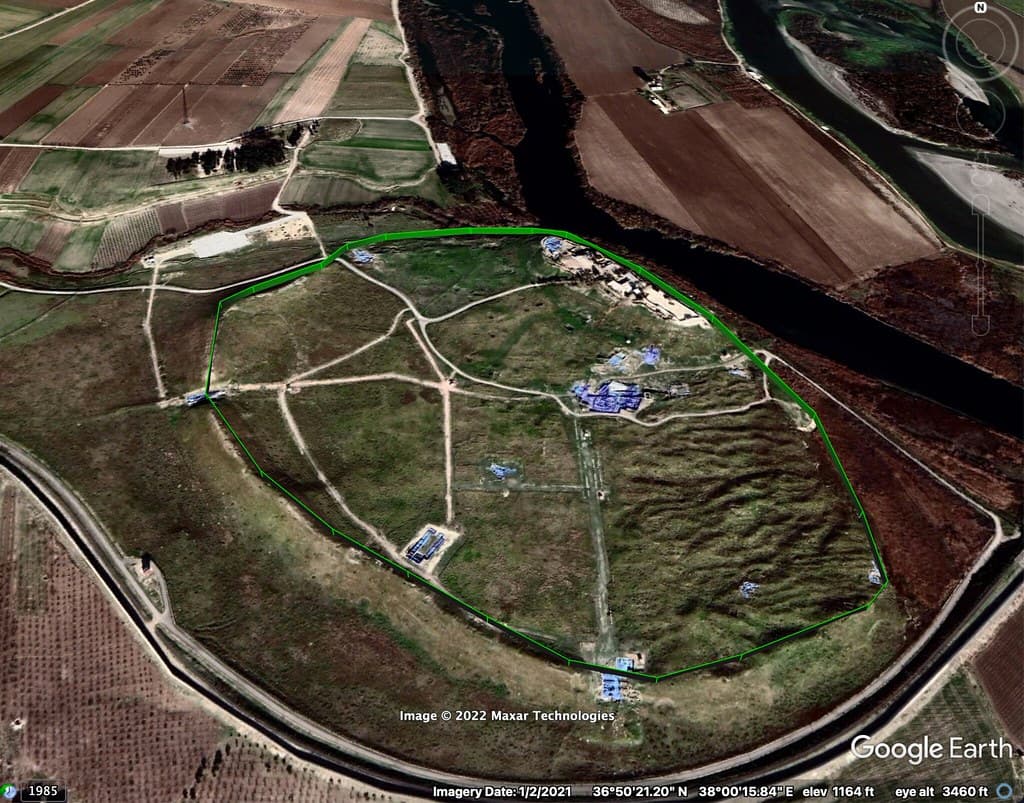
The Orontes River, which curves to the north of the site, was in antiquity a sacred waterway — its Greek name, which means 'the river that flows backwards' (northward to the Mediterranean), set it apart from other rivers and gave it a quality of geographic uncanniness that would have been spiritually significant.
Royal capital and sacred center of the Neo-Hittite Kingdom of Patina/Unqi; seat of divine kingship ratified through temple-based treaty ceremonies
From Neo-Hittite royal capital (c. 900–738 BCE) with temples to the Storm God and consort, to Neo-Assyrian provincial administrative center with cuneiform oath-archives stored in the repurposed sanctuary; subsequently abandoned and buried; partially excavated by Oriental Institute (1935–1938) and ongoing University of Toronto excavation since 1999
Experience and orientation
Tell Tayinat is not a developed heritage site. It sits in the agricultural plain east of Antakya (ancient Antioch), largely unimproved for visitors, accessible primarily to researchers and those who specifically seek it out. This is both its limitation and its singular quality: you encounter the remains of a Neo-Hittite royal city without interpretive infrastructure, without crowds, without the mediating apparatus of heritage tourism.
What there is, is the land itself — the flat expanse of the Amik Valley, extraordinary in its fertility and in its long human memory. The Amik Plain was one of the most densely occupied regions of the ancient Near East for nearly four thousand years; to stand within it is to stand inside a deep continuity of human habitation.
Where excavation has exposed architectural remains, you can see walls of basalt orthostats, stone bases that once supported the columns of a temple porch, the outline of rooms that replicated, in their proportions and sequence, the sacred architecture of Jerusalem and Aleppo and a dozen other ancient cities. For those with knowledge of the Biblical parallel, the experience carries a particular quality: this is where abstraction becomes stone.
The textual description in 1 Kings of Solomon's Temple — ulam, hekhal, devir — finds its clearest physical counterpart not in Jerusalem but here. In the mornings, the valley fills with a low mist from the Orontes. By midday in summer, the heat is intense and the plain shimmers. The best time to visit is spring, when the grain is green and the light is clear, and the mountains of the Amur are visible to the north.
Coordinate access in advance with the Tayinat Archaeological Project at the University of Toronto. The site is on agricultural land approximately 25–30 km east/southeast of Antakya. Private vehicle is necessary. Researchers may be present during summer field seasons.
Context and lineage
The tell's earliest significant occupation in the historical record dates to the late 3rd millennium BCE, with a possible connection to the site of Alalaḫu mentioned in early Mesopotamian texts. Its fullest flowering was as Kunulua, capital of the Neo-Hittite Kingdom of Patina, established by a dynasty associated with the legendary Taita.
By the 10th and 9th centuries BCE, Kunulua was a substantial royal city: the bit hilani palaces — a distinctively North Syrian palatial form with columned porticos and ceremonial reception halls — were decorated with carved basalt orthostats. The temples followed the tripartite Levantine plan. A magnificent female statue discovered in 2017, possibly depicting the goddess Kubaba or the royal ancestress Kupapiyas, suggests that the founding mythology of Kunulua involved divine or semi-divine feminine authority.
The city's fall came with the Assyrian campaigns of Tiglath-Pileser III, who conquered the Patina kingdom around 738 BCE, deported its population, and installed Assyrian administrative infrastructure — including the reuse of the city's own holiest sanctuary as a repository for imperial loyalty oaths.
Late Bronze Age Syro-Anatolian urban tradition; Neo-Hittite Aramaean dynastic tradition; Neo-Assyrian imperial administration; abandoned after Assyrian conquest, c. 738–600 BCE
Traditions and practice
The temples of Kunulua served as the primary theaters of royal religious life. Libation ceremonies — the pouring of water, wine, or oil before the divine statue — were the most common form of address to the gods and were performed daily. Animal sacrifice, including cattle, sheep, and birds, accompanied major ceremonies.
The most binding category of ritual at Tell Tayinat's temples was the ratification of treaties: in the ancient Near East, oaths sworn before the gods in their own house were understood as irrevocable, witnessed by the deity who physically dwelled in the sanctuary. The Neo-Assyrian cuneiform tablets found in Building XVI's holy of holies preserve loyalty oath documents sworn to Esarhaddon — demonstrating that even the Assyrian conquerors understood the site's sacred authority as a venue for binding commitment.
This is a place where the power of place and the power of oath-swearing were understood as one.
Annual University of Toronto archaeological field seasons; scholarly publication of finds including the goddess statue and cuneiform texts; ongoing multidisciplinary analysis.
Approach the site with specific preparation: read the scholarly summary of the tripartite temple plan and its relationship to the Hebrew Bible's description of Solomon's Temple before you go. When you stand before the exposed architectural remains, you will then be able to hold both the physical stones and the textual tradition simultaneously — and the convergence of these two streams of knowledge produces a quality of understanding that neither alone can offer.
Pay attention to the quality of the light in the Amik Plain. Ancient sacred sites were rarely placed accidentally; the open, fertile valley floor, framed by mountains on three sides and watered by the Orontes, would have been understood as a location of divine abundance. Consider what it meant to build a god's house in this place — to say, by act of construction, that the divine chose to live here.
Neo-Hittite / Aramaean (Kingdom of Patina/Unqi)
HistoricalTell Tayinat was Kunulua, royal capital of the Neo-Hittite Kingdom of Patina. Its temples followed the tripartite plan — identical in form to Solomon's Temple — and housed the Storm God and consort in lion-flanked sanctuaries. Libation, sacrifice, and treaty ratification before the divine statue defined the religious life of the city.
Libation ceremonies, animal sacrifice, treaty ratification oaths sworn before divine witnesses, royal ancestor veneration
Neo-Assyrian Imperial Cult
HistoricalAfter Tiglath-Pileser III's conquest c. 738 BCE, Building XVI was repurposed as a Neo-Assyrian sacred precinct. Loyalty oath tablets to Esarhaddon were stored in the holy of holies — the Assyrians exploiting the sacred authority of the conquered city's own temple to bind its population.
Imperial oath-taking in the sanctified space, cuneiform tablet deposition as sacred-legal act
Archaeological / Scholarly
ActiveThe University of Toronto's Tayinat Archaeological Project is one of the most important active excavations in the ancient Near East. Tell Tayinat is the closest known parallel to Solomon's Temple and a key site for understanding Iron Age Levantine sacred architecture and covenant theology.
Annual excavation field schools, multidisciplinary analysis, international scholarly publication
Perspectives and open questions
Tell Tayinat is located at the intersection of Biblical studies, Syro-Anatolian archaeology, and ancient Near Eastern religious history — making it a site where different interpretive traditions find very different things to illuminate.
Scholarly perspective
Archaeologists identify Tell Tayinat as Kunulua, capital of the Neo-Hittite Kingdom of Patina/Unqi, and recognize the site's tripartite temple (Building XVI) as the closest known architectural parallel to Solomon's Temple. The discovery of cuneiform loyalty oath tablets stored in the holy of holies has transformed scholarly understanding of how ancient Near Eastern temples functioned as repositories of binding political-religious power.
The 2017 goddess statue remains under analysis, with its identification — Kubaba, the mother of the gods; or Kupapiyas, the dynasty's founding queen — still debated.
Living and traditional perspectives
No surviving community with direct religious continuity exists. The Hatay region's diverse communities — Alawite, Armenian Christian, Sunni Muslim, Arab — each carry fragments of the region's extraordinarily deep sacred history, though none claim continuous connection to Neo-Hittite Kunulua. The site carries particular resonance for Jewish and Christian visitors aware of the Biblical parallel, and for anyone drawn to the theological question of how ancient peoples understood divine presence in architecture.
Alternative interpretations
The 2017 discovery of the goddess statue has reinvigorated discussion about the role of divine feminine power in the founding mythologies of ancient Syro-Anatolian states. The possibility that Kunulua's founding was legitimized through a divine or semi-divine queen — Kubaba, the mother of gods in the Anatolian tradition later transmitted to Cybele — connects this site to one of the ancient world's most enduring theological currents.
Open questions
The identity of the 2017 female statue remains debated. The full extent of the Bronze Age settlement and its possible identity as the early 3rd-millennium Alalaḫu are unresolved. The fate of Kunulua's population after the Assyrian conquest — whether deported, absorbed, or dispersed — has not been determined. Whether the site served any continued sacred function after the Assyrian period is unknown.
Plan your visit
Access and arrival
Located approximately 25–30 km east/southeast of Antakya (Hatay) in the Amik Valley. Reachable by private car from Antakya via the Amik Plain. The site is not open to casual public tourism — contact the Tayinat Archaeological Project (tayinat.artsci.utoronto.ca) in advance for researcher access.
Antakya (Hatay city) offers a range of hotels and is the natural base for the region. The city's own heritage — ancient Antioch, Saint Peter's Church, the Antakya mosaic museum — makes it worth extended stay.
Respectful visit
Practical field clothing for outdoor walking in an agricultural landscape. Sun protection and sturdy footwear are essential.
Generally permitted during academic visits. Check with project staff before photographing excavation trenches or ongoing work.
Not applicable.
Do not enter or disturb excavation features. Access may require permission from the project or local landowners. The site is on private agricultural land — arrive via coordination, not uninvited.
Public access is not formally established; coordinate with the Tayinat Archaeological Project before visiting. Do not disturb excavation features. The region's agricultural land should be respected — do not cross planted fields.
Location
Map loads as you approach this section.
Pilgrim reflections
A portrait of encounter, not a score
Pilgrims describe what they felt, how present they could become, and whether the place would shape a journey. There are no stars and no ranking of traditions.
No reviewed reflections yet
The first pilgrims can help describe the character of being here.
Share a reflection
Available after an account-backed “Been there.” Every reflection is reviewed before publication.
Nearby sacred places
Explore other sacred places in the region. Proximity does not establish access or travel time; check each place’s guidance.


References
Sources consulted for this page. Source categories describe the publication, not a guarantee that every claim is verified. Traditional accounts and outside interpretations may differ.
- 01About the Site - Tayinat Archaeological Project — University of Toronto, Timothy Harrison (PI)academicOfficial project website with ongoing excavation data
- 02The Tell Tayinat Archaeological Project - Department of Near & Middle Eastern CivilizationsacademicUniversity of Toronto project description
- 03Tell Tayinat, Turkey: 'Dark Age' TempleacademicCoverage of Iron Age temple discovery at Tell Tayinat
- 04Tayinat's Building XVI: The Religious Dimensions and Significance of a Tripartite Temple at Neo-Assyrian KunuluaacademicDetailed academic analysis of the tripartite temple and its religious function
- 05Tell Tayinat - WikipediaencyclopediaComprehensive Wikipedia article on history, excavations, and discoveries
- 06Tell Tayinat and the Judean Temple — Design and Placing the Treaty/Covenant Document in the Holy of HoliesacademicComparative analysis of Tell Tayinat and Solomon's temple traditions
- 07Hittite Monuments - Tell TayinatguideSpecialized site covering Hittite and Neo-Hittite monuments including Tell Tayinat
- 08GPS coordinates of Tell Tayinat, TurkeySource contextGPS coordinate source: 36.2418°N, 36.3725°E
Share a photo
Help visitors recognize Tell Tayinat. Every submission is reviewed before publication.