Alalakh
An Ishtar temple rebuilt on the same sacred ground for nearly a thousand years, through every conquest
Understand sacred places, explore living traditions, and learn how to engage respectfully with Pilgrim Map.
Access has not been verified. Check current local guidance before planning a visit.
Hatay, Turkey
Read the sources
Visit essentials
A quick read before you go
- Duration
- 1–2 hours for a thorough visit of the exposed architectural remains.
- Access
- Located approximately 20 km northeast of Antakya (Hatay) near Reyhanlı.
Overview
Alalakh repeatedly rebuilt holiness after violent destruction across nearly eight centuries, from around 2000 to 1200 BCE. New cities rose on old ruins, and through at least sixteen reconstructions the temple of Ishtar and her Hurrian form Shaushka returned to the same Amuq Plain location. Archaeologists call this 'sacred continuity': generations separated by centuries treated that ground as irreducibly sacred, as though the goddess refused relocation.
Meaning 'the Forgotten Kingdom,' Alalakh remains little known beyond specialists despite being one of the most text-rich Bronze Age cities outside Mesopotamia. Its cuneiform tablets record movement of people and goods across an ancient crossroads. Great King Idrimi, who lived around 1490–1450 BCE, left a uniquely personal autobiographical statue inscription; now in the British Museum, it is often missed by visitors who do not know to seek it. The site's obscurity similarly rewards preparation.
Why this place is sacred
The Ishtar Temple at Alalakh was rebuilt sixteen times in succession on the same sacred location. This fact, recovered through stratigraphy — the careful reading of soil layers — is not merely a technical archaeological detail. It is a record of religious commitment of extraordinary depth. In the ancient Near Eastern understanding, the goddess Ishtar (in her Hurrian form, Shaushka) was not an abstraction.
She was a powerful, specific presence — goddess of love and war, of fertility and destruction, whose nature held opposites in creative tension. Her cult was among the most ancient and most widespread in the ancient world, and her temples were centers of economic, social, and religious life. When Alalakh was burned — as it was, repeatedly — and its population dispersed, someone always came back.
And when they came back, they built the temple for Ishtar again, in the same place. This is the meaning of the site's most distinctive archaeological fact: not merely that it was occupied for a long time, but that it was considered impossible to abandon the sacred location. The ground itself carried an authority that transcended the human. Alalakh also held a different quality of sacredness through its role as a political crossroads.
In the Bronze Age, Alalakh sat at the point where the Amuq Plain opens to both the Euphrates valley and the Levantine coast — a location through which traders, armies, diplomats, and refugees from Mesopotamia, Anatolia, Syria, and Egypt all passed. Its cuneiform archives record the movement of people with a granularity that has no parallel in the ancient world: citizenship lists, land transactions, census records, ration lists.
Alalakh was a place where the human world was written down, bureaucratically preserved, made legible. This combination — a place where the divine is resident and the human is recorded — gives the site an unusual density of meaning.
Bronze Age city-state and administrative center; seat of the goddess Ishtar with a continuously rebuilt temple; regional capital under Mitanni suzerainty and later Hittite administration
From Amorite founding (c. 2000 BCE) through Middle Bronze Age palace culture, Hurrian-influenced religion, Mitanni vassalage, Hittite period, and final destruction during the Bronze Age Collapse (c. 1200 BCE). Excavated by Sir Leonard Woolley 1937–1939 and 1946–1949, and by K. Aslıhan Yener and Murat Akar from 2003 to the present.
Experience and orientation
Alalakh today is an open-air archaeological park, free to enter, with minimal interpretive infrastructure. This is unusual for a site of its significance and is both its limitation and its greatest gift. You walk among exposed walls and floors from palaces that stood 3,500 years ago without the mediation of barriers, display cases, or interpretive panels. The distance between you and the Bronze Age is reduced to a few centimeters of air.
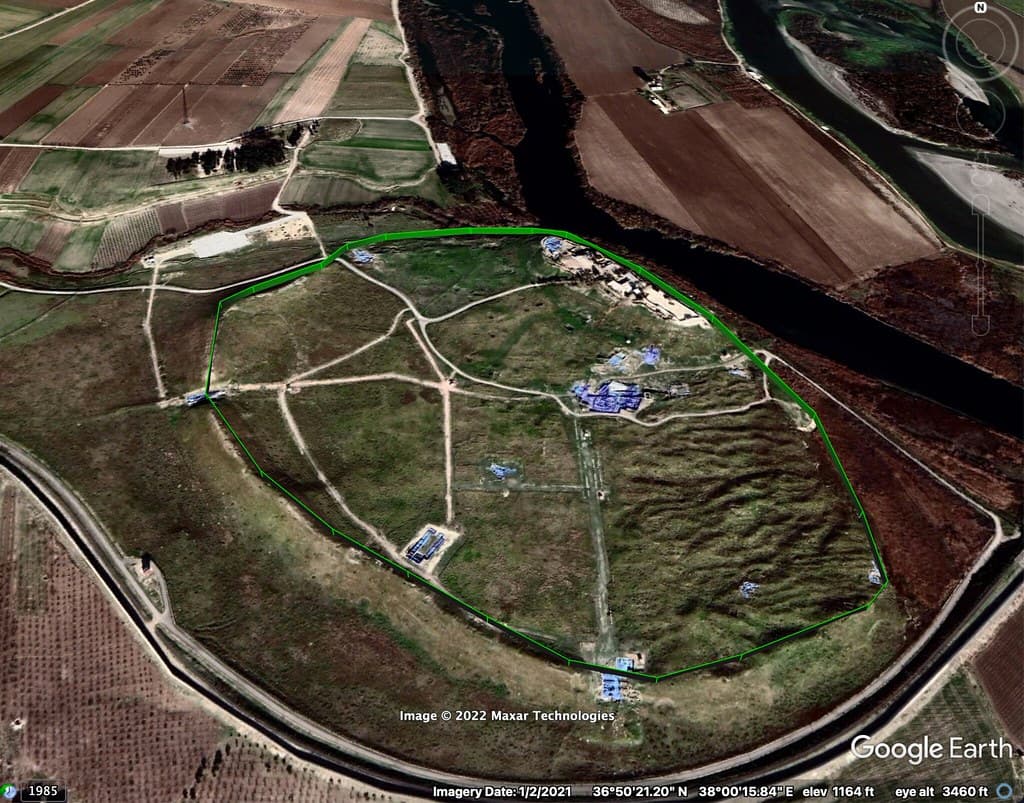
The site occupies a tell in the Amuq Plain near Reyhanlı in Hatay Province — a flat, agricultural landscape that gives the raised tell a quiet prominence. The exposed architecture — thick basalt walls, paved floors, the outline of palatial rooms — is visible without excavation equipment or specialist knowledge. Two of the main palace complexes are partially cleared, and the sense of standing within a space that once housed Bronze Age kings and their households is immediate.
The Hatay light, especially in spring and autumn, has a quality particular to this part of the Mediterranean world — clear and slightly golden, falling across the plain and the exposed ruins in a way that seems to make the depth of time visible rather than abstract. In summer, the heat is severe and shade is minimal; early morning visits are strongly preferable.
The site's minimal interpretation means that the prepared visitor — who has read about King Idrimi, about the Ishtar Temple sequence, about the Bronze Age Collapse that ended the city — will have an experience of a different order than the uninformed passerby. Alalakh rewards research in a way that more developed sites do not, because the gap between what you see and what you know has to be bridged actively by the visitor.
The site is located near Reyhanlı, approximately 20 km northeast of Antakya (Hatay). Access is free. A private vehicle is recommended. The Alalakh Archaeological Park official website (alalakh.org) provides current access information and may offer contact details for guided visits with the excavation team during field seasons.
Context and lineage
Alalakh appears in the Mari archives and Ebla texts as a recognized city from the early 2nd millennium BCE. Its Amorite founders established a dynasty connected to the broader Syrian urban world — a world of palace economies, cuneiform administration, and polytheist religious life centered on temples. The city's founding coincided with the earliest construction of the Ishtar Temple, establishing from the beginning the religious and political configuration that would persist through all its subsequent reincarnations.
The most vivid founding narrative associated with Alalakh belongs not to the city's origins but to one of its greatest kings: Idrimi, who ruled around 1490–1450 BCE. His autobiographical statue inscription — incised on a basalt statue now in the British Museum — narrates how he was driven into exile, wandered among the habiru (a term for displaced or stateless people), and was eventually restored to his throne through the favor of the god Adad and the goddess Ishtar.
The inscription is remarkable for its personal register: Idrimi speaks of feeling ashamed, of seeking signs from the gods, of building alliances through patience rather than force. It is one of the most human documents to survive from the Bronze Age.
Amorite founding tradition; Middle Bronze Age Syrian palace culture; Hurrian-influenced religion under Mitanni suzerainty; Hittite period administration; final destruction in Bronze Age Collapse c. 1200 BCE
Traditions and practice
The religious life of Alalakh was organized around the Ishtar Temple and the goddess's requirements. Daily ritual — feeding the goddess, clothing her statue, maintaining the sacred fire — was the responsibility of a priestly class. Animal sacrifice, primarily sheep and cattle, accompanied major festivals. Libation — the pouring of liquids before the divine image — was the most common act of ordinary worship.
The cuneiform texts from Alalakh record these practices with some specificity, including the names of priests and the quantities of offerings. The temple was also the location of treaty ratification: in the ancient Near East, to swear an oath before the gods in their own house was to invoke divine punishment on any violation.
The lions flanking the temple gates were not merely decorative — they were apotropaic guardians of the sacred threshold, marking the boundary between the profane world and the divine space within. Before each rebuilding of the Ishtar Temple, excavations have found evidence of ritual votive deposition: sacred objects, sometimes from the destroyed level, carefully placed in the foundation of the new construction. The goddess's continuity had to be explicitly re-established through intentional religious acts, not merely through architectural replacement.
Annual excavation campaigns; ongoing cuneiform tablet conservation and documentation, including the newly discovered archive that is among the most significant Bronze Age textual finds in years; population genetics research using ancient DNA.
Before arriving at Alalakh, spend some time with the image and text of the Idrimi statue — it is accessible online through the British Museum's collection. This preparation transforms the visit.
When you stand at the site, you are standing in the world that produced one of the ancient world's most direct human voices: a king who wrote, or dictated to a scribe, about shame and exile and divine favor in terms that remain legible three and a half millennia later. Walk the perimeter of the exposed palace walls slowly, attending to their scale and the quality of the basalt construction.
The walls that survive are thick and deliberate — they were built to endure. Note where the burn layers are visible in the stratigraphy: these are the destructions. And then consider what it meant for the people who returned to build again, not elsewhere on the plain but here, on the same ruined foundations, because the ground had authority that a catastrophe could not cancel.
In the late afternoon, the low sun across the tell illuminates the texture of the walls in a way that makes the difference between worked stone and natural deposit visible.
Amorite / Early Syrian Polytheism (Middle Bronze Age)
HistoricalAlalakh was founded by Amorite settlers and from its earliest levels contained formal temples. The Ishtar Temple sequence — rebuilt on the same spot through at least sixteen destructions — is one of the most remarkable records of sacred topographical continuity in the ancient world.
Animal sacrifice, libation, votive offerings, cylinder seal use with divine imagery, ritual votive deposition before temple rebuilding
Hurrian-Influenced Religion (Late Bronze Age)
HistoricalBy the Late Bronze Age, Alalakh was embedded in the Hurrian cultural sphere. The goddess Ishtar was worshipped in her Hurrian form as Shaushka; the storm god was Tessub; lion imagery flanked temple gates across all rebuilding phases as apotropaic guardians.
Temple libations and sacrifice, treaty ratification before divine witnesses, use of apotropaic lion imagery, diplomatic oath-swearing in the temple's sacred space
Archaeological / Scholarly
ActiveAlalakh is a foundational site for Bronze Age Near Eastern studies. The Idrimi statue, the palace archives, the Ishtar Temple sequence, and the newly discovered cuneiform archive collectively make it one of the most textually and archaeologically rich Bronze Age sites outside Mesopotamia.
Annual excavation campaigns, cuneiform tablet documentation, population genetics research, international scholarly publication
Perspectives and open questions
Alalakh sits at the center of several important scholarly debates — about the Bronze Age Collapse, about Hurrian religion, about ancient Near Eastern sacred topography — while remaining accessible to contemplative interpretation outside the academy.
Scholarly perspective
Alalakh is regarded as one of the most important Bronze Age urban sites in the ancient Near East. The Woolley excavations established the 18-level stratigraphic sequence and recovered the Idrimi statue and the original cuneiform archives. Subsequent work by Yener and Akar has revised and refined the stratigraphy, and the newly discovered cuneiform archive announced in 2025 promises to significantly expand the textual record.
The site's importance for understanding Bronze Age population genetics, commercial networks, and diplomatic institutions is the subject of active research.
Living and traditional perspectives
No surviving community with continuous religious connection to the site exists. Hatay Province's multicultural communities — Alawite, Sunni, Armenian Christian, Arab — preserve layers of much later religious history in the region but do not claim ancestral connection to Bronze Age Alalakh. The site's spiritual significance today is primarily available through the contemplative interpretation of archaeological evidence.
Alternative interpretations
The persistent rebuilding of the Ishtar Temple on the identical sacred spot through nearly a millennium of violent destructions has been interpreted by some writers as evidence that certain landscapes radiate a persistent sacred energy that ancient peoples could perceive and felt compelled to honor. Whether this framing is taken literally or metaphorically, the archaeological fact behind it — repeated deliberate choice of the same location — is not in dispute.
Open questions
The reasons for Alalakh's final destruction around 1200 BCE remain debated: the Bronze Age Collapse involved simultaneous disruptions across the Mediterranean and Near East, and Alalakh was one of dozens of cities that did not recover. Whether the destruction came from the so-called Sea Peoples, internal collapse, Hittite disintegration, or some combination, is unresolved. The full content of the newly discovered cuneiform archive has not yet been published.
The complete pantheon of Alalakh in its later levels — which deities were worshipped, in what forms, and with what rites — remains partially unknown.
Plan your visit
Access and arrival
Located approximately 20 km northeast of Antakya (Hatay) near Reyhanlı. Best accessed by private car from Antakya. Free entry — open-air archaeological park. No on-site facilities; bring water and food from Reyhanlı or Antakya.
Antakya (Hatay) is the natural base, offering hotels at various price points. The city's remarkable multicultural heritage — Alawite, Arab Christian, Armenian, Sunni — and the nearby Saint Peter's Church make it a worthwhile extended destination.
Respectful visit
Practical field clothing. Sun protection — hat, sunscreen, light long sleeves — is strongly recommended for visits in the warmer months. Sturdy footwear for uneven ground.
Freely permitted throughout the open-air park. Bring your own interpretive context — signage on site is minimal.
Not applicable.
Do not remove artifacts, pottery sherds, or any site material — this is illegal under Turkish cultural heritage law. Do not enter or disturb roped-off excavation trenches. The excavation team's active work areas should be respected.
Sun protection and water are essential in the Hatay heat. The site has minimal shade and no on-site facilities. Bring your own provisions. Do not disturb excavation trenches or remove any material.
Location
Map loads as you approach this section.
Pilgrim reflections
A portrait of encounter, not a score
Pilgrims describe what they felt, how present they could become, and whether the place would shape a journey. There are no stars and no ranking of traditions.
No reviewed reflections yet
The first pilgrims can help describe the character of being here.
Share a reflection
Available after an account-backed “Been there.” Every reflection is reviewed before publication.
Nearby sacred places
Explore other sacred places in the region. Proximity does not establish access or travel time; check each place’s guidance.


References
Sources consulted for this page. Source categories describe the publication, not a guarantee that every claim is verified. Traditional accounts and outside interpretations may differ.
- 01Alalakh | The Forgotten Kingdom — Murat Akar (director)academicOfficial project website for current excavations
- 02Tell Atchana, Alalakh Volume 2: The Late Bronze II City 2006–2010 Excavation Seasons — Yener, Akar, HorowitzacademicMajor scholarly excavation report from University of Chicago Press
- 03Alalakh: an account of the excavations at Tell Atchana in the Hatay, 1937–1949 — Sir Leonard WoolleyacademicFoundational excavation account by Sir Leonard Woolley
- 04Human mobility at Tell Atchana (Alalakh), Hatay, Turkey during the 2nd millennium BC: Integration of isotopic and genomic evidenceacademic2021 peer-reviewed study on population movement using isotopic and ancient DNA evidence
- 052025 Harris Grant Report: Documenting Archival Dynamics in the Late Bronze Age: A New Archive of Cuneiform Tablets from AlalakhacademicRecent ASOR grant report on newly discovered cuneiform tablet archive
- 06Material Evidence of Cult and Ritual at Tell Atchana, Ancient AlalakhacademicDetailed study of cult objects and ritual practices across excavation levels
- 07Alalakh - WikipediaencyclopediaComprehensive English Wikipedia article on Alalakh's history and archaeology
- 08Alalakh Archaeological ParkguideVisitor and access information from the official project site
Share a photo
Help visitors recognize Alalakh. Every submission is reviewed before publication.