Talatí de Dalt
Menorca's finest taula sanctuary, left leaning where it fell
Understand sacred places, explore living traditions, and learn how to engage respectfully with Pilgrim Map.
Access has not been verified. Check current local guidance before planning a visit.
Maó, Balearic Islands, Spain
Read the sources
Visit essentials
A quick read before you go
- Duration
- No source consulted specifies an expected visit length for this settlement.
- Access
- Located directly off the Maó–Ciutadella road (ME-1), reported at approximately kilometer 4 from…
Overview
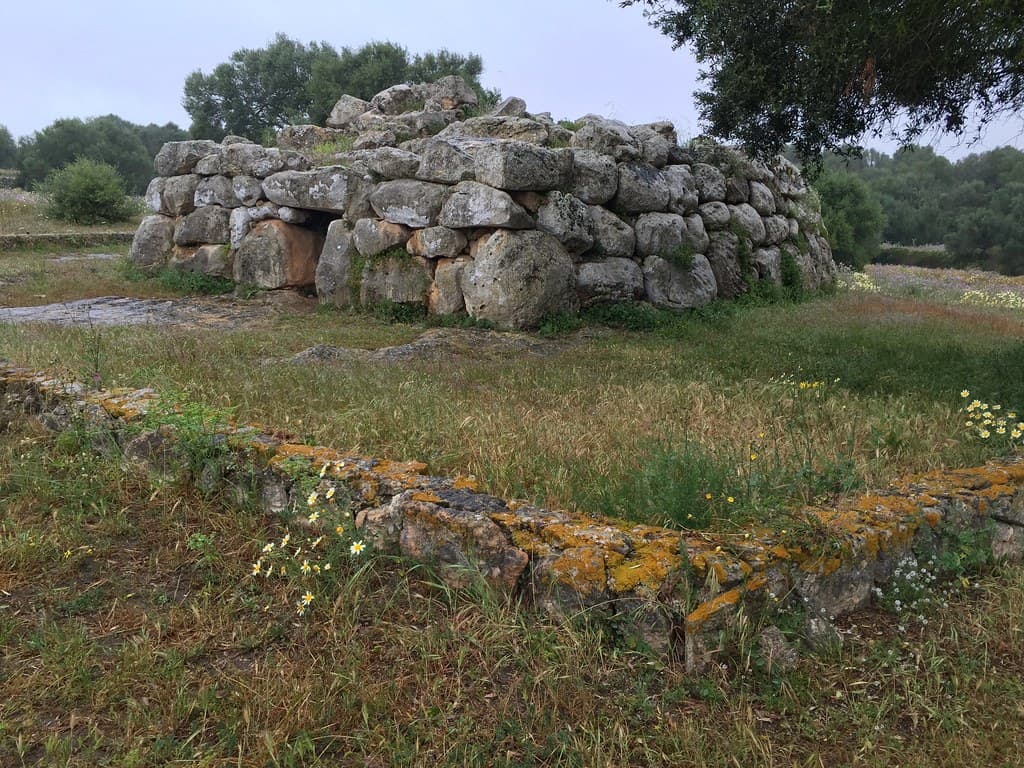
A short drive from Maó on the Maó–Ciutadella road, Talatí de Dalt is among the more complete Talayotic settlements that shaped Menorca through the Bronze and Iron Ages. Inside its perimeter walls are a central talayot; a taula enclosure regional tourism authorities call among the island's most monumental; foundations of round houses; a hypostyle room roofed on one column; and several rock-cut hypogea used at different times for burial or shelter.
Its famous taula differs from freestanding examples: a column and capital lean against the horizontal face of its vertical stone. Sources disagree whether this was intentional architecture or an ancient fall preserved exactly as archaeologists found it. Talatí de Dalt is counted among sites represented within Talayotic Menorca, which UNESCO inscribed as a World Heritage property in September 2023, though primary UNESCO documentation naming every component structure could not be independently confirmed here.
The site has no living ceremonial use today; it is visited, studied, and conserved rather than worshipped.
Why this place is sacred
What made this ground significant to the people who built here is inferred rather than recorded. No inscription, myth, or unbroken tradition explains the taula sanctuary's original purpose; what remains is the archaeology itself — hearths, the bones of young animals, and imported wine amphorae recovered from the settlement, the kind of assemblage archaeologists elsewhere associate with ritual or votive activity rather than ordinary domestic refuse.
That evidence supports treating the taula precinct as a ceremonial center of some kind, without licensing a fuller account of what was said or done there. The site's more immediate thinness for a modern visitor is architectural and spatial rather than devotional: within one compact, walled settlement stand a sanctuary, a defensive tower, domestic foundations, and burial chambers, all from the same cultural horizon and largely legible on foot.
Few sites let a visitor stand inside a Talayotic sanctuary, a Talayotic house, and a Talayotic tomb within the same few minutes of walking. Whether the taula's tilted capital was deliberately built that way or is a preserved accident of collapse is unresolved in the sources consulted for this profile; either reading changes how the monument's 'unfinished' or 'broken' quality should be understood, and neither can be stated as settled fact here.
A fortified Talayotic settlement combining domestic housing, a defensive talayot tower, a taula ceremonial enclosure, and hypogea used for burial and, at points, habitation or storage.
Some tourism sources place the settlement's origins in the Copper Age (roughly 3000–1600 BC) with a later Iron Age/Celtic reoccupation around 400–200 BC; the official Consell Insular de Menorca page instead documents, via excavation, a post-talayotic occupation phase of 650–123 BCE with associated houses dated to the 2nd century BCE. These are competing chronologies drawn from different sources rather than a single agreed timeline, and are presented here without collapsing them into one figure.
Excavation of the settlement is reported as ongoing since 1997 by Amics del Museu de Menorca and Arqueomenorca; an earlier 1960s excavation campaign is referenced by the official menorca.es tourism page without further detail on who conducted it. In September 2023, Talayotic Menorca — the wider archaeological ensemble in which this settlement is represented — was inscribed on the UNESCO World Heritage List.
Experience and orientation
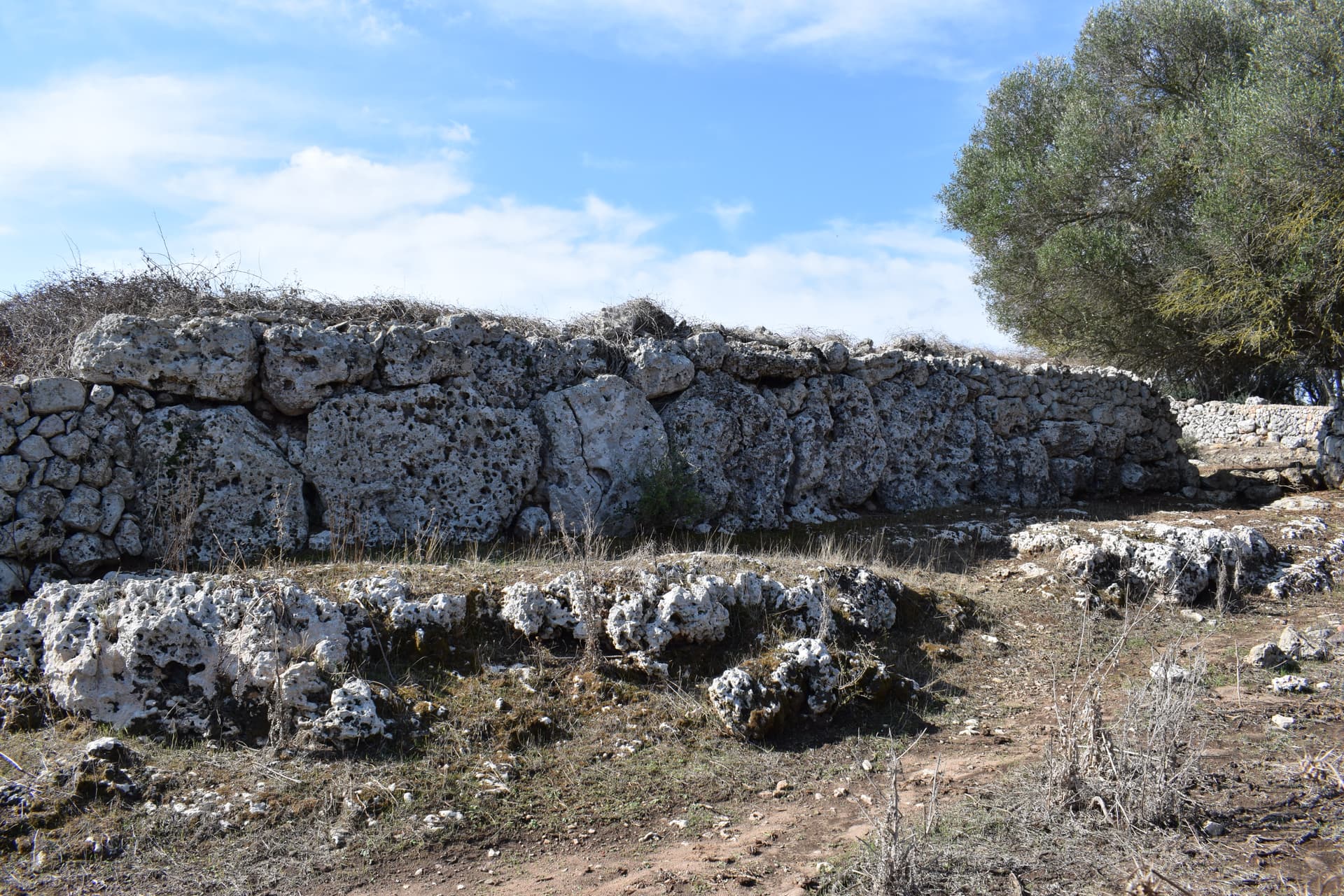
The approach is unremarkable by design — a signposted path leaves the Maó–Ciutadella road and crosses open, sun-exposed ground with little shade, so the first practical sensation is often simply heat and glare rather than atmosphere. The settlement announces itself gradually: a perimeter wall built of stones too large to have been moved by hand alone, then the truncated conical bulk of the central talayot rising on the highest point of the enclosed ground.
Walking the interior, the domestic evidence is legible at floor level — circular wall foundations, a hypostyle room where a single stone column once carried a roof of flat slabs, the outlines of a village that by some estimates held on the order of a hundred people at its most populated. The taula enclosure sits at the heart of this, its bell-shaped precinct opening toward a concave façade.
The T-stone itself stands largely intact, but the column and capital that once ringed it are, in most cases, gone or fallen; here, uniquely among Menorca's taulas, one such column-and-capital rests leaning against the horizontal stone rather than lying flat or standing apart.
Whether that arrangement was engineered or is simply how it came to rest centuries ago is not something a visitor can resolve by looking, and the sources consulted disagree on the point — some frame it as the sanctuary's most distinctive design feature, others as an accident of collapse preserved where it fell.
At the settlement's edge, natural caves and hewn hypogea drop into the hillside; several are columned hypostyle chambers roofed with massive stone slabs, reached by stone steps, and require care and a working light source to enter safely.
Enter from the roadside path; the talayot occupies the high point, the taula enclosure sits near the settlement's center, and the hypogea/caves are toward the settlement's southeastern edge.
Context and lineage
No founding myth or origin legend specific to Talatí de Dalt survives in the sources consulted; what is known about the settlement's beginnings comes entirely from archaeology, and even that is contested — one line of sources places construction in the Copper Age with later Iron Age reoccupation, another documents a post-talayotic occupation phase of 650–123 BCE with houses dated to the 2nd century BCE. No single date should be treated as confirmed.
Part of the broader Talayotic culture of Menorca and Mallorca, and represented within the Talayotic Menorca archaeological ensemble inscribed by UNESCO in September 2023.
The Talayotic community of prehistoric Menorca
Builders and original inhabitants of the settlement, including the taula sanctuary, talayot, houses, and hypogea; no individual names survive.
Amics del Museu de Menorca
Archaeological association reported to have carried out excavation work at the site on an ongoing basis since 1997, in partnership with Arqueomenorca.
Arqueomenorca
Archaeological body credited alongside Amics del Museu de Menorca with excavation and study of the settlement since 1997.
Consell Insular de Menorca / Fundació Destí Menorca
Island council body that manages the settlement's official tourism information and documents its 1960s excavation findings and chronology.
The family managing the site today
Talatí de Dalt is privately owned and, per the official regional tourism page, managed by the family that owns the property.
Traditions and practice
Original Talayotic use of the taula sanctuary is inferred, not directly recorded. Excavated finds at the settlement — hearths, bones of young livestock, and imported wine amphorae — are the kind of evidence archaeologists elsewhere read as signs of ritual or votive activity rather than ordinary daily refuse, which supports treating the taula precinct as a ceremonial focal point without specifying what rites were performed there.
None. The site functions today as a ticketed archaeological and heritage attraction with no reported ongoing ceremonial use by any community.
Walk the perimeter wall first to take in the settlement's scale before entering the interior. At the taula, resist reading the leaning column as decoration and instead take the time to look at how the T-stone's mass is distributed — the sanctuary was built to be seen from inside its bell-shaped precinct, not from a photograph.
At the hypogea, pause at the entrance before descending; let your eyes adjust, and notice how the massive slab roofing changes the acoustics of your own footsteps and voice.
Talayotic Culture
HistoricalTalatí de Dalt is one of the settlements of the Talayotic culture, the prehistoric Bronze-to-Iron-Age society of Menorca and Mallorca known for cyclopean dry-stone architecture: talayots (tower structures), taula enclosures (T-shaped sanctuary monuments found only on Menorca), hypogea (rock-cut chambers), and navetas.
Archaeological evidence from the settlement — hearths, bones of young animals, and imported wine amphorae — is consistent with ritual or votive activity at the taula precinct, though the specific rites practiced there are not established in the sources consulted.
Archaeological and heritage conservation stewardship
ActiveExcavation and conservation of Talatí de Dalt has continued since at least the 1960s, with ongoing archaeological work reported since 1997 by Amics del Museu de Menorca and Arqueomenorca, and the site is now managed as part of Menorca's heritage tourism infrastructure alongside its role within the 2023 UNESCO 'Talayotic Menorca' inscription.
Ongoing excavation, site management by the family that owns the property, and interpretation/visitor access coordinated through the Consell Insular de Menorca's tourism body.
Perspectives and open questions
Talatí de Dalt is read almost entirely through the lens of archaeology today; the perspectives below distinguish what excavation supports, what living tradition can and cannot say, and what remains genuinely unresolved rather than merely under-researched.
Scholarly perspective
Regional and official tourism authorities and archaeological bodies treat Talatí de Dalt as one of Menorca's best-preserved Talayotic settlements, notable for the completeness of its taula sanctuary, talayot, hypostyle rooms, and hypogea within a single walled site, and as a site represented within the 2023 UNESCO 'Talayotic Menorca' inscription documenting the island's cyclopean building tradition from the Bronze Age into the Late Iron Age.
Excavation is reported as ongoing since 1997 by Amics del Museu de Menorca and Arqueomenorca, building on earlier 1960s excavation work referenced by the official Consell Insular de Menorca tourism page. Sources diverge on the settlement's founding chronology, and that divergence is treated here as a live scholarly gap rather than resolved in either direction.
Living and traditional perspectives
No continuous indigenous or devotional tradition survives from the Talayotic culture into the present; there is no living community whose testimony can speak for what the taula sanctuary meant to the people who built and used it. Interpretation is archaeological throughout.
Alternative interpretations
Popular and esoteric writing on Menorca's taulas more broadly sometimes speculates about astronomical or ritual alignments in these monuments; no source consulted for this profile substantiates such a claim specifically for Talatí de Dalt, so none is asserted here.
Open questions
Two questions sit at the center of the site and remain genuinely open. First, whether the taula's leaning column and capital were placed that way intentionally or are a preserved accident of ancient collapse — sources characterize it both ways, and nothing in the archaeological record consulted here settles it. Second, when the settlement was actually founded: one line of sources gives a Copper Age origin (c.
3000–1600 BC) with Iron Age/Celtic reoccupation around 400–200 BC, while the official island council page instead documents a post-talayotic occupation phase of 650–123 BCE with 2nd-century-BCE houses. Both cannot be simultaneously true as stated, and this profile does not adjudicate between them.
Plan your visit
Access and arrival
Located directly off the Maó–Ciutadella road (ME-1), reported at approximately kilometer 4 from Maó, on privately owned land reached via a short, signposted path from the roadside; on-site parking and drivable access are noted. A small admission fee (reported around €4 by one visitor database) has been charged historically; current pricing should be checked with the site's official contact before travel, as fees change.
Mobile signal reliability at the site itself was not documented in the sources consulted — travelers relying on connectivity for navigation or emergencies should not assume coverage and should confirm before visiting, or treat nearby Maó (a substantial town a few kilometers away) as the nearest point of reliable signal and services.
For current opening hours, access arrangements, or group bookings, the official tourism contact listed for the site is +34 971 36 86 78 or fundaciodesti@menorca.es (Fundació Destí Menorca / Consell Insular de Menorca); no seasonal closure dates were found in the sources consulted, so none should be assumed — check with that contact for current details.
Respectful visit
No dress code is specified by any source. Given the site's sun exposure and lack of shade, practical outdoor clothing, sun protection, and sturdy footwear for uneven ground are advisable.
No photography restrictions are documented; photographing the taula and talayot is a normal part of visiting, reflected in how frequently the leaning-column feature appears in tourism materials.
No offerings tradition is documented at this site.
Visitors should not climb or touch the talayot, taula stones, or wall structures. Underground chambers and hypogea should be entered carefully; at least one source flags that passages require attentiveness given uneven footing and low overhead slabs.
Underground chambers and hypogea require caution when entering — footing can be uneven and slabs low overhead. Do not climb on the talayot, taula stones, or wall structures; conservation of dry-stone cyclopean architecture depends on visitors not adding new stress to already-collapsed or fragile sections (the main talayot is noted as partially collapsed on its southern side).
Location
Map loads as you approach this section.
Pilgrim reflections
A portrait of encounter, not a score
Pilgrims describe what they felt, how present they could become, and whether the place would shape a journey. There are no stars and no ranking of traditions.
No reviewed reflections yet
The first pilgrims can help describe the character of being here.
Share a reflection
Available after an account-backed “Been there.” Every reflection is reviewed before publication.
Nearby sacred places
Explore other sacred places in the region. Proximity does not establish access or travel time; check each place’s guidance.


References
Sources consulted for this page. Source categories describe the publication, not a guarantee that every claim is verified. Traditional accounts and outside interpretations may differ.
- 01Talayotic Menorca — UNESCO World Heritage Centre (List entry 1528) — UNESCO World Heritage CentreofficialOfficial UNESCO listing for 'Talayotic Menorca', inscribed 18 September 2023 as Spain's 50th World Heritage Site; comprises nine territorial component parts (Migjorn and Tramuntana regions of Menorca) encompassing roughly 280 archaeological sites/landscapes with cyclopean architecture spanning Bronze Age (c. 1600 BCE) to Late Iron Age (123 BCE), including talayots, taula enclosures, hypogea, and navetas. Direct WebFetch of the page returned HTTP 403; content confirmed via consistent secondary reporting referencing this listing.
- 02Spain achieves with 'Menorca Talayotic' the 50th inscription on the UNESCO World Heritage List — La Moncloa (Spanish Government)officialSpanish government press release confirming the 18 September 2023 UNESCO inscription date and its designation as Spain's 50th World Heritage Site.
- 03Talaiot Talatí de Dalt (Menorca) — Illes Balears Travel — Agència de Turisme de les Illes Balears (official Balearic Islands tourism board)officialOfficial regional tourism board description: taula sanctuary with bell-shaped floor plan and concave façade; conserved monumental central T-stone with a capital-topped column resting/leaning on it (by chance, not confirmed original design); large talayot partially collapsed on its southern side with a second talayot's foundations visible to the north; three hypostyle underground chambers ('hypogea') in the southeast, roofed with stone slabs on stone pillars, used for storage or dwelling at various times; site address on the Maó–Ciutadella road; privately managed.
- 04Talatí de Dalt — Megalithic Menorca — Descobreix Menorca (island tourism/culture portal)Source contextDescribes the taula's distinguishing feature — a column that leans against the horizontal capstone of the T, unique among Menorcan taulas — plus a truncated-conical central talayot in good condition, a hypostyle room with a large stone-flag roof on a central column, foundations of circular Talayotic houses, and two natural caves of unclear function. States the broader Talayotic culture spans roughly 1000 BC to the Roman conquest of 123 BC, without giving a site-specific founding date.
- 05Talatí de Dalt talayotic settlement — Menorca.es — Consell Insular de Menorca / Fundació Destí Menorca (official island council tourism site)officialOfficial island-council tourism page. Notes the settlement lies on the Maó–Ciutadella road at km 4; describes an elliptical talayot with truncated-conical profile, a taula enclosure called 'one of the most monumental and beautiful in Menorca' with an unusual column-and-capital resting against the lateral side of the central T, a residential sector with radial stone-slab roofing on columns, and several caves. States 1960s excavations documented a post-talayotic occupation phase (650–123 BCE), with associated houses dated to the 2nd century BCE; finds include hearths, young-livestock bones, and wine amphorae suggesting ritual activity. Privately owned/managed; no public phone/site listed for this page.
- 06Talatí de Dalt [Taula i talaiot de Talatí de Dalt] Ancient Village or Settlement — The Megalithic Portal — The Megalithic Portal (community-maintained megalith database)Source contextGives coordinates 39.893470N, 4.211950E, roughly 4 km from Maó. Describes a central talayot, a taula within a sanctuary enclosure, two further talayots forming part of the defensive wall, multiple stone-built rooms with columns and flagstones, underground chambers, and a necropolis of natural caves. States excavation work has been ongoing since 1997 by Amics del Museu de Menorca and Arqueomenorca; population estimate of roughly 100 inhabitants 'at its best times' (specific era attribution on this source, '3rd century CE', conflicts with the Talayotic/Iron Age chronology used elsewhere and should be treated with caution — likely a source error for an earlier BCE period). Admission fee noted as around €4; site is drivable and well signposted.
- 07Talatí de Dalt, Algendar, Minorca, Balearic Islands — The Journal of AntiquitiesSource contextEnthusiast/heritage blog giving alternate coordinates (39.892946N, 4.215006E), located roughly 300-400m south of the C-721 highway near Algendar village. Describes the taula as T-shaped with a fashioned capital stone on an oval base, with a fallen pilaster leaning against it and three further standing stones nearby (the 'leaning' element is thus a fallen/displaced support piece rather than confirmed original engineering). Describes hypogea as columned hypostylic burial chambers hewn into hillside caves with massive stone-slab roofs, reached via stone steps. States the site and settlement are thought to date to the Copper Age (3000-1600 BC) as part of the Bronze Age, with reoccupation in the Iron Age Celtic period (c. 400-200 BC). No named excavating archaeologist given.
- 08Talaiot — Wikipedia — Wikipedia contributorsacademicGeneral encyclopedia background on talayot tower-structures across Menorca and Mallorca; lists Talatí de Dalt among Menorcan talayotic sites without extended site-specific detail.
- 09Talayotic Menorca: UNESCO World Heritage Site Travel Guide — worldheritagesite.orgSource contextIndependent World Heritage travel-guide site corroborating that Talayotic Menorca comprises nine component parts and that Talatí de Dalt — noted for one of Menorca's best-preserved taulas and its distinctive leaning column resting on the horizontal capstone — is among the sites represented within the inscription.
Share a photo
Help visitors recognize Talatí de Dalt. Every submission is reviewed before publication.