Naveta de Rafal Rubí
Two Bronze Age stone tombs, built almost touching, on a quiet Menorcan lane
Understand sacred places, explore living traditions, and learn how to engage respectfully with Pilgrim Map.
Access has not been verified. Check current local guidance before planning a visit.
Alaior, Balearic Islands, Spain
Read the sources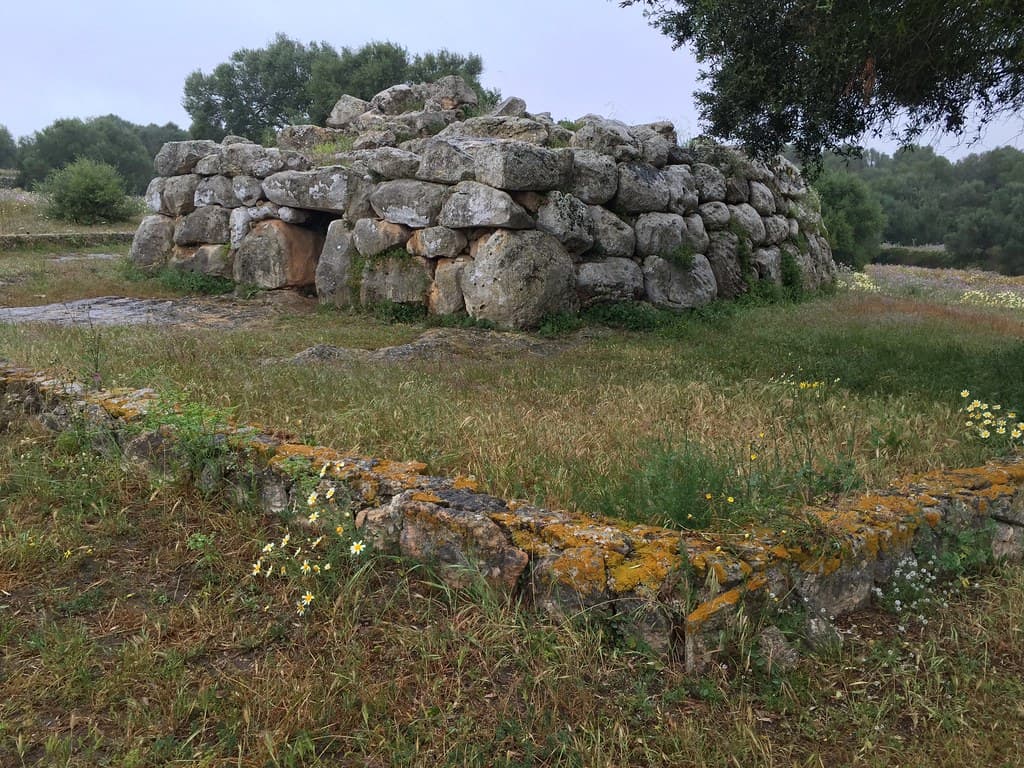
Image of Naveta de Rafal Rubí. Image source
Visit essentials
A quick read before you go
- Duration
- Roughly 15-30 minutes is typical, given the compact size of the two structures and their close…
- Access
- From Maó, take the Me-1 highway toward Alaior; at kilometer marker 6.6, a signposted rural path…
Overview
The Naveta de Rafal Rubí is not one monument but two: Bronze Age funerary structures close enough to touch in a Menorcan field beside the Me-1 highway between Maó and Alaior. Each is a horseshoe-shaped chamber of massive, unmortared stone blocks, its long silhouette compared to an overturned boat's hull—the feature that gives navetas their name.
Built at the hinge between the pre-Talayotic and Talayotic periods, they served as collective ossuaries, receiving bones after the flesh had been removed elsewhere. Twentieth-century archaeologists recovered human remains, Bronze Age pottery, and small bronze grave goods. One skull bore signs of trepanation, a detail that still raises more questions than it answers.
The pair now belongs to the wider 'Talayotic Menorca' UNESCO World Heritage inscription, visited on quiet Sunday mornings by travelers tracing the island's prehistoric landscape rather than by any surviving devotional community.
Why this place is sacred
What makes Rafal Rubí notable is not a single striking feature but a doubling: two nearly identical funerary monuments raised almost side by side, at a moment when Menorcan communities were shifting from pre-Talayotic to Talayotic ways of building and burying. Both structures share the same essential form — a horseshoe-shaped cyclopean chamber with a narrow, slab-sealed entrance leading into a two-level interior — but differ in their state of preservation and in what excavation found inside them.
The northern naveta, more collapsed at its upper courses, yielded bone remains from both interior levels. The southern naveta, better preserved with an intact monolithic threshold and lintel, held human remains largely in its upper chamber alongside Bronze Age ceramics and bronze objects — a biconic pendant and a fragment of a torque — that most likely accompanied the dead as grave goods.
The presence of a trepanned skull among the remains points to a Bronze Age medical or ritual practice that current sources do not fully explain. What can be said with more confidence is the function: these were secondary collective tombs, receiving bones rather than fresh burials, in keeping with practices documented at other Menorcan navetas such as Naveta des Tudons.
Collective secondary burial — a repository for the bones of multiple individuals from a Talayotic-era community, deposited after initial treatment of the body elsewhere.
Built in the second half of the second millennium BCE, the navetas remained in funerary use through the Talayotic period before falling out of use; some later material found nearby suggests activity in the area continued into a much later period, but the structures themselves are not documented as having been repurposed.
Both were formally protected as Bien de Interés Cultural in the twentieth century (northern naveta, 1931; southern naveta, 1966), excavated and restored in the 1960s and in 1977, and in 2023 folded into the broader 'Talayotic Menorca' UNESCO World Heritage listing.
Experience and orientation
There is no visitor center at Rafal Rubí, no ticket booth, no crowd. The approach is a rural path, roughly a hundred meters long, leading off a marked turnoff from the Me-1 highway.
What comes into view first is scale and proximity: two long, low stone forms, walls of large unworked blocks laid without mortar, standing close enough to each other that a visitor's first instinct is often to look for a reason — a shared ritual logic, a family plot, a construction sequence — that the stones themselves do not explain.
The northern structure shows its age more openly, its upper courses fallen inward; the southern one holds its apsidal form and threshold with more clarity, giving a better sense of the completed shape both were meant to have. Walking the perimeter of each in turn, the visitor can trace the horseshoe plan and the narrow, deliberately restricted entrance that would have required stooping or careful maneuvering to pass through — a threshold built for bones and rites, not daily movement.
The field around the navetas is open and exposed, with the sound of intermittent traffic from the nearby highway, a reminder that this monumental architecture for the dead was raised without any particular isolation from the routes and rhythms of the living landscape around it.
Park along the rural access road near the Me-1 km 6.6 turnoff (no dedicated parking exists) and walk the signposted path roughly 100 meters to the site; the two navetas stand within a few meters of each other in an open field, viewable from the perimeter.
Context and lineage
The navetas belong to a building tradition unique to Menorca among the Balearic Islands, most famously exemplified by the larger, better-preserved Naveta des Tudons; Rafal Rubí represents a smaller-scale, paired variant of the same collective-tomb architecture.
Guillermo (Guillem) Rosselló Bordoy
Archaeologist who directed excavation of the southern naveta in the 1960s and the northern naveta's excavation and restoration in 1977, establishing the core chronology and interpretation of the site.
María Luisa (Maria Lluïsa) Serra Belabre
Archaeologist who co-directed the 1960s excavation of the southern naveta alongside Rosselló Bordoy.
Consell Insular de Menorca
Island heritage authority that maintains the site's official documentation and public access information as part of Menorca's archaeological heritage network.
UNESCO World Heritage Committee
Inscribed the site in 2023 as one of 32 prehistoric locations comprising the 'Talayotic Menorca' World Heritage listing, formally recognizing its place within the island's Bronze Age funerary landscape.
Traditions and practice
The original practice was secondary collective burial: once bodies had been defleshed elsewhere, bones were carried through the narrow perforated entrance and laid within the two-level interior chamber, joining those of others from the same community over time.
No contemporary ceremonial use is documented. The living practice today is heritage stewardship and interpretation — island authorities maintain the site's protected status and public access, and it functions within Menorca's broader Talayotic heritage trail.
Walk the two structures in sequence rather than treating them as a single stop: circle the more intact southern naveta first to register the complete horseshoe form and threshold, then move to the northern structure and notice what collapse has taken away. Pause at the narrow entrance slabs and consider the deliberate smallness of the opening against the size of the chamber behind it — architecture built for the dead's passage, not the living's.
Talayotic Culture
HistoricalThe navetas are a defining example of the collective funerary architecture unique to Menorca's Talayotic culture, built to house the bones of a community's dead across generations.
Secondary collective burial: bones deposited within a two-level chamber after initial treatment of the body elsewhere, accessed through a narrow, slab-sealed entrance.
Heritage stewardship and archaeological research
ActiveOngoing protection, interpretation, and UNESCO-level recognition keep Rafal Rubí legible and accessible as part of Menorca's prehistoric landscape.
Formal heritage protection (Bien de Interés Cultural status), periodic excavation and restoration, and inclusion in the 'Talayotic Menorca' UNESCO World Heritage Site inscribed in 2023.
Perspectives and open questions
Because no continuous tradition survives to interpret Rafal Rubí from within, understanding of the site rests almost entirely on archaeological reconstruction, leaving real gaps alongside its firmer conclusions.
Scholarly perspective
Archaeologists agree the two navetas were built at the transition from pre-Talayotic to Talayotic culture, in the second half of the second millennium BCE, using cyclopean stone technique, and that both functioned as collective secondary tombs holding commingled human remains alongside Bronze Age ceramics and bronze grave goods.
Open questions
The exact number of individuals interred in each structure is not settled across sources consulted, and the meaning behind the evidence of cranial trepanation in one skull — medical intervention, ritual practice, or something else — remains an open question. Why the two navetas were built so close together, rather than at a greater remove as seen elsewhere on the island, is likewise unresolved.
Plan your visit
Access and arrival
From Maó, take the Me-1 highway toward Alaior; at kilometer marker 6.6, a signposted rural path branches off and leads about 100 meters to the site entrance. No dedicated parking exists, so vehicles are left along the rural access road.
No information on mobile phone signal at the site was available at time of writing; check with the Consell Insular de Menorca for current access details, as the site is close to a main road and signal is likely but not confirmed in sources reviewed.
Respectful visit
No specific attire is required or expected; ordinary outdoor clothing suitable for a rural field visit is sufficient.
No restrictions on photography were found in available sources; the site is freely photographed by visitors and featured openly in travel guides.
Not applicable — there is no tradition of offerings at this site.
Visitors should not climb on or remove stones from either structure, and should keep to the signposted path given the absence of staff on site.
As with any unstaffed archaeological monument, avoid climbing on the stonework or entering collapsed sections, both for personal safety and to avoid accelerating erosion of a structure already partially fallen.
Location
Map loads as you approach this section.
Pilgrim reflections
A portrait of encounter, not a score
Pilgrims describe what they felt, how present they could become, and whether the place would shape a journey. There are no stars and no ranking of traditions.
No reviewed reflections yet
The first pilgrims can help describe the character of being here.
Share a reflection
Available after an account-backed “Been there.” Every reflection is reviewed before publication.
Nearby sacred places
Explore other sacred places in the region. Proximity does not establish access or travel time; check each place’s guidance.


References
Sources consulted for this page. Source categories describe the publication, not a guarantee that every claim is verified. Traditional accounts and outside interpretations may differ.
- 01Navetes de Rafal Rubí — Viquipèdia — Wikipedia contributorsencyclopediaCoordinates, dimensions, excavation dates and directors, architectural description, access details.
- 02Navetas de Rafal Rubí — Wikipedia, la enciclopedia libre — Wikipedia contributorsencyclopediaConfirms construction period, excavation history, grave goods (bronze pendant and torque fragment), UNESCO 2023 inscription.
- 03Arqueologia - Rafal Rubí — Consell Insular de Menorca (menorca.org)officialOfficial heritage tourism authority description of site as pre-talayotic/talayotic transitional collective tomb; secondary funerary use noted.
- 04Rafal Rubí – Burial Vessels — Menorca DiferenteguideDescribes horseshoe-shaped cyclopean construction, north/south naveta distinction, purpose as collective pantheons for deceased.
- 05Navetas de Rafal Rubí: historia, acceso y curiosidades del yacimiento arqueológico de Menorca — Menorca al díanewsVisiting hours (Sundays 9am-9pm May-Sept, 9am-6pm Oct-Apr), free access, directions from Me-1 highway km 6.6.
- 06Talaiotic sites of Menorca, Spain — Time Travel TurtleguideGeneral context on Talayotic culture sites across Menorca, UNESCO World Heritage listing context.
Share a photo
Help visitors recognize Naveta de Rafal Rubí. Every submission is reviewed before publication.