Sa Cudia Cremada
A Talayotic settlement with an excavated sanctuary at its heart
Understand sacred places, explore living traditions, and learn how to engage respectfully with Pilgrim Map.
Access has not been verified. Check current local guidance before planning a visit.
Maó, Balearic Islands, Spain
Read the sources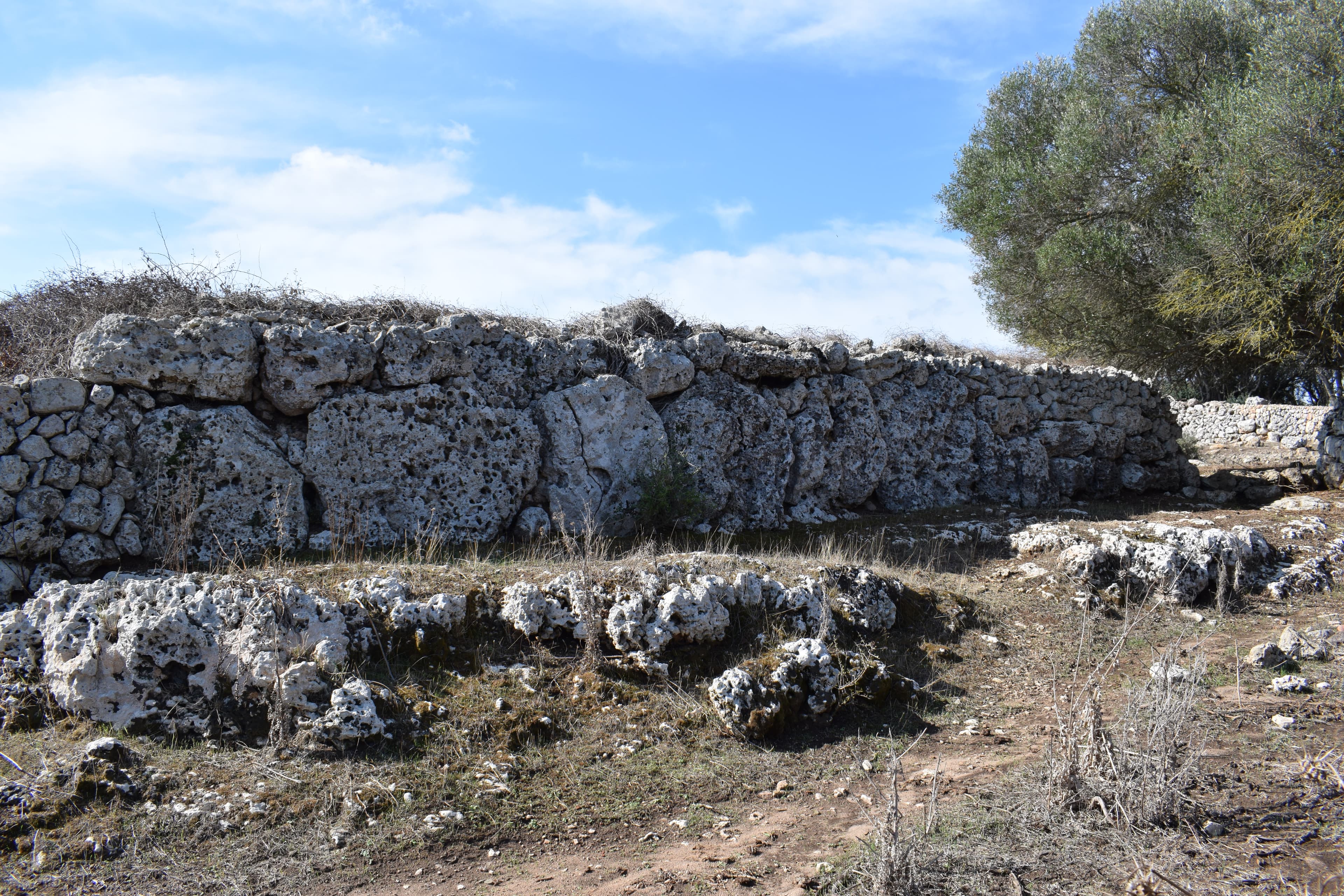
Image of Sa Cudia Cremada. Image source · CC BY-SA 4.0
Visit essentials
A quick read before you go
- Duration
- No official duration is published; allow enough time to understand the settlement before…
- Access
- Use current custodial directions and remain on the permitted route.
Overview
Sa Cudia Cremada preserves the varied architecture of a Menorcan community rather than a single isolated sacred stone. Two talayots rise within a wider settlement that also includes a taula enclosure, rock-cut hypogea, cisterns, storage features, and dry-stone construction. The official excavation project has concentrated on the taula enclosure, where architectural and faunal evidence supports interpretation as a sanctuary.
Excavators documented two altar features and deposits that illuminate the preparation and consumption of animals in a ritual setting. The evidence is strong enough to describe ceremonial activity, but not to name a specific god or reproduce a full liturgy. Popular associations between Menorcan taulas and Tanit, bull worship, or other cults should not be transferred to Sa Cudia Cremada without direct site evidence.
The sanctuary's interior was excavated through the 2015-2020 project, and the official synthesis describes intentional abandonment late in the third century BCE. Research and conservation continue to reshape understanding. Today the site is archaeological heritage on rural land, with no documented continuation of ancient Talayotic worship.
Why this place is sacred
The taula enclosure is only one part of Sa Cudia Cremada, yet it offers the clearest evidence for ritual life. Its interior organization, altar features, pottery, ash, and animal remains allow archaeologists to move beyond calling every monumental structure sacred.
Even here, evidence has limits. Animal consumption may be described as ritual because of context and deposition, but the participants' words, divine recipients, calendar, and precise sequence are not known. The site's significance becomes clearer when interpretation remains at that level instead of borrowing a complete religion from regional analogies.
A Talayotic settlement supporting domestic, communal, storage, water-management, funerary, and monumental activity, with a taula enclosure functioning as a sanctuary.
The settlement developed over the Talayotic and later prehistoric periods. Excavation indicates intentional abandonment of the sanctuary late in the third century BCE, while later material documents subsequent activity in the broader area. Modern fieldwork from 2015 onward has excavated, conserved, and reinterpreted the site.
Experience and orientation
The most responsible visit begins with the whole-site identity. The talayots, hypogea, cisterns, and dry-stone features establish a community landscape before the taula enclosure comes into focus. At the sanctuary, observe the arrangement of standing stone, walls, and excavated interior without treating every depression or loose object as ritual evidence.
Research remains active, and areas visible in photographs or earlier reports may not be open. Do not cross a fence, livestock passage, rope, or excavation boundary. A contemplative response can remain grounded in careful observation and the official interpretation.
The site lies on rural land between Mao and Sant Climent. Use current directions from Agencia Menorca Talaiotica and distinguish the settlement boundary from surrounding farms and roads.
Context and lineage
No named founder or traditional foundation account survives. Archaeology reconstructs a community that built and reused monumental structures over centuries. The sanctuary's later intentional abandonment is inferred from the excavated sequence rather than remembered in a surviving narrative.
The ancient lineage is Talayotic Culture. Contemporary archaeology and conservation are stewardship activities, not a living continuation of the settlement's former religious practice.
Sa Cudia Cremada excavation team
Archaeological project responsible for excavation and interpretation of the taula enclosure from 2015 onward
Agencia Menorca Talaiotica
Heritage authority supporting research, conservation, and public interpretation
Traditions and practice
Faunal remains, ash, pottery, and altar architecture are interpreted together as evidence of ritual meals or offerings. Statements about particular gods or a universal taula cult exceed the site-specific record.
Current activity consists of archaeological research, conservation, and volunteer stewardship carried out under organized projects. Visitors should not treat participation in heritage work as equivalent to ancient ritual practice.
Observe how the sanctuary is bounded within the settlement and use the official excavation account to connect altar features with the recovered deposits.
Talayotic Culture
HistoricalThe settlement preserves an excavated taula sanctuary within a broader Talayotic community landscape.
Ritual animal preparation and consumption are inferred from altar, faunal, ash, and pottery contexts; details beyond that evidence remain unknown.
Perspectives and open questions
Sa Cudia Cremada requires two scales of interpretation: a broad settlement and a specific sanctuary within it. The page attributes ritual claims to the excavated enclosure and leaves the rest of the site open to its own archaeological functions.
Scholarly perspective
Official excavation supports sanctuary use, altar features, ritual animal consumption, and an intentional abandonment episode. Dating, the exact meaning of the taula, later reuse, and the identity of any divine focus remain subjects of interpretation.
Living and traditional perspectives
No living custodial community is documented as transmitting the ancient rites. Talayotic Culture names the archaeological society whose material remains are studied here, not a modern religion represented by present practitioners.
Alternative interpretations
Regional theories involving Tanit, Mars Balearicus, bull cults, or fertility religion are not presented as Sa Cudia Cremada facts unless direct excavation evidence supports them.
Open questions
The sanctuary's divine focus, spoken ritual, participant roles, calendar, full sacrificial sequence, and relationship to every settlement feature remain unknown.
Plan your visit
Access and arrival
Use current custodial directions and remain on the permitted route. Mobile coverage, emergency access, parking, and mobility accommodations were not verified.
Use established services in Mao or elsewhere on Menorca; no visitor accommodation is associated with the archaeological site.
Respectful visit
Wear footwear and weather protection suitable for uneven rural ground; no ritual clothing is appropriate or required.
Personal exterior photography should remain within current access boundaries. Confirm drone, professional, and excavation-area rules with the custodian.
No living offering practice is documented. Leave no objects or substances in the sanctuary or elsewhere on the site.
Excavation closures, fences, landowner boundaries, livestock management, and heritage-authority directions take precedence.
Do not perform an invented ceremony, light fire, pour liquid, leave food or objects, touch excavated surfaces, or enter active work areas.
Location
Map loads as you approach this section.
Pilgrim reflections
A portrait of encounter, not a score
Pilgrims describe what they felt, how present they could become, and whether the place would shape a journey. There are no stars and no ranking of traditions.
No reviewed reflections yet
The first pilgrims can help describe the character of being here.
Share a reflection
Available after an account-backed “Been there.” Every reflection is reviewed before publication.
Nearby sacred places
Explore other sacred places in the region. Proximity does not establish access or travel time; check each place’s guidance.


References
Sources consulted for this page. Source categories describe the publication, not a guarantee that every claim is verified. Traditional accounts and outside interpretations may differ.
- 01Sa Cudia Cremada talayotic settlement — Menorca Talaiòtica — Agència Menorca TalaiòticaofficialOfficial heritage agency page for the site, part of the Menorca Talayótica UNESCO candidature network.
- 02Excavation project at the talayotic site of Sa Cudia Cremada — Menorca Talaiòtica — Agència Menorca TalaiòticaofficialOfficial page describing the ongoing excavation project at the taula enclosure.
- 03Proyecto de excavacion en el poblado talayotico de Sa Cudia Cremada — Agencia Menorca TalaioticaofficialCurrent official synthesis of full interior excavation, sanctuary architecture, double altar, faunal ritual evidence, late-third-century BCE abandonment, and the newer research project; accessed 2026-09-04.
- 04Decision 45 COM 8B.24: Prehistoric Sites of Talayotic Menorca — UNESCO World Heritage CommitteeofficialUNESCO's 2023 inscription decision and official property name; supports serial-property status but not sacred function by itself.
- 05Sa Cudia Cremada — Wikipedia — Wikipedia contributorsSource contextProvides coordinates, structure descriptions (talayots, hypogea, cyclopean wall), dating context, and UNESCO candidature status.
- 06Unearthing an Iron Age Sanctuary in the Mediterranean — Popular ArchaeologySource contextDescribes the Sa Cudia Cremada Field School, its findings (talayots, hypogeum, storage pits, imported Punic/Greek/Iberian/Roman artifacts), and interpretive material on possible deities (Tanit, Mars Balearicus) associated with Talayotic taula sanctuaries generally.
- 07Un nou projecte de voluntariat impulsa la conservació del poblat talaiòtic de Sa Cudia Cremada — Fora Vila VerdSource contextConfirms site location between Maó and Sant Climent, the Agència Menorca Talaiòtica and Voluntariat de Camins i Jaciments de Menorca conservation project, structures present (two talayots, taula enclosure, hypogea, cisterns, dry-stone structures), and that intensive research took place 2015-2021.
- 08Resultats preliminars de les excavacions al recinte de taula de Sa Cudia Cremada — Montserrat Anglada, Cristina Bravo, Irene Riudavets (Sa Cudia Cremada Field School)academicAcademic preliminary-results paper on excavations at the taula enclosure by the field school's affiliated researchers; abstract/title referenced via search, not fully fetched.
Share a photo
Help visitors recognize Sa Cudia Cremada. Every submission is reviewed before publication.