Biniai Nou Hypogea
Menorca's oldest known graves, cut into rock above Maó
Understand sacred places, explore living traditions, and learn how to engage respectfully with Pilgrim Map.
Access has not been verified. Check current local guidance before planning a visit.
Maó, Balearic Islands, Spain
Read the sources
Visit essentials
A quick read before you go
- Access
- The site is located near kilometer 5 of the Me-1 road between Mahón and Ciutadella, via a turn…
- Etiquette
- Treat the site as a grave, not a ruin to climb on, and confirm access before arriving.
Overview
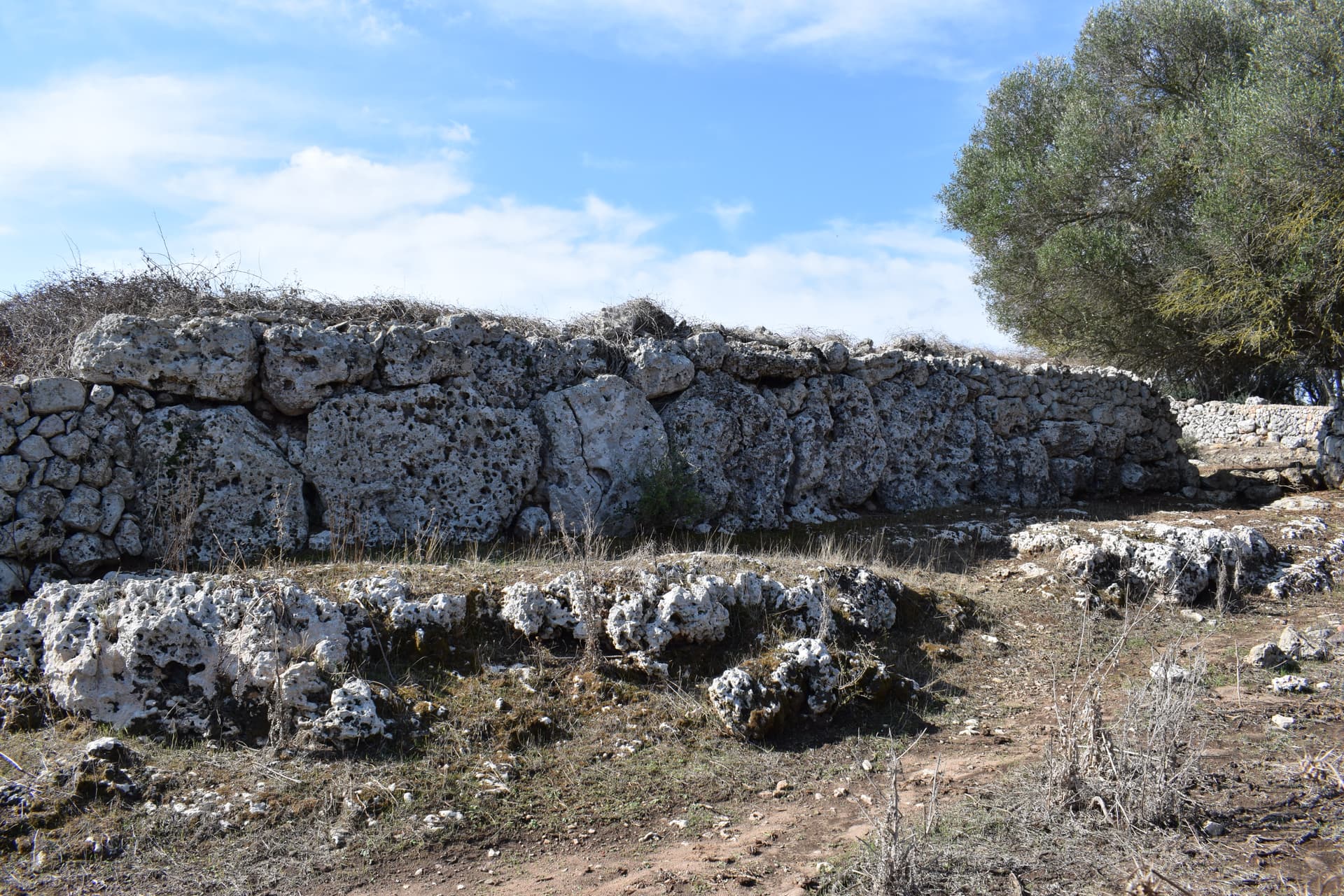
Biniai Nou consists of two hypogea — collective tombs with a chamber excavated directly into the limestone and an entrance corridor built up from vertical megalithic slabs. Radiocarbon testing on bone recovered from the site produced the oldest confirmed date for human presence on Menorca, placing a Chalcolithic community here centuries before the island's classic Talayotic towers and taulas were raised.
One chamber held the remains of at least 81 individuals in primary burials, alongside ceramic vessels, bone awls, and worked radiolarite. The site sits within the broader Talayotic Menorca UNESCO World Heritage landscape, inscribed in 2023, though it is reached today across private farmland rather than through a managed visitor circuit.
Why this place is sacred
Nothing is known of what the builders of Biniai Nou believed about death or the afterlife; no text or oral tradition survives from a pre-literate Chalcolithic community. What can be said comes from the ground itself — the chamber form, the grave goods, the sheer number of bodies interred over time in the smaller of the two tombs.
Later Menorcans returned to Monument 2 for burial many centuries afterward, in the Postalayotic period (roughly 550-123 BC), suggesting the site retained some standing as a place for the dead long after its original builders were gone.
Collective funerary chamber for a Chalcolithic community, the earliest known permanent settlers on Menorca.
Reused for burial in the later Postalayotic period; in more recent centuries one chamber was pressed into service as livestock shelter, which damaged its contents before archaeological excavation.
Experience and orientation
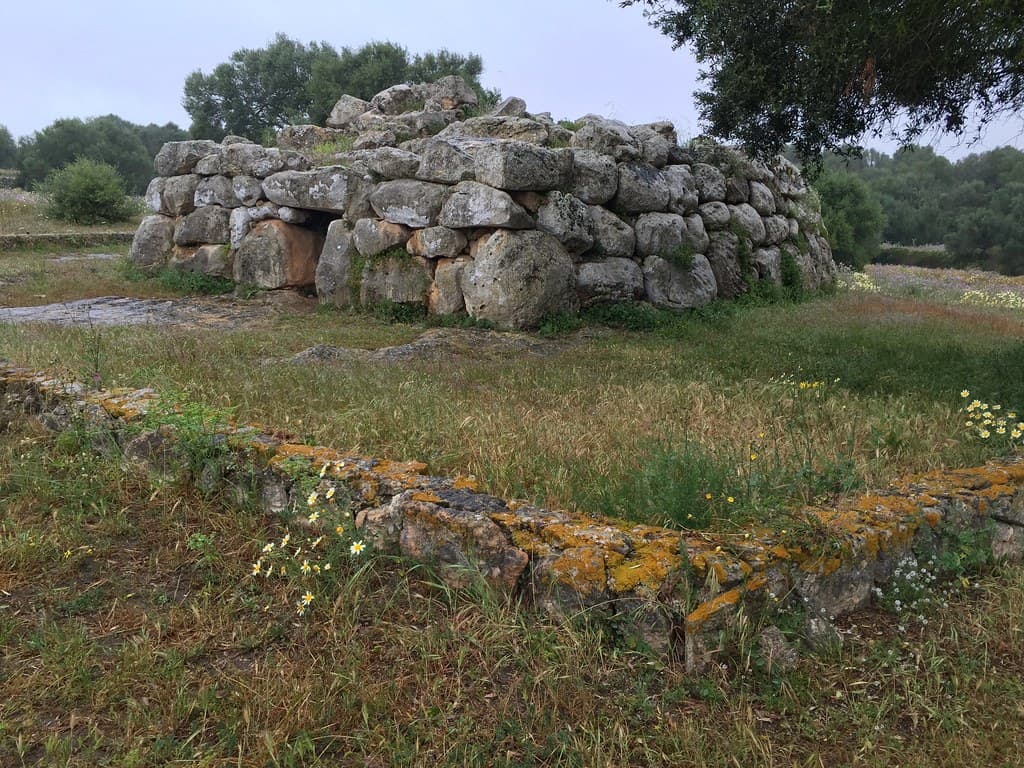
The two hypogea are easy to walk past without recognizing what they are: shallow openings in the bedrock, their standing-slab facades softened by five thousand years of weather. Ducking into the corridor of Monument 1 means moving through a space clearly not built for standing upright — it was made for the dead, not the living. Inside, the oval chamber and its stone bench are the only architectural gestures beyond the bare requirement of enclosure.
Monument 2's circular chamber, its roof rebuilt after an ancient collapse, carries a visible seam between original rock-cut wall and modern restoration — a reminder that what stands today is itself a conserved artifact, not an untouched relic.
Both hypogea face outward from the same low outcrop, roughly fifty meters apart, oriented toward the surrounding farmland rather than any confirmed celestial target.
Context and lineage
No continuous lineage connects the Chalcolithic builders to any later community; the site's second known use, in the Postalayotic period, appears to be a much later reoccupation of an existing tomb rather than a continuation of the same tradition.
Lluís Plantalamor
Archaeologist, Museum of Menorca — co-led the excavation team that uncovered and dated the Biniai Nou hypogea
Josep Marquès
Archaeologist, Museum of Menorca — co-led the excavation alongside Plantalamor
Traditions and practice
The original practice was collective primary burial — bodies placed directly in the chamber, accompanied by ceramic vessels, bone awls, and worked radiolarite, rather than cremation or secondary reburial.
Ongoing engagement with the site is archaeological and conservational: study of the recovered remains and grave goods, and physical restoration of the collapsed chamber roof in Monument 2.
Move slowly at the threshold of each chamber before entering. Notice the transition from open farmland light to the enclosed dark of the corridor, and the difference in temperature and sound once inside — these are the same thresholds the original builders shaped the space to create.
Talayotic Culture
HistoricalBiniai Nou predates the classic Talayotic period but is grouped with Menorca's broader Talayotic-era heritage landscape as foundational prehistory; its Chalcolithic burials represent the deep past that preceded the island's Bronze and Iron Age monument-building traditions.
Collective primary burial in a rock-cut chamber with a built megalithic corridor facade; grave goods included ceramic vessels, bone awls, and worked radiolarite.
Archaeological research and heritage conservation
ActiveThe site remains actively studied and legally protected, sitting within the Talayotic Menorca UNESCO World Heritage serial property inscribed in 2023 and under Balearic heritage law.
Excavation, radiocarbon dating, and physical restoration of the collapsed chamber roof in Monument 2, carried out historically by a Museum of Menorca team led by Lluís Plantalamor and Josep Marquès.
Perspectives and open questions
Interpretation of Biniai Nou is almost entirely archaeological rather than contested among traditions, since no surviving belief system claims the site.
Scholarly perspective
Archaeologists treat Biniai Nou as the earliest confirmed evidence of permanent settlement on Menorca, notable for a hybrid construction technique — a bedrock-cut chamber paired with a built megalithic corridor facade — distinct from the larger hypogea of the later Talayotic period proper.
Open questions
Nothing is known of the beliefs, kinship structure, or specific rites of the community that built and used these tombs; the grave goods and skeletal count are the only direct evidence, and no written or oral tradition bridges the gap.
Plan your visit
Access and arrival
The site is located near kilometer 5 of the Me-1 road between Mahón and Ciutadella, via a turn north toward the Biniai Nou farm and roughly 800 meters of track beyond the farm buildings. No public opening hours or ticketing were found; at least one heritage source states that visits require advance arrangement rather than casual walk-up entry.
Mobile signal reliability at the site was not addressed in available sources — Mahón, the nearest town with confirmed services, is roughly 5 kilometers away. No information on emergency access, keyholder contacts, or seasonal closures was available at time of writing; check with the Consell Insular de Menorca / Talayotic Menorca Agency, which manages the wider UNESCO property, for current access arrangements.
Respectful visit
Access crosses private farmland rather than a public reserve; at least one heritage source indicates visits require advance arrangement. Avoid entering or climbing on the restored chamber roof of Monument 2.
Both structures hold human remains in a funerary context; treat the chambers with the restraint due any grave, and avoid disturbing loose stonework.
Location
Map loads as you approach this section.
Pilgrim reflections
A portrait of encounter, not a score
Pilgrims describe what they felt, how present they could become, and whether the place would shape a journey. There are no stars and no ranking of traditions.
No reviewed reflections yet
The first pilgrims can help describe the character of being here.
Share a reflection
Available after an account-backed “Been there.” Every reflection is reviewed before publication.
Nearby sacred places
Explore other sacred places in the region. Proximity does not establish access or travel time; check each place’s guidance.


References
Sources consulted for this page. Source categories describe the publication, not a guarantee that every claim is verified. Traditional accounts and outside interpretations may differ.
- 01Talayotic Menorca — UNESCO World Heritage Centre — UNESCOofficialConfirms 2023 UNESCO World Heritage inscription of Talayotic Menorca as a nine-component serial property spanning Bronze Age to Late Iron Age (1600 BCE-123 BCE); Biniai Nou cited by secondary sources as part of this broader designated landscape, exact component-area membership not independently confirmed on this page.
- 02Biniai Nou hypogea — Wikipedia — Wikipedia contributorsSource contextCoordinates, C14 dating range, chamber descriptions, 2017 UNESCO candidature mention.
- 03Hipogeos de Biniai Nou — Wikipedia (Spanish) — Wikipedia contributorsSource contextNames excavation leads Lluís Plantalamor and Josep Marquès (Museo de Menorca); monument descriptions; grave goods.
- 04Hipogeos de Binai Nou — Baleares Antigua — José Vicente Jiménez RibasSource contextHeritage/archaeology enthusiast site with dated authored article; access directions (Me-1 km 5, arrange visit via email), notes livestock-shelter reuse damaged Monument 1 contents, and later Postalayotic burials (550-123 BC) in Monument 2.
- 05Menorca's 'houses of the dead' reveal these ancient secrets — National Geographic — National GeographicSource contextGeneral context on Menorcan hypogea burial practice and the possible sacred association of the sea with the afterlife among early settlers; does not name Biniai Nou specifically.
- 06Yacimientos arqueológicos del calcolítico: Hipogeos de Biniai Nou, Menorca — Pueblos FantasmasSource contextSecondary heritage-travel blog; corroborates Chalcolithic dating and grave-goods description found in higher-reliability sources; used only for corroboration, not as primary source of new facts.
Share a photo
Help visitors recognize Biniai Nou Hypogea. Every submission is reviewed before publication.