Ta' Ħaġrat Temples
The oldest trefoil temples on Earth, quietly waiting in a Maltese village
Understand sacred places, explore living traditions, and learn how to engage respectfully with Pilgrim Map.
Access has not been verified. Check current local guidance before planning a visit.
Mġarr, Malta
Read the sources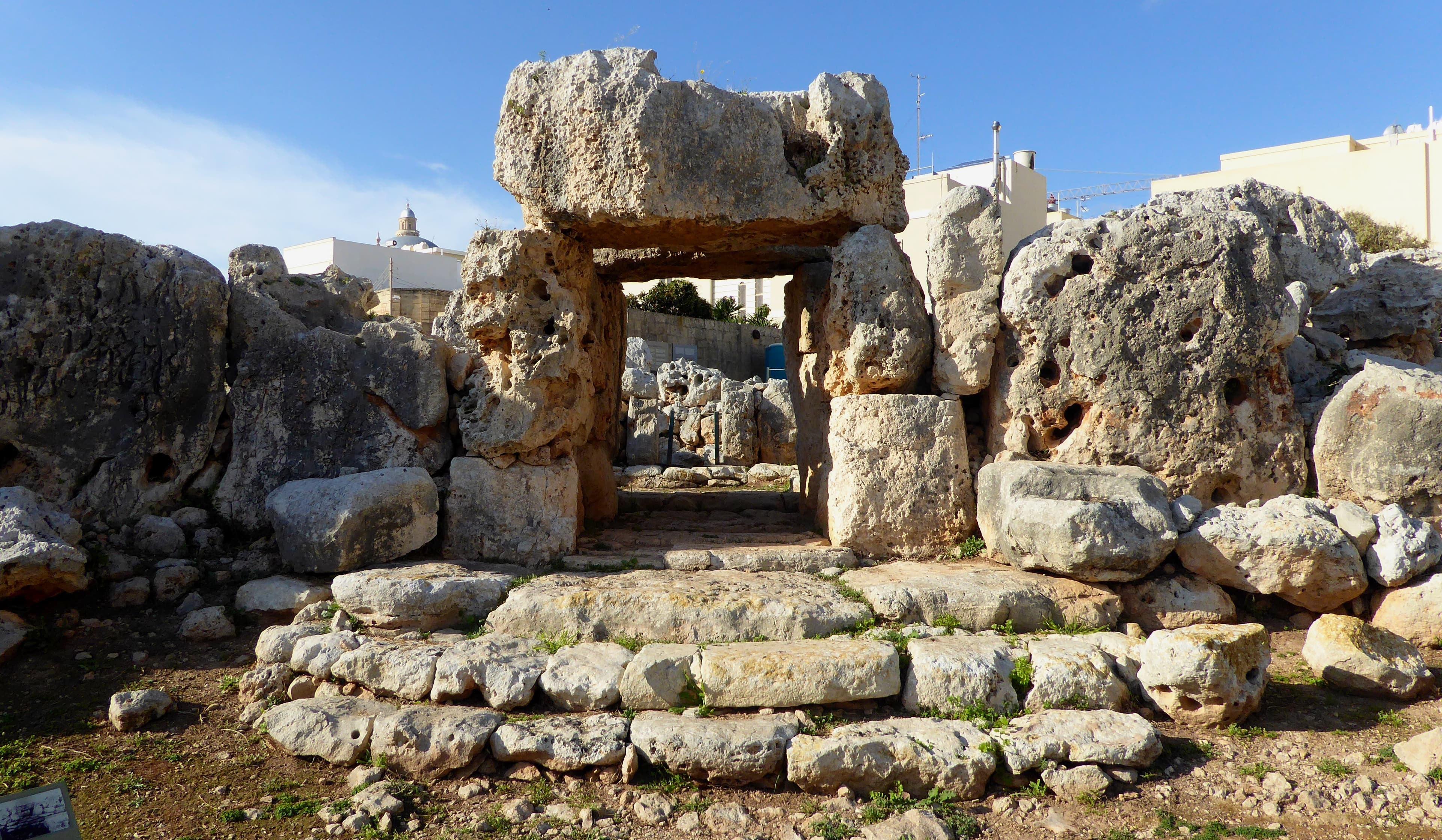
Image of Ta' Ħaġrat Temples. Image source
Visit essentials
A quick read before you go
- Duration
- 30–60 minutes for the site itself.
- Access
- Located on the eastern outskirts of Mġarr village in northwest Malta.
Overview
In Mġarr, a quiet agricultural village in northwest Malta, two megalithic temples stand on ground already recognised as sacred before they were built. The Mġarr-phase settlement beneath Ta' Ħaġrat preceded the monuments by perhaps two centuries, suggesting that generations valued this stretch of coralline limestone without leaving a written explanation.
The larger temple, built during the Ġgantija phase around 3600 to 3200 BC, introduced the vocabulary that would define Maltese sacred architecture: a semi-circular forecourt, monumental threshold, and semi-circular apse chambers arranged in a trefoil plan. Its apses, barely larger than small rooms, organize sacred space at an intimate scale.
A few centuries later, the Saflieni-phase builders added a simpler two-apse temple in the same stone. Together the structures span at least four centuries of continuous sacred use. No pottery or ritual objects found here explain what was venerated or how; the architectural form remains while its meaning is unknown.
Why this place is sacred
What makes Ta' Ħaġrat unusually thin is not one dramatic event but the sheer continuity of the sacred impulse here. Before the stone temples existed, a village occupied this ground — and the archaeological record suggests that village had its own ritual functions. When the builders raised the larger temple in the Ġgantija phase, they were not founding a sacred place so much as formalising one that already existed in the memory of the community.
The site's age places it among the oldest free-standing stone religious structures on Earth. This is not a claim about its being the earliest human sacred space — Göbekli Tepe predates it by millennia — but about a specific architectural ambition: the deliberate construction of permanent enclosed spaces whose geometry organised the relationship between human bodies, the earth, and whatever lay beyond ordinary perception.
The trefoil plan, originating here, would propagate across Malta for a thousand years as a kind of transmitted sacred grammar.
That grammar was eventually forgotten. Around 2500 BC, the Maltese temple-building culture vanished with a speed that remains unexplained. Ta' Ħaġrat does not commemorate a tradition that survived; it preserves the material remains of a way of being in the world that ended absolutely.
This is its particular quality of thinness: not a place where the sacred is alive and practised, but a place where its earliest organised form still stands in the Maltese sun, available for whatever attention a visitor brings.
Ceremonial and communal gathering, possibly connected to ancestor veneration, fertility, or cosmological observation — all remain speculative. The trefoil plan suggests a concern with enclosure and the framing of interior sacred space.
Built in two phases across the Ġgantija and Saflieni periods (c. 3600–3000 BC). After the collapse of Maltese temple culture around 2500 BC, the site fell out of use. It was rediscovered and excavated by Sir Temi Zammit in 1923–1926, re-excavated by John Davies Evans in 1954, and accurately dated by David H. Trump in 1961. Now managed by Heritage Malta as a UNESCO World Heritage Site.
Experience and orientation
Ta' Ħaġrat is a site that rewards stillness and unhurried attention. Arrive in the morning if possible, when the light is low and directional and falls differently on each face of the coralline limestone. The stone itself is worth studying: it is the oldest exposed rock on Malta, pale and porous, its surface holding a granular quality that marks it as something geological rather than manufactured.
Approach the larger temple along the reconstructed threshold path and pause at the entrance. The semi-circular facade is not imposing at this scale — you are not overwhelmed. Instead, you are invited to step through a doorway roughly proportioned to a human body. Inside, the apse chambers close around you. Each one is perhaps the size of a modest living room. The effect is not claustrophobic but enveloping — a sense of being held by the geometry.
Move slowly through each apse in turn. Notice how the floor transitions — the original paving that survives under your feet was laid by hands whose owners had no knowledge of writing or metal. Run your eyes across the fitted stones of the walls and consider the precision of joints made without mortar, without measuring instruments in any modern sense, without any precedent — these builders were inventing this form as they went.
The smaller temple, added later, carries a slightly different quality: more austere, less elaborated. Stand in its two-apse space and compare the feeling with the larger structure. Both were built by people for whom this was not archaeology but living practice. The question of what that practice was — its gestures, its sounds, its purposes — is not answerable, and that uncertainty is itself part of what the site offers.
Maximum 15 visitors at a time. The smaller scale means the site rarely feels crowded, but the strict visitor limit is for conservation. Allocate 30–60 minutes. The adjacent Skorba Prehistoric Site is 1 km away and makes an excellent companion visit.
Context and lineage
The name Ħaġrat means simply 'stones' in Maltese. No mythology survives for this site specifically, though the giant-builder legends attached to Ġgantija on Gozo may have loosely extended to other Maltese temples in popular imagination. What archaeology reveals is quieter and more significant: beneath the megalithic temples lie traces of a Mġarr-phase settlement dating to c. 3800–3600 BC — meaning this location held social and possibly ritual importance before the stone monuments were conceived.
The decision to build here was not arbitrary. The larger temple was raised during the Ġgantija phase (c. 3600–3200 BC), introducing the trefoil plan that defines Maltese sacred architecture. The smaller temple followed in the Saflieni phase (c. 3300–3000 BC).
The Maltese temple-building tradition (c. 3600–2500 BC) represents one of the most concentrated and architecturally distinctive prehistoric sacred cultures in the world. Ta' Ħaġrat is its earliest surviving datable monument in trefoil form. The tradition ended abruptly around 2500 BC with no surviving descendants.
Traditions and practice
Unknown. No votive deposits, inscriptions, or iconographic objects were recovered from Ta' Ħaġrat that clarify the nature of ceremonies. Pottery found at the site is consistent with use across the Ġgantija and Saflieni phases, suggesting sustained activity, but the form that activity took — its gestures, its calendar, its participants — is not recoverable from the current archaeological record. Parallels with other Maltese temples suggest communal gathering and possibly ancestor-related rites, but this remains inference.
No active religious or spiritual practice at the site. Heritage Malta manages Ta' Ħaġrat for conservation and public access. The broader Maltese megalithic tradition has been adopted by some contemporary goddess-spirituality practitioners who treat the temples as sites of earth-energy awareness and Neolithic feminine divinity, though no specific tradition is attached to Ta' Ħaġrat alone.
Arrive at opening time (10:00) to avoid the full quota of 15 visitors and have the apses to yourself. Move through the forecourt slowly before entering — stand at the threshold and look back toward the landscape the builders also saw. Inside the larger temple, spend time in each apse individually rather than walking through quickly. Sit or crouch to lower yourself to the scale that the space was built for; the apses read differently at body height than standing.
In the smaller temple, notice the comparative austerity — less elaborated, built later, perhaps by people who understood the form deeply enough to strip it back. Before leaving, walk the exterior perimeter and observe how the temple presents itself to the surrounding countryside from different angles. The site is small enough that this takes ten minutes; those ten minutes change the scale of the encounter considerably.
Neolithic Temple Culture
HistoricalTa' Ħaġrat was built and used by a sophisticated Neolithic society whose religious and ritual practices remain largely undeciphered. The complex was preceded by a Mġarr-phase village, suggesting generations of sacred use at the same location.
Presumed ceremonial and ritual gatherings; possibly funerary or communal rites based on parallels with other Maltese temples
Archaeological Heritage
ActivePart of the UNESCO World Heritage 'Megalithic Temples of Malta' inscription; subject of ongoing scholarly study into the origins of Maltese temple culture.
Guided tours, scholarly visits, conservation management by Heritage Malta
Perspectives and open questions
Ta' Ħaġrat sits at the intersection of several interpretive traditions — archaeologists studying the origins of monumental architecture, heritage communities claiming it as national patrimony, and the broader spiritual ecology of those drawn to the deep past.
Scholarly perspective
Ta' Ħaġrat is considered by archaeologists the earliest surviving expression of the trefoil temple plan in Malta, making it foundational to understanding the development of the entire tradition. The pre-temple Mġarr-phase settlement beneath the complex suggests that the site's sacred significance predates its monumental construction. Purpose is generally interpreted as communal and ceremonial rather than residential or economic, though the absence of figurines and cult objects here — unlike at Tarxien or Ħaġar Qim — limits more specific interpretation.
Living and traditional perspectives
The Maltese broadly regard the megalithic temples as the deepest root of national identity and cultural pride. Ta' Ħaġrat, while less visited than the southern sites, shares in this sense of the temples as ancestors — evidence that sophisticated communal life, aesthetic sense, and spiritual aspiration existed on these islands before any historical civilisation reached them.
Alternative interpretations
Within the broader Maltese temple landscape, Ta' Ħaġrat appears in goddess-spirituality literature as part of the archipelago-wide 'Goddess culture' interpretation, wherein the temples are read as evidence of a pre-patriarchal, matrilineal sacred tradition focused on female divinity and earth cycles. No specific claims or alignments are documented for Ta' Ħaġrat beyond this general application.
Open questions
The precise ritual function of the apse chambers; whether the larger and smaller temples were used simultaneously by different groups or sequentially at different moments in the ceremonial calendar; the identity of any beings or forces venerated; why a second, smaller temple was added to an existing complex rather than a new site chosen; and what ultimately ended the tradition around 2500 BC.
Plan your visit
Access and arrival
Located on the eastern outskirts of Mġarr village in northwest Malta. Approximately 1 km from Skorba Prehistoric Site. Accessible by car or by bus from Valletta (routes 44/45 to Mġarr). Combo tickets covering both Ta' Ħaġrat and Skorba are available online via Heritage Malta. Adult admission €3.50.
No accommodation in Mġarr village itself. The nearest hotels are in St Paul's Bay (~7 km) or Valletta (~20 km). The site is convenient as a day trip from either base.
Respectful visit
No dress code requirements. Comfortable, flat walking shoes are advisable on the uneven ancient surfaces.
Photography is permitted throughout the site. No tripods or professional lighting equipment without advance Heritage Malta permission.
The site has no tradition of offerings and no infrastructure for them. This is not the appropriate context.
Do not touch or climb the megalithic stones. Respect the maximum 15-visitor limit. Tickets are online-only; no on-site purchase.
Do not touch or lean on the megalithic stones. The maximum 15-visitor limit is strictly enforced and tickets must be purchased online in advance — they are not available at the site. Arrive on time; your slot is timed.
Location
Map loads as you approach this section.
Pilgrim reflections
A portrait of encounter, not a score
Pilgrims describe what they felt, how present they could become, and whether the place would shape a journey. There are no stars and no ranking of traditions.
No reviewed reflections yet
The first pilgrims can help describe the character of being here.
Share a reflection
Available after an account-backed “Been there.” Every reflection is reviewed before publication.
Nearby sacred places
Explore other sacred places in the region. Proximity does not establish access or travel time; check each place’s guidance.


References
Sources consulted for this page. Source categories describe the publication, not a guarantee that every claim is verified. Traditional accounts and outside interpretations may differ.
- 01Ta' Ħaġrat Temples - Wikipedia — Wikipedia contributorsencyclopediaGood overview of dating, excavation history, and architecture
- 02Ta' Ħaġrat Megalithic Site - Heritage Malta — Heritage MaltaofficialOfficial site manager; visitor info and opening hours
- 03Megalithic Temples of Malta - Wikipedia — Wikipedia contributorsencyclopediaBroader UNESCO World Heritage context for all Maltese temples
- 04Ta' Hagrat Temples in Mġarr - Atlas Obscura — Atlas Obscura contributorsguideUseful visitor context and curatorial notes
- 05Malta Archaeology Periods - Zebbug, Mgarr and Ggantija Phase - Bradshaw Foundation — Bradshaw FoundationacademicAcademic background on Mgarr pottery phase predating the temples
- 06Ta' Hagrat Temples in Mgarr - Maltatina — Maltatina editorialguideGood summary of UNESCO status and architecture
- 07Visiting the Ta' Ħaġrat Temples at Mġarr (Malta) - Malta Uncovered — Malta UncoveredguidePractical visit guide, nearby Skorba mention
- 08Ta' Hagrat Temples - The Brain Chamber — The Brain ChamberguideAdditional architectural and chronological detail
Share a photo
Help visitors recognize Ta' Ħaġrat Temples. Every submission is reviewed before publication.