Hagar Qim
Where stone and sun converge on Malta's southern cliffs — a 5,500-year-old temple that still tracks the solstice
Understand sacred places, explore living traditions, and learn how to engage respectfully with Pilgrim Map.
Access has not been verified. Check current local guidance before planning a visit.
Qrendi, Qrendi, Malta
Read the sources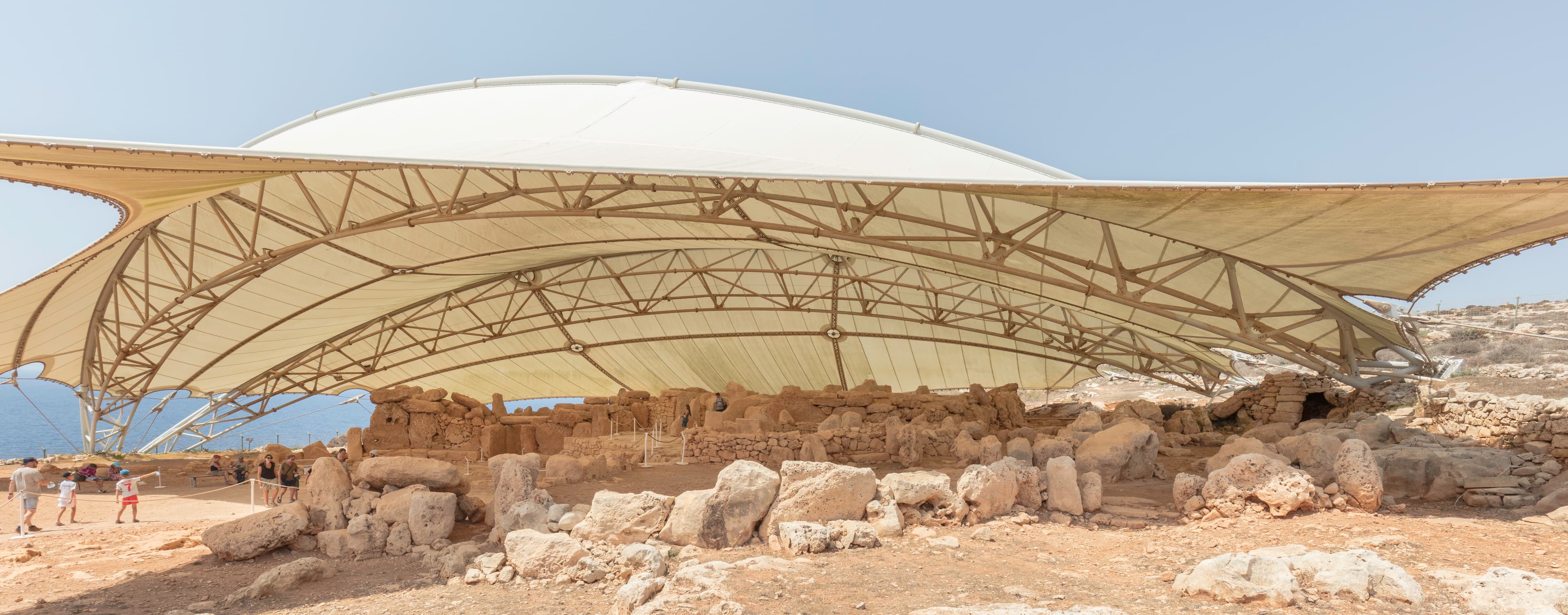
Image of Hagar Qim. Image source
Visit essentials
A quick read before you go
- Duration
- 1.5–2 hours for Ħaġar Qim alone.
- Access
- Located near Qrendi village in southern Malta.
Overview
Ħaġar Qim—Maltese for 'standing stones' or 'worshipping stones'—stands on a limestone plateau above Malta's southern coast, roughly five hundred metres from the sea and facing Filfla and the open horizon. Built about 3600–3200 BCE during the Ġgantija phase, it contains the largest known megalith in a Maltese temple, carved altars, trilithon doorways, and an oracle hole.
At summer-solstice sunrise, light passes through the oval aperture and crosses an inner megalith first as a crescent, then a disc—an intentional alignment still working roughly five and a half thousand years later. Its builders left no writing or surviving mythology. The name's joined senses of standing and worship in Maltese folk memory preserve the site's sacred character across later Christian centuries.
Why this place is sacred
Most archaeological sites require an imaginative effort: you must supply what is missing, project yourself backward across the gap of millennia, try to inhabit a context that is gone. Ħaġar Qim requires less of this effort than most ancient religious sites, because one element of its original sacred programme still functions: at the summer solstice sunrise, light enters through the oracle hole and moves across the inner megalith exactly as intended, five and a half thousand years ago.
This observable phenomenon is not a reconstruction, not a re-enactment, not an interpretation. It is the original thing, still happening. The light enters because the temple was oriented, with care and knowledge, to receive it at this particular moment of the solar year. Watching it, you are experiencing — in a direct, unmediated way — the cosmological intention of a people whose language, religion, and social structure are entirely unknown.
The second quality of thinness at Ħaġar Qim is the setting. The plateau stands above the sea; the horizon is open; the cliffs drop away behind the temple. The Neolithic community that built and maintained this place understood the relationship between the structure and its landscape. This was not an interior urban temple. It faced the sea, the sky, and the rising sun.
It was a threshold place — between the habitable interior of the island and the open water beyond, between the human world and something larger.
The fat lady figurines found here — corpulent, deliberately crafted forms in limestone — add a third quality. They speak to a cosmology in which the body, in its fullness, was sacred. Whether they represent a deity, venerated ancestors, or some other category of sacred person is not settled. But their presence indicates that Ħaġar Qim was not only an astronomical instrument.
It was a place where something closer to the body — fertility, birth, abundance, perhaps death — was also tended.
Ritual and ceremonial centre for the Maltese Neolithic Temple Period culture. The oracle hole alignment with the summer solstice suggests astronomical and calendrical intent. Altars, votive deposits, and figurines indicate sustained fertility veneration and possibly oracle or divination practices.
Active from approximately 3600–3200 BCE until the collapse of Maltese Temple Period civilisation around 2500 BCE. The site was first formally excavated in 1839 by Colonel John Otto Bayer; further excavations in 1885 by A.A. Caruana uncovered the now-famous limestone altar and several statuettes. UNESCO inscription as part of the Megalithic Temples of Malta came in 1980, with the listing extended in 1992.
In 2008, protective fabric canopy shelters were erected over both Ħaġar Qim and adjacent Mnajdra to reduce weathering of the globigerina limestone, which is softer and more vulnerable than the coralline limestone used at Ġgantija.
Experience and orientation
The drive or walk to Ħaġar Qim through the southern Maltese countryside — flat limestone plateau, low stone walls, open sky — gives little warning of what the temple is. The shared visitor centre with Mnajdra is the entry point; the protective canopy shelters that now cover both sites are visible from a distance, and some visitors find them dissonant with the antiquity of what they house.
Step inside the shelter and the adjustment is immediate: the canopy reduces direct sunlight and wind, creating a sheltered microclimate that is, in its own way, appropriate for the quality of attention the site asks.
The façade is the first lesson. The largest megalith in any Maltese temple is here, set into the outer wall, its scale immediately establishing that this is not a structure built for a single person or a small group. Something communal was intended; something that required the effort of many hands over a long time.
Move through the trilithon doorway — the framed opening formed by two upright stones and a horizontal lintel — and notice how the threshold feels. Trilithon construction is a deliberate choice; it frames entry as passage through something, not merely arrival somewhere. The interior divides into a series of curved apses, each with its own character. The altars are set at a height that invites kneeling or stooping — not elevated above the participant, but at their level or below.
The oracle hole is small, easy to miss if you do not know to look for it. It is an oval aperture cut through a stone wall, positioned to receive the summer solstice sunrise beam. Outside that single day, it is simply a hole in a wall. At the solstice, it becomes a calendar, a lens, and — for those who witness it — a direct communication from five and a half millennia ago.
Before leaving, take the 500-metre path to Mnajdra. The two sites are distinct but complementary; experiencing both in a single visit deepens what either can offer alone.
The visitor centre and both Ħaġar Qim and Mnajdra share an entry ticket. Allow 3 hours for both sites combined. Arrive early; summer midday temperatures on the exposed plateau can be extreme. The canopy shelters reduce sun exposure inside the temples but do not shade the approach paths.
Context and lineage
No written tradition from the temple's own time survives. The Maltese name — Ħaġar Qim — preserves the memory of the site as a place of standing stones and worship, but nothing more specific. The builders are known only through the material record they left: the orientation of the structure, the objects deposited within it, the wear on the thresholds.
The construction sequence places Ħaġar Qim in the Ġgantija phase of Maltese prehistory, contemporary with or slightly later than the founding of Ġgantija on Gozo. The choice of the southern plateau was deliberate: the site faces the sea and the horizon, and its oracle hole alignment with the summer solstice sunrise means its builders understood the annual cycle of the sun's rising point along the eastern horizon with sufficient precision to encode it in stone.
The temple was in continuous use for over a millennium, then abandoned — along with all other Maltese temple sites — around 2500 BCE. The reasons for this disappearance are unknown.
Ħaġar Qim is one of seven sites in the UNESCO Megalithic Temples of Malta World Heritage listing (initially inscribed 1980, extended 1992 to include Mnajdra and Skorba). The listing recognises the entire Neolithic Temple Period complex as a unified civilisational achievement spanning both Malta and Gozo. The individual temples vary in date, scale, and orientation, but all share the characteristic trefoil or semicircular apse plan and the use of coralline and globigerina limestone.
Colonel John Otto Bayer
Conducted the first major formal excavation of Ħaġar Qim in 1839, establishing its significance as a prehistoric monument and documenting its principal features
A.A. Caruana
Led the 1885 excavation that uncovered the limestone altar, pitted altar stone, and several figurines ('fat ladies') now held in the National Museum of Archaeology in Valletta
Traditions and practice
The altar configurations, oracle hole, votive deposits, and figurines together describe a ritual life centred on fertility, seasonal observation, and possibly divination. The oracle hole — positioned to receive the solstice sunrise beam — was almost certainly a focal point of ceremony at the height of the solar year. Carved altars at floor level suggest that offerings were placed or burned at specific points within the apse sequence.
The fat lady figurines, found within the temple complex, indicate that representations of the sacred body were present during ritual activity, whether as objects of veneration or as votive gifts.
Heritage Malta hosts a special guided summer solstice sunrise event (around 21–22 June each year) during which visitors observe the oracle hole light phenomenon as intended by the builders. Equinox events are also held. All astronomical events require advance reservation via heritagemalta.mt. General admission is available daily during standard opening hours.
The oracle hole's solstice alignment is the site's most direct connection to its original sacred programme; if you can attend the Heritage Malta solstice event, do. Outside of that event, stand in the apse nearest the oracle hole and note the quality of light: how it falls, where the shadows accumulate, how the stone surfaces catch the sun at different angles throughout the day.
The experience of being inside a Neolithic temple is partly one of being held — these curved walls, this moderate scale — and partly one of being oriented: the building always knows where the sun is.
Allow time at the altars without agenda. The low, horizontal surfaces ask for a different posture than the upright standing of most modern sacred sites. The site does not require a particular spiritual framework; what it offers is scale, age, and a quality of intention that survives five millennia intact.
Neolithic Temple Cult (prehistoric)
HistoricalĦaġar Qim was a major ceremonial site for the Maltese Temple Period, used for more than a millennium. Its oracle hole, altars, votive deposits, and figurines record a sophisticated ritual life that integrated astronomical observation, fertility veneration, and possibly divination.
Seasonal ceremonies aligned with the solar year, altar offerings and burning, oracle consultations (via the oracle hole), possible animal sacrifice, deposition of figurines and votive objects.
Archaeological Heritage and Conservation
ActiveFirst excavated in 1839, Ħaġar Qim has been a focal site for Maltese prehistoric studies for nearly two centuries. The 2008 installation of protective canopy shelters was an internationally recognised conservation intervention.
Archaeological research, ongoing conservation monitoring, public education and interpretation, Heritage Malta visitor management, annual astronomical events, UNESCO World Heritage stewardship.
Perspectives and open questions
Ħaġar Qim has attracted interpretive attention from archaeologists, archaeoastronomers, Goddess spirituality scholars, and cultural heritage institutions. Each perspective illuminates a different facet of a site whose deepest meanings remain genuinely unknown.
Scholarly perspective
Archaeological and archaeoastronomical research has established Ħaġar Qim's core significance: it is a major ritual centre of the Maltese Temple Period, precisely oriented to the summer solstice sunrise, and equipped with altar arrangements and votive deposits consistent with sustained ceremonial use over more than a millennium. The oracle hole alignment is documented and accepted by mainstream scholars.
The figurines — popularly called 'fat ladies' — continue to generate interpretive debate: they may represent a deity, venerated ancestors, ritual officiants, or some other category. Their gender designation as female has itself been contested in recent scholarship.
Living and traditional perspectives
No living indigenous tradition is directly linked to Ħaġar Qim. The Maltese cultural relationship with the site is one of national pride and identity: these temples represent a civilisational achievement that distinguishes Malta as one of the world's earliest centres of monumental religious architecture. The name Ħaġar Qim — embedded in Maltese language across Christian centuries — preserves a memory of sacredness without a theology.
Alternative interpretations
Ħaġar Qim is a significant site in Goddess spirituality traditions, interpreted as a temple of the Great Mother or Earth Goddess. The fat lady figurines, fertility altar configurations, and the general Maltese temple tradition are read within this framework as evidence of a prehistoric matrifocal religion. The clifftop setting above the sea, combined with the solar alignment, is also significant in earth mysteries and archaeoastronomy traditions as evidence of a comprehensive prehistoric sacred geography for the Maltese islands.
Open questions
The oracle ritual: what happened in the oracle hole's chamber at the solstice, who performed it, and what was asked or received. The identity of the deity or power venerated in the apses. The social mechanism by which a small island community organised the sustained labour required for construction and maintenance over twelve centuries. The reason for the civilisation's disappearance around 2500 BCE.
Plan your visit
Access and arrival
Located near Qrendi village in southern Malta. Bus connections from Valletta (bus 201 serves the Qrendi/Ħaġar Qim route; verify current timetable). Car park on site. Shared visitor centre and ticket office with Mnajdra. Both sites are covered by protective canopy shelters erected in 2008. Mobile phone signal is generally available at the visitor centre and car park; coverage may be intermittent on the exposed plateau.
Accommodation is not available in Qrendi village itself; the nearest towns with hotels are Żurrieq (~4 km) and Marsaxlokk (~10 km). Valletta and the main resort areas (St Julian's, Sliema) are approximately 30 minutes by car. Given the site's proximity to Mnajdra, consider basing in the south of Malta for a day that includes both temples and the coastal landscape.
Respectful visit
No formal dress requirement. Sturdy footwear is recommended — the temple floors are uneven limestone. Sun protection is essential in summer.
Photography for personal use is permitted. Do not climb on the structures to obtain a vantage point.
Ħaġar Qim is an archaeological heritage site under scientific management; no offerings are appropriate.
Do not touch the ancient stones — the limestone is vulnerable to skin oils and physical wear. Stay on designated pathways. Do not interfere with the protective canopy structures. Follow instructions from Heritage Malta staff at all times.
The summer solstice event books quickly; Heritage Malta tickets should be secured weeks in advance. The plateau is fully exposed in summer; heat can be debilitating by mid-morning. Bring water and sun protection even for a short visit.
Location
Map loads as you approach this section.
Pilgrim reflections
A portrait of encounter, not a score
Pilgrims describe what they felt, how present they could become, and whether the place would shape a journey. There are no stars and no ranking of traditions.
No reviewed reflections yet
The first pilgrims can help describe the character of being here.
Share a reflection
Available after an account-backed “Been there.” Every reflection is reviewed before publication.
Nearby sacred places
Explore other sacred places in the region. Proximity does not establish access or travel time; check each place’s guidance.


References
Sources consulted for this page. Source categories describe the publication, not a guarantee that every claim is verified. Traditional accounts and outside interpretations may differ.
- 01Ħaġar Qim and Mnajdra Archaeological Park – Heritage Malta — Heritage MaltaofficialOfficial managing authority
- 02The Solstice & Equinox at Ħaġar Qim and Mnajdra — Heritage MaltaofficialOfficial PDF leaflet on astronomical alignments
- 03Ħaġar Qim – Wikipedia — Wikipedia contributorsencyclopediaWell-referenced overview
- 04Hagar Qim: Discover Malta's Most Mysterious Prehistoric Temple — Cultural MaltaguideDetailed cultural context
- 05Hagar Qim – History and Facts — History HitSource contextConcise factual overview
- 06Ħaġar Qim Malta: Complete Guide to the 5,500-Year-Old Temples [2026] — Take Me To Europe ToursguideCurrent practical visitor information
- 07Ħaġar Qim & Mnajdra Temples: Complete Visitor Guide — Sea and StoneguidePractical visitor guide including etiquette
- 08Ħaġar Qim, Malta's ancient wonder — The Lost GuardianguideSpiritual and visitor perspective
Share a photo
Help visitors recognize Hagar Qim. Every submission is reviewed before publication.