Buġibba Temple
A 5,000-year-old temple swallowed by a resort — and still asking its question about the sea
Understand sacred places, explore living traditions, and learn how to engage respectfully with Pilgrim Map.
Access has not been verified. Check current local guidance before planning a visit.
St. Paul's Bay, Malta
Read the sources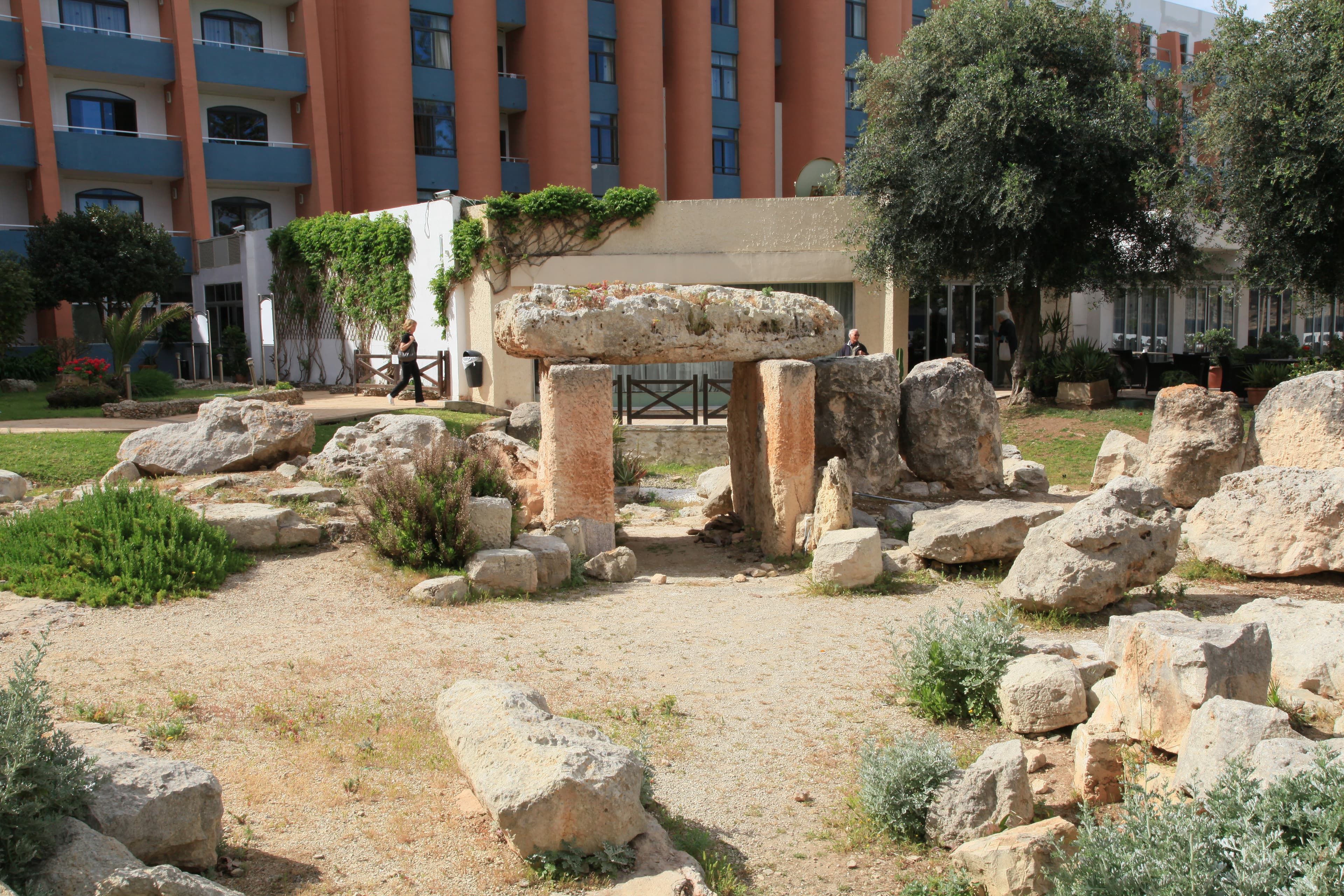
Image of Buġibba Temple. Image source
Visit essentials
A quick read before you go
- Duration
- 15–30 minutes at the site.
- Access
- Located within Dolmen Resort Hotel, Triq Il-Papa Gwanni Pawlu II, St Paul's Bay (Buġibba/Qawra…
Overview
Buġibba Temple survives within the grounds of Dolmen Resort Hotel in St Paul's Bay, entered through the hotel lobby. The partial Tarxien-phase site retains a trilithon entrance, central corridor, three apses, facade fragments, and original flooring; its most important carved blocks are now in the National Museum of Archaeology in Valletta. Its defining find is fish carved on two faces of a stone block—unique among Maltese megalithic temples.
Whether the coastal location was deliberate or the fish meant food, symbol, or deity remains unknown, making this the only place in Neolithic Malta where the sea appears as an explicit sacred image.
Why this place is sacred
Most Maltese megalithic temples sit inland on elevated ground, oriented toward landscapes of ridge and sky. Buġibba sits close to the northern coast. Whether this location was chosen deliberately — for proximity to the sea, to a harbour, to the liminal edge between land and water — is not documented. But the fish-carved stone suggests that the people who built and used this temple were thinking about the sea in ways their contemporaries at inland sites apparently were not.
The carved fish have no surviving parallel in Maltese Neolithic art. Spirals, oculi, pitted surfaces, human figures — these appear across the temple tradition. Fish do not, except here. Popular speculation has ranged from sea-deity worship to a fishing community's thanksgiving offering to Phoenician influence (anachronistic by over a millennium). None of these explanations has archaeological support. The fish remain unanswered.
This is the quality that makes Buġibba thin in the precise sense used here: it is a place where ordinary explanation runs out. The temple is fragmentary; the hotel is real; the fish are carved; the meaning is gone. Standing in the remaining apse chambers — small, roughly made by comparison with the major sites, embedded in a landscape of sun-umbrellas and pool tiles — you encounter a gap in the human record that the site itself refuses to fill.
Ceremonial/ritual use consistent with the Tarxien phase. The fish iconography may indicate a maritime or fishing-community orientation distinct from the inland temple tradition, but this remains speculative.
Built during the Tarxien phase (c. 3150–2500 BC). Discovered 1925 by Themistocles Zammit; excavated 1928 by Zammit and L. J. Upton Way. Key carved stone blocks removed to National Museum of Archaeology, Valletta. Hotel construction in the 20th century partially destroyed or enclosed the site. Now preserved within the grounds of Dolmen Resort Hotel, accessible to the public through the hotel.
Experience and orientation
The experience of Buġibba Temple is shaped entirely by its context. You are not arriving at a managed heritage park with interpretive panels and timed entry. You are walking through a hotel to find a set of ancient stones that the hotel was built around and has, in its own way, been custodian of ever since.
Approach via the hotel reception and ask about access to the temple if signage is unclear. The remains are typically in the rear garden area of the complex. Once there, the stones announce themselves without fanfare. The trilithon entrance — two upright megaliths supporting a lintel — frames the threshold. Step through it and you are in the corridor. The three apse spaces are partial; the facade survives in sections. The floor stones visible underfoot are original Tarxien-phase paving.
The carved fish block is no longer in situ — the original is in the National Museum of Archaeology in Valletta, and any replica or panel at the site depends on current hotel arrangements. But the absence of the carved stone is itself instructive. The most significant object produced at this site now lives in a museum vitrine in the capital. The site retains the structural form but has released its most provocative artifact to the city.
This is the common fate of prehistoric sacred sites that are not purpose-built heritage parks.
Spend fifteen to twenty minutes here. Stand in each apse in turn. Look back through the trilithon toward the sea — or toward where the sea would be, through whatever hotel architecture now intervenes. Consider what it meant to a Neolithic coastal community to build a stone temple and carve fish into one of its altar blocks. Let the question sit without an answer. That is the practice this site makes available.
Access is through Dolmen Resort Hotel grounds — free but through private hotel property. Verify current hotel policy before visiting. No formal guided tours are offered on-site. The original carved fish block is in the National Museum of Archaeology, Valletta; visiting both is worthwhile for context.
Context and lineage
No mythology survives for this site. The fish carvings have generated popular speculation about sea-deity worship, fishing-community rites, and maritime sacred traditions — none of which can be confirmed from the archaeological record. The temple predates Phoenician contact by over a millennium, ruling out Phoenician influence on the iconography. The fish remain the site's defining mystery: an image unique in Maltese Neolithic sacred art, found at the one temple that stands closest to the sea.
Buġibba belongs to the Tarxien phase of the Maltese temple-building tradition (c. 3150–2500 BC) — the final and most elaborate period of Neolithic monumental construction in Malta. Unlike the six sites in the UNESCO inscription cluster, Buġibba was excluded, limiting its official recognition. The fish-carved block is now held in the National Museum of Archaeology, Valletta.
Traditions and practice
Unknown. The altar block and fish-carved stone suggest ritual use consistent with other Tarxien-phase temples — probably communal ceremony, possibly involving offerings — with the additional possibility of a marine or aquatic symbolic dimension not present at other sites.
None. The temple is accessible as an informal archaeological curiosity within hotel grounds. No Heritage Malta management; no guided programme.
Come with the specific intention of encountering the fragmentary. This is not a site for comprehensive understanding but for a single, focused question: what did the sea mean to the people who built this temple? Approach through the trilithon entrance deliberately, pausing at the threshold as you would at any sacred doorway. Stand in each surviving apse. Study the floor paving — you are standing on the same surface they stood on.
Notice how the temple's orientation relates to the coastline: is there a view toward the water, or is the sea now occluded by the hotel? Even this occlusion is part of what Buġibba offers — a meditation on what happens to sacred space when the world builds around it without ceremony. Before leaving, take a mental note to visit the National Museum of Archaeology in Valletta to see the fish-carved stone in person.
The site and the museum are now two halves of the same encounter.
Neolithic Temple Culture (Tarxien Phase)
HistoricalBuilt during the Tarxien phase (c. 3150–2500 BC); the carved fish altar block is unique in Maltese prehistoric art, suggesting a maritime or aquatic dimension to ritual life at this site.
Unknown; presumed ceremonial and ritual based on parallels with other Maltese temples
Archaeological Heritage
ActiveRecognised as part of Malta's prehistoric temple legacy; the fish-decorated stone block is held in the National Museum of Archaeology in Valletta.
Informal tourism through hotel grounds; scholarly awareness
Perspectives and open questions
Buġibba sits in an interpretive gap: too fragmentary for mainstream archaeological significance, too singular in its fish iconography to be dismissed, and too physically awkward to visit for casual heritage tourism.
Scholarly perspective
Archaeologists accept Buġibba as a genuine Tarxien-phase megalithic temple. Its exclusion from the UNESCO inscription cluster reflects its state of preservation and fragmentation rather than its chronological or cultural significance. The fish-carved stone is unique in Maltese prehistoric art and has no parallel. Its meaning remains undetermined in the scholarly literature.
Living and traditional perspectives
No living tradition is attached to this site. Maltese people broadly regard all megalithic temples as national heritage; Buġibba is the least-known of the major examples.
Alternative interpretations
The fish iconography has attracted speculation about sea-god worship, Phoenician influence (chronologically impossible), and connections to aquatic symbolism in broader Mediterranean prehistory. None of these interpretations has archaeological support, but the question of what the fish meant is a genuinely open one.
Open questions
The meaning of the fish carvings; whether the coastal location was sacred by intention or practical coincidence; why a small temple was built here relative to the inland clusters; and what ritual life, if any, distinguished this site from its inland contemporaries.
Plan your visit
Access and arrival
Located within Dolmen Resort Hotel, Triq Il-Papa Gwanni Pawlu II, St Paul's Bay (Buġibba/Qawra border), Malta. Access is free through the hotel grounds. Bus from Valletta to Buġibba (routes 49/51); taxi from Buġibba seafront approximately €5–7. No formal admission charge.
Dolmen Resort Hotel itself (on-site access). Numerous other hotels in St Paul's Bay and Buġibba within walking distance.
Respectful visit
No requirements.
Photography is permitted.
Not applicable.
Do not touch or disturb the remaining stone structures. Respect the hotel grounds and check in with reception if unsure about access areas.
Access is through private hotel grounds — confirm current policy with Dolmen Resort Hotel before visiting. Do not touch or disturb the remaining stone structures. There is no on-site interpretation; basic background reading beforehand makes the visit considerably more meaningful.
Location
Map loads as you approach this section.
Pilgrim reflections
A portrait of encounter, not a score
Pilgrims describe what they felt, how present they could become, and whether the place would shape a journey. There are no stars and no ranking of traditions.
No reviewed reflections yet
The first pilgrims can help describe the character of being here.
Share a reflection
Available after an account-backed “Been there.” Every reflection is reviewed before publication.
Nearby sacred places
Explore other sacred places in the region. Proximity does not establish access or travel time; check each place’s guidance.

References
Sources consulted for this page. Source categories describe the publication, not a guarantee that every claim is verified. Traditional accounts and outside interpretations may differ.
- 01Buġibba Temple - Wikipedia — Wikipedia contributorsencyclopediaMost authoritative single source; covers discovery, excavation, finds, and current status
- 02Buġibba Temple in St. Paul's Bay - Atlas Obscura — Atlas Obscura contributorsguideGood visitor context; confirms hotel grounds location
- 03The Prehistoric Archaeology of the Temples of Malta - Bradshaw Foundation — Bradshaw FoundationacademicGeneral Maltese temple context
- 04Bugibba (Ancient Temple) - The Modern Antiquarian — The Modern AntiquarianacademicSite-focused megalith database entry
- 05Buġibba Temple, Buġibba, Malta - SpottingHistory — SpottingHistoryguideLocation and discovery details
- 06Buġibba Temple: A Glimpse into Malta's Neolithic Past - Evendo — EvendoguideVisitor-oriented; mentions fish carving and astronomical alignment claim
Share a photo
Help visitors recognize Buġibba Temple. Every submission is reviewed before publication.