Mnajdra
Three Neolithic temples whose Lower Temple functions as a precise solar calendar, still accurate after 5,000 years
Understand sacred places, explore living traditions, and learn how to engage respectfully with Pilgrim Map.
Access has not been verified. Check current local guidance before planning a visit.
Qrendi, Qrendi, Malta
Read the sources
Visit essentials
A quick read before you go
- Duration
- 1–1.5 hours at Mnajdra; 3 hours combined with Ħaġar Qim.
- Access
- Accessible via the shared car park and visitor centre with Ħaġar Qim near Qrendi village in…
Overview
Five thousand years ago, builders encoded the solar year in Mnajdra's Lower Temple. Its doorway forms a functioning calendar: sunrise lights the axis from threshold to innermost chamber at the spring and autumn equinoxes, enters from the right at the summer solstice and the left at the winter solstice, marking the year's passage. Peer-reviewed archaeoastronomy confirms the alignment; Heritage Malta documents it and holds annual equinox events where visitors watch a calendar that has worked without interruption for five millennia.
Mnajdra's three temples share an outer precinct. The Upper Temple, built around 3600–3200 BCE, is oldest; the Middle was built or rebuilt later; and the precisely aligned Lower dates to about 3150 BCE. All use the Maltese trefoil plan of curved apses off a central axis, while differing in scale, detail, and astronomical orientation. Five hundred metres down the coastal path from the busier Ħaġar Qim, Mnajdra is quieter and less commercial.
The Lower Temple's solar function, clifftop sea setting, and relative solitude give it a concentrated atmosphere sometimes absent at larger, more visited sites.
Why this place is sacred
What makes Mnajdra different from most prehistoric sites is the quality of the evidence it offers. At most ancient religious places, the sacred character is inferred: we know there were offerings because of residue; we know there was ceremony because of arrangement. At Mnajdra's Lower Temple, the original sacred programme performs itself, twice a year, for anyone who is present at sunrise.
The equinox alignment is not symbolic. The architects of the Lower Temple understood that the sun's rising point shifts throughout the year along the eastern horizon, reaching its extreme north point at the summer solstice and its extreme south point at the winter solstice, with the midpoint — the equinox — occurring twice between them.
They used this knowledge to orient a doorway so that only at the midpoint of the solar year would the rising sun illuminate the full axis of the temple from threshold to rear chamber. At the solstices, the light enters off-axis, as if deliberately displaced.
This is cosmology made into architecture. The temple is a statement about the structure of time, built in stone on a clifftop above the sea. The people who used it would have gathered here — twice a year, or perhaps all four solar turning points — to witness the sun doing exactly what it was supposed to do, because the building told them so.
For contemporary visitors, the experience of the equinox sunrise at Mnajdra is described consistently as one of the most moving heritage experiences in Malta: the combination of the ancient stone, the open sea behind and below, and the light moving exactly along the prescribed axis connects the present moment to a cosmological intention five thousand years old.
The Upper Temple served as a ceremonial and ritual centre from approximately 3600–3200 BCE. The Lower Temple, built later, was designed as a functioning solar calendar marking the equinoxes and solstices within an integrated cosmological and ritual framework.
The site was in active use from approximately 3600 BCE until the collapse of Maltese Neolithic temple culture around 2500 BCE. It received formal archaeological attention from 1840 onward; a site plan was created in 1901. The World Monuments Fund placed Mnajdra on its World Monuments Watch in 2001 following a serious vandalism event in April of that year, in which dozens of stones were damaged. The WMF's involvement supported restoration and enhanced protection measures.
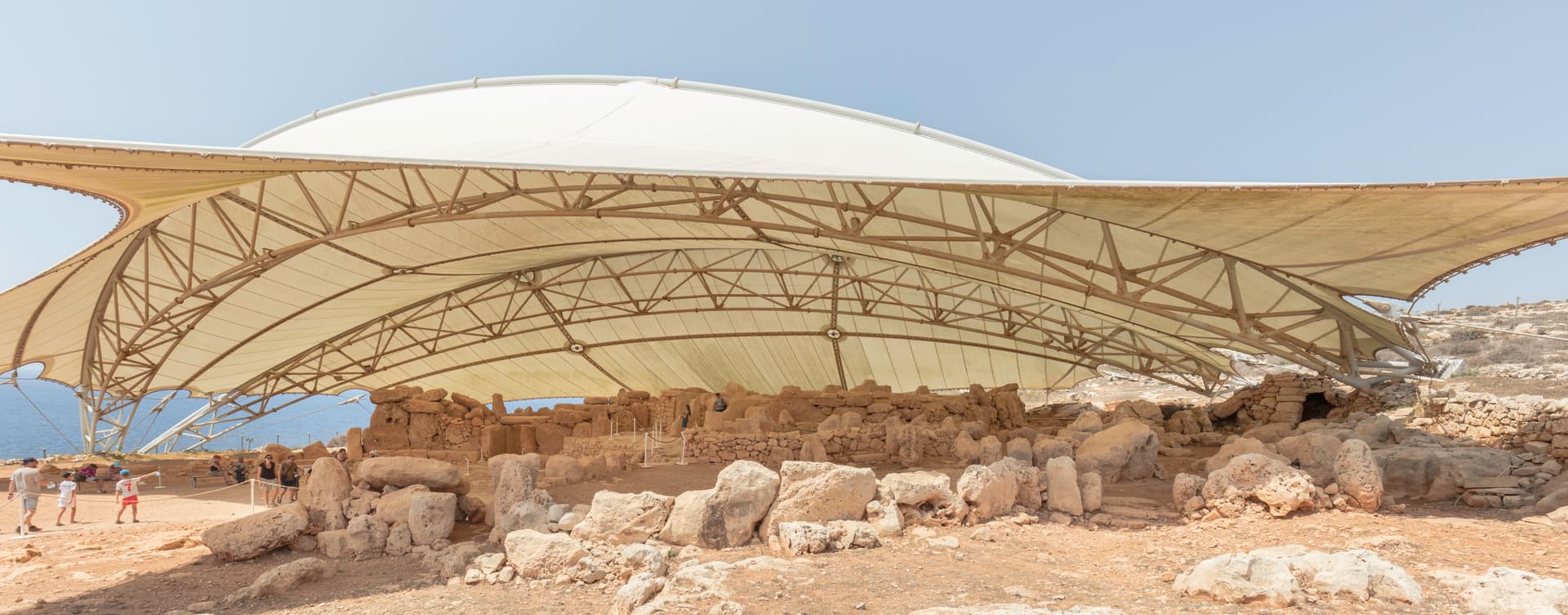
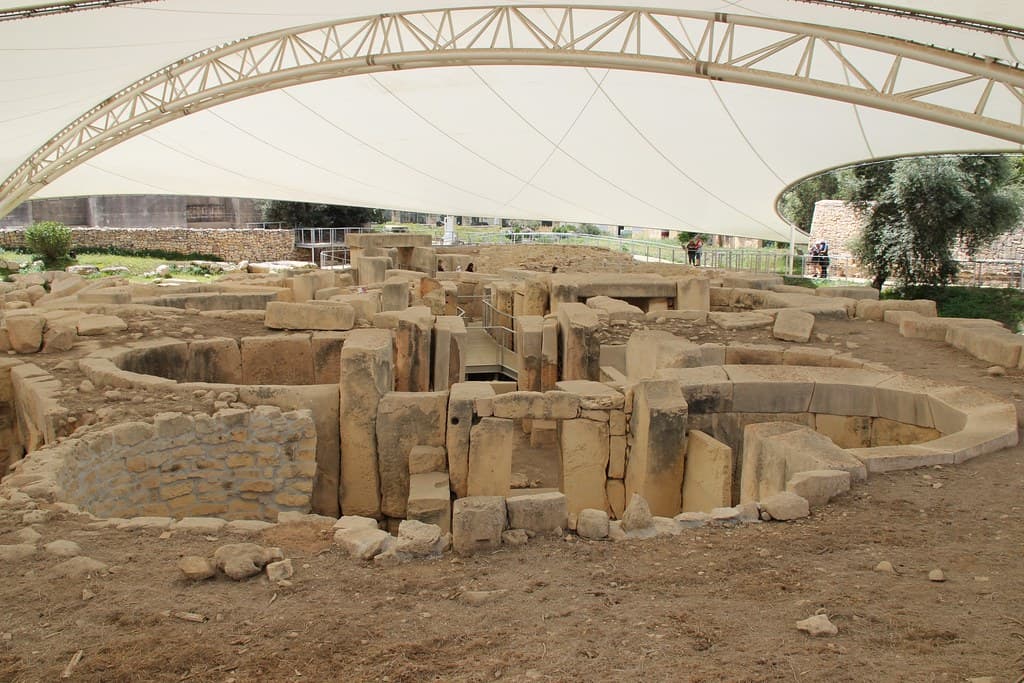
Protective canopy shelters were erected in 2008. UNESCO formally included Mnajdra in the extended Megalithic Temples of Malta World Heritage listing in 1992.
Experience and orientation
The five-hundred-metre walk from the Ħaġar Qim visitor centre to Mnajdra follows a flat path across the plateau, with views over the southern Maltese coastline and, on clear days, the outline of Filfla islet. The walk is brief but useful: it allows the mind to slow, and it establishes the sense of moving through a landscape that was understood, millennia ago, as a unified sacred territory.
Mnajdra sits lower on the plateau than Ħaġar Qim, closer to the cliff edge. The three temples are arranged in a rough row; they share an outer precinct space. The Middle Temple is the most ruinous of the three; the Upper Temple is intact enough to read clearly; the Lower Temple is the most complete and the most architecturally precise.
Enter the Lower Temple slowly. The doorway — the calibrated opening that produces the equinox alignment — is before you. Note its proportions: it is not grand or imposing. It is a precise aperture. The interior consists of two pairs of apses opening off a central corridor, with a niche at the rear. On an ordinary morning, the light inside is diffused and cool.
On the equinox mornings, it arrives directly, filling the axis from front to back in a way that has not changed since the temple was completed around 3150 BCE.
Spend time in the Upper Temple as well. It is older than the Lower by four or five centuries; its apse configuration is less precisely documented but its scale is substantial. Moving between the three structures, you can trace something like an architectural evolution: each temple differently oriented, differently scaled, differently detailed, as if successive generations of builders were working on variations of a problem.
If you are visiting both Mnajdra and Ħaġar Qim in one day, consider visiting Mnajdra first. The walk back, with the Lower Temple's precision still held in mind, allows Ħaġar Qim's oracle hole — a complementary astronomical feature — to register with more depth.
Access via the shared visitor centre with Ħaġar Qim; allow 1–1.5 hours at Mnajdra, 3 hours for both sites combined. The path between the two sites is flat and accessible. Bring water in summer; the coastal path is exposed.
Context and lineage
Mnajdra's name is of uncertain etymology; no indigenous mythology survives from the site's period of use. What is known is derived entirely from archaeology and archaeoastronomy.
The Upper Temple is the oldest structure, contemporary with the earliest phases at Ġgantija on Gozo. The Middle Temple's dating and relationship to the others is debated; it may have been rebuilt. The Lower Temple, the most precisely engineered, dates to approximately 3150 BCE — after the Upper Temple but before the end of the Temple Period.
The decision to build three distinct temples in close proximity, rather than one larger one, is itself unexplained. The three structures differ in orientation, scale, and detail, suggesting they may have served different ritual functions within a single sacred precinct. The Lower Temple's solar precision was almost certainly intentional — the degree of accuracy achieved could not have been accidental — but whether it was primarily calendrical, cosmological, or devotional in purpose remains unknown.
Mnajdra is part of the UNESCO Megalithic Temples of Malta World Heritage listing, formally included in the extended designation of 1992. It is managed by Heritage Malta in conjunction with adjacent Ħaġar Qim. The site's significance in archaeoastronomy has been recognised through peer-reviewed scholarship, including a study published in the Journal of Skyscape Archaeology documenting the equinox alignment.
Unknown Neolithic architects
Designed and oriented the Lower Temple with sufficient astronomical precision to produce the equinox and solstice alignments still documented today
World Monuments Fund
Listed Mnajdra on the World Monuments Watch in 2001 following vandalism of approximately 60 stones in April of that year; supported subsequent restoration and protection measures
Traditions and practice
The Lower Temple's design implies that the equinoxes and solstices were focal points of the ritual calendar: the building was engineered to mark them. Seasonal gatherings — to witness the solstice sunrise enter from one side, the equinox sunrise fill the whole axis — were almost certainly central events in the community's ceremonial year. Votive offerings, animal sacrifice, and communal ceremony consistent with other Maltese Temple Period sites are evidenced by archaeological deposits.
Heritage Malta organises guided sunrise events for the equinoxes (c. 20 March and 22 September) and solstices (c. 21 June and 21 December). These are among the most popular heritage events on Malta and require advance booking via heritagemalta.mt. The March equinox event, in particular, is described by attendees as one of the most precise and moving demonstrations of prehistoric astronomical knowledge in the world. General admission is available daily during standard opening hours.
If you cannot attend the Heritage Malta equinox or solstice events, visit the Lower Temple at sunrise on any clear morning and stand in the doorway. The light enters differently at different times of year; the quality of the early morning illumination inside the chamber changes throughout the solar cycle. Even without the equinox alignment fully active, the orientation of the doorway is perceptible: the building faces east-southeast, and the morning sun enters obliquely.
Move through all three temples in sequence, from Upper to Lower, noting the differences in scale and orientation. In the Middle Temple, observe what the vandalism of 2001 has left: restoration was carefully done but the scars are present. This is a place that has been physically harmed, and has survived.
In the Upper Temple, find a place to sit for several minutes and pay attention to sound — the sea is audible from here, and wind in the stone has a particular quality.
The walk between Mnajdra and Ħaġar Qim is itself part of the experience: the two sites visible to each other across the plateau, the Filfla islet on the sea horizon, the sense of a landscape in which multiple sacred intentions were held simultaneously.
Neolithic Solar Calendar and Temple Cult (prehistoric)
HistoricalMnajdra's Lower Temple represents the most precisely documented integration of astronomical observation and ritual practice in Neolithic Malta. The equinox and solstice alignments suggest that the solar year was the organisational backbone of the community's ceremonial life.
Seasonal astronomical observances at the equinoxes and solstices, communal ceremony in the temple precincts, votive offerings, possibly ritual banqueting in the outer precinct.
Archaeological Heritage and Conservation
ActiveMnajdra's solar calendar function has made it a landmark site in archaeoastronomy. Its conservation, particularly following the 2001 vandalism, represents a significant international heritage effort.
Archaeological research, site conservation, WMF partnership, protective infrastructure maintenance, Heritage Malta visitor management, annual astronomical events, UNESCO World Heritage stewardship.
Perspectives and open questions
Mnajdra is interpreted through multiple lenses — archaeoastronomical, archaeological, traditional, and alternative — and its Lower Temple's solar calendar function has made it a focal point for debates about the extent of prehistoric astronomical knowledge and the relationship between astronomy and religion in Neolithic Malta.
Scholarly perspective
The archaeoastronomical case for Mnajdra's Lower Temple is among the strongest for any prehistoric site. Peer-reviewed studies confirm the equinox and solstice alignments. The main scholarly debate concerns whether this was the temple's primary purpose or an integrated element within a broader ritual framework. Most researchers lean toward the latter: the temple was not merely a calendar, but a place where the calendar and the sacred were understood as the same thing.
The relationship between the three temples at Mnajdra — why three distinct structures, each differently oriented — is less well understood and represents an active area of research.
Living and traditional perspectives
No living indigenous tradition is directly tied to Mnajdra. The Maltese nation regards it as a primary prehistoric heritage monument. The 2001 vandalism event produced a significant national cultural response; the public outcry and subsequent WMF involvement reflect the depth of Maltese identification with these structures.
Alternative interpretations
Mnajdra is cited extensively in earth mysteries, sacred landscape, and Goddess spirituality traditions as evidence of a sophisticated prehistoric solar religion in the Mediterranean. Its precise astronomical function is used in these traditions to argue for a high level of cosmological awareness among Neolithic societies that mainstream historiography has undervalued.
Open questions
Why three separate temples were built in such close proximity, with different orientations and scales, rather than one larger unified structure. Whether the Middle Temple's unusual configuration represents a different ritual function or simply a different period of construction. The nature of the deity, power, or principle that the Lower Temple's solar axis was intended to honour or communicate with. Whether the equinox and solstice gatherings were open to the wider community or restricted to a priestly or specialist group.
Plan your visit
Access and arrival
Accessible via the shared car park and visitor centre with Ħaġar Qim near Qrendi village in southern Malta. Bus connections from Valletta. A flat 500-metre path connects the two sites. Protective canopy shelters cover all three Mnajdra temples. Mobile signal available at visitor centre; may be intermittent at the site itself on the exposed plateau. No information on emergency contact availability at time of writing; the nearest town with full services is Żurrieq (~4 km).
No accommodation in the immediate vicinity; nearest options in Żurrieq (~4 km) or Marsaxlokk (~12 km). Valletta and the central Malta resort belt are approximately 30 minutes by car.
Respectful visit
No formal dress code. Warm layers recommended for equinox and solstice events, which take place before sunrise. Sturdy footwear essential; the coastal path and temple floors are uneven.
Permitted for personal use throughout the site. Do not climb on the structures for camera positioning.
Mnajdra is an archaeological heritage site under scientific management; no offerings are appropriate.
Do not touch the stones. Do not interfere with the protective canopy structures, which preserve both the astronomical function and the long-term integrity of the temples. Stay on designated pathways. Follow all Heritage Malta staff instructions.
Equinox events book out well in advance; Heritage Malta's calendar opens months before the events. Clifftop location means wind even in summer; bring a layer for early morning visits. The restored sections of Mnajdra are clearly distinguishable from the original fabric — be aware when photographing that some elements are restoration.
Location
Map loads as you approach this section.
Pilgrim reflections
A portrait of encounter, not a score
Pilgrims describe what they felt, how present they could become, and whether the place would shape a journey. There are no stars and no ranking of traditions.
No reviewed reflections yet
The first pilgrims can help describe the character of being here.
Share a reflection
Available after an account-backed “Been there.” Every reflection is reviewed before publication.
Nearby sacred places
Explore other sacred places in the region. Proximity does not establish access or travel time; check each place’s guidance.

References
Sources consulted for this page. Source categories describe the publication, not a guarantee that every claim is verified. Traditional accounts and outside interpretations may differ.
- 01Ħaġar Qim and Mnajdra Archaeological Park – Heritage Malta — Heritage MaltaofficialOfficial managing authority
- 02Mnajdra Prehistoric Temples – World Monuments Fund — World Monuments FundofficialConservation project documentation
- 03An Investigation of the possible Equinox Alignment at Mnajdra, Malta — Journal of Skyscape Archaeology / Equinox PublishingacademicPeer-reviewed study on astronomical alignment
- 04The Solstice & Equinox at Ħaġar Qim and Mnajdra — Heritage MaltaofficialOfficial PDF with detailed alignment description
- 05Mnajdra – Wikipedia — Wikipedia contributorsencyclopediaDetailed overview with citations
- 06Visiting the Mnajdra megalithic temples at Qrendi (Malta) — Malta UncoveredguideDetailed visitor and historical context
- 07Mnajdra – Atlas Obscura — Atlas ObscuraguideGood overview of astronomical significance
- 08Ħaġar Qim & Mnajdra Temples: Complete Visitor Guide — Sea and StoneguideCurrent practical visitor information
Photo gallery
3 curated photos
Share a photo
Help visitors recognize Mnajdra. Every submission is reviewed before publication.