Suisen-ji
Chichibu #34 — the kechigan-jo of two ancient Kannon pilgrimages and the entire 100 Kannon
Understand sacred places, explore living traditions, and learn how to engage respectfully with Pilgrim Map.
Access has not been verified. Check current local guidance before planning a visit.
Minano, Saitama Prefecture, Japan
Read the sources
Station 34 of 34
Chichibu 34 Kannon PilgrimageVisit essentials
A quick read before you go
- Duration
- 60–90 minutes for a focused visit; longer if completing the pilgrimage, when the kechigan ritual…
- Access
- Located in Shimo-Hinozawa, Minano-machi, Chichibu-gun, Saitama.
Overview
Suisen-ji, a Sōtō Zen temple under the mountain name Nittaku-san (日沢山), stands in a forested limestone valley at Shimo-Hinozawa, Minano-machi. It is the kechigan-jo (結願所, 'place where the vow is fulfilled') of the approximately 100-km Chichibu 34 and, by extension, the Japan 100 Kannon (Hyakkannon, 日本百観音): Saigoku 33 (~1,000 km), Bandō 33 (~1,300 km), and Chichibu 34. A full pilgrimage can exceed 2,400 km across years of practice. Its Muromachi-period single-piece wooden Senju Kannon embodies unbounded responsive compassion.
Completion is supported by two entrance monuments, Hyakkannon-no-suna from all 100 temples, the Hyakkannon Conclusion Hall for final fudasatsu and oizuru, a closing goshuin, and the Mizukuguri-no-iwaya cave with Chōmei-sui. The early-sixteenth-century dates and complete historical record remain in the origin account; the practices and thinness sections hold the ritual details.
Why this place is sacred
Suisen-ji's quality of thinness joins three registers. Structurally, it closes the Saigoku 33, traditionally founded in the 8th century, the Kamakura-period Bandō 33, and the late-medieval Chichibu 34 at temple 100; full-circuit pilgrims may arrive after more than 2,400 km and years of practice, while even Chichibu-only visitors describe an unusually weighted arrival.
Infrastructurally, the two named entrance monuments, sand gathered from all 100 temples, stone merit tablet, Conclusion Hall beside the Sanbutsu-dō, and accumulated fudasatsu and oizuru materialize completed vows, including for people unable to walk the full circuit. In the landscape, Suisen-ji (水潜寺, 'Water-Diving Temple') takes its name from the roughly 5-meter Mizukuguri-no-iwaya in a Cretaceous limestone Chichibu Geopark outcrop. Chōmei-sui ('long-life water') still drips there and is traditionally associated with longevity.
Historical water-diving enacted death and rebirth through the narrow chamber; that rite is now largely historical and cave access limited, while the sand, hall, goshuin, spring, and symbolic return to ordinary life continue.
Experience and orientation
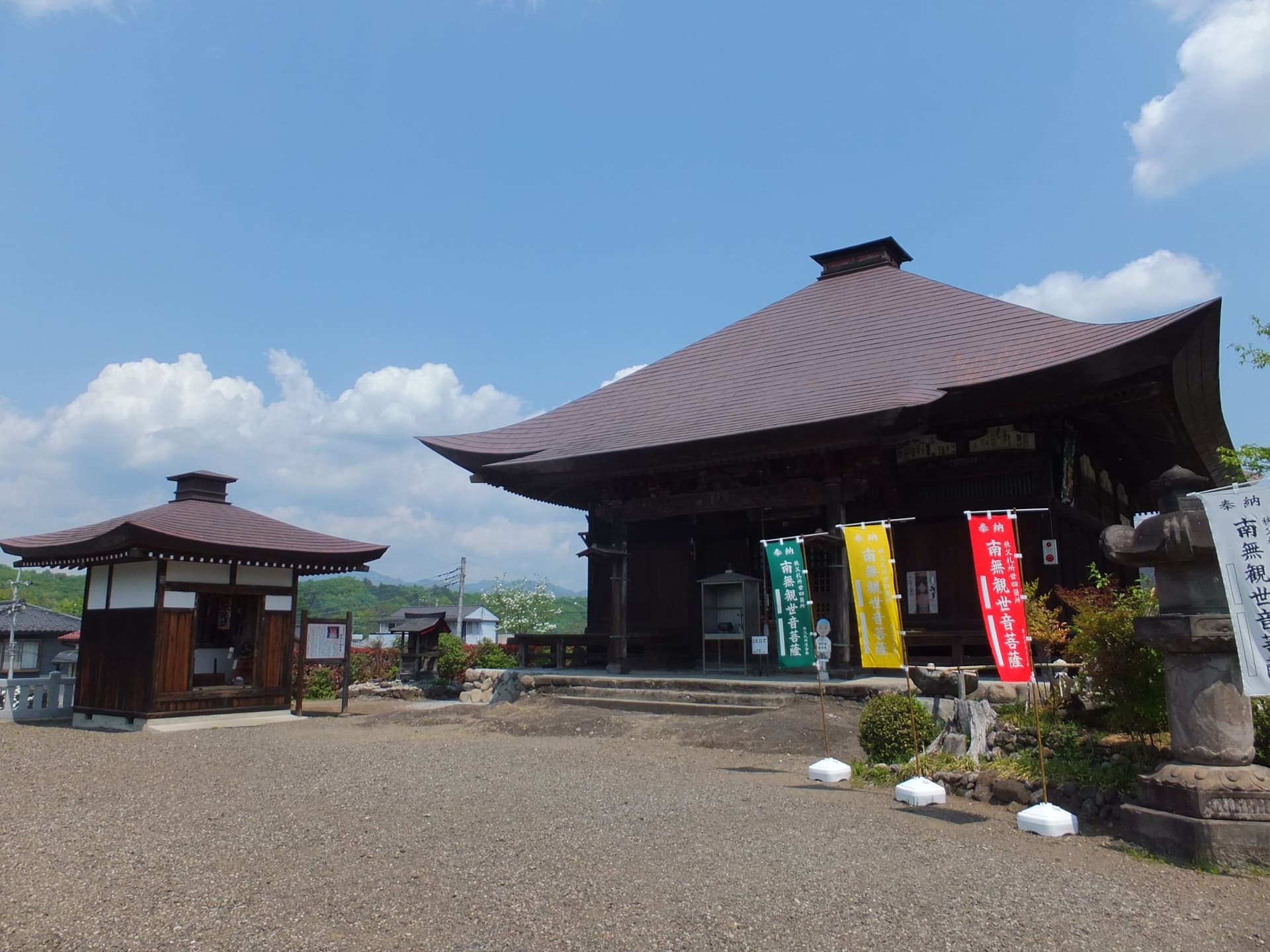
Arrive with time for an unhurried close: pause at both entrance monuments, approach the 1828 six-bay-square Kannon-dō and its large karahafu porch, and worship the Senju Kannon while standing on the Hyakkannon-no-suna. For full-Hyakkannon pilgrims, the larger 'Nihon Hyakkannon Kannon no Ketsuganjo' stone can mark the structural climax of years of practice. The Conclusion Hall beside the Sanbutsu-dō holds deposited fudasatsu and travel-worn oizuru.
A short path leads to the roughly 5-meter Mizukuguri-no-iwaya limestone cave and dripping Chōmei-sui, drunk in small quantities as final purification. Interior cave access and the historical water-diving rite are limited; symbolic completion continues.
From Minano Station on the Chichibu Railway, reach the temple by local bus, taxi, or a longer walk into Shimo-Hinozawa. Pause at the entrance and read both stone monuments — the 'Chichibu 34th Fudasho' stone and, in larger characters, 'Nihon Hyakkannon Kannon no Ketsuganjo'. At the main hall, stand on the Hyakkannon-no-suna sandbox and worship the principal Senju Kannon. For pilgrims completing the route: deposit the final fudasatsu and oizuru at the Hyakkannon Conclusion Hall next to the Sanbutsu-dō.
Walk the short path to the Mizukuguri-no-iwaya stone chamber and drink in small quantity from the Chōmei-sui spring. Receive the closing kechigan goshuin at the temple office; allow time, especially during the 2026 sōkaichō. Pilgrims continuing onto a different circuit can begin from here.
Context and lineage
Suisen-ji's institutional history is shaped less by a founding legend than by the structural addition of the 34th Chichibu temple to round the three-circuit Japan 100 Kannon (Hyakkannon) to exactly 100 temples. The earlier Saigoku 33 (Kansai) and Bandō 33 (eastern Japan) pilgrimages had stabilised by the medieval period; the Chichibu route, formed across the late medieval period, originally consisted of 33 temples in deliberate parallel to the older two circuits.
The need to round the three-circuit total to a meaningful 100 led to the addition of a 34th Chichibu fudasho. Sources differ on the date: a stele discovered at Iwao Castle in Nagano Prefecture bears 1525 evidence of pilgrim activity, while the conventional date for the formal addition is 1536. Both circulate in pilgrimage histories, and the discrepancy reflects the gradual rather than punctual character of the route's institutionalisation.
Suisen-ji was placed at the close, in keeping with the temple's already-existing role as a regional Kannon site, and has held the kechigan-jo position since.
Founding details predating the 16th-century addition are obscure. The temple's mountain name, Nittaku-san (日沢山), is recorded; Sōtō Zen affiliation is well-attested. The principal Senju Kannon image is a single-piece wooden statue traditionally dated to the Muromachi period — consistent with, or earlier than, the 16th-century formal closure of the Hyakkannon. The current Kannon-dō dates from 1828 (Bunsei 11), a six-bay-square structure with a large karahafu (cusped-gable) outer porch.
The Mizukuguri-no-iwaya stone chamber is a natural limestone feature integrated into the temple landscape and is part of the Chichibu Geopark.
Late-Edo woodblock prints in the 'Miracles of Kannon' (Kannon reigenki) Chichibu series include a depiction of Suisen-ji as 'Suisen-ji on Mount Nittaku, No. 34 of the Chichibu Pilgrimage Route' (held in the collection of the Museum of Fine Arts, Boston) — confirming the temple's prominence in 19th-century pilgrim popular culture and securing its kechigan-jo identity in the late-Edo high tide of pilgrimage practice.
Suisen-ji is a Sōtō Zen temple of the Nittaku-san mountain order, in keeping with the Sōtō dominance of approximately twenty of the thirty-four Chichibu fudasho. Its institutional role as kechigan-jo gives it national rather than merely local importance within Sōtō pilgrimage practice. The Senju Kannon devotion at the heart of the temple, dated by tradition to the Muromachi period, sits within the wider Mahāyāna tradition of Senju Kannon as the bodhisattva of unbounded responsive compassion.
The unrecorded medieval institutional architects of the Hyakkannon
Originators of the 100-temple supersystem
The medieval-period institutional process by which the Saigoku 33, Bandō 33, and Chichibu 34 were combined into the Japan 100 Kannon (Hyakkannon) is not securely attributable to specific named figures. The addition of the 34th Chichibu temple (early 16th century) was the formal step that completed the three-circuit total to exactly 100 — a structural decision whose specific authors are not recorded.
The unrecorded carver of the Muromachi-period Senju Kannon
Sculptor of the principal image
The principal image is a single-piece wooden Senju Kannon (Thousand-Armed Avalokiteśvara) traditionally dated to the Muromachi period. The specific carver and provenance are not securely recorded. The thousand arms symbolise the bodhisattva's unbounded capacity to respond to suffering — a fitting image for the temple where two ancient pilgrimages reach their conclusion.
The 1828 builders of the Kannon-dō
Late-Edo reconstructors
Builders of the present Kannon-dō, completed in 1828 (Bunsei 11) — a six-bay-square structure with a large karahafu (cusped-gable) outer porch. The structure dates from the late-Edo Bunka-Bunsei era, the peak of pilgrim traffic on the Chichibu route and the wider Hyakkannon. Specific builders' names are not securely recorded.
Late-Edo ukiyo-e artists of the 'Miracles of Kannon' (Kannon reigenki) series
Documenters of the temple in 19th-century pilgrim popular culture
Mid-19th-century woodblock-print artists who included Suisen-ji as 'Suisen-ji on Mount Nittaku, No. 34 of the Chichibu Pilgrimage Route' in their 'Miracles of Kannon' (Kannon reigenki) Chichibu series — securing the kechigan-jo identity in late-Edo pilgrim consciousness. A surviving impression is held in the Museum of Fine Arts, Boston.
Resident Sōtō Zen clergy
Contemporary stewards of the kechigan-jo
The Sōtō community responsible for daily ritual at the Kannon-dō, year-round pilgrim hospitality, the issuance of the closing kechigan goshuin, and stewardship of the Hyakkannon Conclusion Hall (where pilgrims deposit final fudasatsu and oizuru), the Hyakkannon-no-suna sandbox, the Mizukuguri-no-iwaya stone chamber, and the Chōmei-sui long-life-water spring. Their work in receiving completion is itself a defining contemporary tradition at the temple.
Traditions and practice
Pilgrims arriving at Suisen-ji perform a fuller version of the standard Chichibu pilgrim sequence — bowing at the gate, water purification, incense and saisen offering, sutra recitation, osamefuda — and then add a series of practices specific to the kechigan-jo. The most distinctive is worship of the principal Senju Kannon while standing on the Hyakkannon-no-suna (sand of the 100 Kannon) sandbox before the main hall.
Tradition holds that the gesture confers the same merit as having visited every one of the 100 Hyakkannon temples. Pilgrims completing the full Hyakkannon — and pilgrims for whom the full circuit has remained unreachable — both perform this practice as a ritual integration of the entire 100-temple supersystem.
For those completing a circuit, the next practice is deposition. At the Hyakkannon Conclusion Hall, set next to the Sanbutsu-dō (Sutra Repository), pilgrims leave their final fudasatsu (placards) and oizuru (white pilgrim's vests). These are personal devotional objects that have travelled the full route — sometimes hundreds, sometimes more than 2,400 kilometres of pilgrimage — and the deposition is the route's institutional close. The accumulated objects in the hall, deposited across many years, are themselves part of the precinct's gravity.
Finally, pilgrims walk the short path to the Mizukuguri-no-iwaya stone chamber and drink in small quantity from the Chōmei-sui (long-life water) spring at the cave. Historically, completing pilgrims passed through the stone chamber itself in a 'water-diving' rebirth rite; the embodied practice is largely historical now, but the symbolic completion at the kechigan-jo continues.
Year-round pilgrim hospitality, kechigan goshuin issuance, and stewardship of the Conclusion Hall. Deposits of pilgrim oizuru and fudasatsu continue. The 12-yearly Chichibu sōkaichō (year-of-the-horse total unveiling), opening from 18 March 2026 and running through the year, brings a major upsurge in pilgrim and visitor traffic — and a year of unusual significance for any visit to the kechigan-jo.
Suisen-ji is also marked on regional itineraries as a Chichibu Geopark site, recognising the limestone outcrop in which the Mizukuguri stone chamber is set.
Allow sixty to ninety minutes for a focused visit, longer if completing a pilgrimage. The kechigan ritual sequence — deposition at the Conclusion Hall, worship on the Hyakkannon sand, drinking from the Chōmei-sui spring, receiving the closing goshuin — takes substantial time and is often completed slowly. For pilgrims completing the full Hyakkannon (some 2,400+ km across years of practice), the visit may take most of a day.
Many pilgrims time the kechigan stamping for late afternoon, allowing for an unhurried close to the journey. Pause at the entrance and read both stone monuments aloud or quietly; for many, the moment of standing before the 'Nihon Hyakkannon Kannon no Ketsuganjo' stone is itself the structural close.
Buddhism
ActiveSuisen-ji is an active Sōtō Zen temple of the Nittaku-san (日沢山) mountain order, in keeping with the Sōtō dominance of approximately twenty of the thirty-four Chichibu fudasho. Its institutional role as kechigan-jo (結願所, 'place where the vow is fulfilled') of two of Japan's three foundational Kannon pilgrimage circuits — the Chichibu 34 (~100 km in Saitama) and, by structural extension, the entire Japan 100 Kannon (Hyakkannon, 日本百観音) combining the Saigoku 33 (~1,000 km in Kansai), the Bandō 33 (~1,300 km in eastern Japan), and the Chichibu 34 — gives it national rather than merely local importance within Sōtō pilgrimage practice. The 34th Chichibu temple was added in the early 16th century (sources give 1525 stele evidence or 1536 conventional date) explicitly to round the three-circuit total to exactly 100 temples; Suisen-ji has held the closing position since. The principal image is Senju Kannon (千手観世音菩薩, Thousand-Armed Avalokiteśvara) — a single-piece wooden Muromachi-period statue. The current Kannon-dō dates from 1828 (Bunsei 11), a six-bay-square structure with a large karahafu (cusped-gable) outer porch.
Chichibu 34 Kannon Pilgrimage (kechigan-jo / 結願寺)
Active34th and final station of the Chichibu Kannon pilgrimage — the kechigan-jo where pilgrims arrive at the close of the ~100-km Chichibu route and traditionally deposit their osamefuda, fudasatsu (final placard), and oizuru (white pilgrim's vest). At the entrance, two stone monuments mark the role: 'Chichibu 34th Fudasho' (秩父三十四番札所) and 'Nihon Hyakkannon Kannon no Ketsuganjo' (日本百観音 観音の結願所).
Japan 100 Kannon Pilgrimage (Hyakkannon, 日本百観音) — institutional completion
ActiveSuisen-ji is the kechigan-jo of the entire Hyakkannon — the combined Saigoku 33 + Bandō 33 + Chichibu 34 routes, totalling 100 temples and more than 2,400 km of pilgrimage. The Chichibu circuit's 34th temple was added in the early 16th century (sources give 1525 or 1536) explicitly to round the three-circuit total to 100. Pilgrims who have completed all three routes — some 2,400+ km of journeying across Kansai, eastern Japan, and Saitama, often spread across years of practice — traditionally complete the entire Hyakkannon at Suisen-ji. A stone tablet before the main hall states that worshipping the principal Senju Kannon while standing on the Hyakkannon-no-suna ('sand of the 100 Kannon') confers the same merit as having visited every Hyakkannon temple — making the kechigan-jo an integration site even for pilgrims whose full circuit has remained unreachable.
Perspectives and open questions
Suisen-ji is the temple where two of Japan's three foundational Kannon pilgrimages structurally end. Holding the registers — the institutional, the devotional, and the cave-and-spring landscape — together is the most honest way to read the kechigan-jo.
Scholarly perspective
Suisen-ji's role as kechigan-jo of the Chichibu 34 and Japan 100 Kannon is well established. Its early-sixteenth-century promotion to 34th fudasho completed the Hyakkannon at exactly 100 temples, but sources differ: an Iwao Castle stele in Nagano Prefecture provides 1525 pilgrim evidence, while 1536 is conventional. The Senju Kannon is traditionally Muromachi-period; the Kannon-dō is firmly dated to 1828 (Bunsei 11). Official materials document the Mizukuguri-no-iwaya and Chōmei-sui as part of the Chichibu Geopark.
Living and traditional perspectives
The temple's identity as the place where the vow is fulfilled — Ketsuganjo (結願所) — gives it an unusual status in the Japanese Buddhist landscape: it exists explicitly to be arrived at. Local Sōtō Zen tradition holds that Suisen-ji's role is precisely to receive completion. Its Hyakkannon-no-suna sandbox, its Hyakkannon Conclusion Hall, its cave-spring, and its closing goshuin are infrastructural supports for the ritual handover from pilgrim journey back to ordinary life.
The Senju Kannon principal image — thousand-armed, infinitely responsive — embodies the bodhisattva's compassion at the moment when long discipline gives way to return.
Alternative interpretations
The Mizukuguri-no-iwaya can be read in dōin / kaidan-meguri terms — narrow passages that compress symbolic death and rebirth, akin to the better-known cave at Hashidate-dō (#28) earlier on the Chichibu route. The historical 'water-diving' rite at Suisen-ji concentrates the route's themes of purification and rebirth at the literal close.
The Chōmei-sui spring is a small representative of the broader East Asian 'long-life water' motif (Penglai-style spring of immortality, chrysanthemum dew at Kikusui-ji #33, the Daoist-Buddhist immortality landscape that crosses through Japanese Buddhist topography). For pilgrims who have completed the route, the Conclusion Hall is structurally analogous to the conclusion of a mandala or a long retreat — the long arc closing.
Open questions
{"The historical record of when the embodied 'water-diving' rite first began and when it ceased to be performed routinely is incomplete","The two competing dates for the addition of the 34th Chichibu temple (1525 stele evidence vs. 1536 conventional date) reflect the gradual rather than punctual character of the route's institutionalisation","Specific carver and commissioning circumstances of the Muromachi-period Senju Kannon image are not securely recorded","Pre-16th-century history of Suisen-ji as a regional Kannon site is obscure"}
Plan your visit
Access and arrival
Located in Shimo-Hinozawa, Minano-machi, Chichibu-gun, Saitama. Nearest station is Minano on the Chichibu Railway and the Seibu Chichibu Line; from the station the temple is reached by local bus, taxi, or a longer walk. From greater Tokyo, take the Seibu Ikebukuro Line to Seibu-Chichibu, transfer to the Chichibu Railway, and alight at Minano. Mobile phone signal is reliable on all major Japanese carriers in the Minano area. Standard hours are roughly 8:00–17:00 March–October and 8:00–16:00 November–February.
The 12-yearly Chichibu sōkaichō opens from 18 March 2026; confirm current access during this unusually significant and busy year.
Chichibu City offers a wide range of accommodations, from small ryokan in the valley to mid-range hotels around Seibu-Chichibu Station. Pilgrims completing the Chichibu 34, and especially those completing the full Hyakkannon, often plan an unhurried final stay — one or two nights in central Chichibu or in Minano itself, allowing space for the kechigan visit to register without time pressure.
Respectful visit
Modest dress; sturdy footwear for the path to the cave. Many pilgrims arrive in oizuru (white pilgrim's vest), and many leave their oizuru at the Conclusion Hall.
External photography permitted in precincts. Photography of pilgrims' deposited oizuru in the Conclusion Hall, and of the principal Senju Kannon image, may be restricted; check posted signs and ask staff.
Coin offerings, incense, candles, osamefuda, and — for those completing — fudasatsu and oizuru. Goshuin fee typically ¥300–¥500.
Give priority to pilgrims engaged in completion ceremonies | Do not remove sand from the Hyakkannon-no-suna sandbox | Treat the Hyakkannon Conclusion Hall and its deposited oizuru with respect | Behave quietly near the Mizukuguri-no-iwaya cave; do not attempt 'water-diving' without explicit guidance | Drink from the Chōmei-sui spring in small quantity only
The Hyakkannon Conclusion Hall, the Sanbutsu-dō, and the deposition area hold personal devotional objects of pilgrims completing their vows; treat the area with respect. Photography of the deposited oizuru in the Conclusion Hall, and of the principal Senju Kannon image, may be restricted; check posted signs and ask staff. Do not remove sand from the Hyakkannon-no-suna sandbox.
Behave quietly near the Mizukuguri-no-iwaya cave; modern access to the inside of the cave for embodied 'water-diving' is limited and visitors should not attempt the rite without explicit guidance. Drink from the Chōmei-sui spring in small quantity only. The path to the cave is generally easy but may be slippery in rain.
Current practical details
Address
3522 Shimohinozawa, Minano, Chichibu District, Saitama 369-1625, Japan
Phone
Hours, fees, and access can change — verify on the official source before you travel. Practical details last checked Jun 2026.
Location
Map loads as you approach this section.
Pilgrim reflections
A portrait of encounter, not a score
Pilgrims describe what they felt, how present they could become, and whether the place would shape a journey. There are no stars and no ranking of traditions.
No reviewed reflections yet
The first pilgrims can help describe the character of being here.
Share a reflection
Available after an account-backed “Been there.” Every reflection is reviewed before publication.
Nearby sacred places
Explore other sacred places in the region. Proximity does not establish access or travel time; check each place’s guidance.


References
Sources consulted for this page. Source categories describe the publication, not a guarantee that every claim is verified. Traditional accounts and outside interpretations may differ.
- 0134番 水潜寺 – 秩父札所 (Official Chichibu Fudasho Association) — Chichibu Fudasho AssociationofficialOfficial kechigan-jo (concluding temple) page.
- 02Chichibu 34 Kannon Pilgrimage Historical Overview (PDF) — Japan Tourism Agency / Chichibu TourismofficialEnglish-language official historical pamphlet.
- 03札所34番水潜寺(すいせんじ)の石灰岩体 | ジオパーク秩父 (Chichibu Geopark) — Chichibu GeoparkofficialGeological context: the limestone outcrop in which the Mizukuguri stone chamber is set.
- 04秩父観音霊場札所三十四番水潜寺 | 皆野町 (Minano Town official cultural-property page) — Minano Town GovernmentofficialMunicipal cultural-property listing.
- 05Suisen-ji on Mount Nittaku, No. 34 of the Chichibu Pilgrimage Route — from the series 'Miracles of Kannon' (Kannon reigenki) — Museum of Fine Arts, BostonacademicMFA Boston's catalogue entry on the late-Edo woodblock print of Suisen-ji — confirming the temple's prominence in 19th-century pilgrim popular culture.
- 06水潜寺 - Wikipedia (Japanese) — Wikipedia contributorsofficialRecords Sōtō Zen affiliation, Nittaku-san mountain name, principal Senju Kannon (Muromachi-period wooden image), 1828 main-hall reconstruction, 'Mizukuguri-no-iwaya' stone chamber and 'Chōmei-sui' (long-life water) spring, status as kechigan-jo of both the Chichibu 34 and the Japan 100 Kannon.
- 07Japan 100 Kannon Pilgrimage - Wikipedia — Wikipedia contributorsofficialConfirms that the three-circuit Hyakkannon (Saigoku 33 + Bandō 33 + Chichibu 34) totals 100 temples and that Suisen-ji is its kechigan-jo.
- 08The Temple Guy: The Chichibu 34 Kannon Route — James BaquetguidePilgrim's first-hand account.
Pilgrim glossary
- Kannon
- The bodhisattva of compassion, central to many East Asian pilgrimage routes.
- Bodhisattva
- An enlightened being who postpones full nirvana to help others toward awakening.
- Mandala
- A symbolic diagram of the cosmos used in meditation and ritual.
- Sutra
- A canonical Buddhist scripture, often chanted as part of practice.
- Zen
- A Japanese Buddhist school emphasizing seated meditation and direct insight.
Share a photo
Help visitors recognize Suisen-ji. Every submission is reviewed before publication.