St. Albans Cathedral, St Albans, United Kingdom
Where Britain's first Christian martyr fell, and seventeen centuries of pilgrims have sought the thin place between worlds
St Albans, England, United Kingdom
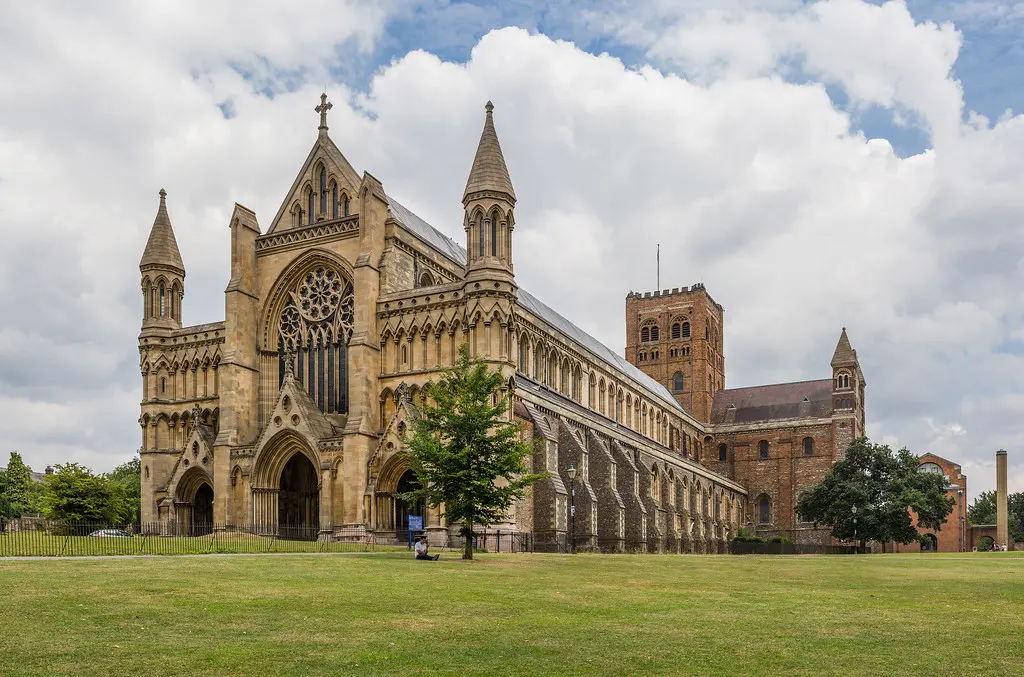
Image of St. Albans Cathedral, St Albans, United Kingdom. Image source
Visit essentials
Before you go
- Access
- From London, trains depart St Pancras International for St Albans City station approximately…
- Address
- Cathedral, Sumpter Yard, St Albans AL1 1BY, UK
- Duration
- A contemplative visit allowing time for the nave, shrine, wall paintings, and quiet reflection…
- Etiquette
- St Albans Cathedral welcomes all visitors with minimal formal requirements.
Overview
Some places hold their history lightly. St Albans Cathedral does not. Every stone here carries the weight of seventeen centuries—the longest continuous span of Christian worship in Britain, rooted in a single act of sacrifice.
Alban was a pagan in Roman Verulamium who sheltered a Christian priest fleeing persecution. Something in the priest's faith moved him. When soldiers came, Alban dressed in the priest's cloak and surrendered himself. He was led to this hill, where tradition holds that waters parted at his prayer, a spring emerged from barren ground, and his executioner's eyes fell out at the moment of the beheading. Miracles cluster around martyrdom, and these have drawn pilgrims ever since.
The Norman tower that now rises over Hertfordshire was built with Roman bricks salvaged from the ruins of Verulamium—a city that died so that this cathedral could live. Inside, the restored shrine of Saint Alban holds a relic of the martyr himself, returned from Cologne in 2002 after five centuries of exile.
Pilgrims still gather here, lighting candles, whispering prayers, sitting in the particular silence that fills a space where people have sought the sacred for longer than almost anywhere else in Britain.
This is not a museum. Mass is celebrated daily. Roman Catholic, Orthodox, Lutheran, and Free Church services happen weekly at the shrine—an ecumenical hospitality that echoes the Benedictine tradition of welcoming all. The cathedral breathes. It asks nothing of visitors except presence, and offers in return the accumulated weight of centuries of seeking.
Why this place is sacred
The hill where Alban died was already significant. Roman burials have been found here, suggesting the site held meaning before Christianity arrived. When a man chose martyrdom on this ground, he may have been adding to an existing sanctity rather than creating it anew.
What makes a place thin? At St Albans, several factors converge. First, the specificity of the sacrifice—a pagan who converted, then died protecting the one who converted him. The story is intimate, personal, not the abstract martyrdom of a distant saint but a transaction between two men that ended on this hill. Second, the continuity of veneration. The Venerable Bede, writing in the early eighth century, already recorded healings at Alban's shrine.
The present cathedral was begun in 1077, but worship here predates it by centuries. King Offa of Mercia founded a Benedictine abbey in 793, but earlier wooden churches served pilgrims before that.
The physical presence matters. A relic of Saint Alban—his shoulder blade—was returned from Cologne in 2002, reuniting the cathedral with tangible remains of its founding martyr. The shrine itself, painstakingly reconstructed from over two thousand fragments discovered during Victorian restoration, now stands where medieval pilgrims knelt. In 2021, the shrine of Saint Amphibalus—the priest for whom Alban died—was also restored, making St Albans the only British cathedral with two medieval pedestal shrines.
The building's fabric carries this history. Roman bricks from Verulamium form the Norman tower's core. Medieval wall paintings—the most extensive in any greater English church—depict the crucifixion, saints, and scenes of daily life. The longest nave in England stretches eastward, its space accumulated over centuries of building and rebuilding. Time here is not linear but layered, each generation adding to what the last left behind.
The earliest purpose of Christian worship on this site was the veneration of a martyr. Alban's grave became a place of pilgrimage within decades of his death, as the newly legalized church sought to honor those who had died for faith. The first structures were likely small memorial buildings marking the execution site.
As Christianity became dominant, the site grew: first a church 'worthy of Alban's martyrdom' in the late Roman period, then the eighth-century Benedictine foundation, finally the Norman cathedral that absorbed and enlarged what came before. Throughout, the purpose remained constant—honoring the protomartyr and providing a place where pilgrims could encounter the sacred presence that clusters around holy death.
The site has evolved through successive waves of destruction and renewal. Viking raids damaged but did not destroy the Anglo-Saxon abbey. The Norman conquest brought a complete rebuilding in 1077, imposing the grand scale that survives today. The dissolution of the monasteries in 1539 ended six centuries of Benedictine life, but the abbey church survived as a parish church. It became a cathedral only in 1877, when the new Diocese of St Albans was created.
Each transformation added rather than erased. The Norman architecture contains Roman materials. The Gothic choir and Lady Chapel extended the Norman nave. Victorian restoration recovered buried treasures—the medieval wall paintings, the shattered shrine fragments—bringing forgotten elements back into the living fabric. The return of Alban's relic in 2002 and the restoration of Amphibalus's shrine in 2021 continue this pattern of recovery and renewal.
Today the cathedral serves simultaneously as a working church, a heritage site, and an ecumenical pilgrimage destination. The traditions that once competed—Protestant and Catholic, national and universal—now coexist at the shrine where Alban's story transcends their divisions.
Experience and orientation
The first encounter is often the nave's sheer length—eighty-five meters, the longest in England, drawing the eye toward the distant sanctuary. The space teaches patience; you cannot rush through it. The Norman pillars, built with Roman bricks in warm red and brown, create a rhythm that slows the pace of those who walk between them.
At the shrine, something shifts. The reconstructed canopy rises above Alban's resting place, its stones patched and scarred, bearing witness to its own destruction and recovery. Pilgrims sit on benches facing the shrine, some praying, some simply present. The silence here has a quality visitors remark upon—not emptiness but attention, as though the space itself were listening.
Many describe unexpected emotional responses. Tears are not uncommon, particularly among those encountering the site during times of personal difficulty. The cathedral seems to hold grief without demanding explanation. Others report a sense of connection across time—an awareness that people have sat in this same space, facing this same question of sacrifice and meaning, for longer than most human institutions have existed.
The medieval wall paintings contribute to this effect. Figures emerge from the stone—saints, angels, scenes of judgment—their colors faded but still present. To look at them is to see through medieval eyes, to glimpse what pilgrims eight hundred years ago saw as they approached the shrine. The Watching Loft, the only surviving example in England, reminds visitors that monks once kept vigil here through the night, ensuring the shrine was never unattended.
Enter through the west door and allow the nave's length to set your pace. Do not rush toward the shrine; let the building unfold. Notice the shift from Norman to Gothic architecture as you move eastward, the nave's austerity giving way to the choir's vertical aspiration.
At the shrine, take a seat. You need not pray in any formal sense; simply being present is enough. Watch how others engage—the lighting of candles, the quiet words, the simple sitting. The shrine has hosted this for seventeen centuries. It does not require your belief, only your attention.
If time allows, seek out the medieval wall paintings. Many are in the nave itself, revealed during Victorian restoration. A guide or audio tour can help locate them, but something is gained by discovering them yourself—the sudden recognition of a painted figure emerging from the stone.
Consider returning for a service if your schedule permits. Daily Eucharist offers the chance to experience the cathedral as its worshippers do, not as heritage but as living practice.
Context and lineage
The story begins with two men whose names history preserved unequally. Alban was a pagan citizen of Roman Verulamium—a prosperous city whose ruins still lie beyond the cathedral grounds. The priest who came to his door, fleeing persecution, was later given the name Amphibalus, though this may derive from a misreading of the Latin word for 'cloak.'
According to tradition recorded by Bede and earlier sources, Alban sheltered the priest for several days. Watching him pray, seeing his devotion, Alban was converted. When soldiers came, Alban dressed in the priest's cloak and surrendered himself. Brought before the magistrate, he refused to sacrifice to the Roman gods. 'I worship and adore the true and living God who created all things,' he declared.
He was taken to the hill outside the city for execution. Tradition holds that the river between the city and the hill parted at his prayer. At the execution site, thirsty, he prayed and a spring emerged from the ground. The first executioner, moved by these miracles, threw down his sword and converted on the spot—he would be killed alongside Alban.
The second executioner carried out the sentence, but as Alban's head fell, the executioner's eyes fell out onto the ground.
The exact date remains disputed. Sources suggest dates ranging from around 209 to around 313, with Bede placing the martyrdom around 305. What matters is not the precise year but the pattern: a man who chose death over betraying the one who had shown him a new way of being. This pattern has drawn pilgrims ever since.
From Alban's death until the present day, the site has never been abandoned. Late Roman Christians built a church worthy of the martyr, where Bede records that sick pilgrims were healed. Germanic settlers, arriving after Rome's withdrawal, apparently respected the site—Christianity here survived the pagan centuries.
King Offa's foundation in 793 began the abbey's rise to prominence. For seven centuries, Benedictine monks maintained the daily round of prayer and welcomed pilgrims to the shrine. The abbey became England's premier Benedictine house, with numerous daughter foundations across the country. Matthew Paris, the famous medieval chronicler, was a monk here.
The dissolution under Henry VIII ended monastic life but not worship. The townspeople of St Albans purchased the church for continued use as their parish. For three centuries it served this humbler function, its former glory fading but not forgotten.
The Victorian era brought restoration and, in 1877, cathedral status with the creation of the new diocese. The twentieth century saw the shrine's reconstruction and the discovery of medieval paintings. The twenty-first has brought the return of Alban's relic and the restoration of Amphibalus's shrine—a pattern of recovery that suggests the story continues to unfold.
Saint Alban
martyr
Britain's first recorded Christian martyr, known as the protomartyr. A pagan who converted after sheltering a priest, he died on the hill where the cathedral now stands. His feast day is June 22.
Saint Amphibalus
historical
The Christian priest whom Alban sheltered. He was later captured and martyred at Redbourn. His shrine was restored in St Albans Cathedral in 2021.
King Offa of Mercia
founder
The powerful eighth-century king who founded the Benedictine abbey at St Albans in 793, transforming the pilgrimage site into a major monastic center.
Paul of Caen
builder
The first Norman abbot, who began construction of the present cathedral in 1077. His building, using Roman bricks from Verulamium, forms the core of the structure today.
The Venerable Bede
chronicler
The early eighth-century monk and historian whose Ecclesiastical History of the English People preserved the account of Alban's martyrdom and the healings at his shrine.
Traditions and practice
Medieval pilgrimage to St Albans followed patterns common to major shrines. Pilgrims approached on foot, often from great distances, some crawling the final stretch on their knees. At the shrine, they would kneel before Alban's relics, offer prayers for healing or intercession, and leave offerings of money or goods. The monks maintained a watching brief through the night, ensuring the shrine was never unattended. The sick came seeking miracles; Bede records that such healings were frequent.
The Benedictine daily office structured the abbey's life. Seven times daily, monks gathered for prayer—Matins, Lauds, Prime, Terce, Sext, None, Vespers, and Compline—surrounding the Eucharist celebrated at the high altar. Pilgrims could witness these services, their own devotions woven into the monks' perpetual round of worship.
Feast days brought intensified celebration. Saint Alban's Day on June 22 was the principal feast, drawing pilgrims from across England. The Translation of Relics on October 7 commemorated the movement of Alban's remains to a new shrine.
Daily Eucharist continues in the cathedral, typically at 9:00am. Morning and evening prayer frame the day. Sunday services include multiple celebrations, with choral Eucharist as the principal morning service.
The shrine serves as a focus for ecumenical worship unique among English cathedrals. Roman Catholic Mass is celebrated at the shrine on Friday mornings. Orthodox Divine Liturgy takes place on certain Tuesdays. Lutheran services in German occur on Tuesday evenings. Free Church services are held on some Wednesday mornings. This hospitality to other traditions reflects the Benedictine heritage of welcoming all who come seeking God.
The annual Alban Pilgrimage, held on the weekend closest to June 22, draws thousands of participants. The celebration includes a procession through the city featuring giant puppets depicting scenes from Alban's story—the priest arriving, the conversion, the journey to execution. The 2026 pilgrimage falls on Saturday, June 20.
Individual pilgrimage happens daily. Visitors light candles at the shrine, sit in prayer or contemplation, and add their intentions to the centuries of seeking that have accumulated here. Prayer sheets in multiple languages are available for those who want guidance.
Begin with simple presence. Find a seat facing the shrine and sit for at least fifteen minutes before doing anything else. The space has its own rhythm; rushing through it means missing what makes it significant.
If prayer is part of your practice, the shrine welcomes it in any form. Light a candle if the gesture has meaning for you. Speak or think your intentions. Many find that placing a hand on the stone bench helps anchor their attention.
Attending a service, if your timing allows, offers encounter with the cathedral as living tradition rather than heritage site. Daily Eucharist takes about thirty minutes. If you can stay longer, choral Evensong provides one of the Church of England's most contemplative services.
The medieval wall paintings reward slow attention. Let your eyes adjust to their faded colors. Consider what it meant to make these images—the devotion embedded in their creation, the centuries they have witnessed.
Before leaving, circle back to the shrine. What you notice on a second visit often differs from the first. The cathedral teaches what returns teach.
Church of England
ActiveSt Albans has been an Anglican cathedral since 1877, when the Diocese of St Albans was created. The cathedral serves as the mother church of the diocese and the seat of the bishop. It continues the tradition of daily worship that has marked this site since the early Christian period, maintaining the rounds of morning and evening prayer alongside Eucharistic celebration.
Daily Eucharist, typically at 9:00am, forms the core of worship life. Morning and evening prayer frame the day. Sunday services include multiple celebrations, with choral Eucharist as the principal gathering. Major festivals are celebrated with special liturgies. The cathedral choir maintains the tradition of English choral music.
Roman Catholicism
ActiveFor Roman Catholics, Alban belongs to the undivided church that existed before the Reformation. Weekly Mass at the shrine maintains a Catholic presence at one of England's oldest Christian sites. The return of Alban's relic in 2002, gifted by the Catholic cathedral of Cologne, symbolized the healing of Reformation-era wounds.
Roman Catholic Mass is celebrated at the shrine on Friday mornings. This service draws local Catholics and visiting pilgrims who wish to receive communion in their tradition while honoring the protomartyr.
Eastern Orthodoxy
ActiveAlban lived and died before the Great Schism of 1054 that divided Eastern and Western Christianity. Orthodox Christians honor him as a saint of the undivided church, recognizing in his martyrdom the same witness their tradition venerates in its own holy ones.
Orthodox Divine Liturgy is celebrated at the shrine on certain Tuesdays, typically at 10:30am. This service follows the Byzantine rite, bringing the prayers and chanting of Eastern Christianity to this ancient Western site.
Lutheranism
ActiveThe Lutheran presence at St Albans reflects both the cathedral's ecumenical hospitality and the German connection established by the return of Alban's relic from Cologne. Monthly services in German serve the local German-speaking community while honoring a martyr who belongs to all Christians.
Lutheran services are held at the shrine on certain Tuesday evenings. The use of German connects worshippers to Lutheran heritage while the setting connects them to British Christian origins.
Benedictine Monasticism
HistoricalFor seven centuries (793-1539), Benedictine monks maintained the daily round of prayer at St Albans. The abbey became one of England's most influential monasteries, its abbots wielding considerable power, its scriptorium producing remarkable chronicles and illuminated manuscripts. The dissolution ended monastic life, but the building and its heritage survived.
The Benedictine daily office—the seven hours of prayer from Matins to Compline—structured monastic life. Hospitality to pilgrims, education, care for the sick, and scholarship occupied the monks between services. The shrine was tended day and night, never left unwatched.
Perspectives and open questions
St Albans Cathedral invites interpretation from multiple angles. Scholars debate the exact dating and historical reliability of the martyrdom account. Church tradition holds the story as foundational to British Christianity. Some perceive in the site's long veneration evidence of a power that transcends historical particulars. Honest engagement holds these perspectives together, recognizing that a place venerated for seventeen centuries accumulates meanings that no single framework can contain.
Scholarly perspective
Historical scholarship accepts the broad outline of Alban's story while debating specifics. The date of martyrdom remains contested, with scholarly opinions ranging from around 209 to around 313. Bede's account, written four centuries after the events, draws on earlier sources that do not survive. The miraculous elements—the parted river, the springing well, the executioner's blindness—follow hagiographic conventions common to martyr stories.
Archaeological evidence confirms early Christian veneration at the site. Roman-period structures consistent with a martyrium have been identified beneath the medieval layers. The presence of Roman burials on the hill suggests the site held significance before Alban's death. The cathedral's use of Roman materials from Verulamium is well documented and visible in the fabric.
The medieval pilgrimage is thoroughly documented. St Albans was one of England's most important shrines, its abbey among the wealthiest and most influential. Matthew Paris and other monks produced chronicles and histories that illuminate medieval monastic life. The shrine's destruction and eventual recovery are part of the documented history of the English Reformation and its aftermath.
Living and traditional perspectives
For Christian tradition, Alban's story is not primarily a matter of historical inquiry but of witness. He demonstrated that faith could transform a pagan Roman into someone willing to die for a stranger. The miracles accompanying his death reveal divine approval of that sacrifice. The shrine's persistence through seventeen centuries of change testifies to the ongoing power of martyrdom to sanctify ground and draw pilgrims.
The ecumenical practice at the shrine today reflects a vision of Christian unity that transcends denominational division. Catholics, Orthodox, Protestants, and others gather at the same altar, honoring a martyr who died before those divisions existed. This unity-in-diversity represents, for many, a recovery of something the church lost and now seeks again.
Traditional teaching holds that places of martyrdom retain a special sanctity. The blood of martyrs, as Tertullian wrote, is the seed of the church. Alban's sacrifice inaugurated British Christianity; pilgrimage to his shrine participates in that founding moment.
Alternative interpretations
Some observers note the site's possible pre-Christian significance. Roman burials suggest the hill was already considered liminal—a boundary space between worlds—before Alban died here. The miraculous spring in the martyrdom account resonates with Celtic traditions of sacred wells. The cathedral's position on the landscape may reflect older geomantic understandings.
Within the contemporary pilgrimage movement, some describe St Albans as a 'thin place' where the boundary between ordinary and sacred reality becomes permeable. This language, rooted in Celtic spirituality, provides vocabulary for experiences that many visitors report but struggle to name. Whether this 'thinness' results from accumulated human intention, the site's physical properties, or something beyond either, remains a matter of individual interpretation.
Open questions
Several mysteries persist. The exact date of Alban's martyrdom cannot be definitively established given the sources available. The identity of the priest Amphibalus—whether this was his actual name or a later invention—remains uncertain. The fate of Alban's relics during the Reformation is only partly known; the shoulder blade returned from Cologne in 2002 is documented, but other portions of his body were reportedly at different locations and their current whereabouts are uncertain.
The nature of the pre-Norman shrine has not been fully excavated. How much of the early Christian structure lies beneath the present building, and what it might reveal about Romano-British Christianity, awaits future archaeological investigation. The precise location of the miraculous spring, if it existed, has not been identified.
Perhaps most persistently unknown is why some places gather the sacred around themselves and others do not. That St Albans has done so for seventeen centuries is documented; why it continues to do so resists definitive explanation.
Plan your visit
Access and arrival
From London, trains depart St Pancras International for St Albans City station approximately every six minutes during peak times. The journey takes about twenty minutes. From the station, the cathedral is a fifteen-minute walk through the historic town center. By road, St Albans is accessible from the M25 (Junction 21A or 22) and the A1(M) (Junction 3). Parking is available in town; the cathedral itself has limited parking.
The main entrance is wheelchair accessible via the Slype Door, which provides ramped access to most ground-floor areas. Wheelchairs are available for loan. Accessible toilets and baby-changing facilities are provided.
St Albans offers accommodation ranging from historic coaching inns to modern hotels. The city center is compact, with most options within walking distance of the cathedral. For those seeking retreat-style accommodation, the diocese can suggest appropriate options. London's extensive lodging is twenty minutes away by train.
Respectful visit
No formal dress code applies, though visitors often find that being thoughtfully dressed enhances their experience. This is a place of worship; clothing appropriate to that context is appreciated. In winter, the cathedral can be cold despite heating; bring layers.
Personal photography is permitted throughout most of the cathedral. Flash photography is discouraged, as it disturbs both other visitors and, over time, the historic fabric. During services, photography is not appropriate. Professional or commercial photography requires advance permission.
Candles can be lit at stations throughout the cathedral; donations toward their cost are suggested. General donations support the cathedral's work; giving boxes are located near the exits. No offerings should be left at the shrine itself.
Opening hours are typically 9:00am to 5:45pm daily, though these may vary for services or special events. Some areas may be closed for private functions or conservation work. The tower can be climbed on designated days; check the cathedral website for the schedule. The building is largely wheelchair accessible via the Slype Door entrance.
Do not touch the medieval stonework or paintings. The oils from hands accelerate deterioration. The shrine's scars testify to past damage; do not add to them.
Current practical details
Address
Cathedral, Sumpter Yard, St Albans AL1 1BY, UK
Phone
Hours
Hours, fees, and access can change — verify on the official source before you travel. Practical details last checked Jun 2026.
Location
Map loads as you approach this section.
Pilgrim reflections
A portrait of encounter, not a score
Pilgrims describe what they felt, how present they could become, and whether the place would shape a journey. There are no stars and no ranking of traditions.
No reviewed reflections yet
The first pilgrims can help describe the character of being here.
Share a reflection
Available after an account-backed “Been there.” Every reflection is reviewed before publication.
Nearby sacred places
Explore other sacred places in the region. Proximity does not establish access or travel time; check each place’s guidance.
References
Sources consulted for this page. Source categories describe the publication, not a guarantee that every claim is verified. Traditional accounts and outside interpretations may differ.
- 01St Albans Cathedral — St Albans CathedralspiritualOfficial cathedral website
- 02British Pilgrimage Trust - St Albans Cathedral — British Pilgrimage TrustSource contextPilgrimage-focused information
- 03Diocese of St Albans — Diocese of St AlbansSource contextOfficial diocesan information
- 04Saint Alban - Britannica — Encyclopaedia BritannicaencyclopediaAuthoritative encyclopedia entry
- 05Association of English Cathedrals - St Albans — Association of English CathedralsSource contextOfficial cathedral association
- 06St Albans Cathedral - Wikipedia — WikipediaencyclopediaEncyclopedia entry with detailed historical information
- 07Saint Alban - Wikipedia — WikipediaencyclopediaDetailed account of Saint Alban's life and martyrdom
- 08Country Life - The tale of St Alban — Country LifeSource contextHistorical and architectural background
- 09St Alban, Christian Martyr - Historic UK — Historic UKSource contextHistorical overview
- 10Eastern Cathedrals - St Albans Cathedral — Eastern CathedralsSource contextVisitor and historical information
Share a photo
Help visitors recognize St. Albans Cathedral, St Albans, United Kingdom. Every submission is reviewed before publication.