Son Fornés
Nearly two millennia of settlement beneath Mallorca's largest talayot
Understand sacred places, explore living traditions, and learn how to engage respectfully with Pilgrim Map.
Access has not been verified. Check current local guidance before planning a visit.
Montuïri, Balearic Islands, Spain
Read the sources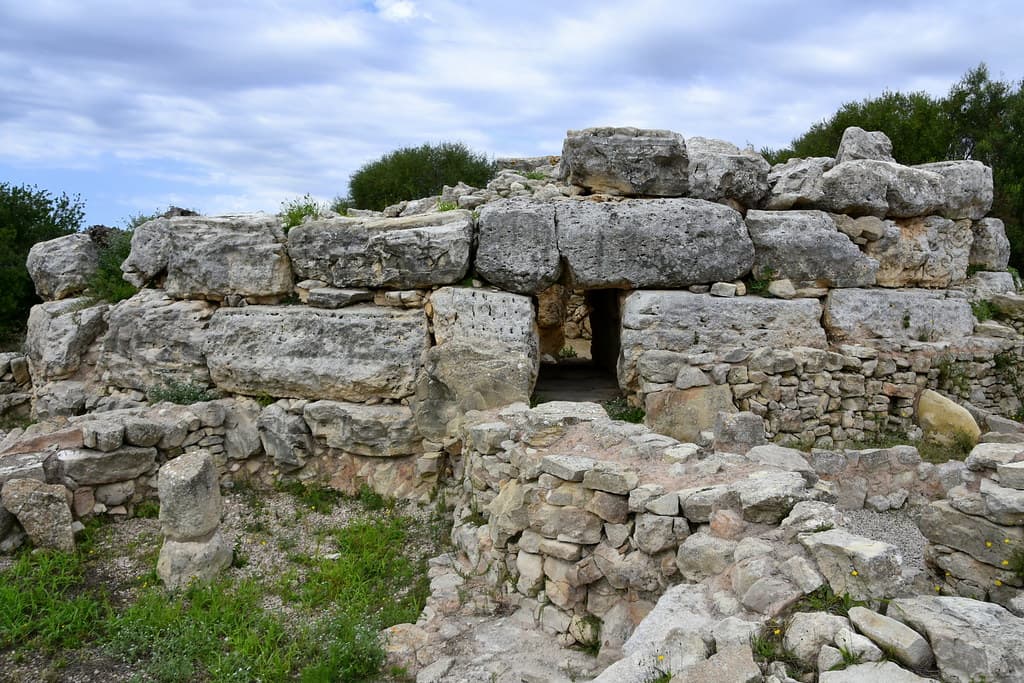
Image of Son Fornés. Image source
Visit essentials
A quick read before you go
- Duration
- A combined visit to the open-air site and the museum, including a guided tour where one is…
- Access
- The archaeological site lies along the Ma-2300 road (Ctra.
Overview
On central Mallorca's agricultural Es Pla, a low stone ridge marks one of the island's longest-inhabited places. Son Fornés was settled around the 10th century BCE and occupied in changing form for close to two thousand years: Talayotic communal tower-building, a Post-Talayotic or “Balearic” phase of new shrines and emerging elites, then Roman-era houses specializing in crafts before gradual abandonment by the mid-1st century CE.
Its layered record includes three talayots—among them Mallorca's largest surviving example—plus house foundations, sanctuaries, and Roman remains. The Universitat Autònoma de Barcelona has led excavations since 1975. In Montuïri, a companion museum in a former flour mill preserves ceramics and tools from the site and supplies the fuller narrative that open ruins alone cannot tell.
Why this place is sacred
There is no evidence in the historical or archaeological record that Son Fornés was regarded as sacred by a later tradition looking back on it, nor does it carry a devotional afterlife the way some ancient sites do. Its significance instead comes from what the ground itself has preserved: a near-continuous sequence of habitation from the Talayotic period through the Roman era, allowing archaeologists to trace social change directly in stone rather than through later retelling.
The earliest layers point to a communal society organized around the talayots — large circular stone towers that appear to have served gathering and possibly ritual functions, though their exact use is not fully established. Later layers show that communal arrangement giving way to greater social stratification: new shrines appear, associated with what researchers interpret as concentrated authority among an emerging elite, and domestic structures grow larger and more differentiated.
By the Roman period, shrines persisted even as houses adapted to specialized production — textiles, pottery, metalwork — before the settlement faded from sustained use, with only sporadic later activity recorded.
A permanently inhabited settlement, not a ceremonial complex built for a single sacred function; its talayots are believed to have combined communal, social, and possibly religious assembly roles, though the balance among these is not precisely known.
From a talayot-centered communal village (10th–6th century BCE) to a more socially stratified settlement with sanctuaries and elite households (6th–3rd century BCE) to a Roman-influenced working village with persistent shrines and craft specialization (3rd century BCE–1st century CE), followed by gradual abandonment and only sporadic later use.
Experience and orientation
The site sits in open country a couple of kilometres from Montuïri, along the road toward Pina, and there is little to announce it beyond low stone walls rising out of cultivated fields. Walking the perimeter path, the first thing that registers is scale: the largest talayot still standing in Mallorca dominates the site, a thick drum of dry-stacked masonry that would have taken real collective effort to raise, long before mortar or metal tools eased the work.
Around it, the footprints of houses and, in later phases, of shrines and drainage-fitted streets, trace the settlement's slow shift from communal village to something more socially divided.
There is no signage-heavy interpretive trail layered over the ruins; the site is presented largely as excavated, which asks more of the visitor's attention but rewards a slower pace — noticing where wall footings from different periods overlap, where a doorway narrows, where the ground itself has been left open to show a cross-section of use.
The museum in Montuïri, a short distance away in a converted historic flour mill, holds the objects — ceramics, tools, and explanatory models — that give the stones on-site their context; the two visits are best taken together rather than separately.
Arrive expecting an open-air excavation rather than a restored monument: exposed foundations and one dominant standing tower, best read with the museum's models and finds as a companion rather than a substitute.
Context and lineage
Son Fornés was first settled at the start of the Talayotic period, roughly the 10th century BCE, when its earliest inhabitants raised three talayots — one of which remains the largest such tower conserved anywhere in Mallorca — alongside a cluster of houses joined by a wall linking two of the towers. No founding narrative or named founder survives; what is known comes entirely from stratigraphy and material culture rather than text or legend.
The site has no continuous devotional or cultural lineage connecting its Talayotic inhabitants to any group living today; its intellectual lineage runs instead through more than a generation of academic archaeology, from the 1975 start of excavation to ongoing university-led research.
Traditions and practice
Talayots are believed by archaeologists to have supported communal gathering and quite possibly assembly or ritual functions during the Talayotic period, and later shrines suggest a more defined religious life emerged alongside social stratification — but the specific rites, if any, practiced at these structures are not preserved and cannot be reconstructed with confidence from the available evidence.
No contemporary ritual or devotional practice takes place at the site; its current use is entirely as an archaeological park and open-air museum, sustained by ongoing university research rather than community observance.
Walk the site slowly and in sequence — the earlier talayots first, then the later houses and sanctuaries — to feel the roughly two thousand years of change move underfoot rather than trying to take the whole settlement in from one vantage. Pause at the base of the largest talayot and take in its footprint before entering; note how much labor its construction implies without machinery or metal tools.
Visit the museum's models and finds either just before or just after walking the ruins, so the stonework and the interpretation reinforce each other rather than competing for attention on the same day.
Talayotic Culture
HistoricalSon Fornés is one of the most thoroughly and continuously excavated Talayotic settlements in Mallorca, providing an unusually long stratigraphic record of the culture's communal origins, later social stratification, and eventual absorption into Roman-period life.
Talayots are believed to have hosted communal gathering and possibly ritual or assembly functions in the earliest phase; later periods saw the construction of shrines associated with emerging elite authority, though specific rites are not preserved in the record.
Archaeological and conservation stewardship
ActiveSince 1975, sustained excavation and research by the Universitat Autònoma de Barcelona's ASOME group, together with the associated museum in Montuïri, has kept Son Fornés an active site of ongoing scholarly work and public heritage interpretation rather than a static ruin.
Ongoing excavation campaigns, academic publication (including recent archaeobotanical research), museum curation and public guided tours, and continued investigation into the site's possible identification with the lost Roman settlements of Tucis or Guium.
Perspectives and open questions
Son Fornés is understood almost entirely through the lens of academic archaeology rather than competing traditional or esoteric readings, though even that scholarly picture still holds open questions about the site's exact identity and ritual life.
Scholarly perspective
Continuous excavation led by the Universitat Autònoma de Barcelona's ASOME research group since 1975 has established Son Fornés as a key reference point for tracing the Talayotic-to-Roman transition in Mallorca: a shift from a communal, talayot-centered society toward increasing social stratification, the emergence of elites and shrines, and eventual integration into and decline within the Roman world. Recent work, including archaeobotanical study of first-millennium-BCE agricultural practice, continues to refine this picture.
Living and traditional perspectives
No continuous indigenous or traditional community maintains a living connection to the Talayotic culture that built Son Fornés; that society did not persist as an identifiable continuous tradition into the present, so there is no traditional-authority perspective to set alongside the scholarly one.
Alternative interpretations
Available sources show no significant esoteric or New Age interpretive tradition attached to Son Fornés, which distinguishes it from some other prehistoric megalithic sites that attract that kind of framing.
Open questions
Whether Son Fornés corresponds to Tucis or Guium — two Roman-era settlements named in ancient textual sources but never conclusively located — remains an open, actively investigated question rather than a settled identification. The precise ritual or social function of the site's multiple talayots, beyond a general communal and assembly role, is also not fully known and may never be recoverable from the archaeological record alone.
Plan your visit
Access and arrival
The archaeological site lies along the Ma-2300 road (Ctra. de Pina), roughly 2 to 2.5 kilometres from the town of Montuïri, and is freely accessible with no admission fee.
The companion museum sits within Montuïri itself, in a converted historic flour mill (Molí des Fraret, Carrer Emili Pou), and charges a modest admission fee (reported at approximately €3.50, with free entry for young children and on the last Sunday of the month); guided tours of the museum, talayot, and mill are reported to be bookable in advance by phone.
No information on mobile phone signal reliability at the open-air site was available at time of writing; visitors relying on navigation or emergency contact should treat this as unconfirmed and check locally, for instance via the museum (contact details on sonfornes.mallorca.museum), before relying on a signal in the field.
Respectful visit
No specific dress code is documented; ordinary outdoor clothing suitable for an exposed, unshaded plain is appropriate, along with sturdy footwear for uneven excavated ground.
No restrictions on photography were found in available sources; this is typical for an open-air archaeological park of this kind, though visitors should follow any signage encountered on-site.
Visitors should not climb on the talayots or other standing structures, should not remove stones or artifacts, and should keep to marked paths to avoid disturbing unexcavated or fragile areas.
Standard heritage-site conduct applies: stay on marked paths, do not climb on or remove material from the standing structures, and treat the exposed stratigraphy — the visible layering of different periods — as fragile evidence rather than incidental rubble.
Location
Map loads as you approach this section.
Pilgrim reflections
A portrait of encounter, not a score
Pilgrims describe what they felt, how present they could become, and whether the place would shape a journey. There are no stars and no ranking of traditions.
No reviewed reflections yet
The first pilgrims can help describe the character of being here.
Share a reflection
Available after an account-backed “Been there.” Every reflection is reviewed before publication.
Nearby sacred places
Explore other sacred places in the region. Proximity does not establish access or travel time; check each place’s guidance.



References
Sources consulted for this page. Source categories describe the publication, not a guarantee that every claim is verified. Traditional accounts and outside interpretations may differ.
- 01Son Fornés — official museum site — Fundació Son Fornés / Ajuntament de MontuïriofficialOfficial site for the associated museum and archaeological park; periodization, museum location, and ongoing UAB-led research since 1975.
- 02Son Fornés Archaeological Site — UAB Archaeology and Palaeontology Campus — Universitat Autònoma de BarcelonaacademicAcademic overview from the university directing excavations since 1975 (Vicenç Lull Santiago, later Rafael Micó, Cristina Rihuete, Roberto Risch); periodization, decline by mid-1st century CE.
- 03Archaeological Site Son Fornés (Mallorca) — Illes Balears Tourist Board (illesbalears.travel)officialOfficial regional tourism authority; site address, free admission, excavated area estimate, two sanctuaries, Roman-period remains.
- 04Crop cultivation in the Talayotic settlement of Son Fornés (Mallorca, Spain): agricultural practices on the western Mediterranean islands in the first millennium BCE — Vegetation History and Archaeobotany (Springer)academicPeer-reviewed archaeobotanical study confirming ongoing academic research at the site into agricultural practices during the Talayotic period; used to confirm scholarly relevance, not for specific crop figures in content.
- 05Archaeological Museum of Son Fornés in Montuïri — spain.info (Turespaña, Spanish national tourism board)officialNational tourism authority confirming museum housed in a converted 17th/18th-century flour mill (Molí des Fraret) and combined site+museum visit format.
- 06Son Fornes Settlement — Ancient Village or Settlement — The Megalithic PortalSource contextEnthusiast/crowdsourced megalith database; used only for coordinates (39.584060 N, 2.967400 E, accuracy noted as 'scaled from a detailed map'), cross-checked against Montuïri town coordinates for plausibility.
- 07Archaeologists Working at Son Fornés May Have Discovered a Roman Long-Lost City on Mallorca — ArkeonewsSource contextReports on recent (as of source) hypothesis linking Son Fornés to the lost Roman-recorded settlements of Tucis or Guium; explicitly framed as a possibility, not confirmed identification — treated as hedged/uncertain in content.
- 08Son Fornes Archaeological Museum, Montuiri — seemallorca.comSource contextTravel guide corroborating museum hours pattern (weekday opening, reduced winter hours, free last Sunday of month) and modest admission fee; used to cross-check practical info, not as sole source.
Share a photo
Help visitors recognize Son Fornés. Every submission is reviewed before publication.