Sanctuary of Cura
The summit sanctuary where Ramon Llull is said to have found illumination
Understand sacred places, explore living traditions, and learn how to engage respectfully with Pilgrim Map.
Access has not been verified. Check current local guidance before planning a visit.
Algaida, Balearic Islands, Spain
Read the sources
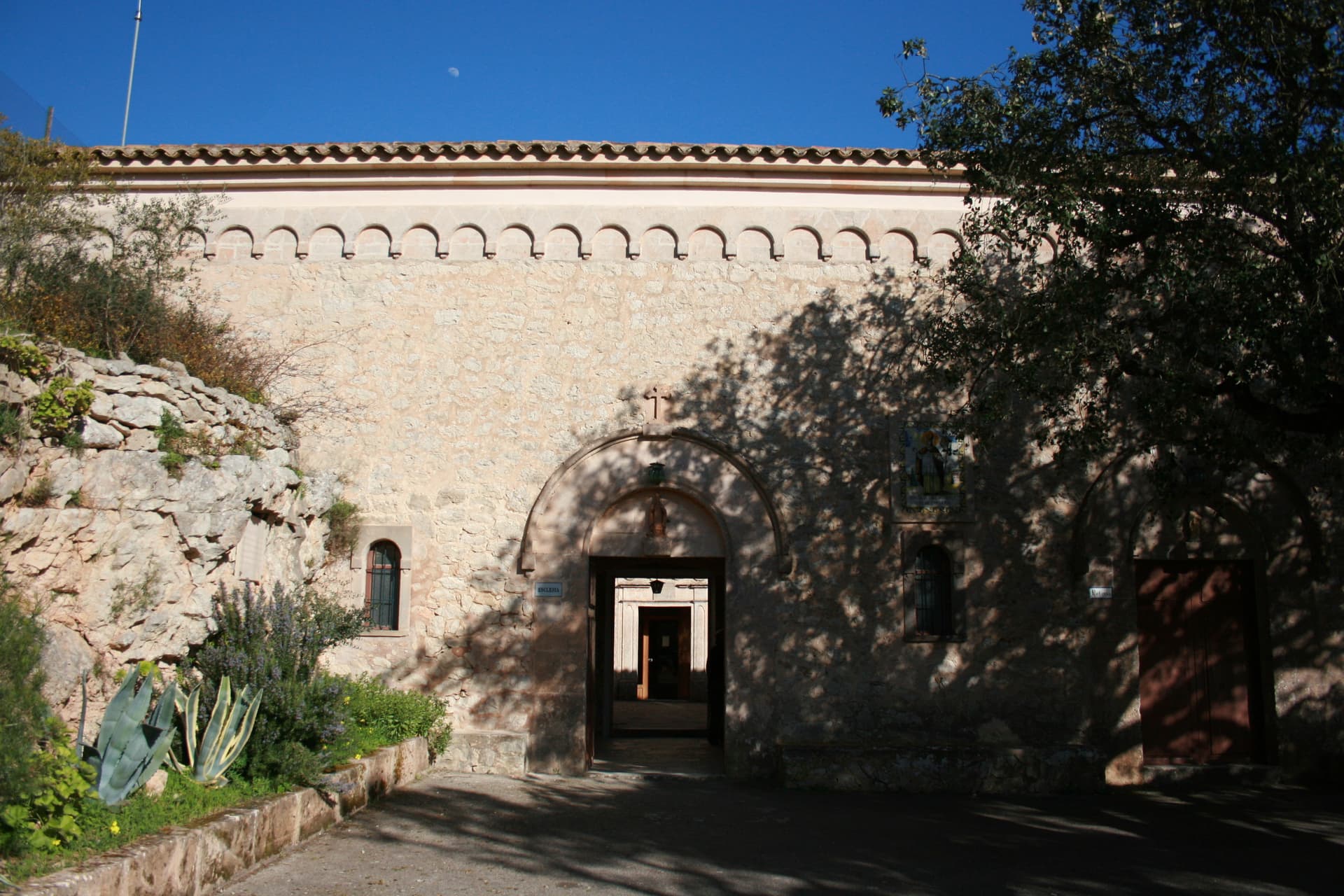
Image of Sanctuary of Cura. Image source
Visit essentials
A quick read before you go
- Duration
- A visit of a few hours is typical to take in the church, museum, cave path, and courtyard…
- Access
- By a winding road of roughly five kilometres from the village of Randa, within the municipality…
Overview
The Sanctuary of Cura stands at 543 metres atop Puig de Randa, a freestanding mountain visible across Mallorca's interior and reached by a winding road from Randa village in Algaida. It is the largest of three historic mountainside sanctuaries: Cura at the summit, with Sant Honorat and Nostra Senyora de Gràcia below. Cura is also the one most closely associated with Mallorca's best-known intellectual figure, Ramon Llull.
Its identity joins Marian devotion to Nostra Senyora de Cura with memory of Llull's hermit years here, reportedly including a spiritual illumination that influenced his theological and philosophical writing. A 17th-century church, former grammar school now serving as a small museum, Franciscan monastery and guesthouse, and Llull's cave on a signposted path near the entrance preserve a site used in some form for retreat and devotion since the late 13th century.
Why this place is sacred
Research did not surface a single, precisely dated founding narrative for the sanctuary. What it does document is a persistent tradition — repeated across the sanctuary's own historical account and independent encyclopedic sources — that Ramon Llull (1232-1316), the Mallorcan logician, philosopher, and theologian, withdrew as a hermit to a cave on Puig de Randa and there underwent a spiritual illumination that shaped his subsequent writing, including elements later echoed in his 'Llibre de l'Amic i l'Amat.'
Sources disagree on the exact year and on Llull's age at the time: one account places the retreat and illumination at around 1274, describing him as roughly forty; another states he withdrew in 1263 at about thirty and remained on the mountain for close to a decade; a further popular account describes him retiring 'when about thirty years old.'
Rather than resolve this discrepancy, this content treats Llull's mountain retreat as a well-attested tradition with a chronology that varies between sources, not a fixed date.
Whatever the precise year, a Marian devotion grew up around the site associated with Llull's retreat, and by the 16th century the sanctuary of Nostra Senyora de Cura had become well known on the island.
Its subsequent history is one of institutional building rather than a single miracle: a Lullian grammar school founded in 1449 that trained students in Llull's philosophy and, from 1501, operated as a royal school of grammar into the 19th century; then decline and roughly seventy years of disrepair following the school's closure around 1830; then restoration from 1913 by the Third Order Regular of St Francis, culminating in the present monastery complex built mainly from 1947 and the 1955 papal coronation of the Virgin's image.
The sanctuary's sacredness, in other words, has been sustained less by a singular revelation than by the accumulated weight of a hermit's cave, a Marian shrine, a centuries-old school, and now a working Franciscan community — each layer building on what came before rather than displacing it.
A hermitage and cave associated with Ramon Llull's contemplative retreat, around which a Marian shrine subsequently formed.
Hermitage and reported illumination associated with Ramon Llull (chronology disputed between sources, variously dated 1263-1275) → Marian shrine and altar → sanctuary's rise to prominence by the 16th century → Lullian grammar school founded 1449, later a royal school of grammar (1501-19th century) → decline and closure around 1830, roughly seventy years of disrepair → restoration from 1913 by the Third Order Regular of St Francis → construction of the present monastery complex from 1947 → papal coronation of the Virgin's image, 1955 → present-day active Franciscan sanctuary, museum, and guesthouse
Experience and orientation
The approach to Cura follows a road of about five kilometres climbing from Randa village, a route also used by cyclists as a hill-climbing challenge. Along the way it passes the mountain's two lower sanctuaries, Nostra Senyora de Gràcia and Sant Honorat, before reaching the summit complex. Just before the entrance, a well-signposted path leads to the cave where Ramon Llull is said to have lived in isolation; visitors can walk it independently of any guided visit.
The sanctuary itself centres on a large stone courtyard bordered by the 17th-century church — dated by a sundial inscription to 1668 — and the former grammar-school building, constructed around 1623, which now houses a small museum (referred to in some sources as the Museu de l'Aula de Gramàtica Ramon Llull) holding religious objects, books, and manuscripts related to Lullism. A portal dated 1682 and a cistern documented as early as 1564 are among the complex's other historic fabric.
From the terrace and courtyard, the views extend across the plain of central Mallorca; several sources describe sightlines reaching Palma Bay and, on clear days, as far as the island of Cabrera. Travel accounts consistently frame the combination of the cave, the church's Gothic-era Virgin and 17th-century Christ figure, the museum, and the elevated outlook as the core of what a visit involves, alongside the practical amenities of a cafeteria and guesthouse run by the resident Franciscan community.
Arrive by the winding access road from Randa, and take the signposted cave path before or after the sanctuary itself. Allow time in the courtyard and church, a brief visit to the museum, and a stop at the terrace for the view before descending — Cura rewards an unhurried half-day more than a quick stop.
Context and lineage
Ramon Llull (1232-1316), a Mallorcan nobleman turned philosopher, logician, and Christian missionary-theologian, is reported to have withdrawn to a cave on Puig de Randa as a hermit and there experienced a spiritual illumination — one account, citing Llull's own semi-autobiographical writing, dates this to around 1274; another dates his withdrawal to 1263, with a stay of close to ten years; a further account simply places it 'when about thirty years old.'
This research treats the exact year as unresolved across sources. The experience earned him the later epithet 'Doctor Illuminatus' and is associated with themes that recur in his writing, including his 'Llibre de l'Amic i l'Amat.' A Marian shrine subsequently grew up at or near the site of Llull's retreat, and by the 16th century the sanctuary of Nostra Senyora de Cura was well established.
In 1449 the scholar Pere Joan Llobet founded a Lullian grammar school at the site, which from 1501 operated as a royal school of grammar and remained one of Mallorca's significant educational institutions until its closure around 1830, after which the sanctuary fell into roughly seventy years of disrepair.
Restoration began in 1913 under the Third Order Regular of St Francis (TOR), who built the present monastery complex mainly from 1947 and oversaw the papal coronation of the Virgin's image in 1955.
Ramon Llull's hermit retreat and reported illumination (chronology disputed, c.1263-1275) → Marian shrine and altar → sanctuary prominence by the 16th century → Lullian grammar school founded 1449 by Pere Joan Llobet → royal school of grammar (from 1501, operating into the 19th century) → school closure c.1830 and roughly seventy years of disrepair → Franciscan (TOR) restoration from 1913 → construction of the present monastery complex from 1947 → papal coronation of the Virgin's image, 1955 → present-day active sanctuary, museum, and guesthouse
Ramon Llull
Philosopher, logician, and theologian (1232-1316) whose reported hermit retreat and spiritual illumination on Puig de Randa is central to the sanctuary's origin tradition; later known as 'Doctor Illuminatus'
Pere Joan Llobet
Scholar credited with founding the Lullian grammar school at the sanctuary in 1449, beginning its centuries-long role as an educational institution
Third Order Regular of St Francis (TOR)
Franciscan community that undertook restoration of the sanctuary from 1913 and constructed the present monastery complex from 1947; still resident today
Traditions and practice
The site's earliest documented practice is Llull's own reported hermit life and contemplative retreat in the mountain cave. From the 15th to 19th centuries, the Lullian grammar school and royal school of grammar structured much of the site's activity around instruction in Llull's philosophy alongside religious education.
Sunday Mass is reported to take place at approximately midday, though visitors should confirm current times with the sanctuary directly. The resident Franciscan (TOR) community maintains the church, museum, and guesthouse, and the sanctuary continues to draw Marian pilgrims as well as general visitors and cyclists using the mountain road.
Visitors are welcome to walk the cave path associated with Llull, sit in the church, and take time at the terrace viewpoint rather than treat the visit as a checklist stop. Those with an interest in Lullian thought may find the small museum's manuscripts and objects worth lingering over.
Roman Catholic Marian devotion
ActiveThe sanctuary is dedicated to Nostra Senyora de Cura, whose image received a papal coronation in 1955. Multiple sources describe it as the second most important Marian pilgrimage destination in Mallorca after the Santuari de Lluc.
Sunday Mass (reported at approximately midday), veneration of the church's Gothic-era Virgin Mary sculpture and 17th-century Christ figure, and general pilgrimage visits.
Lullian contemplative and scholarly tradition
ActiveThe sanctuary's founding tradition centres on Ramon Llull's reported hermit retreat and spiritual illumination on the mountain, and the site subsequently hosted a Lullian grammar school (from 1449) and royal school of grammar (from 1501) that trained students in his philosophy and in missionary preparation into the 19th century.
Visits to the cave associated with Llull near the sanctuary entrance, study of Lullian manuscripts and objects preserved in the small on-site museum, and continuing cultural commemoration of Llull's legacy.
Franciscan monastic life (Third Order Regular of St Francis)
ActiveFollowing roughly seventy years of disrepair after the grammar school's 19th-century closure, the Third Order Regular of St Francis restored the sanctuary from 1913 and built the present monastery complex mainly from 1947, maintaining a resident community there today.
Resident religious life, hospitality through the on-site guesthouse, and stewardship of the church and museum.
Perspectives and open questions
Cura can be read as the site of a specific philosopher's transformative retreat, as Mallorca's second-ranking Marian pilgrimage destination, or simply as the highest viewpoint in central Mallorca — three framings that coexist in the sources without fully resolving into one another.
Scholarly perspective
Biographical accounts of Ramon Llull agree that a period of hermit retreat and intellectual-spiritual transformation on Puig de Randa was formative for his subsequent work, but they diverge on the precise chronology — variously dating his withdrawal to 1263 or his illumination to around 1274, and describing him as either about thirty or about forty at the time.
No academic architectural survey of the sanctuary's current buildings was located in this research pass; institutional history (the grammar school, its 1449 founding, its 1830 closure) is documented mainly through the sanctuary's own historical account and general encyclopedic sources rather than independent scholarship.
Living and traditional perspectives
Within Mallorcan Catholic tradition, Cura is understood as the place of Llull's illumination and as a major Marian shrine — the island's second most important pilgrimage site after Lluc — sustained institutionally first by the Lullian grammar school and now by the resident Franciscan (TOR) community, whose members treat the site as an active home and place of hospitality rather than a historical curiosity.
Open questions
The precise year of Llull's retreat and illumination, and the exact moment the Marian shrine that preceded today's sanctuary first took shape, remain variously reported rather than definitively fixed across the sources consulted. No source located in this research pass addressed any pre-Christian use of the mountain summit, though nearby slopes are reported elsewhere to carry Islamic-era defensive remains.
Plan your visit
Access and arrival
By a winding road of roughly five kilometres from the village of Randa, within the municipality of Algaida, Mallorca. The Balearic Islands' official tourism board lists a full address, phone number, and email for the sanctuary, though this profile does not reproduce those contact specifics verbatim; visitors should confirm current contact details directly with that source before travelling. No confirmed public transport route to the summit was found in research; most visitors arrive by car or bicycle.
The sanctuary itself operates a guesthouse ('spiritual hotel') with modestly priced rooms run by the resident Franciscan community. Additional accommodation is available in the villages of Randa and Algaida nearby, though specific options were not confirmed in sources consulted.
Respectful visit
No specific dress code was documented in research; modest, respectful clothing is advisable, as at other active Mallorcan sanctuaries, particularly during Mass.
No explicit restriction was found in research; general discretion is advisable inside the church and during services.
No specific offering customs were documented in research.
No formal access restrictions beyond respecting the private areas of the monastery and guesthouse and being mindful during Mass and other religious observances.
This is an active church and monastery, not a secular heritage attraction; areas reserved for the resident community should be respected, and visitors should be mindful of Mass times and other religious observances in progress.
Location
Map loads as you approach this section.
Pilgrim reflections
A portrait of encounter, not a score
Pilgrims describe what they felt, how present they could become, and whether the place would shape a journey. There are no stars and no ranking of traditions.
No reviewed reflections yet
The first pilgrims can help describe the character of being here.
Share a reflection
Available after an account-backed “Been there.” Every reflection is reviewed before publication.
Nearby sacred places
Explore other sacred places in the region. Proximity does not establish access or travel time; check each place’s guidance.


References
Sources consulted for this page. Source categories describe the publication, not a guarantee that every claim is verified. Traditional accounts and outside interpretations may differ.
- 01Puig de Randa — Wikipedia — Wikipedia contributorsacademicCoordinates (39.52722°N, 2.92472°E), elevation (543m), confirms location in Algaida municipality and Ramon Llull association (site of his penance after conversion)
- 02History — Santuari de Cura — Santuari de Cura (Franciscan TOR community)officialOfficial sanctuary history: Islamic-era defensive remains on the mountain, Llull's illumination 'around 1274' per his autobiography, 14th-century hermitage, 1394 permanent hermits confirmed by the Bishop, Grammar School as one of Mallorca's three major schools by the 15th century, closure ~1830, 70 years of decay, 1913 Franciscan restoration, 1947 monastery construction, 1955 papal coronation of the Virgin
- 03Ramon Llull — Santuari de Cura — Santuari de Cura (Franciscan TOR community)officialLlull (1232-1316) lived isolated in the cave of Randa where he 'received the enlightenment'; connects this experience to his book Llibre de l'Amic i l'Amat; epithet 'Doctor Illuminatus'
- 04Santuari de Nostra Senyora de Cura — Wikipedia (German) — Wikipedia contributorsacademicStates Llull withdrew as a hermit to Randa in 1263 and lived/worked there for nearly ten years, learning Arabic and founding a school for missionary training; church dates from 1668; restoration begun 1913 by the Third Order Regular of St Francis, extended to the whole complex in 1950; ranks Cura as second most important pilgrimage site in Mallorca after Lluc
- 05Sanctuary Nostra Senyora de Cura (Mallorca) — Agencia de Turisme de les Illes Balears (illesbalears.travel, official Balearic tourism board)officialOfficial tourism-board listing: sanctuary erected near the cave associated with Llull's illumination; 1449 Lullian grammar school founded by Pere Joan Llobet; royal school of grammar from 1501 operating into the 19th century; church dated 1668 via sundial inscription, houses 15th-16th century Gothic Virgin Mary sculpture and 17th-century Christ figure; grammar-school building built c.1623 now housing a small museum; restoration 1913, full complex restoration 1950; address, phone, and email for the sanctuary
- 06Puig de Randa & Santuari de Cura, Algaida — See MallorcaSource contextDescribes Llull arriving 'aged 40, shaken by an incident that made him re-assess his way of life'; three hermitages on the mountain (Oratori de Nostra Senyora de Gràcia, Santuari de Sant Honorat, Santuari de Cura); Sala Gramàtica houses Llull manuscripts; seasonal cafeteria hours; panoramic views to Palma Bay and Cabrera
- 07Santuari Nuestra Senyora de Cura – Monastery and place of pilgrimage — mallorca.comSource contextAccess via a 5km road from Randa village; portal dated 1682; cistern documented 1564; second most important pilgrimage site after Lluc; garden statue of St Francis of Assisi; guest rooms for overnight stays; nearby Santuari de Nostra Senyora de Gràcia (15th c.) and Ermita de Sant Honorat (14th c., still inhabited by monks)
- 08Sanctuary of Cura (The viewpoint of Mallorca) — Spiritual MallorcaSource contextCave of Ramon Llull sits just before the sanctuary entrance, along a signposted path; museum (Museu de l'Aula de Gramàtica Ramon Llull) preserves religious objects, books, manuscripts on Lullism; Sunday mass at 12pm; describes visitor amenities (courtyard, chapel, shop, cafeteria)
- 09Santuari de Nostra Senyora de Cura — Lonely PlanetSource contextGeneral travel-guide listing confirming location atop Puig de Randa and status as a visited monastery/pilgrimage site
Share a photo
Help visitors recognize Sanctuary of Cura. Every submission is reviewed before publication.