Es Turassot
Mallorca's best-preserved cluster of Bronze Age naveta homes
Costitx, Balearic Islands, Spain

Plan this visit
Practical context before you go
Roughly 15-30 minutes at the naveta cluster; the wider Sencelles-Costitx archaeological route, which also takes in Cova del Bisbe and Talaiot de Binifat, takes considerably longer.
Park at the Observatori Astronòmic de Mallorca, Camí de Son Bernat 9, Costitx, then follow the signposted stone path about five minutes on foot. Access is free, with no admission fee reported. No information on mobile phone signal at the site was available at time of writing; check with the Costitx Observatory or Ajuntament de Costitx for current access details.
Standard heritage-site conduct applies: stay on the marked path, leave the stones as they stand, and treat the ruins as you would any protected archaeological monument.
At a glance
- Coordinates
- 39.6419, 2.9513
- Type
- Talayotic Village/Settlement
- Suggested duration
- Roughly 15-30 minutes at the naveta cluster; the wider Sencelles-Costitx archaeological route, which also takes in Cova del Bisbe and Talaiot de Binifat, takes considerably longer.
- Access
- Park at the Observatori Astronòmic de Mallorca, Camí de Son Bernat 9, Costitx, then follow the signposted stone path about five minutes on foot. Access is free, with no admission fee reported. No information on mobile phone signal at the site was available at time of writing; check with the Costitx Observatory or Ajuntament de Costitx for current access details.
Pilgrim tips
- No restrictions found; the site is an open-air public stop on a signposted route.
Overview
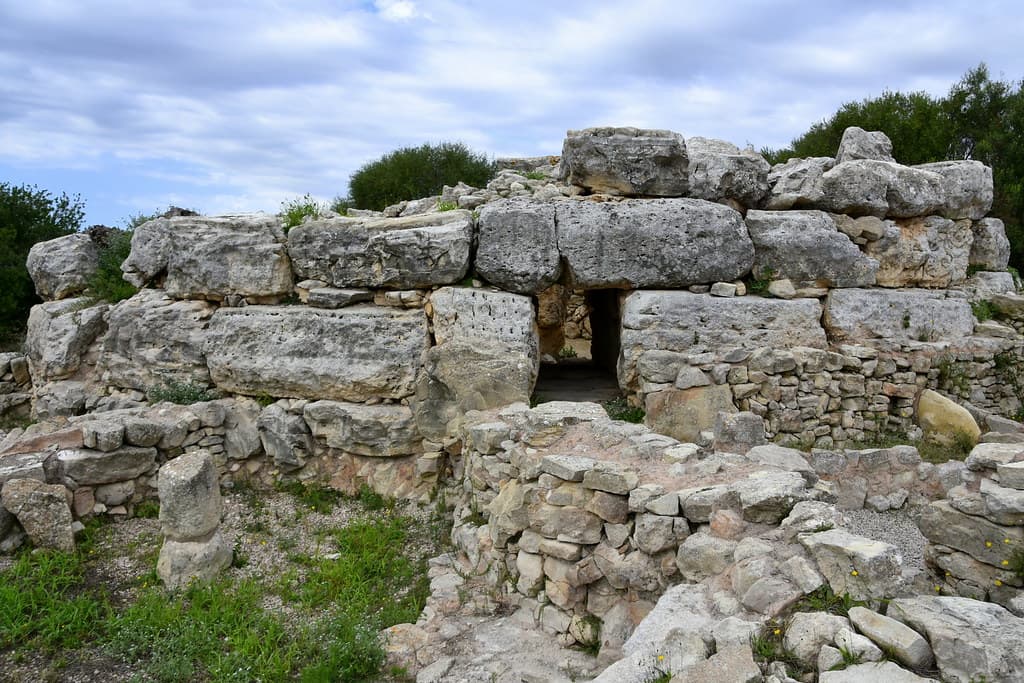
Es Turassot, near Costitx in central Mallorca, is a Bronze Age naviform settlement of six or seven boat-shaped stone dwellings — regarded as the best-preserved group of navetas on the island. Under excavation since 2015, its cyclopean walls and hearth-and-storeroom interiors offer a domestic counterpart to Mallorca's more famous talaiot towers.
Context and lineage
Part of Mallorca's naviform culture, the domestic building tradition that ran alongside and fed into the wider Talayotic culture named for its characteristic talaiot towers.
Why this place is sacred
Es Turassot is not a site of veneration but of memory: a cluster of naveta houses, still standing over three meters tall in places, that lets visitors stand inside a Bronze Age room rather than merely look at one.
A cluster of naviform (boat-shaped) houses built and inhabited during Mallorca's naviform Bronze Age, roughly 1600-1050 BC by available estimates. Excavated interiors show a central hearth, dividing walls creating separate rooms, a western passageway, and a probable storage area, with bone tools recovered on site — the ordinary architecture of daily life rather than ceremony. Every entrance faces south, though no source explains why.
Occupation shows at least two phases, the original open interior later remodeled with a framed entrance set between cyclopean stone jambs. The settlement lay largely unexamined until cleaning, excavation, and restoration began in 2015 with support from the Costitx municipal government and the Consell de Mallorca, work that continues today.
Traditions and practice
Occasional public archaeoastronomy evenings pair a guided tour with a lecture and telescope observation; recent programming has featured CSIC researcher A. César González García. No specific alignment has been confirmed for the navetas themselves.
Walk the interior room by room, noting the hearth, the dividing walls, and the narrower western passage.
Talayotic Culture
HistoricalEs Turassot preserves the domestic side of Mallorca's Bronze Age naviform culture, the building tradition that preceded and ran alongside the island's better-known Talayotic culture of stone watchtowers. Regional heritage sources describe its naveta cluster as among the best-preserved on the island.
Ordinary household life is what the excavated interiors show — a hearth, partitioned rooms, a storage area, and recovered bone tools — rather than any ceremonial function.
Experience and perspectives
A five-minute walk on a marked stone path from the Costitx observatory car park brings visitors to a quiet cluster of massive stone ruins set in open countryside.
Follow the signposted path from the observatory and watch for the black wooden arrow marking the turn; there is no formal entrance sequence, only open farmland closing in around thick walls that still stand taller than a person in places.
Heritage-route and regional tourism sources treat Es Turassot as a genuine and unusually intact naviform Bronze Age settlement. No peer-reviewed excavation report was located in this research; the fuller academic record likely sits in Spanish- or Catalan-language publications outside easy web access.
Periodic archaeoastronomy lectures held at the site reflect public curiosity about ancient sky-watching, but no alignment has been confirmed for Es Turassot specifically.
Why every naveta entrance faces south is not resolved in available sources, and no named excavation director could be identified for the 2015-present campaign.
Pilgrim reflections
A portrait of encounter, not a score
Pilgrims describe what they felt, how present they could become, and whether the place would shape a journey. There are no stars and no ranking of traditions.
No reviewed reflections yet
The first pilgrims can help describe the character of being here.
Share a reflection
Available after an account-backed “Been there.” Every reflection is reviewed before publication.
Visit planning
Park at the Observatori Astronòmic de Mallorca, Camí de Son Bernat 9, Costitx, then follow the signposted stone path about five minutes on foot. Access is free, with no admission fee reported. No information on mobile phone signal at the site was available at time of writing; check with the Costitx Observatory or Ajuntament de Costitx for current access details.
Standard heritage-site conduct applies: stay on the marked path, leave the stones as they stand, and treat the ruins as you would any protected archaeological monument.
No restrictions found; the site is an open-air public stop on a signposted route.
Stay on the marked path, do not climb on or dislodge the cyclopean walling, and do not remove stones, bone tools, or other material from the site.
Nearby sacred places
Sacred places within a half-day’s reach. Pilgrims often visit them together: walk one, stay for the other.


References
Sources consulted when researching this page. Independent verification by readers is welcome.
- 01Majorca's archaeological legacy — Illes Balears Turisme (official Balearic Islands tourism board)high-reliability
- 02Es Turassot — Baleares Antigua — Baleares Antigua
- 03Ruta arqueológica por Sencelles y Costitx — Turisme Petit
- 04Ruta arqueólogica Sencelles – Costitx, los restos de la cultura Talayótica — El discreto encanto de viajar
- 05Arqueoastronomía en Es Turassot de Costitx: Visita, Charla y Observación Astronómica (15 nov. 2025) — AstroMallorca
- 06Es Turassot — OpenStreetMap node 1242636382 — OpenStreetMap contributors
- 07379 Talaiot de Binifat-Navetes des Turassot (Costitx) — Wikiloc community
Key questions
What pilgrims usually ask
- Why is Es Turassot considered sacred?
- Walk through Mallorca's best-preserved Bronze Age naveta homes near Costitx, with hearths and cyclopean walls still standing after 3,000 years.
- Can I take photos at Es Turassot?
- No restrictions found; the site is an open-air public stop on a signposted route.
- How long should I spend at Es Turassot?
- Roughly 15-30 minutes at the naveta cluster; the wider Sencelles-Costitx archaeological route, which also takes in Cova del Bisbe and Talaiot de Binifat, takes considerably longer.
- How do you visit Es Turassot?
- Park at the Observatori Astronòmic de Mallorca, Camí de Son Bernat 9, Costitx, then follow the signposted stone path about five minutes on foot. Access is free, with no admission fee reported. No information on mobile phone signal at the site was available at time of writing; check with the Costitx Observatory or Ajuntament de Costitx for current access details.
- What etiquette should visitors follow at Es Turassot?
- Standard heritage-site conduct applies: stay on the marked path, leave the stones as they stand, and treat the ruins as you would any protected archaeological monument.