Sanctuary of Nostra Senyora de Gràcia
The threshold sanctuary of Puig de Randa's sacred ascent
Understand sacred places, explore living traditions, and learn how to engage respectfully with Pilgrim Map.
Access has not been verified. Check current local guidance before planning a visit.
Llucmajor, Balearic Islands, Spain
Read the sources
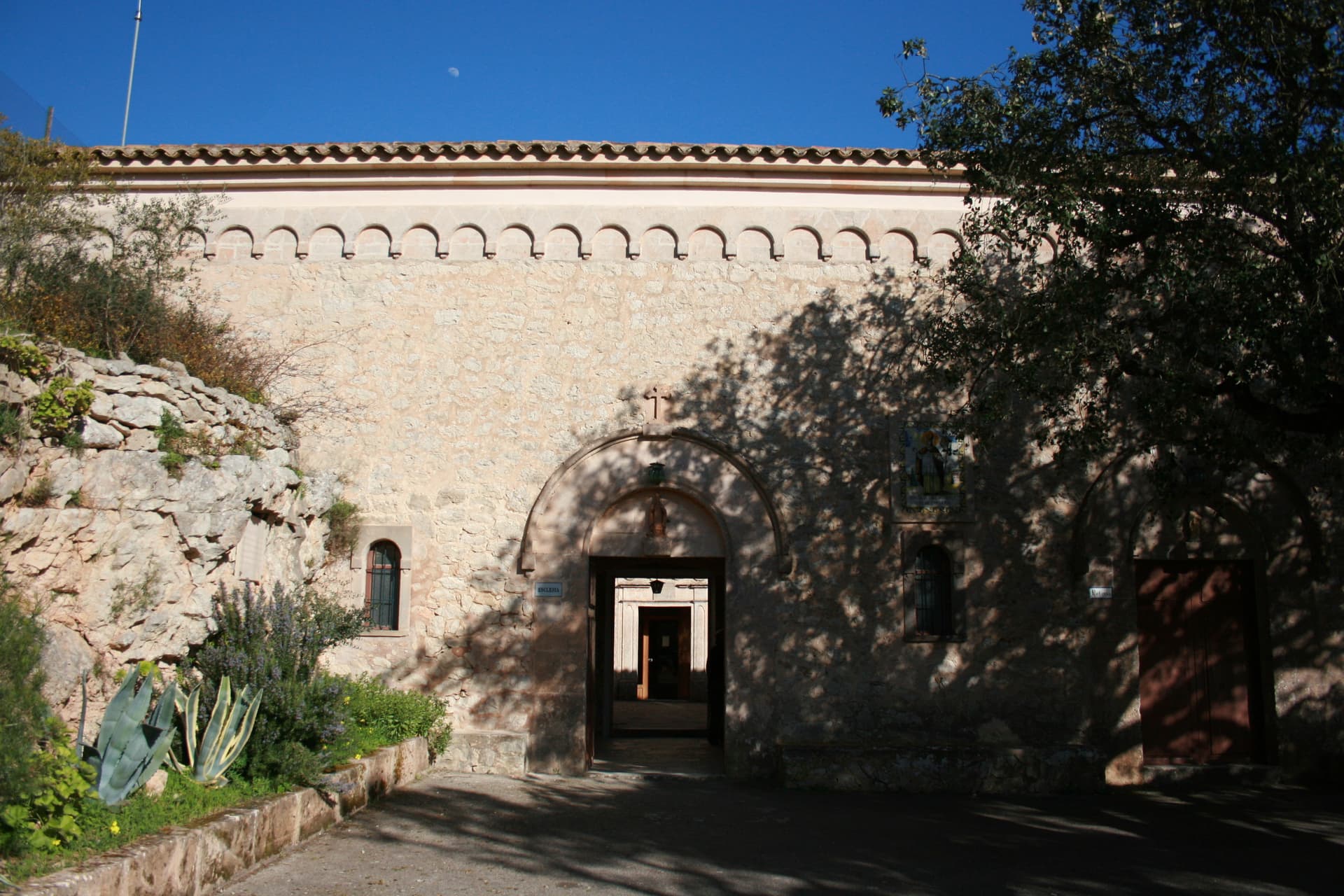
Image of Sanctuary of Nostra Senyora de Gràcia. Image source
Visit essentials
A quick read before you go
- Duration
- Not documented precisely; the chapel's modest single-nave scale suggests a brief visit, commonly…
- Access
- Reached via the Ctra MA-5018 ascending Puig de Randa in the municipality of Llucmajor, Mallorca;…
Overview
The Sanctuary of Nostra Senyora de Gràcia stands low on Puig de Randa's slopes in Llucmajor, Mallorca, beneath the Penya Falconera cliff. Tradition begins in s'Aresta cave, where two Franciscan friars withdrew as hermits in the mid-15th century and gradually shaped their shelter into a place of prayer.
A Gothic church stood here by that century's end. The present neoclassical mountain-stone building, with one vaulted nave and side chapels, replaced it through the 18th century and was finished in 1819. Puig de Randa's three sanctuaries ascend through Gràcia, Sant Honorat, and Cura. Encountered first, Gràcia remains a modest threshold and place of pause before the path continues toward the better-known summit shrine.
Why this place is sacred
What draws attention here is less a legend of vision or miracle than the plain fact of withdrawal: two Franciscan friars chose this cave, and in choosing it set in motion five centuries of continuous religious use on a spot that offered them shelter and little else.
That original impulse — retreat into rock, prayer in enclosure — persists in the building's character even after its Gothic and then neoclassical rebuildings: the church remains modest in scale, fitted into the cliff rather than standing apart from it. Its place within the wider Puig de Randa landscape adds a second, quieter layer of significance.
The mountain is described by regional sources as Mallorca's second most important pilgrimage focus after the Santuari de Lluc, and Gràcia's position as the lowest of its three sanctuaries makes it the first religious threshold a pilgrim or walker crosses on the ascent — a role defined by sequence and geography as much as by any event particular to the site itself.
A hermitage carved from a natural cave, intended for the eremitic retreat of two Franciscan friars rather than for public worship.
What began as a lived-in cave became a Gothic church by the close of the 15th century, then was rebuilt in neoclassical form between the mid-18th century and 1819 — the structure standing today. An 18th-century hostelry beside the church, occupying the former hermit cells, marks the shift from solitary retreat to a site equipped to receive visiting pilgrims.
Experience and orientation
Arrival at Gràcia is arrival at a threshold rather than a destination in itself: the chapel is the first stop on the stone path and road that climbs Puig de Randa toward Sant Honorat and, higher still, Cura. The building presses close against the Penya Falconera cliff, and travel writers note the small scale of the interior — a single nave, side chapels, a domed presbytery — that asks for a pause rather than a lengthy visit.
Sources consulted describe the space as inviting quiet rather than spectacle: a place to sit briefly in the same enclosure the original hermits chose, before the ascent continues toward the mountain's higher and more visited shrine.
Treat it as a first station rather than a culmination — the felt experience described in sources is one of brief, unadorned pause on the way up, not of arrival at a climactic destination.
Context and lineage
Local and tourism-board accounts describe two Franciscan friars withdrawing to the cave of s'Aresta in the mid-15th century — sometimes dated to around 1440, though this specific year is not independently corroborated — and gradually converting their shelter into a chapel. A Gothic church replaced the cave hermitage by the end of the 15th century; the present neoclassical building followed in the 18th and early 19th centuries, completed in 1819.
One of three historic sanctuaries on Puig de Randa, alongside the Ermita de Sant Honorat and the Santuari de Nostra Senyora de Cura, linked by a stone path and understood locally as stages of a single ascent.
Traditions and practice
Sources describe a historical practice of local rogation pilgrimages: communities came to the sanctuary during periods of drought specifically to pray for rain, a practice framed in regional accounts as binding together community, land, and the divine.
The sanctuary functions today as an active Catholic chapel, maintained as part of the Puig de Randa religious complex and visited both by pilgrims walking the mountain's three-sanctuary route and by heritage travelers. No current festival calendar or devotional schedule was confirmed in research consulted.
Approach as the first stage of the wider Puig de Randa walk rather than as an isolated stop — pausing here before continuing toward Sant Honorat and Cura mirrors the sequence the sanctuary has held for pilgrims historically.
Roman Catholic Christianity (Marian devotion)
ActiveDedicated to Nostra Senyora de Gràcia (Our Lady of Grace), the sanctuary is the first of three historic sanctuaries ascending Puig de Randa, a mountain regarded in regional sources as Mallorca's second most significant pilgrimage focus after the Santuari de Lluc.
Marian veneration, individual prayer and visits, and historically, rogation pilgrimages undertaken during drought to pray for rain.
Perspectives and open questions
Interpretation of the sanctuary rests almost entirely on local devotional and tourism-board sources rather than academic scholarship, leaving several details open rather than settled.
Scholarly perspective
No peer-reviewed academic source on this specific sanctuary was located during research; its history as described in tourism and encyclopedic sources — a mid-15th-century hermitage that became a Gothic and then neoclassical church, completed in 1819 — is consistent across the sources consulted but has not been cross-checked against primary archival or academic material.
Living and traditional perspectives
Within local Mallorcan Catholic tradition, the sanctuary is understood as the entry point to the sacred ascent of Puig de Randa, and was historically the destination of rogation pilgrimages made to pray for rain during drought.
Open questions
The precise year of the friars' original settlement (mid-15th century broadly, sometimes given as 1440 specifically) is not independently confirmed, and the attribution of the venerated image of the Virgin — to a 1500 sculpture by Gabriel Mòger II per one source, versus an unattributed Gothic carved image per another — remains unresolved between the sources consulted.
Plan your visit
Access and arrival
Reached via the Ctra MA-5018 ascending Puig de Randa in the municipality of Llucmajor, Mallorca; it is the first and lowest of the mountain's three sanctuaries, connected by path and road to the Ermita de Sant Honorat and the Santuari de Nostra Senyora de Cura higher up.
The Llucmajor municipal tourism office (postal address sometimes given via Plaça d'Espanya 12, 07620 Llucmajor) is the point of contact used in sources for visitor information; this profile does not reproduce a phone number or email, as none was confirmed in research. No mobile-signal, keyholder, or seasonal-closure information was found in research consulted; treat this as an open gap rather than an assumption of full access, and confirm current conditions locally before visiting.
Respectful visit
Not documented in sources consulted; modest dress customary at active Catholic churches is a reasonable default.
Not documented in sources consulted.
Not documented in sources consulted.
None documented beyond ordinary church-visiting conduct.
No specific visitor cautions were documented; general care appropriate to any working parish church applies.
Location
Map loads as you approach this section.
Pilgrim reflections
A portrait of encounter, not a score
Pilgrims describe what they felt, how present they could become, and whether the place would shape a journey. There are no stars and no ranking of traditions.
No reviewed reflections yet
The first pilgrims can help describe the character of being here.
Share a reflection
Available after an account-backed “Been there.” Every reflection is reviewed before publication.
Nearby sacred places
Explore other sacred places in the region. Proximity does not establish access or travel time; check each place’s guidance.


References
Sources consulted for this page. Source categories describe the publication, not a guarantee that every claim is verified. Traditional accounts and outside interpretations may differ.
- 01Sanctuary of Nostra Senyora de Gràcia: Serenity and Devotion in Llucmajor — Visit Llucmajor (municipal tourism office)officialOfficial municipal tourism page; confirms founding history and address
- 02Santuari Nostra Sra. de Gràcia (Mallorca) — Illes Balears Tourism Board (Govern de les Illes Balears)officialOfficial regional tourism board page; describes location on Puig de Randa, the Virgen de Gracia sculpture (1500) by Gabriel Mòger II, Santa Ana chapel, and Valencia tile collection
- 03Santuari de Nostra Senyora de Gràcia — Viquipèdia — Wikipedia contributors (Catalan)encyclopediaMost detailed source; covers founding history, architecture, coordinates, altitude, and the venerated image
- 04Santuario de Nostra Senyora de Gràcia — Llucmajor — Escapada RuralguideTravel guide corroborating founding history and providing alternate coordinate reading
- 05Puig de Randa & Santuari de Cura, Algaida — SeeMallorca.comguideDescribes Puig de Randa's role as Mallorca's second most important pilgrimage site after Lluc, and the three-sanctuary layout (Gràcia, Sant Honorat, Cura)
- 06Randa, the mountain of the three sanctuaries — Hotel Pergola Mallorca (blog)guideDescribes Gràcia as the lowest and first-encountered of the three Randa sanctuaries; notes historical rain-pilgrimage tradition (rogations during drought)
- 07The sanctuary of Gràcia de Randa in Majorca — ViagallicaguideIndependent travel-history site corroborating founding narrative, architecture, and artworks
- 08Santuari de Gràcia. Llucmajor. Mallorca. (historic postcard listing) — TodocoleccionSource contextUsed only as corroborating evidence of the site's name and long-standing local recognition as a tourist/postcard subject; not used for factual claims
Share a photo
Help visitors recognize Sanctuary of Nostra Senyora de Gràcia. Every submission is reviewed before publication.