Sanctuary of Sant Honorat
A quiet hermitage on Puig de Randa, still lived in after six centuries
Understand sacred places, explore living traditions, and learn how to engage respectfully with Pilgrim Map.
Access has not been verified. Check current local guidance before planning a visit.
Algaida, Balearic Islands, Spain
Read the sources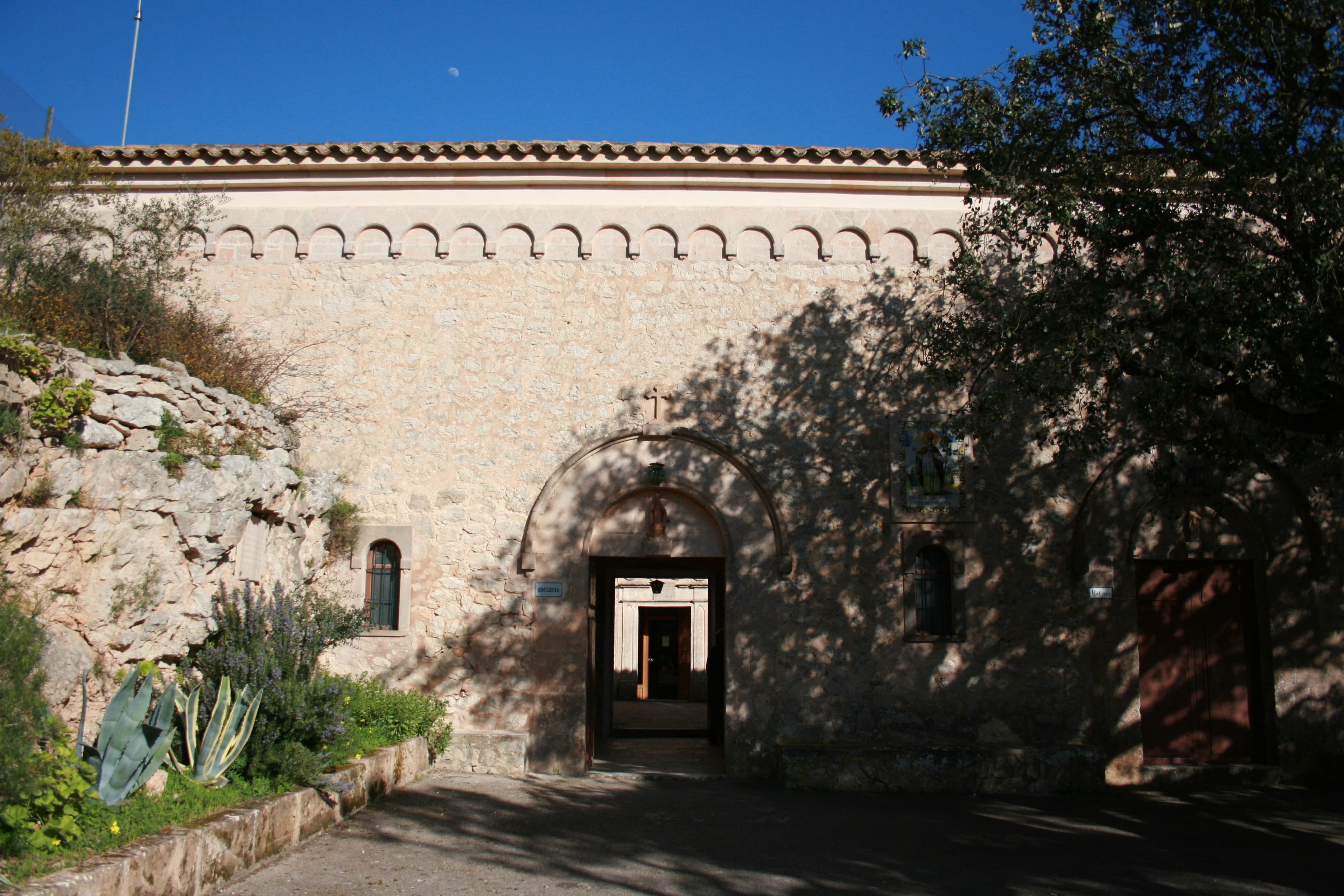
Image of Sanctuary of Sant Honorat. Image source
Visit essentials
A quick read before you go
- Duration
- Not specified in sources; given the site's small scale, a visit of roughly 30-60 minutes is a…
- Access
- By paved access road on the south-facing slope of Puig de Randa, within the municipality of…
Overview
Sant Honorat occupies Puig de Randa's south-facing slope, below the summit and better-known sanctuary of Cura. It began as a hermitage in the 1390s, when hermits settled here and built a chapel blessed within a few years. Unlike Cura, which tradition links to Ramon Llull's hermit years and writing of the Ars, Sant Honorat has remained more modest and institutional: a place where people in religious life have lived, prayed, and organized across generations, largely beyond the tourists climbing higher.
That continuity defines the site. Individual hermits, then a lay confraternity, and then a still-active missionary congregation founded on this exact spot in 1890 have kept the chapel in use, with no break longer than a few decades since the 14th century. The present building, with its 1888 facade and stone-niched interior, records that continuing tenancy rather than one dramatic origin.
Why this place is sacred
Research did not surface an apparition, relic, or miracle narrative behind Sant Honorat's founding. What it documents instead is a straightforward act of eremitic settlement: hermits — named in the more detailed Catalan-language sources as Arnau Desbrull and Miquel Catllar — established themselves on this stretch of the mountainside in the 1390s, and their chapel was blessed by 1397. The sacredness of the site has accrued, rather than been declared, through the length and steadiness of its use.
That steadiness is worth sitting with. Ownership passed from the original hermits to the Confraternity of Sant Pau i Sant Antoni in 1763, who kept the chapel running for well over a century.
When the priest Joaquim Rosselló i Ferrà retired here in 1890, he did not simply retire — within months he founded the Missioners dels Sagrats Cors de Jesús i Maria, the Sacred Heart Missionaries, whose novitiate has operated from Sant Honorat since 1915 and whose members still use the building today as a retreat and retirement house.
Few sacred sites can point to an unbroken chain of residential religious use spanning six hundred years without significant gaps; Sant Honorat's claim to sacredness is largely that continuity itself.
A hermitage built to house solitary religious life on the mountainside, distinct from any single miracle or apparition narrative.
Hermit settlement (1394-1397) → stone chapel rebuilt and reformed (1654-1661, and again reported as 1670 in some sources) → lay Confraternity of Sant Pau i Sant Antoni stewardship (1763 to late 19th century) → founding house of the Missioners dels Sagrats Cors de Jesús i Maria (from 1890, novitiate from 1915) → further renovation (1962) → present-day retreat and retirement residence
Experience and orientation
Sant Honorat is reached by a paved access road climbing the south slope of Puig de Randa, through olive groves and wooded ground, in the municipality of Algaida near the village of Randa. There is no café, no gift shop, no ticket booth.
The 1888 west-facing facade presents two round-arched doorways beneath a crowning cross — one leading into the chapel, the other into the caretaker's office, where a small image of Ramon Llull occupies the tympanum even though his own hermitage tradition belongs to the sanctuary higher up the mountain, not to this one.
Inside, a plain stone wall has replaced a 1928 altarpiece that no longer survives; it holds three niches with images of Sant Honorat, Ramon Llull, and the Blessed Francesc Palau.
Because the site remains a working religious house, visitors move through it differently than they would through a tourist attraction. The residential and retreat quarters are not open, and there is no expectation of a guided tour. What is available — the courtyard, the chapel, and an elevated viewpoint over the central plain of Mallorca — rewards a visit that is unhurried rather than comprehensive.
Travel accounts consistently note the contrast with Cura: less visited, less commercialised, and for that reason able to hold a stiller, more monastic quality.
Drive or walk the paved access road up from Randa village; arrive expecting a working religious house rather than a museum. Spend time at the facade and the interior niches, then take the viewpoint before leaving — there is little else formally laid out for visitors to see.
Context and lineage
The hermits credited with founding Sant Honorat built the site's first chapel between 1394 and 1397; it was blessed within that window. Catalan-language sources name two co-resident hermits, Arnau Desbrull and Miquel Catllar, who are recorded as having already been living on the mountainside before the chapel's construction; some English-language travel sources credit Desbrull alone. No miracle or vision narrative accompanies the founding in the sources consulted — it reads as a settlement, not a revelation.
The chapel was substantially rebuilt in the mid-17th century (accounts vary between 1654-1661 and 1670) after a period when the site had no resident hermits. From 1763 the Confraternity of Sant Pau i Sant Antoni took stewardship and ran the chapel into the late 19th century.
That custodianship ended with the arrival of Joaquim Rosselló i Ferrà in 1890: within months of his retirement to Sant Honorat, he founded the Missioners dels Sagrats Cors de Jesús i Maria, a clerical congregation that established its novitiate at the site in 1915 and continues to use the building as a retreat and retirement residence for priests today.
Hermit settlement (1394-1397) → stone chapel reconstruction (mid-17th century) → Confraternity of Sant Pau i Sant Antoni stewardship (1763-late 19th century) → Joaquim Rosselló's retirement and founding of the Missioners dels Sagrats Cors de Jesús i Maria (1890) → congregational novitiate (from 1915) → building renovation (1962) → present-day retreat and retirement house
Arnau Desbrull
Hermit credited with founding the site in 1394; the chapel was blessed within a few years
Miquel Catllar
Co-resident hermit named alongside Desbrull in Catalan-language sources as already living on the mountainside before the chapel's construction
Joaquim Rosselló i Ferrà
Priest who retired to Sant Honorat in 1890 and, within months, founded the Missioners dels Sagrats Cors de Jesús i Maria there — the congregation still resident at the site
Ramon Llull
Commemorated with an image at Sant Honorat (in the facade tympanum and among the interior niches), though the hermitage, cave, and writing of the Ars traditionally associated with Llull belong to the nearby Santuari de Cura, higher up the same mountain, not to Sant Honorat itself
Traditions and practice
From the 1390s the site supported solitary and small-group hermit life; from 1763 the lay Confraternity of Sant Pau i Sant Antoni maintained regular chapel worship. Neither practice continues in its original form today, but both fed into the site's present institutional character.
The Missioners dels Sagrats Cors de Jesús i Maria use Sant Honorat as a retreat and retirement residence for priests, and the site hosts spiritual retreats and workshops. Locally, the feast of Sant Honorat on 16 May draws devotional visitors, functioning as the site's one clearly dated annual observance identified in research.
Visitors are welcome to sit in the courtyard or chapel rather than treat the site as a checklist stop. Because there is no visitor infrastructure, the most appropriate way to engage is to slow down: read the facade's 1888 doorways and the interior niches for what they record — Sant Honorat, Ramon Llull, and the Blessed Francesc Palau side by side — and take the elevated viewpoint over the plain before leaving.
Roman Catholicism
ActiveSant Honorat has supported Catholic devotional and monastic life continuously since the 1390s: first as a hermitage, then under lay-confraternity stewardship from 1763, and since 1890 as the founding house of the Missioners dels Sagrats Cors de Jesús i Maria. Interior niches venerate Sant Honorat, Ramon Llull, and the Blessed Francesc Palau together.
Mass and liturgical prayer, clergy retreat and retirement residence, spiritual workshops, and an annual local observance of the feast of Sant Honorat on 16 May.
Perspectives and open questions
Sant Honorat reads differently depending on whether it is approached as a footnote to the more famous Cura above it, or as a subject in its own right — a site whose real distinction is quiet, unbroken institutional continuity rather than a single dramatic story.
Scholarly perspective
The sources consulted for Sant Honorat were largely encyclopedic and travel-oriented rather than academic; no dedicated architectural or historical survey of the building was located in this research pass. What scholarly-adjacent sources do agree on is the sequence of custodians — hermits, then the Confraternity of Sant Pau i Sant Antoni, then the Missioners dels Sagrats Cors — though a minor discrepancy exists over whether one or two hermits founded the site.
Living and traditional perspectives
Locally, Sant Honorat is understood as one of the three historic sanctuaries of Puig de Randa, with its own name day on 16 May and a living community — the Sacred Heart Missionaries — for whom the site is not history but home.
Open questions
Detail on daily hermit life at the site in the 14th-17th centuries, and any art-historical analysis of the chapel's architecture, was not located in this research pass and remains an open gap.
Plan your visit
Access and arrival
By paved access road on the south-facing slope of Puig de Randa, within the municipality of Algaida near the village of Randa, lower on the mountain than the summit sanctuary of Santuari de Cura. No opening-hours or booking information was confirmed in research; visitors should check current details locally or via the hermitage's own site before travelling.
No visitor accommodation at the site itself was documented in research; the site functions as a retreat/retirement residence for clergy rather than public lodging. Nearby Algaida and Randa village offer standard local accommodation options, though none were confirmed in sources consulted.
Respectful visit
No specific dress code was documented in research; modest, respectful clothing is advisable given the site's function as an active religious residence.
No explicit restriction was found in research; general discretion is advisable in and around the chapel and any areas where clergy may be present.
No offering customs were documented in research.
Residential and retreat quarters are private and reserved for clergy and monastic guests. Casual tourism is not the site's purpose, though visitors approaching the courtyard, chapel, and viewpoint with respect are described in travel sources as welcome.
This is an active residence for clergy, not a secular heritage attraction; residential and retreat quarters are not open to visitors, and casual sightseeing should be kept to the courtyard, chapel, and viewpoint areas.
Location
Map loads as you approach this section.
Pilgrim reflections
A portrait of encounter, not a score
Pilgrims describe what they felt, how present they could become, and whether the place would shape a journey. There are no stars and no ranking of traditions.
No reviewed reflections yet
The first pilgrims can help describe the character of being here.
Share a reflection
Available after an account-backed “Been there.” Every reflection is reviewed before publication.
Nearby sacred places
Explore other sacred places in the region. Proximity does not establish access or travel time; check each place’s guidance.



References
Sources consulted for this page. Source categories describe the publication, not a guarantee that every claim is verified. Traditional accounts and outside interpretations may differ.
- 01Ermita de Sant Honorat — Viquipèdia — Wikipedia contributors (Catalan)encyclopediaPrimary reference for construction dates (1394-1397), the two founding hermits (Arnau Desbrull, Miquel Catllar), 1654-1661 reform, 1763 Confraternity of Sant Pau i Sant Antoni, 1890 founding of the Missioners dels Sagrats Cors by Joaquim Rosselló, and 1962 renovation
- 02Una mica d'història — Ermita Sant Honorat — Ermita Sant Honorat (official site)officialOfficial hermitage site's own historical account
- 03Randa — Viquipèdia — Wikipedia contributors (Catalan)encyclopediaDescribes Puig de Randa as 'the mountain of the three sanctuaries' (Cura to the north; Sant Honorat and Gràcia to the south) and the mountain's association with Ramon Llull's retreat and contemplation, generally located at Cura rather than Sant Honorat
- 04Biografia de Ramon Llull (1232 † 1316) — Cronicó de MallorcaencyclopediaDescribes Llull's withdrawal to Puig de Randa around age thirty, living as a hermit in a cave, meditating, experiencing illumination, and beginning the Ars — traditionally sited at what is now the Santuari de Cura, not Sant Honorat
- 05Santuari de Sant Honorat, Randa - Mallorca — AccesMallorcaguideDetailed architectural description: 1888 west facade with two round-arched doorways, Ramon Llull image in caretaker-office tympanum, 1928 altarpiece (now disappeared) replaced by stone wall with niches for Sant Honorat, Ramon Llull, and Blessed Francesc Palau; founding attributed to Arnau Desbrull, 1394
- 06Sant Honorat — Majorcan VillasguideCorroborates 1394 founding, 1670 stone chapel construction, 1763 ownership transfer, 1890 founding of Missioners dels Sagrats Cors, current use as retreat residence for priests/monks
- 07The hermitage of Sant Honorat de Randa in Majorca — ViagallicaguideDescribes the site as a small church on the south slope of Puig de Randa, part of the trio of mountain sanctuaries; visitor-oriented description of grounds
- 08Ermita Sant Honorat Map — Monastery — Algaida, Balearic Islands, Spain — MapcartaSource contextCoordinates: 39.51959 N, 2.92817 E; elevation approx. 456 m
- 09Puig de Randa & Santuari de Cura, Algaida — See MallorcaguideRegional context for the three-sanctuary mountain; useful for distinguishing Cura from Sant Honorat and Gràcia
- 10What to see in Ermita de Sant Honorat, Mallorca — VacaliaguideDescribes courtyard, chapel, and forested slopes; character of the site as secluded and non-commercialised; mentions the feast day of Sant Honorat on 16 May as a local pilgrimage occasion
Share a photo
Help visitors recognize Sanctuary of Sant Honorat. Every submission is reviewed before publication.