Son Corró Sanctuary
A Post-Talayotic hall whose original purpose remains debated
Understand sacred places, explore living traditions, and learn how to engage respectfully with Pilgrim Map.
Access has not been verified. Check current local guidance before planning a visit.
Costitx, Balearic Islands, Spain
Read the sources
Visit essentials
A quick read before you go
- Duration
- Allow a short, unhurried stop to read the plan and interpretation; no official duration is…
- Access
- Use the signed Sencelles-Costitx archaeological route and obey current site notices.
Overview
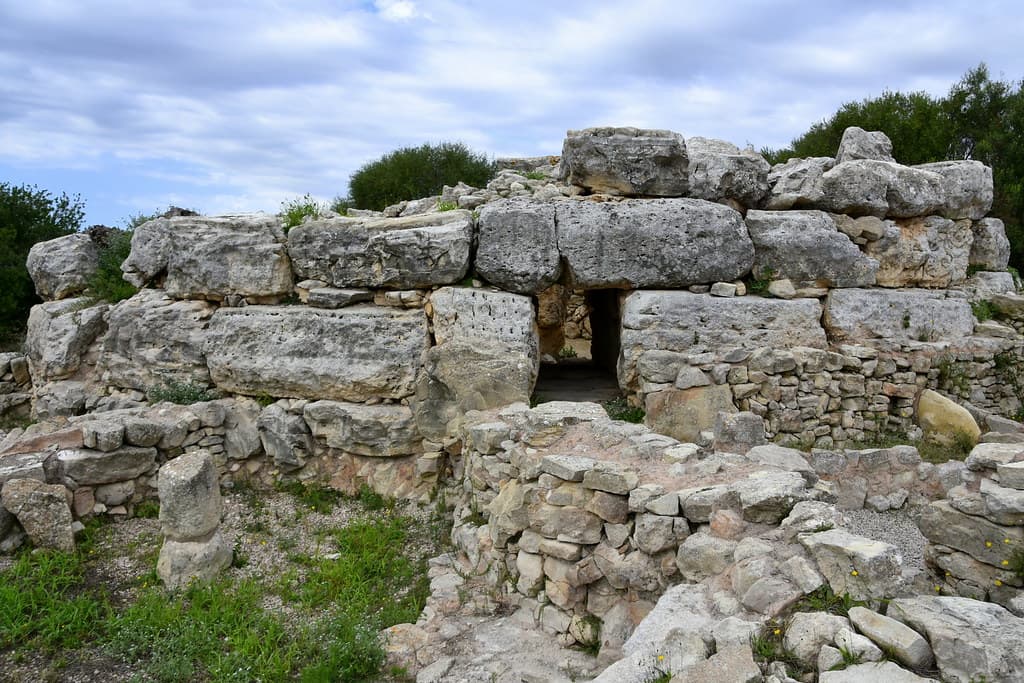
Son Corró survives as a low, reconstructed arrangement of walls and columns in Mallorca's central plain. Its importance is tied to the bronze bull heads discovered there, now held by Spain's National Archaeological Museum. Those finds make the building central to discussions of Post-Talayotic imagery and authority.
The word sanctuary is an archaeological convention here, not proof of a named deity or a complete bull cult. Sencelles's municipal interpretation explains that buildings of this class may have supported cult, elite domestic activity, or both. The evidence supports religious possibility and symbolic use, while requiring uncertainty about who gathered here and what actions took place.
Why this place is sacred
The three bull heads are real archaeological finds, yet their meaning is not self-explanatory. They may have carried religious, political, social, or combined significance. The site's strongest interpretation therefore keeps the objects, architecture, and scholarly alternatives together.
Modern restoration and public interpretation make the place legible today. Reconstructed columns should not be mistaken for an untouched ancient interior, and replicas or displays elsewhere should not be described as if the original bronzes remain on site.
A Post-Talayotic hall whose precise cult, elite residential, or combined function remains debated.
The building was disturbed around the 1895 discovery, later documented and reconstructed, and is now presented as a visitable archaeological stop.
Experience and orientation
From the enclosure, visitors can study the apsidal plan, column arrangement, and rural setting. Interpretive signs and the building's present form help with orientation, but modern reconstruction must remain visible in the story. Do not turn uncertainty into a reenacted ceremony.
The site lies beside the road between Sencelles and Costitx. Follow current signs and remain within the public archaeological enclosure.
Context and lineage
The original builders left no written account. The modern public history begins with the 1895 discovery and later archaeological reconstruction.
Post-Talayotic Mallorca, described through archaeology without claiming a living ritual succession.
Bartomeu Ferrà and Gabriel Llabrés
Early documenters associated with the 1895 discovery
Guillem Rosselló Bordoy
Archaeologist associated with the 1990s restoration
Traditions and practice
The bull images may have participated in symbolic or cult activity, but the same building class may also have housed elite gatherings or residences.
Current activity is conservation, archaeological interpretation, education, and public visitation.
Compare the surviving footprint, reconstructed supports, and documented finds while holding competing explanations open.
Post-Talayotic archaeological tradition
HistoricalThe site preserves material evidence from Post-Talayotic Mallorca and possible cult use within a socially differentiated community.
No specific rite is securely known; cult, elite gathering, residential, and combined interpretations remain under discussion.
Perspectives and open questions
Son Corró is best approached through archaeological evidence and explicit interpretive uncertainty.
Scholarly perspective
The site's conventional sanctuary label, architecture, and bronze finds support possible cult use, while municipal interpretation also allows elite residential or mixed functions.
Living and traditional perspectives
No continuous community account of the building's Post-Talayotic meaning was established in the reviewed sources.
Alternative interpretations
A named bull deity and a definite bull cult are excluded because the evidence does not resolve them.
Open questions
The building's exact social membership, ceremonies, spoken meanings, and relationship between sacred and political power remain uncertain.
Plan your visit
Access and arrival
Use the signed Sencelles-Costitx archaeological route and obey current site notices. Roadside proximity does not authorize stopping where unsafe.
Use established services in Costitx, Sencelles, or elsewhere in Mallorca; none is associated with the monument.
Respectful visit
Use sun protection and footwear suitable for an outdoor roadside archaeological site; no ritual attire is documented.
Non-invasive personal photography is appropriate where current signs permit it. Confirm drone and commercial rules separately.
No living offering practice is documented. Leave nothing at the site.
Current barriers, conservation work, land boundaries, and on-site instructions take precedence.
Do not leave offerings, climb reconstructed elements, or present bull worship as established fact.
Location
Map loads as you approach this section.
Pilgrim reflections
A portrait of encounter, not a score
Pilgrims describe what they felt, how present they could become, and whether the place would shape a journey. There are no stars and no ranking of traditions.
No reviewed reflections yet
The first pilgrims can help describe the character of being here.
Share a reflection
Available after an account-backed “Been there.” Every reflection is reviewed before publication.
Nearby sacred places
Explore other sacred places in the region. Proximity does not establish access or travel time; check each place’s guidance.


References
Sources consulted for this page. Source categories describe the publication, not a guarantee that every claim is verified. Traditional accounts and outside interpretations may differ.
- 01Ruta arqueològica — Ajuntament de SencellesofficialMunicipal identification of Son Corró and explicit uncertainty over cult, elite residential, or combined function.
- 02Plan Territorial de Mallorca - Memoria — Consell de MallorcaofficialIsland-government plan including Son Corró in a route of excavated, conditioned, signposted, visitable archaeological sites.
- 03Santuari de Son Corró — Wikipedia (German) — Wikipedia contributorsencyclopediaCoordinates, dimensions, discovery narrative, and restoration overview.
- 04Son Corró — Wikipedia (Spanish) — Wikipedia contributorsencyclopediaCoordinates, architectural description, discovery, and restoration overview.
- 05Bous de Costitx — Viquipèdia (Catalan) — Wikipedia contributorsencyclopediaBackground on the three heads, their acquisition, and later return campaign.
- 06Son Corró. Santuario — Baleares Antigua — Baleares AntiguaguideRegional archaeology guide used for setting and roadside location.
- 07Cabezas de toro de Son Corró. Els Bous de Costitx — Baleares Antigua — Baleares AntiguaguideRegional description of the bronze bull heads and metalworking.
- 08Costitx Bulls — Atlas Obscura — Atlas ObscuraguideSecondary context for the original bronzes' current location and repatriation discussion.
- 09Santuario de Son Corró, Costitx — mallorca-touristguide — mallorca-touristguide.co.ukguideVisitor-facing account retained for provenance; practical details require current confirmation.
- 10El yacimiento de Son Corró revive tras 25 años sin intervenciones — Última Hora — Última HoranewsRegional reporting on renewed conservation interest.
- 11Bernardí Roig devuelve los Bous de Costitx a su tierra en una performance en Son Corró — Thursday Daily Bulletin — Thursday Daily BulletinnewsReports a 2025 performance referencing the bulls; used only for modern cultural reception.
- 12File:Santuari de Son Corró 07.jpg — Olaf TauschacademicExact-subject image provenance only: Olaf Tausch, own work, CC BY 3.0, with camera coordinate.
Share a photo
Help visitors recognize Son Corró Sanctuary. Every submission is reviewed before publication.