Cova del Bisbe
A Naviform collective burial cave outside Sencelles
Understand sacred places, explore living traditions, and learn how to engage respectfully with Pilgrim Map.
Access has not been verified. Check current local guidance before planning a visit.
Sencelles, Balearic Islands, Spain
Read the sources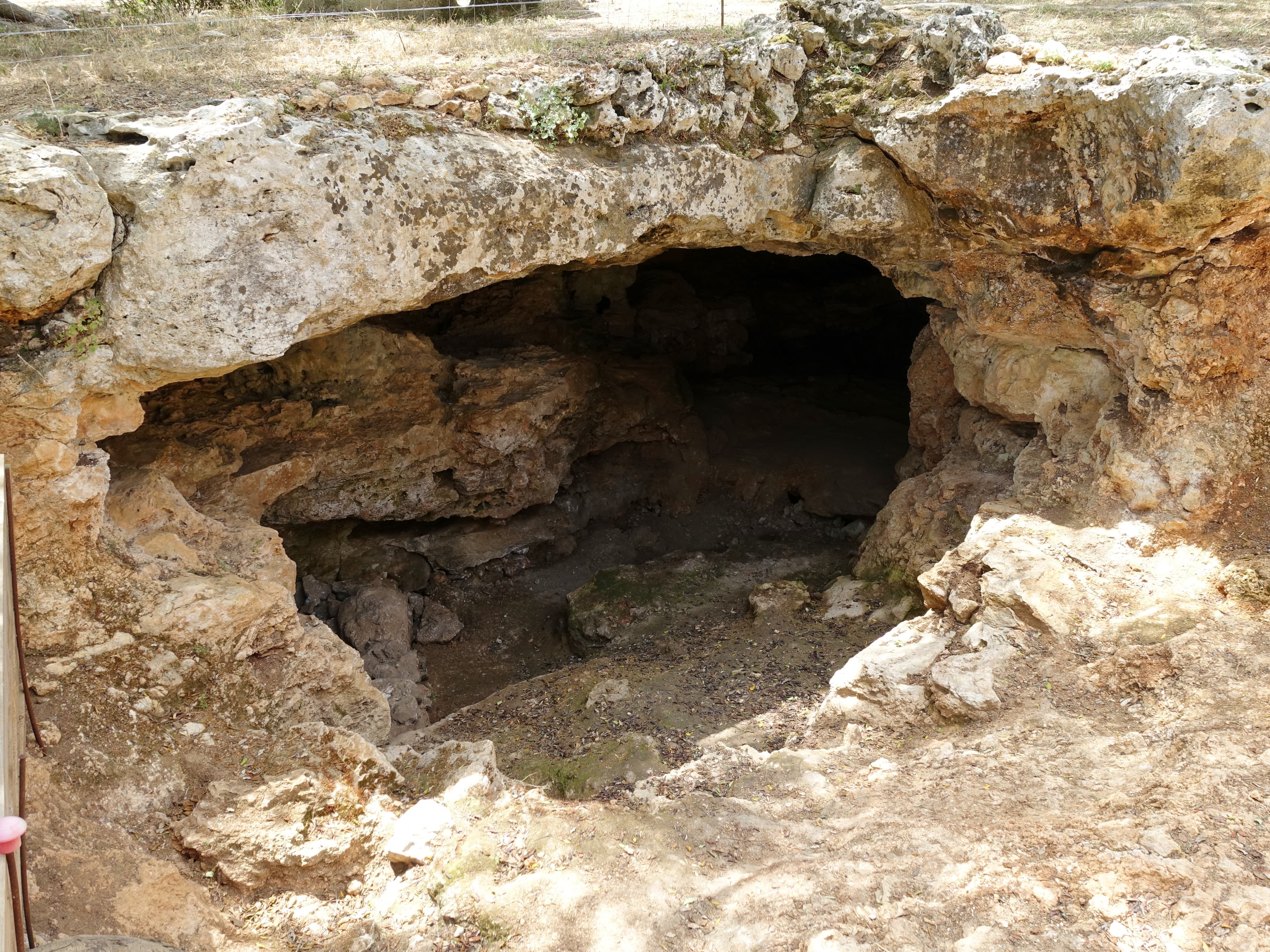
Image of Cova del Bisbe. Image source · CC BY 3.0
Visit essentials
A quick read before you go
- Duration
- No standard visit duration is published; allow a short exterior stop unless joining an…
- Access
- Use current municipal route information and signs.
Overview
Cova del Camp del Bisbe preserves a place where a Bronze Age community returned to care for its dead. Municipal interpretation identifies collective funerary use in the Naviform period, while excavation has revealed a more complicated history of disturbance and later reuse. The cave therefore matters as a burial place and archaeological record, not as a reconstructed temple.
A doctoral study gives a site coordinate that agrees within metres with the approved photograph's camera location, replacing the former village-centre pin. That precision is used for identity, not as permission to enter. The chambers contain human-burial contexts and have been subject to continuing research and protection.
Why this place is sacred
The strongest evidence comes from the cave itself: human remains, funerary context, pottery, animal deposits, and stratigraphy studied by excavation teams. Some later deposits have been interpreted as ritual, but interpretation should remain attributed to researchers rather than presented as a complete belief system.
The site's long use does not mean one unbroken tradition continued from prehistory to the present. Modern excavation, municipal ownership, signage, and cultural events are forms of stewardship and public engagement, not a revival of the ancient funerary practice.
A natural cave used as a collective funerary enclosure during the Naviform period.
The cave was disturbed and revisited in later periods, entered archaeological investigation in 2013, and is now publicly identified within the Sencelles-Costitx archaeological route.
Experience and orientation
The visible entrance and surrounding landscape can orient visitors to the relationship between cave, settlement area, and agricultural plain. Do not infer that a public map pin opens every chamber. Occasional guided programs or events do not create standing permission for independent entry.
Use the corrected cave coordinate and current archaeological-route signage. If a gate, barrier, event boundary, excavation area, or local instruction limits movement, stop there.
Context and lineage
No traditional foundation story is documented. Modern knowledge comes from archaeological investigation begun in 2013 and subsequent municipal stewardship.
Naviform-period funerary practice in Mallorca, described archaeologically rather than as a surviving religion.
Lua Valenzuela-Suau
Archaeologist and author of the doctoral source used for the exact site coordinate
Beatriz Palomar Puebla and Nicolau Escanilla Artigas
Researchers associated with excavation and publication of the cave
Traditions and practice
Bodies and remains were placed within a shared funerary setting. Details of preparation, social roles, words, and belief cannot be fully reconstructed.
Current activity consists of research, conservation, route interpretation, and occasional organized cultural programming.
Observe quietly from permitted areas and reflect on the care represented by a shared burial place without assigning modern beliefs to those interred.
Naviform funerary tradition of Mallorca
HistoricalArchaeological evidence identifies the cave as a shared funerary enclosure during Mallorca's Naviform period.
Collective deposition of the dead is documented; later deposits may reflect additional ritual actions, but their full meaning is not recoverable.
Perspectives and open questions
The site can be understood through municipal heritage interpretation and archaeological research. Personal reflection should remain separate from claims about prehistoric belief.
Scholarly perspective
Excavation supports collective funerary use and documents later deposits and reuse. Some deposits are interpreted as ritual, with uncertainty preserved.
Living and traditional perspectives
No living community was identified as carrying an unbroken ritual tradition from the Naviform users of the cave.
Alternative interpretations
Modern spiritual, energy, or deity claims are not included without site-specific evidence.
Open questions
The names, language, prayers, divine beings, and complete mortuary sequence of the people represented here remain unknown.
Plan your visit
Access and arrival
Use current municipal route information and signs. Treat any gate or closure as controlling, even when a map or older account suggests access.
Use established services in Sencelles or elsewhere in central Mallorca; none is associated with the cave.
Respectful visit
Wear footwear suitable for uneven rural ground; no ancient ritual attire can be responsibly prescribed.
Follow current signs and event instructions. Do not photograph human remains, active excavation, or restricted interiors without explicit permission.
No living offering tradition is documented. Leave no candles, food, flowers, coins, or objects.
Do not cross barriers or enter chambers unless an authorized program explicitly permits it.
Do not enter closed chambers, touch deposits, move stones, leave offerings, or reenact funerary activity.
Location
Map loads as you approach this section.
Pilgrim reflections
A portrait of encounter, not a score
Pilgrims describe what they felt, how present they could become, and whether the place would shape a journey. There are no stars and no ranking of traditions.
No reviewed reflections yet
The first pilgrims can help describe the character of being here.
Share a reflection
Available after an account-backed “Been there.” Every reflection is reviewed before publication.
Nearby sacred places
Explore other sacred places in the region. Proximity does not establish access or travel time; check each place’s guidance.


References
Sources consulted for this page. Source categories describe the publication, not a guarantee that every claim is verified. Traditional accounts and outside interpretations may differ.
- 01Ruta arqueològica - Ajuntament de Sencelles — Ajuntament de Sencelles (municipal government)officialOfficial municipal route page identifying the cave as a Naviform collective funerary site and placing it in the surrounding archaeological landscape.
- 02Talaiotic culture - Wikipedia — Wikipedia contributorsacademicGeneral cultural context only; not used for site-specific sacred claims.
- 03L'edat del bronze a Mallorca. Una aproximació a través de l'anàlisi arqueozoològica — Lua Valenzuela-Suau, Universitat de les Illes BalearsacademicDoctoral thesis giving the cave coordinate and archaeological setting.
- 04Nova senyalització turística i patrimonial a Sencelles — Ajuntament de SencellesofficialMunicipal confirmation of new archaeological-route signage including the cave.
- 05La Cova del Camp del Bisbe: 4 anys recuperant el nostre passat — Sa Sella (local Sencelles cultural association)Source contextLocal heritage association article covering four years (2013-2017ish) of excavation; names the 2014-2018 collaboration agreement between Sencelles Town Council and the Fundació Mossèn Bartomeu Oliver; describes Naviform necropolis use, ivory buttons, carbonized cereals/legumes, and researchers Lua Valenzuela-Suau, Beatriz Palomar Puebla, and Nicolau Escanilla.
- 06L'Ajuntament de Sencelles comprarà la cova del Camp del Bisbe — IB3 NotíciesSource contextRegional public broadcaster news item on the municipal purchase of the cave's land parcel (~3,200 m2 for ~EUR 36,000), funded via a Consell de Mallorca heritage-acquisition grant.
- 07La Cova del Camp del Bisbe se suma al patrimonio local — Última HoraSource context2025 regional newspaper coverage of the site formally entering local heritage protection; cites ~5,000 m2 / ~EUR 40,000 purchase figures, European-fund-backed Consell de Mallorca subsidy, and notes two further chambers remain unexcavated.
- 08Hallan dos nuevas salas en la Cova des camp del Bisbe — Última HoraSource context2015 news coverage of the discovery of two new, largely intact chambers beyond the main entrance and the earlier excavation chronology.
- 09Cova del Camp del Bisbe — Jose Vicente Jimenez Ribas, Baleares AntiguaSource contextIndependent regional heritage summary used only for attributed descriptive context.
- 10Pràctiques rituals a la Cova del Camp del Bisbe (Sencelles) — Lua Valenzuela-Suau and collaboratorsacademicIndexed conference paper on ritual deposits; specific interpretations remain attributed to the researchers.
- 11La Cova del Camp del Bisbe (Sencelles). Dades preliminars de les intervencions 2013-2015 — Valenzuela-Suau et al.academicPreliminary excavation report used for the research chronology and archaeological context.
- 12File:Cova del Camp del Bisbe 04.jpg — Olaf TauschacademicExact-subject image provenance only: Olaf Tausch, own work, CC BY 3.0; camera coordinate agrees with the thesis location.
- 13GPS coordinates of Sencelles, Spain — latitude.toSource contextLegacy village-centre coordinate source retained for provenance but superseded for site location by the doctoral thesis.
Share a photo
Help visitors recognize Cova del Bisbe. Every submission is reviewed before publication.