Sefertepe
A room full of skulls — 10,000 years of ancestral presence on the Şanlıurfa plateau
Understand sacred places, explore living traditions, and learn how to engage respectfully with Pilgrim Map.
Access has not been verified. Check current local guidance before planning a visit.
Şanlıurfa, Turkey
Read the sources
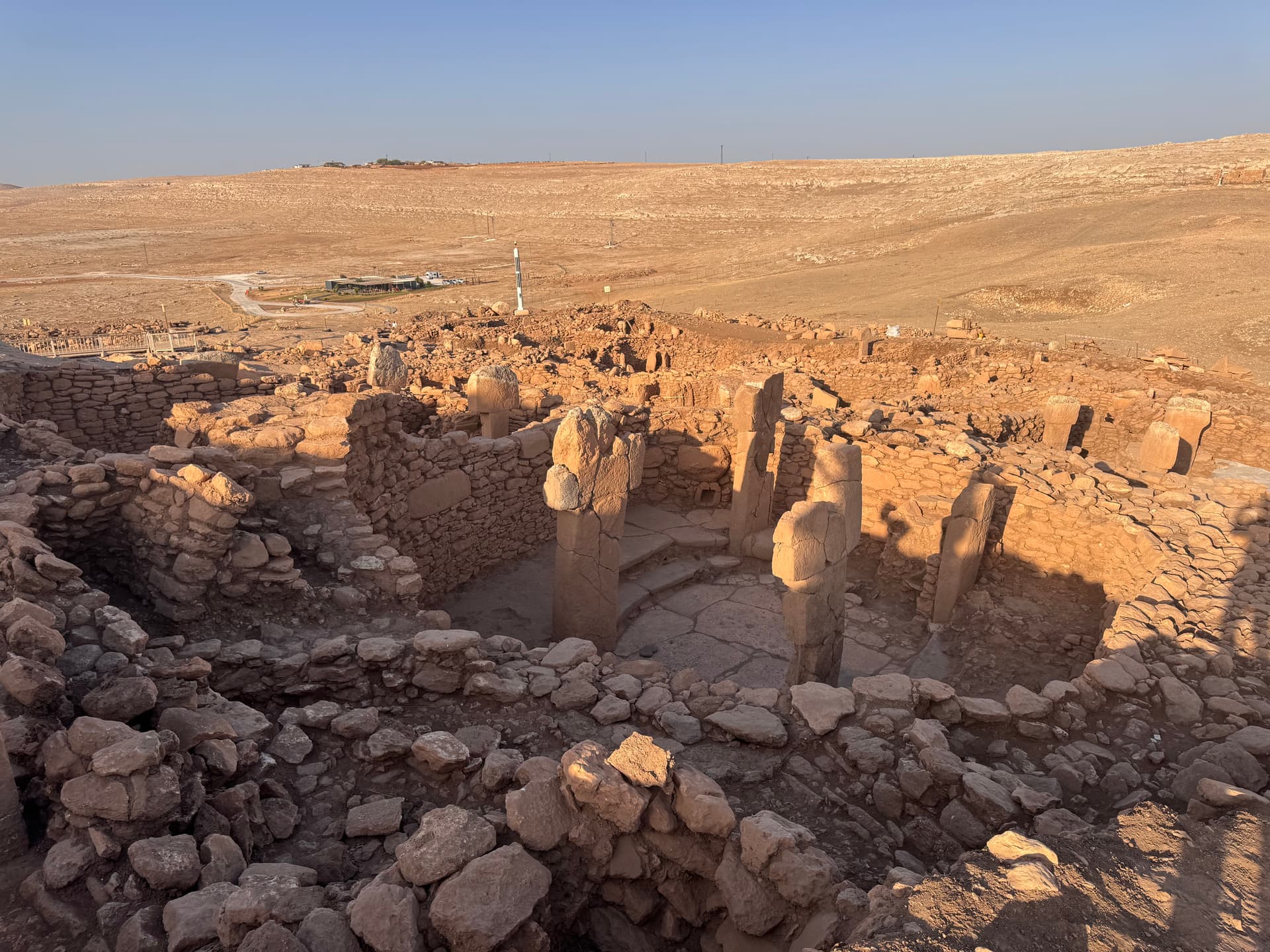
Image of Sefertepe. Image source
Visit essentials
A quick read before you go
- Duration
- Allow 2–3 hours at the site with a guide; the Şanlıurfa Museum visit adds 2 hours and is…
- Access
- Sefertepe is located approximately 72 km east of downtown Şanlıurfa, near Eskikale and Kırbalı…
Overview
Sefertepe lies 72 kilometres east of Şanlıurfa at the boundary of the Tektek Mountains and Viranşehir plains. It is the easternmost known Taş Tepeler site and, in some respects, the network's most intimate. Where Göbekli Tepe impresses through scale and T-pillars, Sefertepe speaks through detail: micro-carved basalt beads requiring magnification, two shaped stone blocks with roughly carved but recognizably individual human faces, and a dedicated skull chamber.
The chamber held thirty-one or more skulls from people ranging from infancy to approximately forty years old. Their gradual, intentional accumulation across many decades or centuries documents a multigenerational practice: ancestors were gathered and kept rather than abandoned after death. Micro-carved beads found alongside symbolic deposits suggest an elaborate visual language scaled for personal touch or intimate ritual.
Excavation is still revealing the site's symbolic program, and its full architectural plan remains unknown. Even so, Sefertepe already ranks among the world's most significant places for understanding Neolithic religious practice.
Why this place is sacred
The quality of presence at Sefertepe is created by accumulation. Thirty-one skulls, gathered over generations, spanning ages from infancy to middle adulthood — the skull room is not a burial ground but a gathering place for the dead. Each skull represents a decision: to bring this person's remains here, to place them among the others, to maintain them in this dedicated space. Across decades or centuries, someone kept doing this.
Whatever motivated that practice — reverence for ancestors, belief in the ongoing spiritual efficacy of the dead, a sense that the community needed its dead present to function properly — it was persistent enough to create a multigenerational institution. The micro-carved beads compound this sense of a world dense with intention.
The carvings are invisible to the naked eye without magnification; they were not made to be seen by a crowd but to be held, to be felt, to be known by the fingers that touched them. This level of investment in small, private, intimate symbolic objects suggests a culture where the sacred operated not only in the monumental (T-pillars, large communal buildings) but also in the personal — in objects small enough to carry, to hold in a closed hand.
Sefertepe sits at the edge of the Tektek Mountains, at the transition between upland and steppe — a landscape boundary that the site's builders may have chosen deliberately. In many traditions, sites of ancestral veneration are positioned at thresholds: between up and down, between wild and cultivated, between the world of the living and the world of the dead.
Quadrangular buildings with lime-clay floors, internal benches, and platforms, combined with specialized structures including the skull chamber — a multi-purpose settlement that integrated domestic, communal, and mortuary functions in close proximity
Occupied in the Pre-Pottery Neolithic B period (10th millennium BCE); registered as an archaeological site in 2013; excavations began 2021 under Istanbul University within the Taş Tepeler framework; each season since 2021 has produced significant new finds, including the skull room (2024–2025), face reliefs, and micro-carved beads
Experience and orientation
Sefertepe is less developed than Göbekli Tepe and retains the rawness of a site in the early stages of excavation. This quality is not a limitation; it is the experience. The trenches are open, the soil is fresh, and the discoveries being made here now — the skull room, the face reliefs, the micro-carved beads — are recent enough that the archaeologists working on them are still formulating their interpretations.
Arriving at Sefertepe means arriving at the edge of human knowledge about the Neolithic. The landscape helps frame this. The site lies 72 kilometres east of Şanlıurfa on the boundary between the Tektek Mountains and the Viranşehir plains — a topographic transition zone where upland and steppe meet. The limestone plateau is wide and open; the site sits within it without drama, a low profile of excavated trenches on a hilltop.
The drama is underground, and in the objects that have been brought up from it. If access permits, observe the skull chamber area from whatever proximity the guide allows. The knowledge that the skulls were placed there not in a single event but across generations — that this was a practice sustained over time — changes the quality of attention you bring.
You are not looking at the site of a disaster or a plague; you are looking at a place of sustained, intentional care for the dead. That difference matters. The micro-carved beads, when displayed in the Şanlıurfa Museum, require you to lean in close. They are that small.
That act of leaning in — of adjusting your perception to the scale of the object — is itself a form of contemplative engagement with the kind of attention the people of Sefertepe brought to their symbolic world.
Access through organized Taş Tepeler tours from Şanlıurfa. The site is approximately 72 km east of the city, near Eskikale and Kırbalı districts, about 25 km west of Viranşehir. A private vehicle or organized tour is essential. The Şanlıurfa Museum displays finds from Sefertepe and is worth visiting before or after the site to understand the material culture in context.
Context and lineage
Sefertepe was first identified by archaeologist Ahmet Cihat Kürkçüoğlu during regional survey and formally registered as an archaeological site in 2013. Excavation began in 2021 under Istanbul University's Prehistoric Archaeology Department, supervised by Şanlıurfa Museum within the Taş Tepeler Project framework. The site's Pre-Pottery Neolithic B date places it slightly later than Göbekli Tepe's founding phases but fully within the active period of the Taş Tepeler ceremonial network.
Each subsequent excavation season has produced major discoveries: the first skull found in a niche, then the skull chamber with its multigenerational accumulation, then the micro-carved beads, and in 2025, two stone blocks bearing carved human face reliefs. The full architectural plan — including how many communal buildings, how many domestic structures, and the total extent of the settlement — remains to be revealed.
Sefertepe is the easternmost confirmed site of the Taş Tepeler Pre-Pottery Neolithic cultural network, which extends westward through Karahantepe, Göbekli Tepe, Sayburç, and Çakmaktepe across the Şanlıurfa Plateau. The shared architectural vocabulary — T-shaped pillars, lime-clay floors, internal benches, specialized communal buildings — and the shared symbolic repertoire — skull veneration, human face representations, animal iconography — indicate a connected cultural world rather than independent local developments.
Ahmet Cihat Kürkçüoğlu
Discoverer of the site during regional survey; responsible for its initial registration in 2013
Istanbul University Prehistoric Archaeology Department
Excavation team conducting work since 2021; responsible for discovery of the skull room, face reliefs, and micro-carved beads
Taş Tepeler Project / Şanlıurfa Museum
Institutional supervisors of excavation and heritage promotion; overseeing the site's integration into the broader Taş Tepeler narrative
Pre-Pottery Neolithic B community (c. 10th millennium BCE)
The original builders; their sustained practice of skull curation in a dedicated chamber over multiple generations defines the site's significance
Traditions and practice
Sefertepe's skull chamber is distinct from simpler forms of skull curation documented at other Neolithic sites. The thirty-one or more skulls found there span an extraordinary demographic range — from infants to adults of approximately forty years — and the accumulation was gradual, extending over what may have been decades or centuries. This is not the aftermath of a single event; it is the record of a sustained institutional practice.
Someone was designated, generation after generation, to bring the skulls of the dead to this room. The room itself had two connected chambers — a main skull chamber and an adjacent cell — suggesting that the practice was spatially differentiated, with different parts of the mortuary process occurring in different spaces.
The micro-carved beads found in association with symbolic deposits represent an extraordinary refinement of intention: carvings executed at a scale that requires magnification to see, made for personal rather than communal display, suggesting an intimate ritual dimension alongside the more public architecture of T-pillars and communal buildings. The two human face reliefs on shaped stone blocks — each depicting a recognizably individual face — may represent ancestors, founding figures, or supernatural beings.
Their placement in architectural contexts suggests they served as focal points within the sacred or communal space.
Excavation is ongoing under Istanbul University within the Taş Tepeler Project framework. Guided tours through Taş Tepeler programs are available, though access to the skull chamber area is strictly controlled. Şanlıurfa Museum displays finds from Sefertepe alongside other Taş Tepeler material.
The skull room cannot be visited casually, and the knowledge that it exists changes how you experience the rest of the site. Walk the excavated areas with the awareness that somewhere nearby — in the earth, in the walls, in the configurations of floor and niche — a practice of sustained ancestral care was maintained for generations.
Look at the T-pillars or their remnants, if visible, and consider that the same community that gathered skulls in a dedicated room also erected these anthropomorphic stone figures: the dead were kept; the ancestors were given form in stone; the boundary between the human dead and the community of the living was actively managed through architecture and symbol. If you visit the Şanlıurfa Museum before the site, ask specifically to see the Sefertepe micro-carved beads. Hold the scale in mind.
Then go to the site and look at the T-pillars, which may stand two metres high. The community worked simultaneously at both scales.
Archaeological / Scholarly
ActiveThe most easterly Pre-Pottery Neolithic site of the Taş Tepeler network; producing extraordinary evidence of Neolithic skull cult practices, human face reliefs, and micro-carved symbolic objects in ongoing excavations since 2021
Annual excavation seasons by Istanbul University Prehistoric Archaeology Department under Şanlıurfa Museum supervision; publication of season reports; integration into Taş Tepeler guided tour program
Pre-Pottery Neolithic Skull Cult / Ancestor Veneration
HistoricalA dedicated skull room containing thirty-one or more skulls from individuals spanning infancy to approximately forty years, accumulated over multiple generations — the most extensive multigenerational skull curation program documented in the Taş Tepeler network
Deposition of skulls and skull fragments in a dedicated two-chamber mortuary space; production of micro-carved symbolic beads; carving of human face reliefs on architectural stone blocks; T-shaped pillar construction in communal buildings
Perspectives and open questions
Sefertepe's skull chamber invites interpretations that range from strictly demographic analysis to speculative reconstructions of an ancestral religion. The site is new enough — excavations began only in 2021 — that the scholarly synthesis is still forming.
Scholarly perspective
The current scholarly consensus, as represented in excavation reports and media coverage of the Istanbul University team's findings, identifies Sefertepe as a Pre-Pottery Neolithic B site in the easternmost extent of the Taş Tepeler network. The skull room's demographic range — spanning infants through adults of approximately forty years — is interpreted as evidence of a sustained, multigenerational mortuary practice rather than a mass burial event.
This aligns Sefertepe with the broader Near Eastern skull cult tradition, though the specific combination of skull curation, micro-carved beads, and face reliefs is unique to this site. The T-shaped pillars connect it architecturally to Göbekli Tepe and Karahantepe. The 2025 discovery of two human face reliefs on shaped stone blocks has added a new dimension to the symbolic program that has not yet been fully analyzed in peer-reviewed literature.
Living and traditional perspectives
No living tradition is directly connected to Sefertepe. The site is within modern Kurdish-majority southeastern Turkey; the prehistoric culture that produced the skull chamber left no surviving cultural descendants in the region.
Alternative interpretations
The multigenerational skull curation practice at Sefertepe — spanning infants through adults — has prompted some researchers to propose that the community maintained a literal ancestral chamber: a room where the dead could be consulted, where they continued to participate in community decisions, or where their presence provided protection.
This interpretation draws on anthropological analogies with documented skull veneration traditions from Papua New Guinea, Madagascar, and Southeast Asia, where preserved skulls of ancestors are understood to be active spiritual agents rather than passive relics.
Open questions
Why skulls representing such a wide demographic range — including infants — were selected for the chamber is unknown. The identity of the individuals depicted in the face reliefs is unclear; they may represent specific venerated ancestors, mythological figures, or idealized human forms. Whether the T-pillars at Sefertepe bear carved animal iconography similar to Göbekli Tepe's zoomorphic reliefs is not yet known. The full architectural plan of the site has not been uncovered.
Plan your visit
Access and arrival
Sefertepe is located approximately 72 km east of downtown Şanlıurfa, near Eskikale and Kırbalı districts, about 25 km west of Viranşehir. Access requires a private vehicle or organized Taş Tepeler tour. Şanlıurfa (GAP Airport) has connections to Istanbul, Ankara, and other Turkish cities. Organized tours depart from Şanlıurfa; contact Şanlıurfa Museum or Taş Tepeler Travels (tastepelertravels.com) for current arrangements.
Mobile phone signal is generally available on the main road to Viranşehir but may be unreliable at the site; carry a charged phone and ensure your guide has emergency contact information. No entry fee or visitor infrastructure is currently present at the site; all visits require prior arrangement.
Şanlıurfa city is the practical base; it offers a range of accommodation options from budget to mid-range. Viranşehir (approximately 25 km east of the site) has basic guesthouses but limited infrastructure. For visitors combining Sefertepe with Karahantepe, Şanlıurfa remains the most convenient base for both sites.
Respectful visit
Modest dress appropriate for rural southeastern Turkey; practical footwear for uneven terrain; sun protection is essential on the exposed plateau in spring and summer.
Follow guide instructions specifically regarding the skull chamber and face reliefs; these may have photography restrictions. Landscape and general architectural context photography is typically acceptable.
None customary.
Access to the skull chamber and excavation areas is strictly controlled. Do not touch any architectural surfaces, carved reliefs, or exposed deposits. Follow all Taş Tepeler guide instructions; the guides' authority on access is absolute.
The skull chamber and associated excavation areas are strictly controlled; do not attempt to access them outside of organized tour arrangements. Human skeletal remains are present; treat the entire site with the respect appropriate to a mortuary context, even where direct remains are not visible. Follow all guide instructions without exception.
Location
Map loads as you approach this section.
Pilgrim reflections
A portrait of encounter, not a score
Pilgrims describe what they felt, how present they could become, and whether the place would shape a journey. There are no stars and no ranking of traditions.
No reviewed reflections yet
The first pilgrims can help describe the character of being here.
Share a reflection
Available after an account-backed “Been there.” Every reflection is reviewed before publication.
Nearby sacred places
Explore other sacred places in the region. Proximity does not establish access or travel time; check each place’s guidance.


References
Sources consulted for this page. Source categories describe the publication, not a guarantee that every claim is verified. Traditional accounts and outside interpretations may differ.
- 01Sefertepe - Taş Tepeler Official Site — Taş Tepeler Project / Turkish Ministry of CultureofficialOfficial Taş Tepeler project description of the site
- 02Sefer Tepe: A New Pre-Pottery Neolithic Site in Southeastern Turkey — Kürkçüoğlu, A.C. et al.academicInitial academic publication announcing the site's discovery and classification
- 03Neolithic human skull found in a niche at Sefertepe provides new insights into burial customs — Anatolian ArchaeologySource contextCoverage of skull niche burial discovery
- 0412 Ancient Human Skulls Unearthed at Sefertepe, Offering New Insights into Neolithic Rituals — Anatolian ArchaeologySource context2025 excavation season findings: 12 skulls, skull room, dual chambers
- 05At Sefertepe, Tiny Carvings and a 10,000-Year-Old Skull Room Reveal an Unexpected Symbolic World — Anatolian ArchaeologySource contextDetailed description of micro-carved bead and skull room symbolism
- 0610,000-year-old human face reliefs found at Sefertepe — Heritage DailySource contextCoverage of two carved human face reliefs found on shaped stone blocks
- 0710,500-Year-Old Skulls Found at Sefertepe, Turkey, Suggest Neolithic Rituals — Greek ReporterSource contextNews report on 2025 skull discoveries and demographic diversity
- 08Turkey Unveils New 12,000-Year-Old Discoveries at Göbeklitepe and Sefertepe — Greek ReporterSource contextCombined coverage of Göbekli Tepe and Sefertepe 2025 findings
- 0910 Questions About Sefertepe — Stone MoundsguideVisitor-oriented Q&A about the site
- 10An 8,500-Year-Old Micro-Carved Bead—and a 10,000-Year-Old Skull Room—Reveal Sefertepe's Hidden Symbolic World — ArkeonewsSource contextRecent 2025 excavation summary including micro-bead and face relief discoveries
Share a photo
Help visitors recognize Sefertepe. Every submission is reviewed before publication.