Kōmyō-ji
A Kannon found in the sea, enshrined in Hiratsuka's oldest building, where Yoritomo prayed for safe childbirth
Understand sacred places, explore living traditions, and learn how to engage respectfully with Pilgrim Map.
Access has not been verified. Check current local guidance before planning a visit.
Hiratsuka, Kanagawa Prefecture, Japan
Read the sources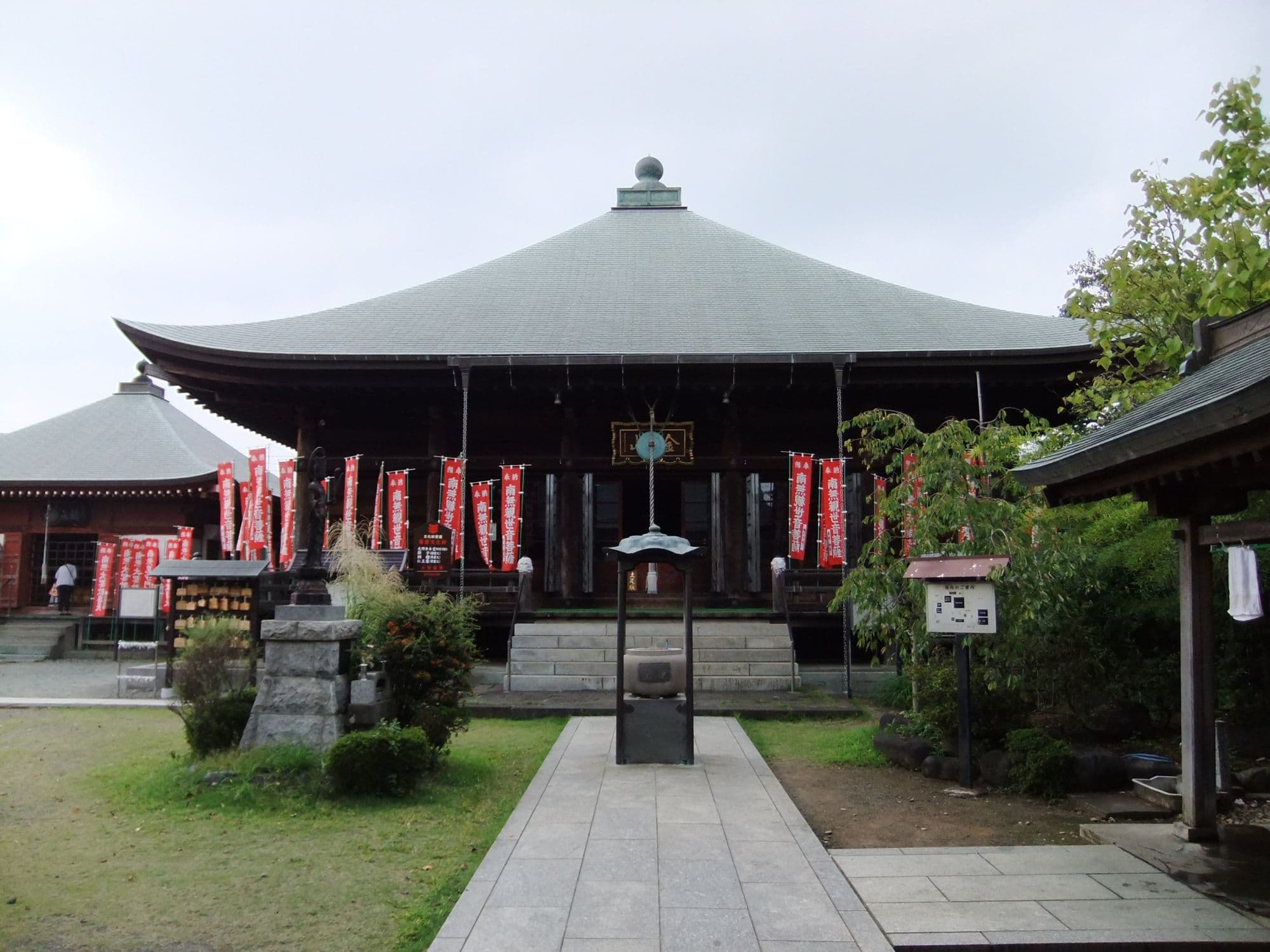
Visit essentials
A quick read before you go
- Duration
- 45 minutes to 1.5 hours.
- Access
- From JR Hiratsuka Station north exit, take a Kanachū bus bound for Hadano-eki or Tōkai Daigaku…
Overview
Kōmyō-ji on the slopes of Mount Kaname in Hiratsuka is known to pilgrims, villagers, and expectant mothers seeking anzan kigan — safe-childbirth prayers — as Kaname Kannon. Temple tradition traces it to a small Kannon image found in the sea by an ama diver in 702 CE and later enclosed within a larger Sacred Kannon carved by Gyōki. Its local name follows the folk etymology that the icon's eyes shone gold — kane-me, contracted into Kaname.
Minamoto no Yoritomo's prayer here for his wife Hōjō Masako's safe childbirth began a tradition that mothers continue more than eight hundred years later.
The current Kannon-dō dates to 1498 and is Hiratsuka's oldest surviving building. Its inner cabinet (zushi) and front-display Sacred Kannon are a national Important Cultural Property. As Bandō Temple #7, Kaname Kannon sits between Iiyama (#6) and Hoshi-no-ya (#8), and pilgrims often visit all three in one day. The hall is small, dim, and weathered; it reads less as a tourist site than as a village hall thick with five centuries of pilgrim breath.
Why this place is sacred
Kaname Kannon's thinness layers continuity, life-passage prayer, and architectural age. The site has been a place of Kannon devotion since at least the early eighth century, when an ama is said to have surfaced with a small icon from Sagami Bay and Dōgi Shōnin built the first hermitage to house it. Gyōki later carved a larger Sacred Kannon and enclosed the sea-discovered image inside it — a visible Kannon enfolding an invisible one.
The 1498 main hall, the oldest surviving building in Hiratsuka, has stood through five centuries of warfare, fire, and modern urbanization. Within it the zushi housing the honzon — a national Important Cultural Property — preserves a continuous line of veneration. What sets Kaname Kannon apart from other Bandō stations, though, is the unusual concentration of life-passage prayer here. Minamoto no Yoritomo prayed at this hall for the safe childbirth of his wife Hōjō Masako.
The anzan kigan tradition that began with that single Kamakura-period prayer remains active eight hundred years later. Expectant families still book the rite; mothers return with newborns to give thanks. Even non-Buddhist visitors often comment on what they describe as an emotional density on the grounds — the felt residue of generations of birth-related prayer at a single small hall.
The sea-discovery legend, the inner-body icon tradition, the warrior-class patronage, the unbroken line of women's prayer, and the dim weathered hall itself all gather at one hillside in present-day Hiratsuka.
An eighth-century devotional site built to enshrine a small Kannon icon discovered in the sea by an ama diver. Founded as a local hermitage and developed into a Tendai-school Kannon temple under Gyōki's enshrinement and later imperial and warrior-class patronage.
From an early hermitage to a Tendai institutional temple under Gyōki, then to a nationally significant Kannon site under Yoritomo and Hōjō Masako's Kamakura patronage. Destroyed during the Eikyō-era warfare (1429-41) between Ashikaga Mochiuji and the Muromachi shogunate, then rebuilt in 1498 — the current main hall. Patronized by Ashikaga Takauji as a clan donation site. Today it remains an active Tendai Kannon temple and station #7 of the Bandō pilgrimage, with its anzan kigan tradition unbroken.
Experience and orientation
Kaname Kannon is reached by a short walk uphill from the Kaname-eki bus stop. The Niō gate, with its 1498-era guardian statues, frames the entry; the path opens onto a modest precinct centered on the small main hall. Visitors who expect Bandō stations to be monumental find Kaname instead a village-scale temple, weathered and quiet. The Kannon-dō reads, especially on a weekday morning, more as a community hall than as a tourist destination.
Inside the hall the zushi — a national Important Cultural Property — houses the honzon. The front-display Sacred Kannon (maedachi) remains visible year-round, so unlike many hibutsu temples Kaname Kannon does not require special opening days. Pilgrims approach, drop saisen in the offering box, light incense, and offer the Heart Sutra or Kannon Sutra in front of the hall.
Many visitors are expectant mothers and family members coming for anzan kigan — safe-childbirth prayers — that may be requested in advance through the temple. Others return after birth to give thanks. The 1498 building, its prefectural-treasure bronze bell, and the Niō statues at the gate together form what architectural pilgrims come for.
The visit is short — forty-five minutes to an hour and a half — and slow visits, paying attention to the dim interior light and the worn wood, often leave a stronger impression than longer stops at grander temples.
Bus from JR Hiratsuka Station north exit to Kaname-eki bus stop, then a 3-5 minute walk. Pause at the Niō gate before approaching the hall. Spring (cherry blossoms) and autumn (foliage) are the favored seasons, but the front-display Kannon is visible year-round. Hours are 8:00-17:00 April-October; 8:30-16:30 November-February.
Context and lineage
Temple tradition holds that in 702 CE (Taihō 2), an ama diving along the Sagami Bay coast discovered a small Kannon image among the rocks. Dōgi Shōnin built a hermitage on a hillside in present-day Kaname to enshrine it. During the Tempyō era (729-749), the wandering ascetic Gyōki carved a larger Sacred Kannon and enclosed the sea-discovered icon inside it as a hidden inner-body image.
The temple's nickname 'Kaname Kannon' is said to come from a folk tradition that the icon's eyes shone gold — kane-me, contracted into Kaname. In the early Kamakura period Minamoto no Yoritomo prayed here for the safe childbirth of his wife Hōjō Masako, beginning the anzan-kigan tradition that continues. Ashikaga Takauji later donated to the temple. The Eikyō-era warfare (1429-41) destroyed the buildings; the current Kannon-dō was rebuilt in 1498 (Meiō 7) and is Hiratsuka's oldest surviving structure.
Tendai school, the Japanese Buddhist tradition founded by Saichō (Dengyō Daishi) at Mount Hiei. Tendai's teachings emphasize the universality of buddhahood and a comprehensive doctrinal training that includes esoteric practice. Kaname Kannon serves as a parish temple within this tradition while functioning as a Bandō Sanjūsankasho station drawing pilgrims from across the Kantō region.
The unnamed ama (diving woman)
Said to have discovered the small Kannon icon in the sea in 702 CE — the founding moment of the site
Dōgi Shōnin (道儀上人)
Built the original hermitage to enshrine the discovered icon, beginning the institutional temple
Gyōki (行基, 668-749)
Said to have carved the outer Sacred Kannon during the Tempyō era and enclosed the sea-discovered image as a hidden inner-body icon
Minamoto no Yoritomo (1147-1199)
Kamakura shogun who prayed here for Hōjō Masako's safe childbirth, embedding Kaname Kannon in the Kantō warrior class's devotional life
Hōjō Masako (1156-1225)
Yoritomo's wife, whose pregnancy occasioned the prayer that began the anzan kigan tradition
Ashikaga Takauji (1305-1358)
Muromachi-era shogun and donor; his patronage helped sustain the temple between its early Kamakura and post-1498 phases
Traditions and practice
The traditional practice cycle here turns on three observances. First, sutra recitation — the Heart Sutra and the Kannon Sutra — at the Kannon-dō, with offerings of incense and saisen. Second, anzan kigan: safe-childbirth prayer rites for expectant mothers and their families, a ritual lineage extending unbroken from Yoritomo's prayer for Hōjō Masako in the early Kamakura period.
The rite involves formal sutra recitation by a temple priest on behalf of the family, offerings, and the issuance of an o-mamori (protective amulet) and sometimes a hara-obi (maternity sash). Third, the Bandō Sanjūsankasho pilgrimage: pilgrims arrive carrying the nōkyō-chō or kakejiku and receive the goshuin at the nōkyō office. The bronze bell, a Kanagawa Prefecture Important Cultural Property, may be sounded as an offering with respectful etiquette.
The temple is open daily 8:00-17:00 April-October and 8:30-16:30 November-February with free admission. Goshuin is issued during posted hours. Anzan kigan ceremonies remain bookable through the temple, typically during the fifth month of pregnancy in the traditional Japanese reckoning. Many families return after birth to give thanks (rei-mairi) and often again at the child's first birthday. Pilgrim reception for Bandō Sanjūsankasho participants continues year-round.
Visitors who want to engage Kaname Kannon contemplatively — rather than as a quick stop — might consider arriving on a weekday morning when the precinct is quiet. Pause at the Niō gate to acknowledge the threshold and observe the 1498-era guardian statues. At the hall, sit briefly before approaching the offering box. The dim interior, the visible maedachi Kannon, and the worn wood reward stillness.
For those carrying personal hopes for life-passages — a pregnancy, a child, a family member's safety — Kaname Kannon's anzan-kigan tradition welcomes prayers offered with sincerity, regardless of formal religious affiliation. Combining the visit with Iiyama Kannon (#6) earlier in the day and Hoshi-no-ya (#8) afterward forms a natural Kanagawa Bandō unit.
Buddhism
ActiveTendai-school Kannon temple founded on a discovery legend (an ama diver finding a small Sacred Kannon in the sea in 702 CE). Locally and historically known as 'Kaname Kannon' — a name derived from the temple's tradition that the icon's eyes shone gold (kane-me, 金目). As Bandō Temple #7, it is a station on the Kantō region's principal Kannon pilgrimage and was a personal prayer site of Minamoto no Yoritomo, who is said to have prayed here for his wife Hōjō Masako's safe childbirth — establishing the temple's enduring association with safe-childbirth prayers (anzan kigan).
Perspectives and open questions
Kaname Kannon's history holds three registers — folk legend, documentary record, and esoteric reading. Pilgrims will encounter all three; the tradition does not require choosing among them.
Scholarly perspective
The 1498 main hall is reliably dated by inscription and architectural analysis, and is Hiratsuka's oldest surviving building. The Eikyō-era (1429-41) warfare that preceded its rebuilding is consistent with broader Kantō-region warfare records of the Ashikaga vs. Mochiuji conflict. The earlier 702 CE founding, Gyōki's involvement, and Yoritomo's prayer all belong to temple tradition and lack contemporary documentary corroboration, though the warrior-class patronage pattern is consistent with the Kamakura shogunate's known devotional networks.
Living and traditional perspectives
The temple presents the founding narrative — ama, sea-discovery, Gyōki's enshrinement, golden eyes, Yoritomo — as a continuous chain of compassionate transmission. Local devotion has centered on the name 'Kaname Kannon' for so many centuries that 'Kōmyō-ji' is rarely used in everyday speech. Anzan kigan remains a living rite, not a heritage display.
Alternative interpretations
Tendai esoteric teaching reads Sacred Kannon as the unmanifest source from which all 33 Kannon forms emerge. At Kaname Kannon the inner-body legend — a small sea-Kannon enclosed within a larger Gyōki-carved Kannon — materially expresses this layered ontology: visible compassion enfolding hidden compassion, the 33 forms unfolding from a single concealed source.
Open questions
The size, material, and current condition of the original sea-discovered inner Kannon are not publicly verified. Whether 'Kaname' is genuinely derived from kane-me ('gold eyes') or is folk etymology over an older place name remains contested by toponymists.
Plan your visit
Access and arrival
From JR Hiratsuka Station north exit, take a Kanachū bus bound for Hadano-eki or Tōkai Daigaku and alight at the Kaname-eki bus stop (~25 minutes). The temple is a 3-5 minute walk from the bus stop. Address: 896 Minamikaname, Hiratsuka-shi, Kanagawa.
No shukubō on site. Hiratsuka offers business hotels around JR Hiratsuka Station; Atsugi and Yokohama are within easy commute, and central Tokyo is reachable on the same day.
Respectful visit
Modest, comfortable. Hakui and pilgrim staff for formal Bandō pilgrims.
Permitted on grounds and at the exterior of the 1498 main hall and Niō gate. Not permitted of the honzon, the zushi interior, or worshippers in prayer.
Saisen at the offering box; incense and candles for purchase. Anzan kigan o-mamori and hara-obi available through the temple. Senjafuda strictly prohibited.
Senjafuda (adhesive name stickers) strictly forbidden at all Bandō stations | Maintain silence in the main hall | Remove hats and bow at the gate before entering | Do not photograph the honzon, zushi interior, or anzan-kigan rites in progress
Photography of the honzon and the interior of the zushi is not permitted without explicit permission. Maintain silence in the small hall, especially when other worshippers are present for anzan-kigan rites — these are emotional, life-passage prayers, not ceremonies for spectator viewing. Senjafuda (adhesive name stickers) are strictly forbidden across all Bandō stations.
Current practical details
Address
896 Minamikaname, Hiratsuka, Kanagawa 259-1201, Japan
Phone
Hours
Hours, fees, and access can change — verify on the official source before you travel. Practical details last checked Jun 2026.
Location
Map loads as you approach this section.
Pilgrim reflections
A portrait of encounter, not a score
Pilgrims describe what they felt, how present they could become, and whether the place would shape a journey. There are no stars and no ranking of traditions.
No reviewed reflections yet
The first pilgrims can help describe the character of being here.
Share a reflection
Available after an account-backed “Been there.” Every reflection is reviewed before publication.
Nearby sacred places
Explore other sacred places in the region. Proximity does not establish access or travel time; check each place’s guidance.


References
Sources consulted for this page. Source categories describe the publication, not a guarantee that every claim is verified. Traditional accounts and outside interpretations may differ.
- 01金目山 光明寺(金目観音)— 坂東三十三観音 公式サイト — Bandō Sanjūsankasho official pilgrimage organizationofficialOfficial pilgrimage authority record of order #7, Tendai sect, Sacred Kannon honzon
- 02光明寺 — 平塚市 — Hiratsuka CityofficialMunicipal cultural property listing
- 03坂東七番【金目山光明寺】 — 湘南ひらつかナビ — Hiratsuka City Tourism AssociationofficialTourism authority entry on temple's role and pilgrimage status
- 04Kōmyō-ji (Hiratsuka) — Wikipedia (English) — Wikipedia contributorsencyclopediaFounding legend (702 CE ama discovery, Gyōki's enshrinement during Tempyō era), Yoritomo and Ashikaga Takauji patronage, destruction in Eikyō-era wars, 1498 reconstruction
- 05光明寺 (平塚市) — Wikipedia (Japanese) — Wikipedia contributorsencyclopediaFounding narrative, name etymology (Kannon's eyes shone gold → 'Kaname'), cultural property designations
- 06光明寺:金目観音〜源頼朝の祈願所:平塚〜 — yoritomo-japan.comSource contextDetailed account of Yoritomo praying at Kaname Kannon for Hōjō Masako's safe childbirth
- 07光明寺 アクセス・営業時間・料金情報 — じゃらんnet — JalanguidePractical access, hours, and admission information
Pilgrim glossary
- Honzon
- The principal Buddhist deity enshrined as a temple's central object of worship.
- Kannon
- The bodhisattva of compassion, central to many East Asian pilgrimage routes.
- Sutra
- A canonical Buddhist scripture, often chanted as part of practice.
- Tendai
- A Japanese Buddhist school based on the Lotus Sutra, foundational to many later traditions.
Share a photo
Help visitors recognize Kōmyō-ji. Every submission is reviewed before publication.