Chōkoku-ji (Iiyama Kannon)
A 1,300-year-old Kannon temple on Mount Hakusan where Gyōki, Kūkai, and Yoritomo each left a mark
Understand sacred places, explore living traditions, and learn how to engage respectfully with Pilgrim Map.
Access has not been verified. Check current local guidance before planning a visit.
Atsugi, Kanagawa Prefecture, Japan
Read the sources
Station 6 of 33
Bandō Sanjūsankasho PilgrimageVisit essentials
A quick read before you go
- Duration
- 1-2 hours for the temple alone; 3-4 hours combined with a Mount Hakusan or Kongō-ji loop hike.
- Access
- From Hon-Atsugi Station (Odakyū Odawara Line), take a Kanachū bus to the Iiyama Kannon-mae bus…
Overview
Iiyama Kannon sits on the wooded mid-slopes of Mount Hakusan in Atsugi, close enough to reach from Tokyo in two hours yet far enough that the city falls away beyond the Niō gate. For thirteen centuries pilgrims have favored this name over the formal Chōkoku-ji — the bodhisattva on the mountain.
Tradition binds the temple to Gyōki's hidden inner-body Kannon, Kūkai's Shingon teaching, and Minamoto no Yoritomo's Kannon-dō; by the Kamakura period, Shingon, Tendai, Ritsu, and Zen monastics studied here together. As the sixth station of the Kantō region's thirty-three-temple Bandō Sanjūsankasho, it enshrines an Eleven-Headed Avalokiteśvara whose compassionate, wrathful, laughing, and crowning Buddha faces are said to address every kind of suffering.
The honzon is hibutsu, usually concealed in its gilded zushi, making an ordinary visit an act of faith without confirmation. Some three thousand cherry trees, worn stone steps, and the prefectural-treasure bell cast in 1442 complete a contemplative mountain setting.
Why this place is sacred
Iiyama Kannon's thinness arises less from a single dramatic feature than from accumulation. Three foundational figures left their imprint here. Gyōki, the eighth-century itinerant who built bridges and irrigation works across Nara-period Japan, is said to have carved the inner-body Kannon — an unseen figure inside the visible one. Kūkai, founder of the Shingon school, taught here in 807 and turned the local lord toward Buddhist practice.
Minamoto no Yoritomo, founder of the Kamakura shogunate, ordered the construction of the Kannon-dō. To stand at the main hall is to occupy a point where the lines of three of medieval Japan's most consequential religious figures intersect. The Kamakura-era ecumenical character compounds this density: at a time when Buddhist schools elsewhere defined themselves by mutual exclusion, Iiyama trained Shingon, Tendai, Ritsu, and Zen monastics in one place. The hibutsu tradition adds another layer.
The principal Eleven-Headed Kannon is normally enclosed in its zushi, opened only on the first three days of January, on the Buddha's birthday (April 8), and on November 3. Pilgrims who arrive on ordinary days do not see the icon; they see the closed cabinet and a maedachi (front-display) figure standing for it.
The mountain itself contributes — the wooded approach, the worn stone steps, the cherry-blossom canopy that briefly transforms the precincts each spring, the prefectural-treasure bell whose 1442 inscription documents its own founding. None of these features alone explains the felt quality of the place. Together they produce what pilgrims have for centuries simply called Iiyama Kannon: a name that points past the institution to whatever lives on the mountain.
An eighth-century mountain Kannon foundation, established (per temple tradition) for the protection and merit-making of local communities and itinerant ascetics, with Gyōki's hand-carved inner-body icon as its devotional core.
From an early Nara-period hermitage tradition, the site received Shingon character under Kūkai in the early ninth century. By the Kamakura period it had grown into an ecumenical training center supported by warrior-class patronage and personally by Yoritomo. Following Sengoku-era turbulence and Edo-era stabilization, it survived as a Kōyasan Shingon-shū parish temple.
Today it remains an active station on the Bandō Sanjūsankasho pilgrimage, observing the same three honzon-opening days that have structured the year for centuries, and preparing in 2025 a 1,300th-anniversary special opening.
Experience and orientation
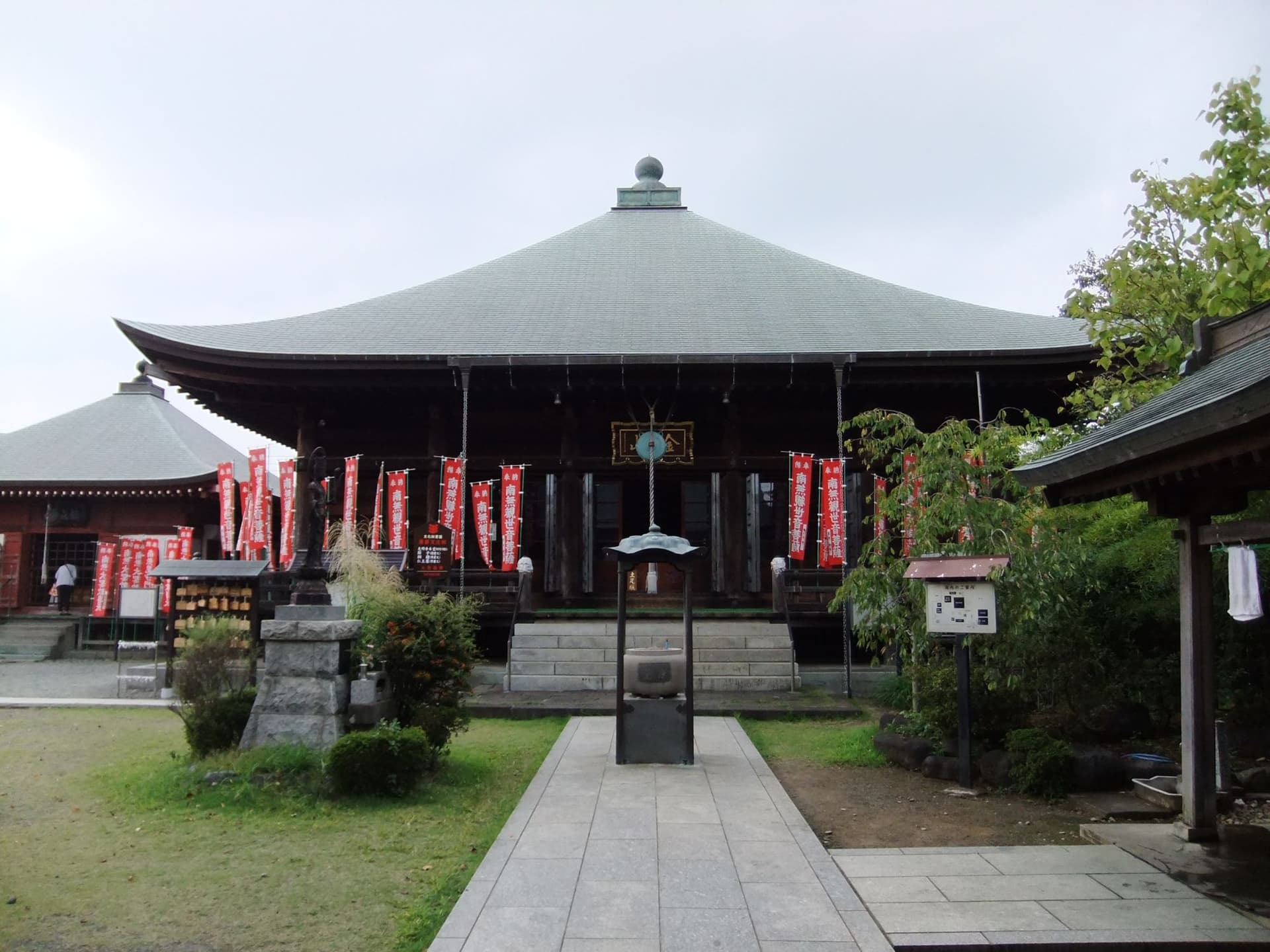
Most visitors arrive by bus from Hon-Atsugi Station and step off at Iiyama Kannon-mae, where the approach begins to lift slowly into Hakusan Forest Park. The Niō gate, hosting paired guardian statues installed by an Iiyama villager named Anzai Kinzaemon in 1709, marks the entrance.
The stone steps that follow are uneven, worn, and lined in spring by some three thousand cherry trees — Somei-Yoshino and yamazakura — that during the Atsugi Iiyama Cherry Blossom Festival, in late March and early April, render the upper precincts a corridor of suspended pink. At the Kannon-dō pilgrims find the principal hall and, beside it, the bell from 1442 whose Muromachi-era inscription documents its own casting. On most days the gilded zushi housing the honzon is closed.
The Eleven-Headed Kannon is only revealed on the first three days of January, on April 8 (the Buddha's birthday), and on November 3. Pilgrims who arrive expecting a direct encounter with the icon meet, instead, the closed cabinet — and that absence reorganizes the visit. Sutra recitation, the offering of incense and saisen, and reception of the goshuin at the nōkyō office become the active gestures.
Many pilgrims combine Iiyama with Kongō-ji along the connecting mountain trail, or pair the morning visit here with an afternoon at Kaname Kannon (Bandō #7) and Hoshi-no-ya (#8) — the three Kanagawa stations form a natural single-day arc through three Kannon forms.
Approach via the bus stop at Iiyama Kannon-mae, then ten minutes uphill on foot. Pause at the Niō gate before climbing. Allow time at the bell and Kannon-dō. The nōkyō office issues goshuin between 8:30 and 16:30. Honzon-opening days are January 1-3, April 8, and November 3.
Context and lineage
Temple tradition holds that in 725 CE (Jinki 2) the wandering ascetic Gyōki ascended Mount Hakusan in what is now Atsugi and carved a small Eleven-Headed Kannon. He sealed this inner-body figure inside a larger enshrining statue, founding the original site. In 807 CE the great Shingon master Kūkai (Kōbō Daishi) is said to have taught at Iiyama, prompting the local lord Iiyama Gondayū to build out the temple's halls and embrace the Shingon teaching.
Some four centuries later, in the early Kamakura period, Minamoto no Yoritomo dispatched his retainer Akita-jōnosuke Yoshikage to construct the Kannon-dō, embedding the temple in the warrior-class devotional life of his new shogunate. By the high Kamakura period Iiyama had become an ecumenical training center where Shingon, Tendai, Ritsu, and Zen monastics studied together — a rare institutional configuration in medieval Japanese Buddhism.
The temple weathered the warfare of the Sengoku era and consolidated as a Kōyasan Shingon-shū foundation under Edo-era stability.
Kōyasan Shingon-shū, the school descending from Kūkai (Kōbō Daishi) and centered at Mount Kōya in Wakayama. Iiyama functions as a parish temple within this school while serving as a major Kantō-region Kannon pilgrimage station.
Gyōki (行基, 668-749)
Founding ascetic per temple legend; said to have hand-carved the inner-body Eleven-Headed Kannon in 725
Kūkai (Kōbō Daishi, 774-835)
Shingon patriarch said to have taught at Iiyama in 807, establishing the temple's enduring Kōyasan Shingon character
Iiyama Gondayū
Local lord credited with constructing the temple's Heian-period halls following Kūkai's teaching
Minamoto no Yoritomo (1147-1199)
Founder of the Kamakura shogunate who commissioned the Kannon-dō
Akita-jōnosuke Yoshikage
Yoritomo's retainer who carried out the construction of the Kannon-dō
Anzai Kinzaemon
Iiyama villager who in 1709 commissioned the Niō statues that still stand at the gate
Traditions and practice
The traditional practice cycle here turns on three observances. First, sutra recitation — typically the Heart Sutra and the Kannon Sutra — at the Kannon-dō, where pilgrims offer incense and saisen before chanting. Second, the bell. The bronze bell cast in 1442 (Kakitsu 2), now a Kanagawa Prefecture Important Cultural Property, has been rung by pilgrims for nearly six centuries; striking it once with quiet attention is a recognized form of offering.
Third, the honzon kaichō — the formal ceremonial unveiling of the hidden Eleven-Headed Kannon on January 1-3 (New Year), April 8 (Buddha's birthday, Hana-matsuri), and November 3. On these days the gilded zushi is opened, and pilgrims may see the principal icon directly.
The Bandō Sanjūsankasho pilgrimage itself, established under Yoritomo's Kamakura shogunate, gives the temple its working ritual identity: pilgrims arrive carrying the nōkyō-chō (pilgrim notebook) or kakejiku (hanging scroll) and receive the goshuin — a calligraphic and red-seal stamp confirming the visit.
The Kannon-dō is open for worship 8:30 to 16:30. Pilgrims with a nōkyō-chō or scroll may receive the goshuin at the nōkyō office during the same hours. The temple continues to host the annual Atsugi Iiyama Cherry Blossom Festival in late March and early April in cooperation with Hakusan Nature Park. The three honzon-opening days remain the year's devotional anchors. In 2025 the temple will hold a special opening for its 1,300th anniversary.
Visitors who want to engage Iiyama as a contemplative practice rather than a tourist stop might consider arriving early — before 10 am — to walk the stone approach in relative silence. Pause at the Niō gate to acknowledge entering sacred ground. At the bell, strike once with full attention and listen until the sound fully resolves. At the Kannon-dō, sit briefly with the closed zushi rather than passing through; the hibutsu tradition asks for trust without seeing.
If carrying a nōkyō-chō, present it at the nōkyō office and watch the calligraphy as it is written. For those interested in the broader Bandō circuit, pairing Iiyama with Kongō-ji along the mountain trail, or with Kaname Kannon (Bandō #7) the same day, deepens the practice.
Buddhism
ActiveMountain temple of the Kōyasan Shingon school dedicated to Jūichimen Kannon (Eleven-Headed Avalokiteśvara). As Bandō Temple #6, it is one of 33 Kannon-dedicated stations that medieval and modern pilgrims visit to accumulate merit, seek compassion in this life, and prepare for rebirth in the Pure Land. Locally venerated as 'Iiyama Kannon,' a name pilgrims have used for centuries.
Perspectives and open questions
Iiyama's history sits across three registers — the legendary, the documented, and the esoteric — and pilgrims will encounter all three. Holding them together without forcing resolution is part of what the place teaches.
Scholarly perspective
Historians treat both the Gyōki (725) and Kūkai (807-835) founding narratives as legendary; no surviving documents confirm either. What is documented is the temple's prominent Kamakura-period role as an ecumenical training center where Shingon, Tendai, Ritsu, and Zen monastics studied together, and Yoritomo's patronage of the Kannon-dō. The bronze bell is independently dated by its own 1442 inscription. The 1709 Niō statues are likewise dated by inscription and donor record.
Living and traditional perspectives
Temple tradition holds firmly to the Gyōki-Kūkai dual founding narrative and treats the inner-body Kannon hand-carved by Gyōki as the mystical heart of the icon. The continuous local use of the name 'Iiyama Kannon' — rather than Chōkoku-ji or Hase-dera — reflects ten-plus centuries of village-level devotion centered on the bodhisattva rather than the institution.
Alternative interpretations
Within Shingon mikkyō, the Eleven-Headed Kannon's faces map onto stages of awakening — the three compassionate front faces extending mercy, the wrathful side faces destroying delusions, the laughing face liberating through joy, and the crowning Buddha face indicating perfect awakening. Esoteric pilgrims approach the hibutsu icon as the embodied yantra of this teaching, and the closed zushi as a reminder that compassion does not require visibility to operate.
Open questions
The exact provenance and dating of the inner-body Kannon attributed to Gyōki has never been independently verified. Whether the temple was continuously occupied during the Sengoku-era warfare in the Kantō, or rebuilt after a hiatus, is unclear from surviving records.
Plan your visit
Access and arrival
From Hon-Atsugi Station (Odakyū Odawara Line), take a Kanachū bus to the Iiyama Kannon-mae bus stop (about 20 minutes), then 10 minutes on foot up the approach. Paid parking lot at the foot of the mountain. The Kannon-dō is at 5605 Iiyama, Atsugi-shi, Kanagawa.
No shukubō (temple lodging) on site. Atsugi city offers a range of hotels around Hon-Atsugi Station, ~25 minutes by bus. Hakone, Yokohama, and central Tokyo are all reachable for return-trip pilgrims.
Respectful visit
Modest, comfortable attire suitable for stone-step climbing. Hakui (white pilgrim vest) and staff for formal Bandō pilgrims.
Permitted on the grounds and at exterior architectural features; not permitted of the honzon, the Kannon-dō interior, or worshippers in prayer.
Saisen at the offering box; incense and candles for purchase. Senjafuda stickers strictly prohibited.
Senjafuda (adhesive name stickers) strictly forbidden across all Bandō stations | Remove hats and packs before approaching the main hall | Maintain silence in the Kannon-dō | Do not photograph the honzon or hall interior without explicit permission
Avoid summer mid-day visits during humid weather; the stone steps can be steep and crowds intensify around the cherry-blossom festival weekends. Photography of the honzon is generally not permitted; observe the hibutsu rhythm rather than seeking to bypass it. Senjafuda — adhesive name stickers historically used by Edo-period pilgrims — are strictly forbidden across all Bandō stations and must not be applied to gates, halls, or pillars.
Current practical details
Address
5605 Iiyama, Atsugi, Kanagawa 243-0213, Japan
Phone
Hours
Hours, fees, and access can change — verify on the official source before you travel. Practical details last checked Jun 2026.
Location
Map loads as you approach this section.
Pilgrim reflections
A portrait of encounter, not a score
Pilgrims describe what they felt, how present they could become, and whether the place would shape a journey. There are no stars and no ranking of traditions.
No reviewed reflections yet
The first pilgrims can help describe the character of being here.
Share a reflection
Available after an account-backed “Been there.” Every reflection is reviewed before publication.
Nearby sacred places
Explore other sacred places in the region. Proximity does not establish access or travel time; check each place’s guidance.


References
Sources consulted for this page. Source categories describe the publication, not a guarantee that every claim is verified. Traditional accounts and outside interpretations may differ.
- 01飯山観音長谷寺 公式ホームページ (Iiyama Kannon Hase-dera official site) — Iiyama Kannon Hase-deraofficialTemple's own statement of history, founding by Gyōki (725 CE), Kūkai's teaching at the site (807 CE), Yoritomo connection, and 2025 1,300th anniversary special opening
- 02飯山観音 長谷寺 — 厚木市観光協会 — Atsugi City Tourism AssociationofficialMunicipal tourism authority entry on history, access, festivals, prefectural cultural properties
- 03飯山観音(長谷寺の観音堂)— 神奈川県 — Kanagawa PrefectureofficialPrefectural government page on the Kannon-dō and its prefecture-designated cultural properties
- 04飯上山 長谷寺(飯山観音) — 坂東三十三観音 公式サイト — Bandō Sanjūsankasho official pilgrimage organizationofficialOfficial pilgrimage authority entry confirming order, sect, honzon, and pilgrim practicalities
- 05Iiyama Kannon — Wikipedia (English) — Wikipedia contributorsencyclopediaSummarizes founding legends, sect affiliation, and Kamakura-era role as ecumenical study center
- 06The Bando 33 Kannon Route — The Temple Guy — James Baquet (The Temple Guy)guidePilgrim's narrative overview of the Bandō circuit including Iiyama
- 07飯山観音〜飯上山長谷寺:厚木市〜 — yoritomo-japan.comSource contextDetailed account of Minamoto no Yoritomo's connection and Yoshikage's commissioning of the Kannon-dō
Pilgrim glossary
- Honzon
- The principal Buddhist deity enshrined as a temple's central object of worship.
- Kannon
- The bodhisattva of compassion, central to many East Asian pilgrimage routes.
- Bodhisattva
- An enlightened being who postpones full nirvana to help others toward awakening.
- Sutra
- A canonical Buddhist scripture, often chanted as part of practice.
- Shingon
- An esoteric Japanese Buddhist school emphasizing ritual, mantra, and mandala practice.
- Tendai
- A Japanese Buddhist school based on the Lotus Sutra, foundational to many later traditions.
- Zen
- A Japanese Buddhist school emphasizing seated meditation and direct insight.
Share a photo
Help visitors recognize Chōkoku-ji (Iiyama Kannon). Every submission is reviewed before publication.