Seigantoji (Seiganto Temple)
Where a vermillion pagoda rises before Japan's mightiest waterfall on an ancient pilgrimage
Understand sacred places, explore living traditions, and learn how to engage respectfully with Pilgrim Map.
Access has not been verified. Check current local guidance before planning a visit.
Nachikatsuura, Wakayama Prefecture, Japan
Read the sources
Visit essentials
A quick read before you go
- Duration
- 1-2 hours for temple and viewpoint alone.
- Access
- From Kii-Katsuura Station (JR Kisei Main Line), buses run to Nachi Falls area (approximately 30…
Overview
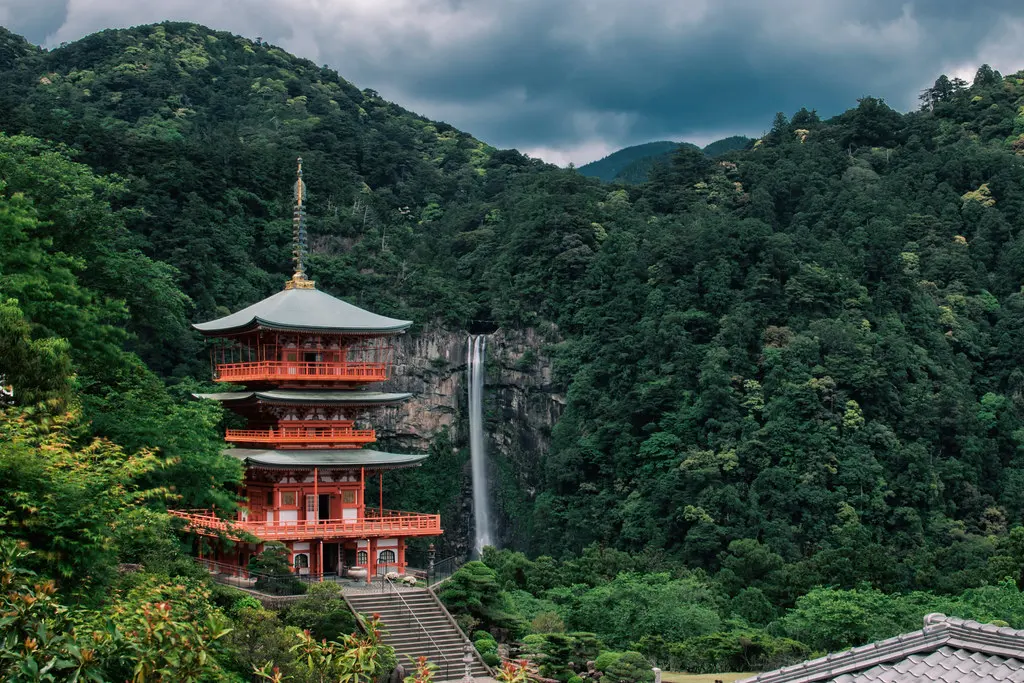
Seigantoji—the Temple of Crossing the Blue Shores—is known for its vermillion pagoda against emerald forest and Japan's tallest single-drop waterfall. At the heart of Kumano, nature worship, Buddhism, and mountain-ascetic practice have intertwined for over a millennium.
Nachi Falls was sacred before the temple. Pilgrims sought purification and spiritual power beneath its 133-metre curtain. In fourth-century tradition, a monk from India found a statue of Kannon, the goddess of compassion, in the pool below; his hermitage grew into a temple where nature worship embraced compassion pervading all phenomena.
In 988 CE, retired Emperor Kazan arrived after one thousand days of severe training beneath the falls. Following a vision of Kannon, he declared Seigantoji first in Japan's oldest pilgrimage circuit: thirty-three Kansai temples sacred to Kannon. Pilgrims still follow paths worn by a thousand years of footsteps, seeking blessings once sought by medieval emperors. Brilliantly refurbished in vermillion, Seigantoji remains a meeting point of human aspiration and the encompassing natural sacred.
Why this place is sacred
What makes Seigantoji a thin place begins with Nachi Falls itself. At 133 meters, this is Japan's tallest single-drop waterfall, an experience of elemental power that needs no religious interpretation to overwhelm the senses. The roar of water, the mist rising, the sheer scale, these work directly on the visitor, creating openness before any conceptual framework is applied.
The temple and its traditions provide structure for this raw encounter. Buddhism teaches that Kannon, the bodhisattva of compassion, manifests in countless forms to help suffering beings. At Seigantoji, the falls themselves can be understood as one such manifestation, compassion taking the form of purifying water. This interpretation does not replace direct experience but enriches it, offering depth to what might otherwise remain merely spectacular.
The Shugendo tradition adds another dimension. For centuries, mountain ascetics performed austerity practices beneath the falls, using the water's cold and power to break through ordinary consciousness. Emperor Kazan's thousand-day training represents the extreme of this approach, but countless practitioners have stood where he stood, seeking transformation through direct encounter with natural force. Their accumulated practice sanctified the site in ways that subsequent visitors can still sense.
The temple's position as first on the Saigoku Pilgrimage concentrates pilgrimage energy here. This is where the journey begins, where intentions are set and blessings sought. Over a thousand years of pilgrims have carried their hopes and devotion to this spot, creating accumulated layers of meaning that contemporary visitors inherit. Standing before the pagoda with the falls behind it, one participates in a tradition reaching back to emperors and forward to whoever will come next.
The original purpose was nature worship at the falls, which predates Buddhism in Japan. The temple developed to house Buddhist practice at this already-sacred site, particularly devotion to Kannon and the austerity practices of Shugendo. Its designation as Saigoku Temple No. 1 formalized its role as a pilgrimage destination.
Before 1868, Seigantoji and the adjacent Nachi Taisha Shrine functioned as a single unified complex, exemplifying shinbutsu shugo, the synthesis of Shinto and Buddhist practice that characterized much of Japanese religion. The Meiji government's forced separation divided what had been organically whole. Today the temple and shrine operate separately but remain physically adjacent, allowing visitors to experience both. Recent restoration (completed December 2024) has renewed the temple's physical appearance while maintaining its traditional function.
Experience and orientation
The approach to Seigantoji builds anticipation. Whether arriving by bus along mountain roads or walking the ancient Daimonzaka trail through towering cedar trees, visitors sense they are entering territory set apart from ordinary life. The final ascent brings the temple complex into view, the vermillion of its buildings vivid against the green of the surrounding forest.
The famous view comes as a culmination. From the temple grounds, the three-story pagoda (recently restored to brilliant vermillion) rises in the foreground while behind it, seeming almost impossibly close, Nachi Falls plunges 133 meters in a single unbroken drop. This composition, reproduced in countless photographs, nevertheless surprises with its impact when experienced in person. The falls provide not just visual spectacle but sound and mist, a presence that pervades the entire area.
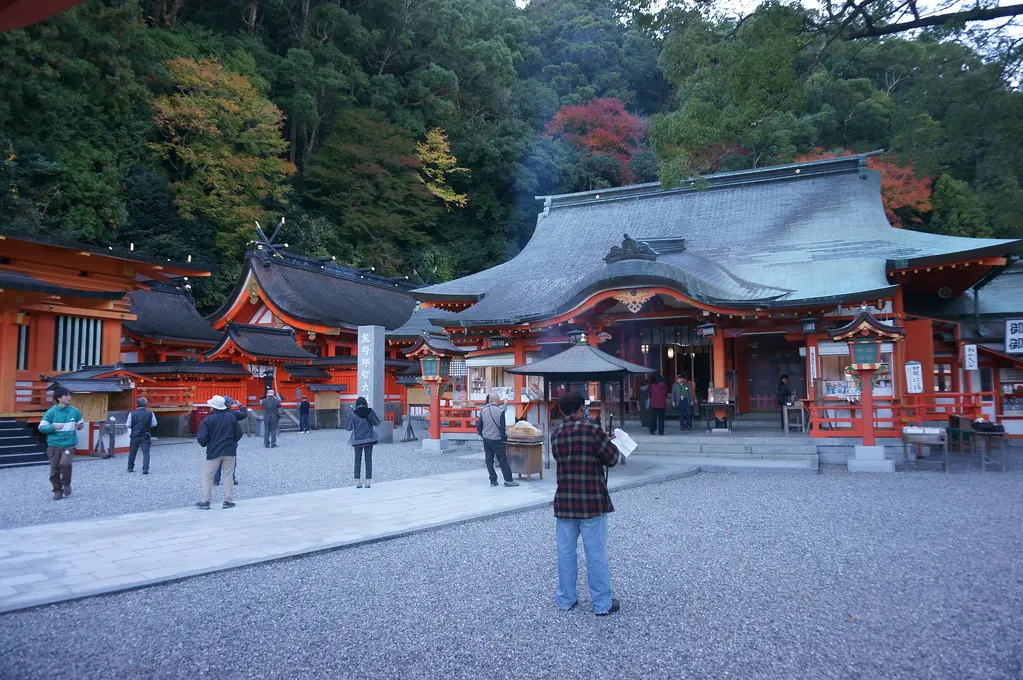
Within the temple proper, the atmosphere shifts to contemplative quiet. The main hall houses the Nyoirin Kannon image carved over 1,400 years ago from a single camellia tree. Pilgrims on the Saigoku circuit receive their first stamp here, marking the beginning of their journey. Even casual visitors often find themselves slowing, responding to the weight of accumulated devotion that has saturated these spaces.
Between temple and adjacent shrine stands the Sacred Camphor Tree, 850 years old, planted according to tradition by a member of the Taira clan. The tree's presence adds another dimension of time depth, connecting visitors to medieval Japan.
Many visitors find that the combination of natural power (the falls) and human devotion (the temple) creates conditions for unexpected inner movement. The roar of water clears mental noise; the temple offers form to whatever arises in the cleared space. Whether understood in Buddhist terms or simply as powerful encounter with nature and history, the experience tends to leave marks that persist.
Allow ample time rather than rushing through. Arrive early if possible to experience the falls before crowds gather. Visit both the temple (Seigantoji) and the adjacent Nachi Taisha Shrine to appreciate the original unity of the site. Descend to Hirou Shrine at the falls' base for the closest encounter with the waterfall itself. If undertaking the Saigoku Pilgrimage, recognize that this first temple sets the tone for your entire journey.
Context and lineage
According to tradition, a monk named Ragyo Shonin came from India during the reign of Emperor Nintoku in the fourth century. At Nachi Falls, he discovered a statue of Kannon in the pool beneath the cascade. He established a small hermitage to enshrine the image. Later, during the reign of Empress Suiko (592-628 CE), Shobutsu Shonin arrived from Yamato to undertake austerity practices.
He carved a four-meter image of Nyoirin Kannon from a single camellia tree and built the main hall (Hondo) to house it. This image remains the temple's central object of worship. In 988 CE, the retired Emperor Kazan visited after completing one thousand days of severe training beneath the falls. Receiving a vision of Kannon, he declared the temple first on the pilgrimage route that became the Saigoku Kannon 33 Pilgrimage.
Seigantoji belongs to the Tendai-Sanmon sect of Buddhism. Its primary lineage is the Saigoku Kannon Pilgrimage tradition, initiated by Emperor Kazan's declaration and maintained by over a thousand years of pilgrims. The temple also preserves connections to Shugendo through the recently rebuilt Gyojado Hall. The 2004 UNESCO designation as part of 'Sacred Sites and Pilgrimage Routes in the Kii Mountain Range' has formalized its status as heritage of universal value.
Ragyo Shonin
Legendary monk from India who discovered the original Kannon image and established the first hermitage at Nachi Falls in the 4th century
Shobutsu Shonin
Monk who carved the 4-meter Nyoirin Kannon image and built the main hall during the reign of Empress Suiko (592-628 CE)
Emperor Kazan
Retired emperor who completed 1,000 days of training under the falls in 988 CE and established Seigantoji as Temple No. 1 of the Saigoku Pilgrimage after receiving a vision of Kannon
Traditions and practice
Historically, the most dramatic practice at Nachi was waterfall austerity (takigyo), where practitioners stood beneath the falls for extended periods, using the cold and force of the water to break through ordinary consciousness. Emperor Kazan's thousand-day practice represents the extreme of this tradition. Shugendo practitioners, the yamabushi or mountain ascetics, used the entire Nachi area for training, regarding the primeval forest and its forty-eight waterfalls as a natural mandala for spiritual development.
Pilgrimage practice has continued since Emperor Kazan established the Saigoku route. Pilgrims traditionally walked the entire circuit of thirty-three temples, receiving stamps at each as proof of their devotion. The journey took weeks or months and represented a significant spiritual undertaking.
Modern visitors participate in simplified versions of traditional practices. Pilgrims still receive goshuin (stamp-and-calligraphy) at the temple office, marking their visit as part of the Saigoku journey or simply as commemoration. Many complete the entire thirty-three temple circuit over multiple trips, returning to Seigantoji as the first station. Prayer and offerings at the main hall continue the devotion to Nyoirin Kannon.
Waterfall austerity is no longer practiced by casual visitors, but the falls remain available for contemplation from Hirou Shrine at their base.
The 2023 rebuilding of the Kumano Shugen Nachisan Gyojado Hall indicates continued Shugendo presence, though the specific practices remain within that tradition.
For those seeking meaningful engagement, approach the temple as the beginning of a pilgrimage journey, even if you will not complete the full Saigoku route. Receive the goshuin as more than mere souvenir; it marks your participation in a thousand-year tradition. Spend time at the pagoda viewpoint allowing the falls to work on your awareness. Visit Hirou Shrine below to experience the falls at their base.
If walking the Daimonzaka trail, understand that you walk where emperors and countless pilgrims have walked before you.
Tendai Buddhism
ActiveSeigantoji is affiliated with the Tendai-Sanmon sect and houses the ancient Nyoirin Kannon image that has been the focus of devotion since the 6th century.
Buddhist services, Kannon devotion, pilgrimage stamp provision
Saigoku Kannon Pilgrimage
ActiveAs Temple No. 1, Seigantoji holds special importance as the beginning of Japan's oldest pilgrimage route, established in 988 CE.
Receiving goshuin stamps, pilgrimage circumambulation, devotional visits
Shugendo
ActiveThe Nachi area was historically a major Shugendo training center, with the waterfall serving as a site for austerity practice.
The 2023 rebuilding of the Gyojado Hall indicates continuing Shugendo presence, though specific practices remain esoteric
Perspectives and open questions
Seigantoji can be understood through Buddhist devotion, pilgrimage tradition, natural spirituality, or historical heritage. Each lens reveals different dimensions of this site where human practice and natural power converge.
Scholarly perspective
Academic study situates Seigantoji within the broader phenomenon of shinbutsu shugo, the synthesis of Shinto and Buddhist practice that characterized Japanese religion before the Meiji-era separation. The temple and adjacent shrine exemplify how nature worship, Buddhism, and Shugendo intertwined at sacred sites. The 2004 UNESCO designation recognizes the outstanding universal value of this religious and cultural landscape.
Living and traditional perspectives
For Buddhist practitioners, Seigantoji offers access to the blessings of Nyoirin Kannon, who responds to the prayers of devotees with compassion and wish-fulfillment. For Saigoku pilgrims, this temple holds special significance as the journey's beginning, where intention is set for the entire thirty-three-temple circuit. For Shugendo practitioners, the waterfall and surrounding mountains remain a mandala of spiritual power available to those properly trained.
Alternative interpretations
Some practitioners understand the concentrated natural power of the waterfall as creating energetic conditions distinct from ordinary locations. The combination of falling water, ancient forest, and sacred architecture is seen as amplifying spiritual receptivity. The thousand-year accumulation of pilgrimage and practice adds human spiritual energy to the natural power of the site.
Open questions
The precise practices Emperor Kazan performed during his thousand days of training remain unknown in detail. The original nature of Ragyo Shonin's journey from India, if historical, is lost to time. What actually occurs in deep waterfall practice, and why this particular site has drawn practitioners for over a millennium, may involve dimensions that resist ordinary analysis.
Plan your visit
Access and arrival
From Kii-Katsuura Station (JR Kisei Main Line), buses run to Nachi Falls area (approximately 30 minutes). The temple is a short walk from the bus stop. Rental cars available. The famous Daimonzaka trail provides a walking approach through ancient cedar forest (about 30 minutes uphill walk).
Kii-Katsuura is a hot spring resort town with numerous ryokan and hotels. Staying overnight allows for early morning visits when the temple is most peaceful and mist often rises from the falls.
Respectful visit
Modest, comfortable clothing suitable for temple visits and some walking. No specific requirements, but avoid excessively casual or revealing attire.
Photography is freely permitted outdoors and the pagoda-waterfall view is the iconic shot. Exercise discretion inside temple buildings. Do not use flash in dark interior spaces.
Monetary offerings can be made at the main hall. Pilgrimage stamps (goshuin) require a small fee.
{"Respect sacred spaces and other visitors","Stay on designated paths","Do not climb on or disturb historic structures","Do not attempt waterfall austerity practices without proper guidance"}
The temple is part of an active pilgrimage route and sacred site. Approach with respect rather than treating it as merely a scenic viewpoint. Do not disturb other pilgrims or visitors seeking quiet contemplation. The falls are for viewing and reflection, not for attempting austerity practices without proper training and guidance.
Current practical details
Address
8 Nachisan, Nachikatsuura, Higashimuro District, Wakayama 649-5301, Japan
Phone
Hours
Hours, fees, and access can change — verify on the official source before you travel. Practical details last checked Jun 2026.
Location
Map loads as you approach this section.
Pilgrim reflections
A portrait of encounter, not a score
Pilgrims describe what they felt, how present they could become, and whether the place would shape a journey. There are no stars and no ranking of traditions.
No reviewed reflections yet
The first pilgrims can help describe the character of being here.
Share a reflection
Available after an account-backed “Been there.” Every reflection is reviewed before publication.
Nearby sacred places
Explore other sacred places in the region. Proximity does not establish access or travel time; check each place’s guidance.


References
Sources consulted for this page. Source categories describe the publication, not a guarantee that every claim is verified. Traditional accounts and outside interpretations may differ.
- 01World's Greatest Places 2025: Kumano Nachi Taisha and Seigantoji — TIME MagazineSource contextMajor publication recognition
- 02Nachisan Seiganto-ji Temple — Visit WakayamaofficialOfficial prefecture tourism website
- 03Seiganto-ji - Wikipedia — WikipediaencyclopediaGeneral reference with cited sources
- 04Kumano Pilgrimage - Seiganto-ji Temple on Mt. Nachi — Roots of JapanguidePilgrimage-focused perspective
- 05Feel the power of nature at the sacred land of Kumano — ANAofficialOfficial airline tourism information
Pilgrim glossary
- Kannon
- The bodhisattva of compassion, central to many East Asian pilgrimage routes.
- Bodhisattva
- An enlightened being who postpones full nirvana to help others toward awakening.
- Mandala
- A symbolic diagram of the cosmos used in meditation and ritual.
- Tendai
- A Japanese Buddhist school based on the Lotus Sutra, foundational to many later traditions.
Share a photo
Help visitors recognize Seigantoji (Seiganto Temple). Every submission is reviewed before publication.