Santuario della Santa Casa di Loreto
Where the walls of Nazareth stand inside a Renaissance basilica on an Italian hill
Understand sacred places, explore living traditions, and learn how to engage respectfully with Pilgrim Map.
Access has not been verified. Check current local guidance before planning a visit.
Loreto, Ancona, Italy
Read the sources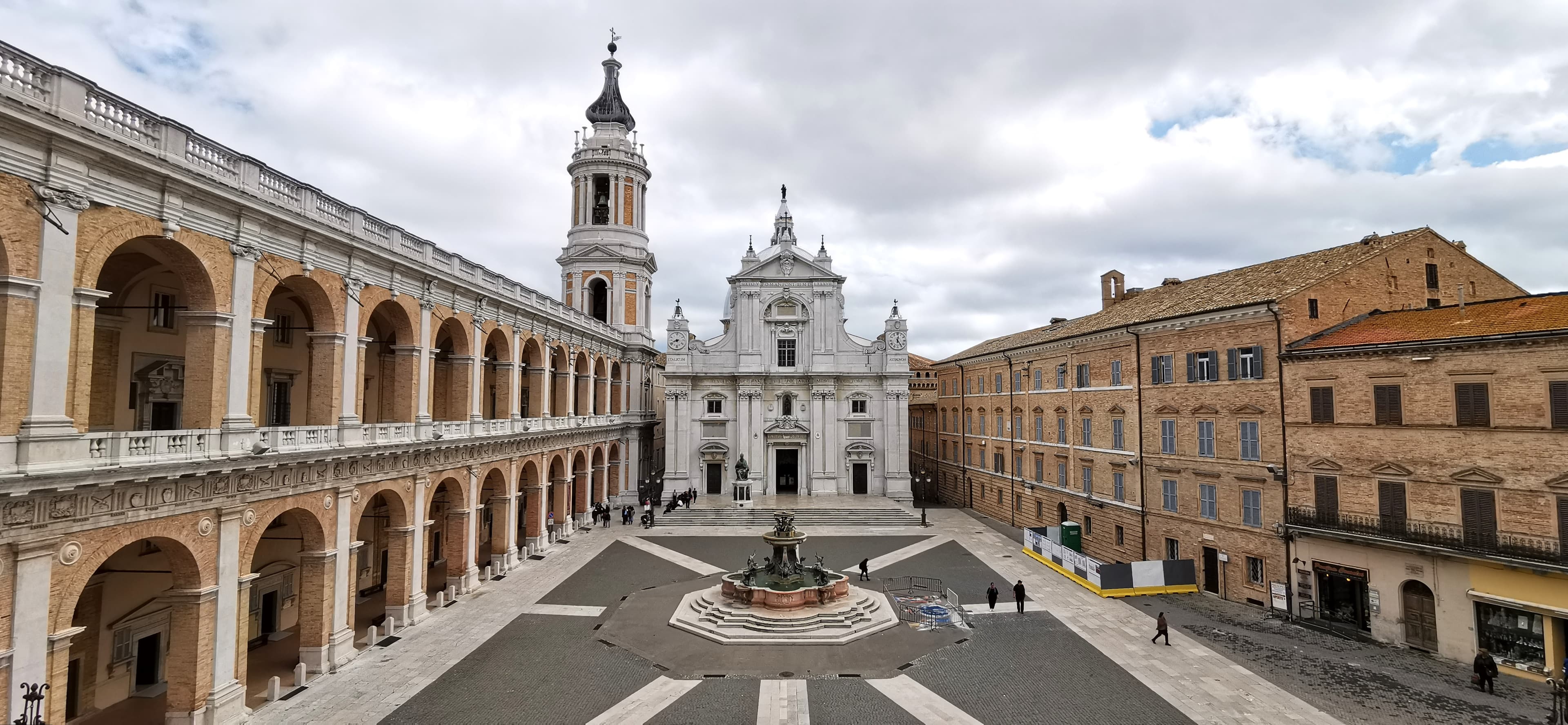
Image of Santuario della Santa Casa di Loreto. Image source · CC-BY-SA-4.0
Visit essentials
A quick read before you go
- Duration
- 2-4 hours for the basilica, Holy House, and surrounding piazza.
- Access
- Train: Loreto station on the Adriatic rail line (Bologna-Lecce).
Overview
In the small town of Loreto, a few miles south of Ancona and within sight of the Adriatic, three ancient walls stand inside one of Italy's most significant Renaissance basilicas. According to a tradition stretching back to the late thirteenth century, these walls are the remains of the house in Nazareth where Mary lived and where the angel Gabriel announced the Incarnation.
The tradition holds that the walls were transported from the Holy Land in the 1290s, arriving first in Croatia and then, in 1294, at their present location. Whether the transport was accomplished by angelic intervention, as the older tradition claims, or by Crusader-era Christians seeking to save the relics from destruction, is a question that has occupied historians and the faithful for centuries.
What is not in dispute is the archaeological evidence: the stones are consistent with Palestinian building materials and construction techniques, and they are not native to this region of Italy.
Around these three walls, a civilization of devotion has grown. The basilica was built between 1469 and 1587. The Litany of Loreto, one of the five litanies approved for public recitation by the Catholic Church, was born here. At least 150 saints and blessed have made pilgrimage to this place. More than fifty popes have come. Pope John Paul II called Loreto the true Marian heart of Christianity.
The sanctuary remains one of Europe's most visited pilgrimage sites. On the evening of December 9 each year, bonfires are lit in town squares across the Marche to light the way for the angels, and at midnight the bells ring to mark the anniversary of the house's arrival. Inside, in the quiet of the Holy House itself, pilgrims still reach out to touch stones that may once have known the presence of the sacred.
Sites inside
Why this place is sacred
The claim at the heart of Loreto is extraordinary: that these three stone walls once formed the front portion of a house in Nazareth, the house where Mary was born, where she grew up, and where she received the message that changed the course of history. The claim cannot be verified with certainty, but neither can it be easily dismissed.
Archaeological analysis has confirmed that the stones are consistent with first-century Palestinian construction methods and materials, and that they do not originate in the Recanati area. The three walls fit precisely against the perimeter of the Grotto of Nazareth, the rear portion of the traditional House of the Virgin, which remains in situ in the Church of the Annunciation in Nazareth.
The traditional narrative of the translation describes the walls being carried by angels, first to Tersatto in what is now Croatia in 1291, then across the Adriatic to various locations before reaching their present hilltop in 1294. A memorial shrine at Trsat in Rijeka marks the Croatian sojourn.
The historical interpretation, which has gained ground since the early twentieth century, suggests that the physical stones were transported by Crusader-era Christians, possibly under the patronage of a noble family named Angeli, whose name may have given rise to the angelic legend.
What matters for the experience of thinness at Loreto is less the mechanism of transport than the continuity of response. Since at least the fourteenth century, pilgrims have been coming here to stand inside walls that they believe heard the words of the Annunciation. That belief, sustained across seven centuries and shared by saints and skeptics, artists and illiterate peasants, popes and anonymous travelers, has generated a density of devotion that is itself a form of thinness.
The walls have absorbed centuries of prayer. The basilica around them has attracted some of the greatest artistic talent of the Renaissance. The Litany of Loreto has been prayed here and carried across the world.
The thinness at Loreto operates at two registers simultaneously. There is the historical and material register: ancient Palestinian stones on an Italian hilltop, an anomaly that demands explanation. And there is the devotional register: the accumulated weight of millions of pilgrims who have touched these walls seeking connection to the moment when, according to Christian tradition, the human and the divine intersected in the simplest of domestic settings.
Tradition holds these are the walls of the house in Nazareth where the Virgin Mary lived and where the Annunciation occurred. Their presence in Loreto dates to 1294.
From simple shelter for the transported walls in the late 13th century to a major basilica built 1469-1587. Became one of Europe's premier pilgrimage destinations by the 16th century. Pontifical sanctuary status. Our Lady of Loreto declared patroness of air travelers in 1920. Approximately 4 million annual visitors today.
Experience and orientation
The approach to Loreto sets the scale. The town sits on a hill visible from the Adriatic coast, the basilica dome and bell tower marking it against the sky of the Marche. The Piazza della Madonna, flanked by the Apostolic Palace (also designed by Bramante) and a Renaissance fountain, opens before the facade completed in 1587 by Boccalini, Ghioldi, and Ventura in the late Florentine Renaissance style.
Entering the basilica, visitors encounter a space of considerable architectural complexity. The Late Gothic structure was continued and modified by Giuliano da Maiano, Giuliano da Sangallo, and Bramante over more than a century. The dome, designed by Sangallo in Brunelleschi's manner, rises above. In the sacristies, frescoes by Melozzo da Forlì and Luca Signorelli survive. Bronze doors forged in the Recanati foundry in 1600 depict episodes from the history of salvation.
Mosaics by Domenichino and Guido Reni add further layers of beauty.
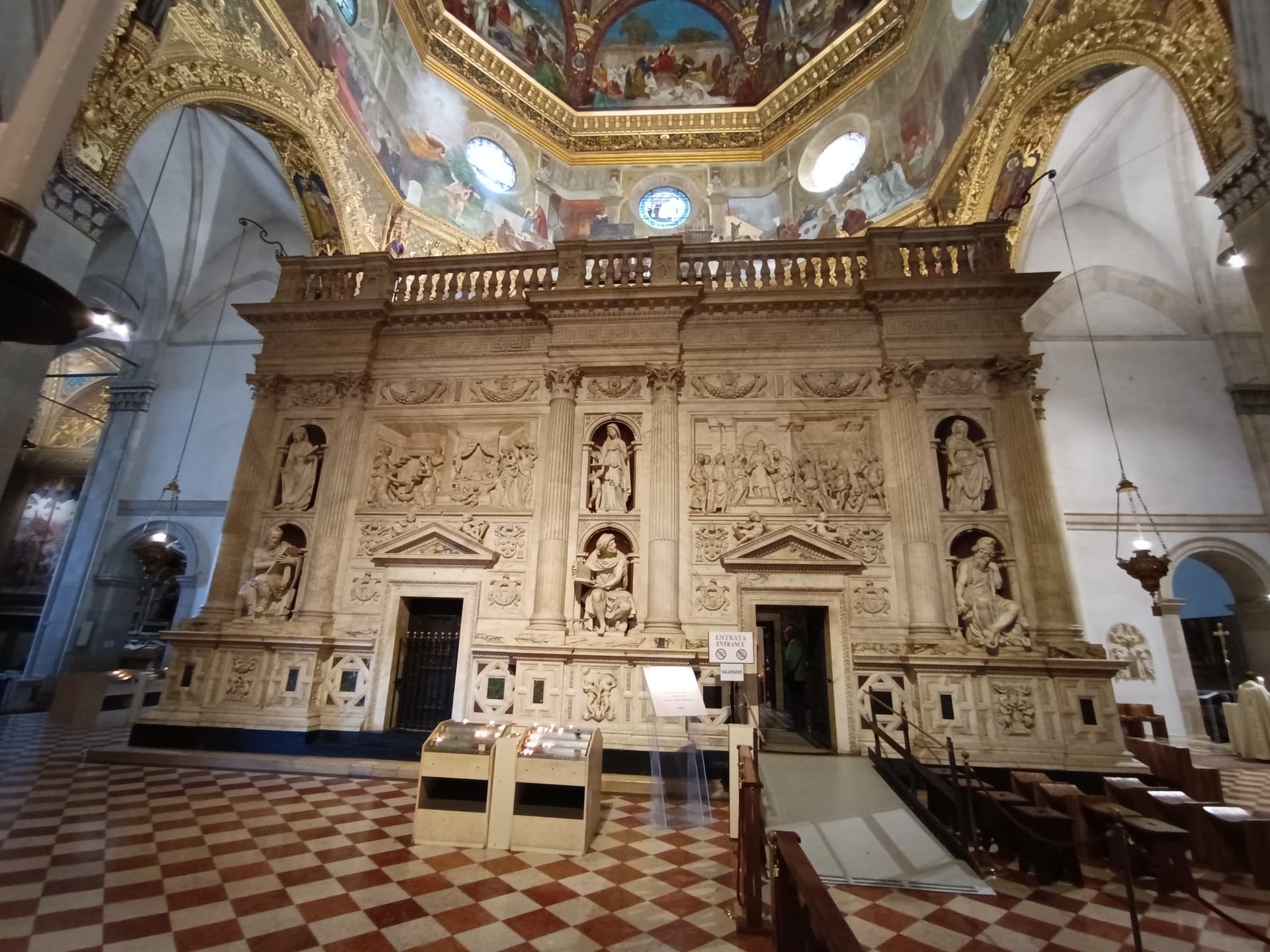
But the destination is the center of the basilica, where Bramante's tall marble screen rises around three rough stone walls. The screen, commissioned by Julius II in 1507, is itself a work of extraordinary craftsmanship, executed under three successive popes. It simultaneously protects and presents the Holy House, creating an architectural frame that heightens the contrast between its own Renaissance elegance and the ancient simplicity it contains.
Stepping through the entrance into the Holy House, the scale shifts dramatically. The space is small, dark, dense with the accumulated presence of centuries. The walls are rough stone, marked by age and by the touch of countless hands. A statue of the Madonna, carved from Lebanese cedar wood after a fire destroyed the original in 1921, maintains the dark coloring that gave rise to the Black Madonna designation. Candles flicker.
The air carries the scent of wax and old stone.
The experience of moving from the monumental exterior to this intimate interior, from Renaissance splendor to Palestinian stone, from the public grandeur of a major basilica to the private scale of a house, is the essential experience of Loreto. It mirrors the theological claim at the heart of the site: that the infinite entered the finite in the simplest of domestic spaces.
Outside again, the piazza and the town offer perspective. The view from the hilltop extends toward the Adriatic. The town has grown around the basilica, shaped by centuries of pilgrimage. On the evening of December 9, this piazza fills with faithful gathered for the bonfire vigil, waiting for the midnight bells that mark the anniversary of the house's arrival.
Loreto sits on a hill approximately 30 km south of Ancona in the Marche region, visible from the Adriatic coast. The basilica and Piazza della Madonna form the town's center. The Holy House stands at the center of the basilica nave.
Context and lineage
According to the oldest tradition, the walls of the house in Nazareth where the Virgin Mary lived were transported by angels in two stages: first to Tersatto in Croatia in 1291, then across the Adriatic to the Loreto hilltop on December 10, 1294. A more recent historical interpretation suggests that Crusader-era Christians physically transported the stones to save them from destruction as Muslim forces advanced in the Holy Land.
Some scholars have noted the possible involvement of a noble family named Angeli, whose name may have been conflated with angelic intervention over the centuries. Archaeological evidence confirms that the stones are of Palestinian origin and consistent with first-century construction techniques. The three walls fit the perimeter of the Grotto of Nazareth. In 1510 the Santa Casa was approved for pilgrimages, rapidly becoming one of the most visited shrines in Europe.
The sanctuary is a pontifical sanctuary directly under Vatican authority. It belongs to the Roman Catholic tradition and has been central to Marian devotion since the fourteenth century. The Litany of Loreto, one of the five litanies approved for public recitation, originated here and has become universal in Catholic practice. Growing ecumenical significance includes Eastern Orthodox pilgrimages and liturgical celebrations within the Holy House.
Donato Bramante
Designed the marble screen around the Holy House and the Apostolic Palace
Pope Paul II
Sponsored the beginning of basilica construction
Pope Julius II
Commissioned Bramante to create the marble screen
Pope Benedict XV
Declared Our Lady of Loreto patroness of air travelers
Pope John Paul II
Called Loreto 'the true Marian heart of Christianity'
Traditions and practice
The Litany of Loreto (Litany of the Blessed Virgin Mary) has been recited at this shrine for centuries and has become one of the most widely known Marian prayers in Christianity. Pilgrimage to the Holy House, often involving touching or kneeling before the ancient walls, has been the central practice since the fourteenth century. The Feast of the Translation, traditionally called the festa della venuta, has been celebrated across Italy since the medieval period.
Daily Mass, confession, and the Liturgy of the Hours are offered. The December 9 vigil bonfire in the Piazza della Madonna draws thousands, with bonfires lit simultaneously in many towns across the Marche. Holy Week processions. Eastern Orthodox communities have begun organizing pilgrimages and celebrating Divine Liturgies within the Holy House. Pilgrim groups from across Europe and beyond visit throughout the year.
Enter the basilica and take time with the Renaissance artwork before approaching the Holy House. Allow the shift in scale from basilica to house to work on you. Within the Holy House, stand quietly. The Litany of Loreto, if you know it, connects your presence to centuries of the same prayer in this same place. If visiting in December, the bonfire vigil of the evening of December 9 and the midnight bells create an experience of communal devotion.
Roman Catholicism
ActiveOne of the most important Marian shrines in the world. The claimed house of the Annunciation. Origin of the Litany of Loreto. Patroness of air travelers. Over 50 popes and 150 saints have made pilgrimage here.
Daily Mass, Liturgy of the Hours, pilgrimage, Litany of Loreto, Feast of the Translation, Holy Week observances
Eastern Orthodoxy
ActiveGrowing recognition of the Holy House's importance, particularly among Russian and Romanian Orthodox Christians.
Organized pilgrimages, celebration of Divine Liturgy within the Holy House
Perspectives and open questions
Loreto sits at the intersection of archaeological evidence, medieval tradition, Renaissance art, and living devotion, inviting engagement from multiple interpretive frameworks.
Scholarly perspective
Archaeological and material analysis has confirmed that the stones of the Holy House are consistent with Palestinian construction methods and materials of the first century, and that they are not native to the Marche. The three walls fit the perimeter of the Grotto of Nazareth. Most scholars now favor the interpretation that the stones were physically transported by Crusader-era Christians, possibly under the patronage of the Angeli family, rather than miraculously carried by angels.
The art historical significance of the basilica is well established, with contributions from major Renaissance figures.
Living and traditional perspectives
Catholic tradition holds the Holy House to be the actual dwelling of the Virgin Mary in Nazareth, the site of the Annunciation. The translation, whether angelic or human, preserved these sacred walls from destruction. The continuous pilgrimage since the fourteenth century, the devotion of over fifty popes and 150 saints, and the origin of the Litany of Loreto all affirm the site's centrality to Marian devotion.
Alternative interpretations
Some visitors approach Loreto through the lens of Black Madonna traditions, noting the dark statue as part of a broader European pattern connecting to pre-Christian goddess worship. Others are drawn by the site's position in sacred geography or by the mystery of the translation narrative itself, which raises questions about the relationship between legend, history, and faith.
Open questions
The exact circumstances of the Holy House's transport remain debated. Whether the Angeli family connection explains the angelic legend is unresolved. The original statue's progressive darkening from candle smoke and the deliberate choice to maintain the dark coloring in the 1921 replacement carry symbolic weight that has not been fully explored.
Plan your visit
Access and arrival
Train: Loreto station on the Adriatic rail line (Bologna-Lecce). Car: A14 motorway, Loreto-Porto Recanati exit. Bus: services from Ancona (approximately 30 km). The town is compact and walkable from the station.
Multiple hotels and pilgrim guesthouses in Loreto. Ancona (30 km) offers a wider range of accommodation. Several religious houses offer hospitality to pilgrims.
Respectful visit
Modest dress required: shoulders and knees covered. This is enforced at the entrance.
Photography without flash is permitted in most areas of the basilica. No photography during liturgical celebrations. Restrictions may apply within the Holy House.
Candles available for offering. Donations appreciated. Votive offerings are a long-standing tradition.
Dress code enforced | Silence within the Holy House | No flash photography | No photography during services | Respect the prayer of others, particularly in the Holy House
The Holy House can be crowded during peak pilgrimage seasons and at midday when tour groups arrive. Early morning or late afternoon offers more contemplative conditions. The emotional intensity of the space should be respected; this is not a museum exhibit but a place where people come to pray.
Current practical details
Address
Piazza della Madonna, 1, 60025 Loreto AN, Italy
Phone
Hours
Hours, fees, and access can change — verify on the official source before you travel. Practical details last checked Jun 2026.
Location
Map loads as you approach this section.
Pilgrim reflections
A portrait of encounter, not a score
Pilgrims describe what they felt, how present they could become, and whether the place would shape a journey. There are no stars and no ranking of traditions.
No reviewed reflections yet
The first pilgrims can help describe the character of being here.
Share a reflection
Available after an account-backed “Been there.” Every reflection is reviewed before publication.
Nearby sacred places
Explore other sacred places in the region. Proximity does not establish access or travel time; check each place’s guidance.


References
Sources consulted for this page. Source categories describe the publication, not a guarantee that every claim is verified. Traditional accounts and outside interpretations may differ.
- 01The Pontifical Sanctuary of the Holy House of Loreto — Santuario LoretoofficialOfficial Vatican-affiliated sanctuary website
- 02CATHOLIC ENCYCLOPEDIA: Santa Casa di Loreto — New AdventencyclopediaDetailed historical and theological analysis
- 03Sanctuary of the Holy House of Loreto - Italia.it — Italia.itSource contextOfficial Italian tourism portal
- 04Basilica della Santa Casa - Wikipedia — Wikipedia contributorsencyclopediaComprehensive article with detailed history and architecture
- 05The Holy House of Loreto - World Pilgrimage Guide — Sacred SitesguidePilgrimage-focused perspective
- 06The Extraordinary Story of Loreto - Ascension — Ascension PressacademicCatholic scholarly perspective on the origin narrative
Share a photo
Help visitors recognize Santuario della Santa Casa di Loreto. Every submission is reviewed before publication.