Our Lady of Loreto
The Holy House of Nazareth, set inside a Marche basilica behind a Bramante marble screen
Pesaro, Marche, Italy
Plan this visit
Practical context before you go
Two to three hours for the basilica, Santa Casa, treasury, and museum. Half a day with the surrounding town.
Located in Loreto, Marche, roughly 30 km south of Ancona. Reached by train (Loreto–Stazione, then a short shuttle bus to the basilica) or by car via the A14 autostrada. Nearest airport is Ancona-Falconara (AOI, ~35 km). Free entrance to the basilica and Santa Casa; the Museum-Pinacoteca has a separate admission. Mobile phone signal is available throughout the town and inside the basilica.
Modest dress (shoulders and knees covered), silence in the Santa Casa, restricted photography during liturgies, and standard church etiquette throughout the basilica.
At a glance
- Coordinates
- 43.9044, 12.9174
- Type
- Shrine
- Suggested duration
- Two to three hours for the basilica, Santa Casa, treasury, and museum. Half a day with the surrounding town.
- Access
- Located in Loreto, Marche, roughly 30 km south of Ancona. Reached by train (Loreto–Stazione, then a short shuttle bus to the basilica) or by car via the A14 autostrada. Nearest airport is Ancona-Falconara (AOI, ~35 km). Free entrance to the basilica and Santa Casa; the Museum-Pinacoteca has a separate admission. Mobile phone signal is available throughout the town and inside the basilica.
Pilgrim tips
- Modest dress required throughout the basilica and especially inside the Santa Casa — shoulders covered, no shorts or short skirts.
- Generally permitted in the basilica with discretion. Restricted in the Santa Casa during Mass and other liturgies. No flash.
- Modest dress is required and is enforced. Photography inside the Santa Casa is restricted during Mass and other liturgies; observe the rhythm of the room before lifting a camera. Mobile phone calls inside the basilica are not permitted.
Overview
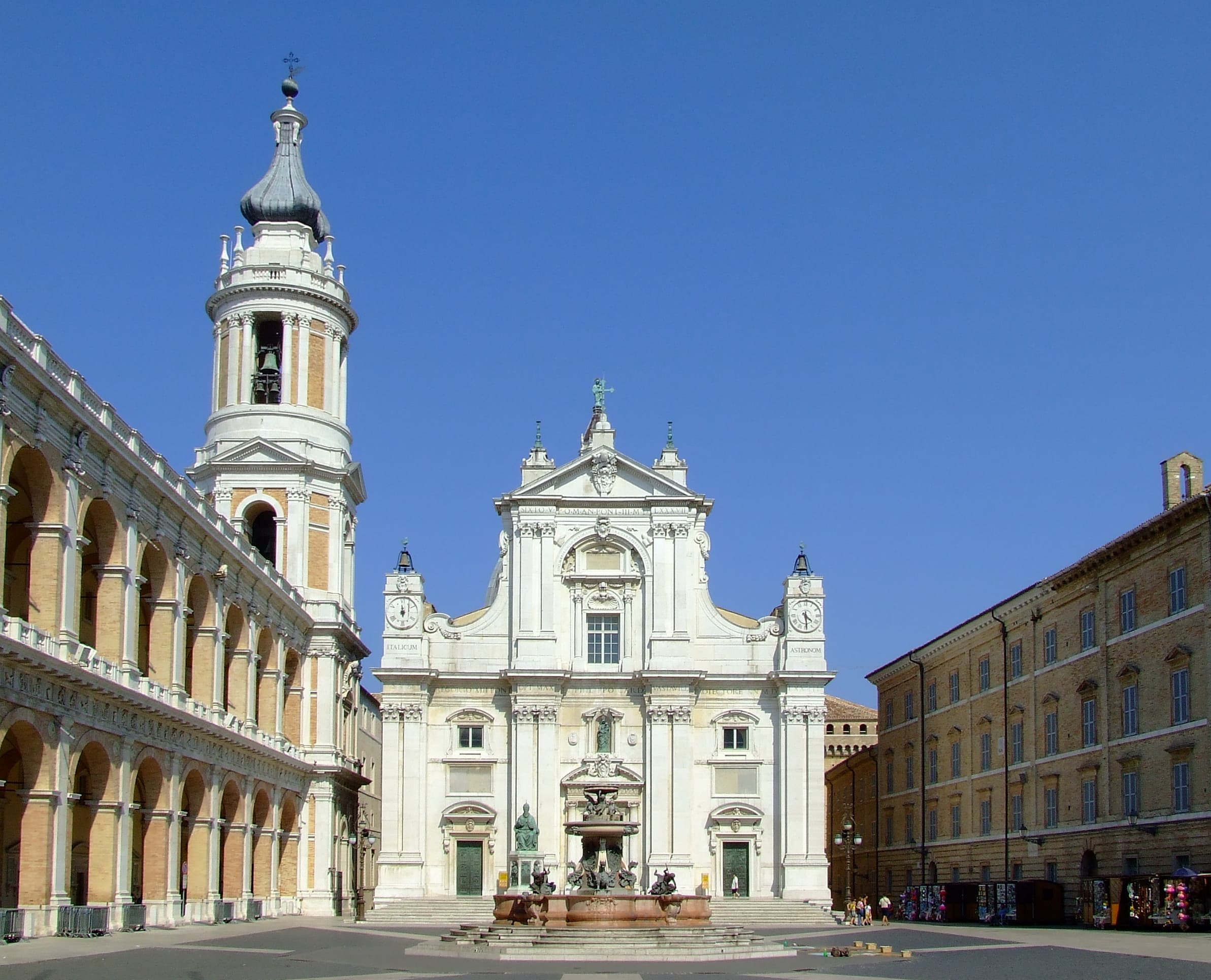
Loreto preserves what Catholic tradition holds to be the actual house of the Holy Family from Nazareth — the room where the Annunciation took place and where Jesus spent his childhood. The three first-century walls stand inside a basilica in the Marche, enclosed by Bramante's 1507 marble screen and centred on the Black Madonna of Loreto.
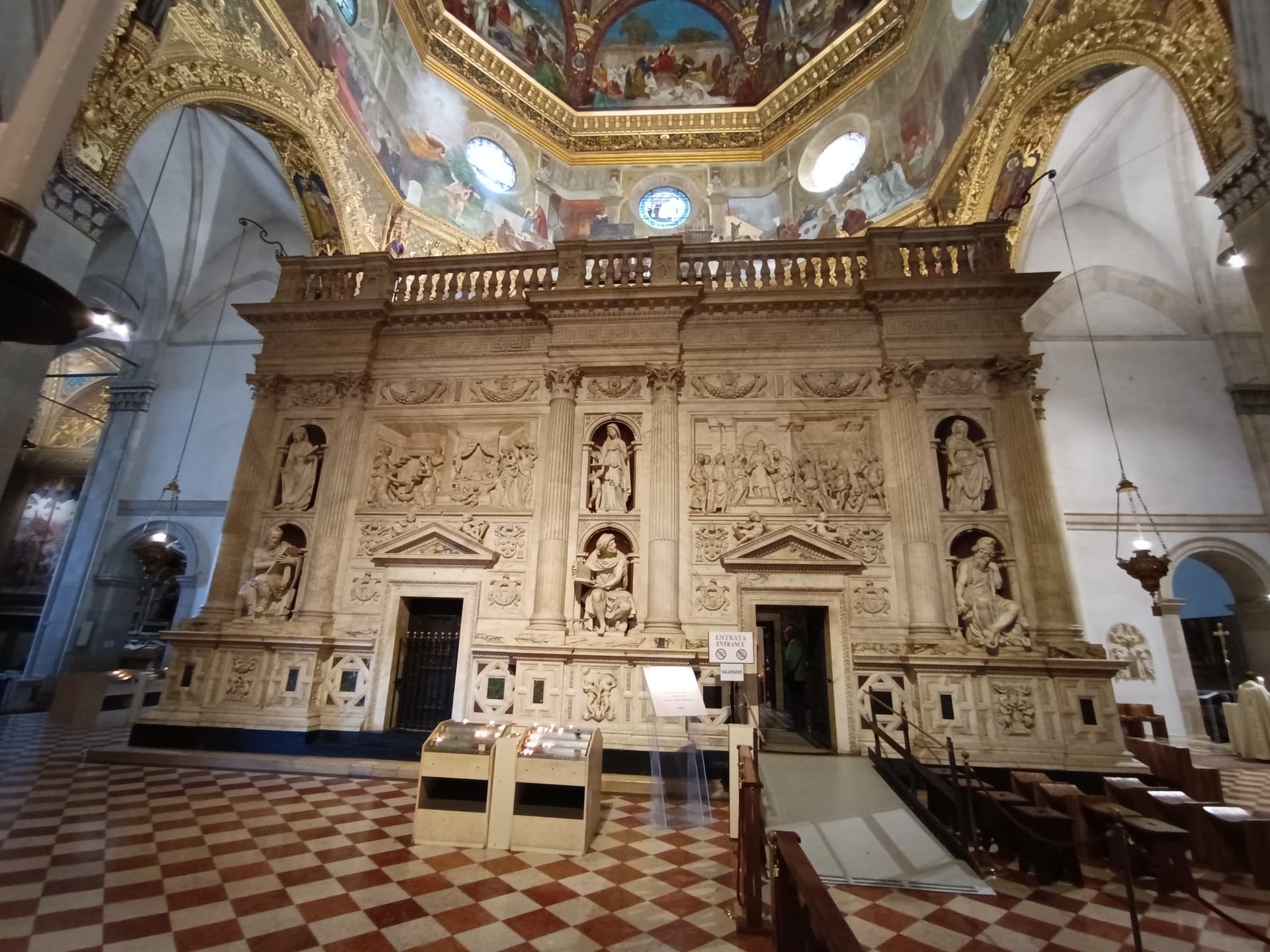
The Pontifical Sanctuary of the Holy House of Loreto rises in the small Marche town of Loreto, roughly thirty kilometres south of Ancona on the Adriatic coast. At its centre sits a small stone room — the Santa Casa — that Catholic tradition identifies as the actual house of the Holy Family from Nazareth. The three surviving walls match the missing front of the surviving Grotto of the Annunciation in Nazareth, and the stone and construction technique are consistent with first-century Palestinian masonry. Whether the house arrived here by angelic translation, as medieval tradition records, or by Crusader-era sea transport organised by the noble Angeli family of Epirus, as twentieth-century scholarship increasingly suggests, both accounts converge on the same conclusion: the walls were carried from Palestine, and they reached Loreto by 10 December 1294, following an earlier phase at Tersatto in modern Croatia. Around them, beginning in 1469, a Renaissance basilica was built, and in 1507 Bramante designed the marble screen that now encloses the house — sculpted under successive popes by Andrea Sansovino, Antonio Sangallo the Younger, and others. The Black Madonna housed in the Santa Casa is a 1922 cedar replacement made by Enrico Quattrini and Leopoldo Celani from Lebanon cedar of the Vatican Gardens, replacing the original statue lost in a 1921 electrical fire. The sanctuary functions under direct papal authority through a Pontifical Delegation. The Litany of Loreto is sung daily here, the feast of Our Lady of Loreto on 10 December was added to the universal Roman calendar by Pope Francis in 2019, and Mary of Loreto is the patron of aviators by declaration of Pope Benedict XV in 1920.
Context and lineage
Tradition records that as Crusaders were expelled from the Holy Land in the late thirteenth century, angels carried the Holy House from Nazareth — first to Tersatto in modern Croatia on 10 May 1291, then across the Adriatic to a wood near Recanati in the Marches on 10 December 1294, and shortly afterward to its present location in Loreto. Twentieth-century documentary research has identified an alternative — or complementary — mechanism: members of the noble Angeli ('Angels') family of Epirus may have arranged for the stones of the house to be transported by sea during the late Crusader period, a literal reading that converges with the legend's vocabulary. Archaeological analysis supports a Palestinian first-century origin: the three surviving walls match the missing front of the surviving Grotto of the Annunciation in Nazareth, and the stone and construction technique are consistent with first-century Palestinian masonry rather than Marche building practice.
Roman Catholic, under direct papal authority through the Pontifical Delegation and supported by the Universal Congregation of the Holy House, founded in 1883.
Why this place is sacred
Several elements combine to give Loreto its singular intensity. The first is the architecture of contrast. Bramante's marble screen, completed under three popes, is a high-Renaissance achievement of carved figures, columns, and reliefs; passing through it into the Santa Casa is a deliberate threshold. Inside, the walls are dim, undressed, and small enough that the room can be apprehended in a single glance. The second element is the continuity of papal patronage. The sanctuary has been under direct Vatican authority for more than seven centuries, with successive popes funding the basilica, the screen, the dome frescoes (Cesare Maccari's Litany of Loreto cycle), and the present governance structure of a Pontifical Delegation. The third is the daily liturgy. The Litany of Loreto — one of the most ancient Marian devotions in the Latin rite — is sung here every day. The fourth is the iconography of the Black Madonna. The 1921 fire destroyed the original, and the 1922 replacement was deliberately carved to preserve the darkened skin, maintaining a tradition that places Loreto within the wider network of European Black Madonnas. Pilgrims commonly describe the Santa Casa interior as physically smaller than expected, and emotionally larger.
A first-century domestic structure in Nazareth, identified in Catholic tradition with the house of the Holy Family and the setting of the Annunciation.
The three walls were brought to Loreto by 1294, preceded by a phase at Tersatto from 1291. Construction of the surrounding basilica began in 1469. Bramante designed the marble screen in 1507, completed under Popes Leo X, Clement VII, and Paul III. A 1921 electrical fire destroyed the original Madonna; the present cedar statue was installed in 1922. The feast of Our Lady of Loreto was added to the universal Roman calendar in 2019.
Traditions and practice
Daily Mass is celebrated inside the Santa Casa, including a televised 7:30 AM liturgy. The Litany of Loreto, the Angelus, and the Holy Rosary are sung or recited daily. Veneration of the Black Madonna takes place throughout the day. Confession is available 08:00 to 12:00 and 15:00 to 18:00, with priests serving in multiple languages.
The feast of Our Lady of Loreto (10 December) is the principal annual observance, marking the traditional anniversary of the arrival of the Santa Casa. In the surrounding region, candlelit vigils and bonfires (focare or 'Venuta') are kept on the eve. Pilgrim processions also mark the Marian feasts of the Assumption (15 August), the Nativity of Mary (8 September), and Holy Saturday. The sanctuary is administered under direct papal authority by a Pontifical Delegation; group pilgrimages book in advance through santuarioloreto.va.
Arrive early — the basilica opens at 06:15 — to spend quiet time in the Santa Casa before the day's pilgrim flow builds. Stay for at least one full recitation of the Litany of Loreto if you can; the text is sung in Latin and printed in multiple languages at the doors. The Treasury and the Museum-Pinacoteca are worth an additional hour for those interested in the centuries of votive offerings the site has accumulated.
Roman Catholicism — Marian devotion
ActiveLoreto preserves what tradition holds to be the actual house of the Holy Family from Nazareth — the room where, according to Catholic belief, the Annunciation took place and where Jesus spent his childhood. As such it is regarded as one of the holiest Marian sites in Christendom, the place where the mystery of the Incarnation became spatially locatable. The Litany of Loreto, the patronage of aviators (Pope Benedict XV, 1920), and the universal feast day of 10 December (added to the Roman calendar by Pope Francis in 2019) all flow from this status.
Daily Mass within the Santa Casa itselfRecitation of the Litany of LoretoConfession (daily 08:00–12:00 and 15:00–18:00)Veneration of the Black Madonna of Loreto (replacement statue, 1922)Pilgrim processions especially around 10 December
Experience and perspectives
The standard pilgrim approach moves through the basilica's main nave toward the centre of the church, where the Santa Casa stands enclosed by Bramante's marble screen. Walking around the screen, with its sculpted prophets, sibyls, and Annunciation reliefs, gradually orients the visitor before entering. The interior of the house is small — a single rectangular room with three exposed stone walls and a low altar at the eastern end, above which the Black Madonna stands. Light is dim, and the surfaces are visibly ancient. Daily Mass is celebrated inside the Santa Casa, including a 7:30 AM Mass that is televised; outside Mass times the room is open for quiet prayer, though groups can fill it quickly. The basilica also holds the Treasury (with goldsmith work, vestments, and votive offerings accumulated over centuries), the Museum-Pinacoteca, and the dome above the Santa Casa frescoed by Cesare Maccari with the Litany of Loreto cycle. Many pilgrims pair the visit with confession (available 08:00 to 12:00 and 15:00 to 18:00 daily) and with attendance at the Litany of Loreto, sung during the principal liturgies.
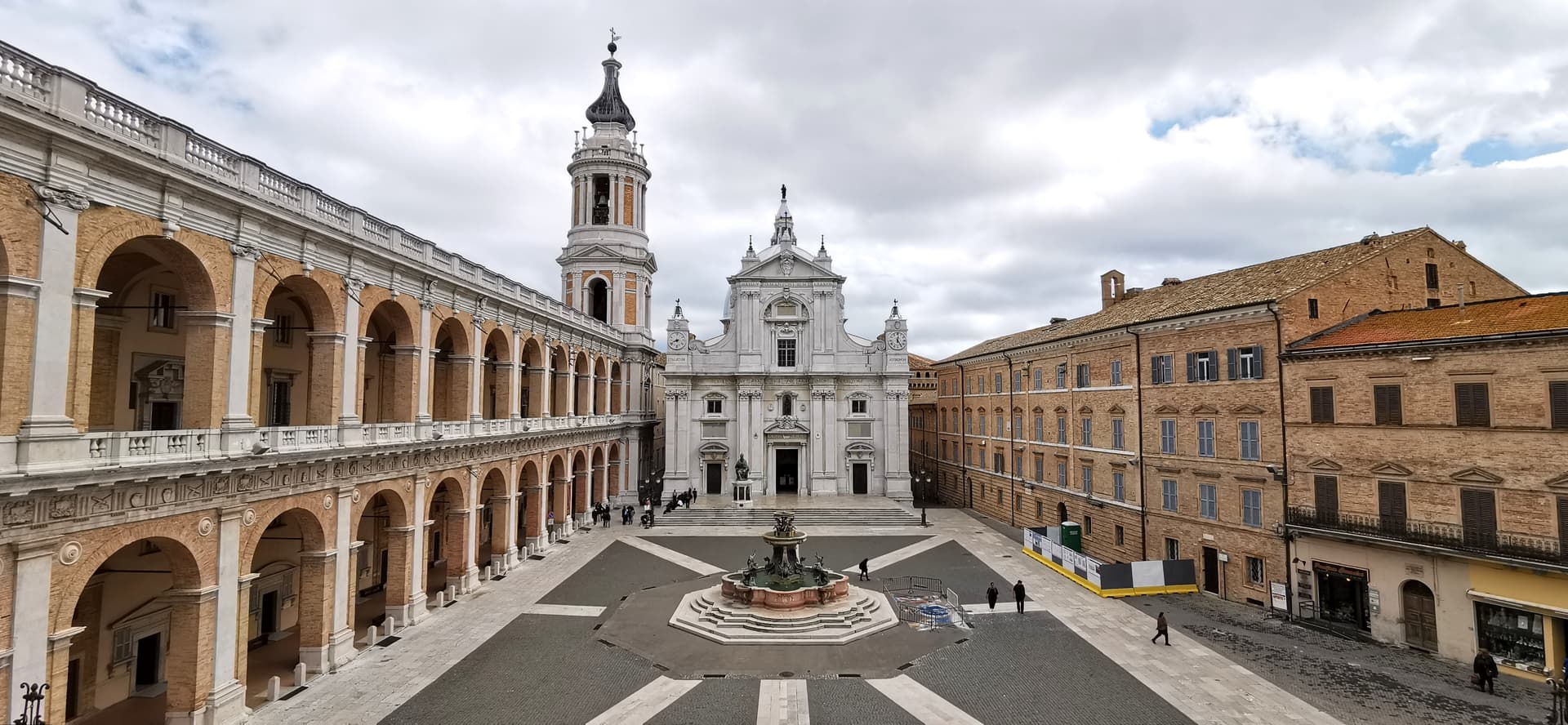
Enter through the main basilica facade on Piazza della Madonna. The Santa Casa is at the crossing under the dome. The Treasury and Museum-Pinacoteca have separate entrances within the complex; the sanctuary information desk inside the basilica can confirm current opening hours.
Loreto is read across Catholic devotion, twentieth-century archaeology, and broader Black Madonna scholarship, with the readings increasingly converging rather than diverging.
The three stones of the Santa Casa are architecturally consistent with first-century Palestinian domestic construction and align with the surviving Grotto of the Annunciation in Nazareth. Whether they were transported miraculously, by Crusader-era ship under the Angeli family, or by some combination, is not settled — but the building's Palestinian origin is increasingly accepted by mainstream archaeologists.
Within Catholic tradition the Santa Casa is the literal house of the Holy Family, and its translation to Loreto a divinely ordained protection from Muslim conquest. The Black Madonna of Loreto is the locus of countless miraculous healings recorded over centuries.
Some readings situate Loreto within a broader European Black Madonna network, interpreting the darkened skin as a symbolic continuation of pre-Christian earth-goddess imagery layered into Marian devotion.
The exact mechanism of the Santa Casa's transport from Palestine; the precise cause of the 1921 fire (electrical fault is the leading explanation); and the historical relationship between the Loreto Black Madonna and other European Black Madonnas remain incompletely documented.
Visit planning
Located in Loreto, Marche, roughly 30 km south of Ancona. Reached by train (Loreto–Stazione, then a short shuttle bus to the basilica) or by car via the A14 autostrada. Nearest airport is Ancona-Falconara (AOI, ~35 km). Free entrance to the basilica and Santa Casa; the Museum-Pinacoteca has a separate admission. Mobile phone signal is available throughout the town and inside the basilica.
Loreto town has a range of pilgrim hostels and small hotels within walking distance of the basilica. The sanctuary's website maintains a list of recommended pilgrim houses for groups. Ancona and Recanati are alternative bases.
Modest dress (shoulders and knees covered), silence in the Santa Casa, restricted photography during liturgies, and standard church etiquette throughout the basilica.
Modest dress required throughout the basilica and especially inside the Santa Casa — shoulders covered, no shorts or short skirts.
Generally permitted in the basilica with discretion. Restricted in the Santa Casa during Mass and other liturgies. No flash.
Candle offerings, Mass intentions, and donations to the sanctuary are traditional.
Silence in the Santa Casa | No mobile phone calls inside the basilica | Men remove hats; head covering for women is not required | No food or drink in the basilica complex
Nearby sacred places
Sacred places within a half-day’s reach. Pilgrims often visit them together: walk one, stay for the other.


References
Sources consulted when researching this page. Independent verification by readers is welcome.
- 01The Holy House from Nazareth to Loreto — Pontifical Sanctuary of the Holy House — Pontifical Sanctuary of the Holy House of Loreto (Vatican)high-reliability
- 02Congregazione della Santa Casa — Pontifical Sanctuary of the Holy Househigh-reliability
- 03Basilica della Santa Casa — Wikipedia — Wikipedia contributorshigh-reliability
- 0410 December: Our Lady of Loreto — Vatican State — Vatican City Statehigh-reliability
- 05Sanctuary of the Holy House of Loreto — Italia.it — ENIT (Italian National Tourist Board)high-reliability
- 06Santa Casa di Loreto — Catholic Encyclopedia — New Advent (1913 Catholic Encyclopedia)high-reliability
- 07Loreto and the Holy House of Mary — National Catholic Register — National Catholic Register
- 08The Black Madonna of Loreto — Interfaith Mary — Interfaith Mary
Key questions
What pilgrims usually ask
- Why is Our Lady of Loreto considered sacred?
- The Holy House from Nazareth set in a Marche basilica behind Bramante's marble screen, with the Black Madonna of Loreto under Pontifical Delegation.
- What should I wear at Our Lady of Loreto?
- Modest dress required throughout the basilica and especially inside the Santa Casa — shoulders covered, no shorts or short skirts.
- Can I take photos at Our Lady of Loreto?
- Generally permitted in the basilica with discretion. Restricted in the Santa Casa during Mass and other liturgies. No flash.
- How long should I spend at Our Lady of Loreto?
- Two to three hours for the basilica, Santa Casa, treasury, and museum. Half a day with the surrounding town.
- How do you visit Our Lady of Loreto?
- Located in Loreto, Marche, roughly 30 km south of Ancona. Reached by train (Loreto–Stazione, then a short shuttle bus to the basilica) or by car via the A14 autostrada. Nearest airport is Ancona-Falconara (AOI, ~35 km). Free entrance to the basilica and Santa Casa; the Museum-Pinacoteca has a separate admission. Mobile phone signal is available throughout the town and inside the basilica.
- What offerings are appropriate at Our Lady of Loreto?
- Candle offerings, Mass intentions, and donations to the sanctuary are traditional.
- What etiquette should visitors follow at Our Lady of Loreto?
- Modest dress (shoulders and knees covered), silence in the Santa Casa, restricted photography during liturgies, and standard church etiquette throughout the basilica.
- What is the history of Our Lady of Loreto?
- Tradition records that as Crusaders were expelled from the Holy Land in the late thirteenth century, angels carried the Holy House from Nazareth — first to Tersatto in modern Croatia on 10 May 1291, then across the Adriatic to a wood near Recanati in the Marches on 10 December 1294, and shortly afterward to its present location in Loreto. Twentieth-century documentary research has identified an alternative — or complementary — mechanism: members of the noble Angeli ('Angels') family of Epirus may have arranged for the stones of the house to be transported by sea during the late Crusader period, a literal reading that converges with the legend's vocabulary. Archaeological analysis supports a Palestinian first-century origin: the three surviving walls match the missing front of the surviving Grotto of the Annunciation in Nazareth, and the stone and construction technique are consistent with first-century Palestinian masonry rather than Marche building practice.