Madonna di Loreto
InsideSanta Casa di Loreto
A dark-faced Madonna carved from cedar, standing where tradition places the Annunciation
Understand sacred places, explore living traditions, and learn how to engage respectfully with Pilgrim Map.
Access has not been verified. Check current local guidance before planning a visit.
Loreto, Ancona, Italy
Read the sources
Visit essentials
A quick read before you go
- Duration
- Part of the Holy House visit
- Access
- Within the Holy House
Overview
Within the Holy House's three ancient walls, the dark-faced Madonna di Loreto calmly holds the child. It is not the original: fire on February 23, 1921 reduced the medieval image to ashes. Its replacement, carved from Lebanese cedar from the Vatican Gardens, was deliberately made dark to preserve an appearance made sacred by centuries of devotion.
Oil-lamp and candle smoke had blackened the original over hundreds of years, together with changes to its pigments. Common among European venerated images, this produced a Black Madonna associated by pilgrims with particular spiritual power. Replacing it with a light-skinned statue would have denied the devotional history represented by blackness, making the decision theological as well as artistic.
In 1920, Pope Benedict XV named her patroness of air travelers, prompted by tradition that angels flew the Holy House across the Mediterranean. Copies stand in shrines worldwide. The Litany of Loreto, prayed before this image for centuries, is among Catholic tradition's most widely recited prayers.
In the small Holy House, the dark statue concentrates centuries of devotion. Tradition places her where Mary stood, receiving prayers from people who crossed continents to enter this house.
Why this place is sacred
Black Madonnas occupy a distinctive place in Christian devotion. Across Europe, from Montserrat to Czestochowa, dark-faced images of Mary attract devotion that often exceeds that given to lighter-skinned images in the same region. Scholars debate the origins of this pattern. Some attribute it to practical causes: candle smoke, pigment degradation, particular wood types. Others detect the influence of the Song of Solomon's declaration that the beloved is black but beautiful.
Still others see continuities with pre-Christian goddess traditions, particularly the worship of Isis or earth-mother figures.
The Madonna di Loreto participates in all of these readings. Her blackness was produced by centuries of candle smoke but was maintained by deliberate choice. She stands in a space claimed as the dwelling of the Annunciation but also resonates with older associations of dark feminine divinity. She is patroness of air travelers, linking the medieval tradition of angelic flight to the modern experience of aviation.
The thinness of this image lies in its capacity to hold multiple meanings simultaneously without resolving them. The Madonna di Loreto is at once a specific Catholic devotional object and a portal into older, less defined territories of sacred feminine presence.
Medieval devotional statue within the Holy House of Loreto
Original statue gradually darkened by candle smoke over centuries. Destroyed by fire February 23, 1921. Replacement carved from Vatican Gardens cedar, deliberately dark. Designated patroness of air travelers 1920.
Experience and orientation
Within the Holy House, the Madonna di Loreto occupies the focal position. She stands at one end of the small interior, dark cedar against rough Palestinian stone, candlelight playing across her features. The statue is not large; it does not need to be. The intimacy of the space means that pilgrims are close, closer than they would be to any altar image in a conventional church.
The darkness of the figure is striking. In the already dim interior of the Holy House, the Madonna's dark face seems to emerge from the stone itself, as if the walls and the image share a common antiquity. This visual continuity, whether intentional or not, reinforces the sense that everything in this space belongs to a single sacred reality.
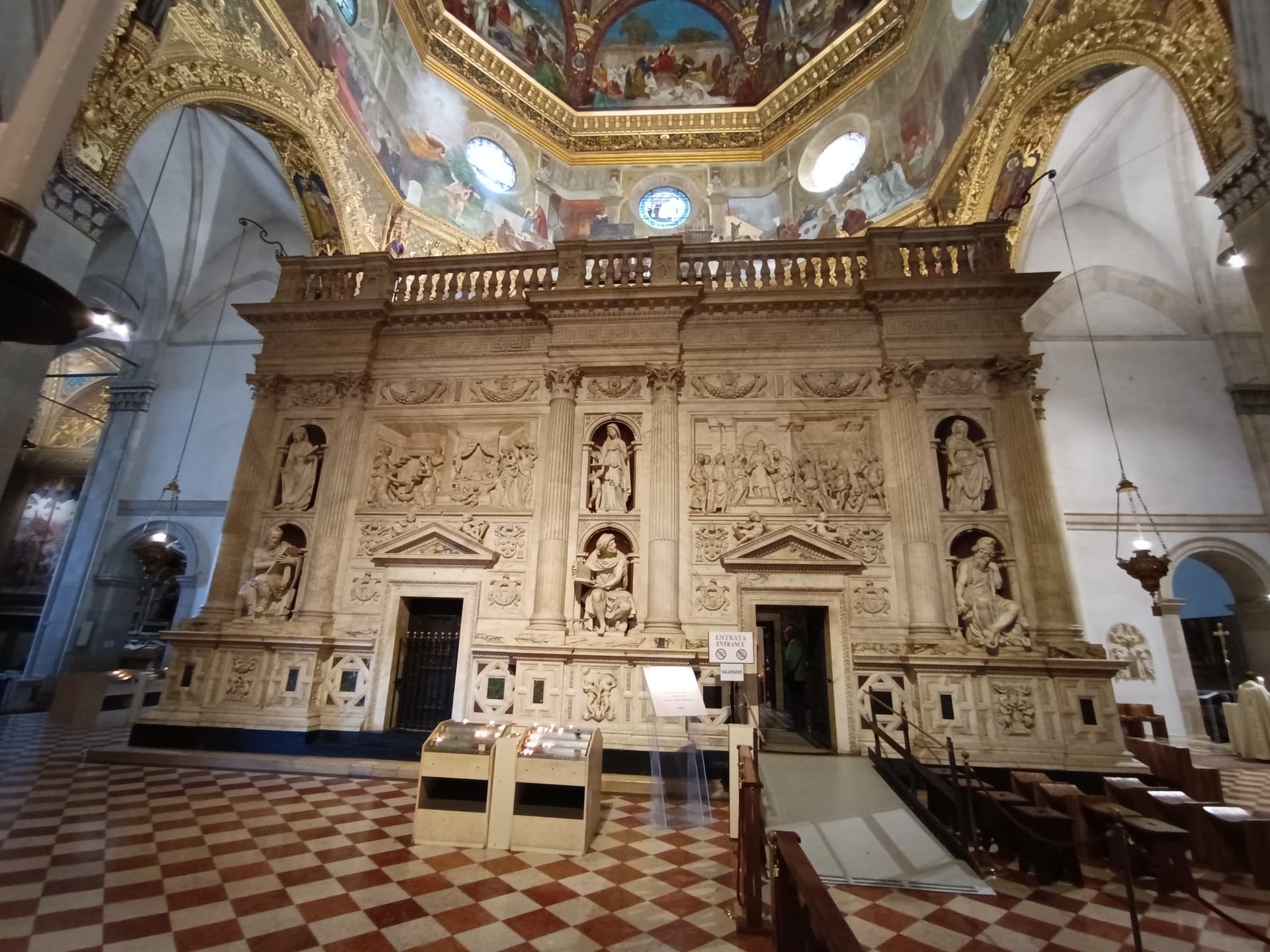
Pilgrims approach with visible emotion. Some kneel. Some simply stand and look. The statue receives their attention without theatrical gesture; the dark face is calm, the pose is holding, the cedar carries the scent of centuries. Outside, Bramante's marble screen represents the highest achievement of Renaissance craft. Inside, a dark woman holds a child in a house that may have known the angel.
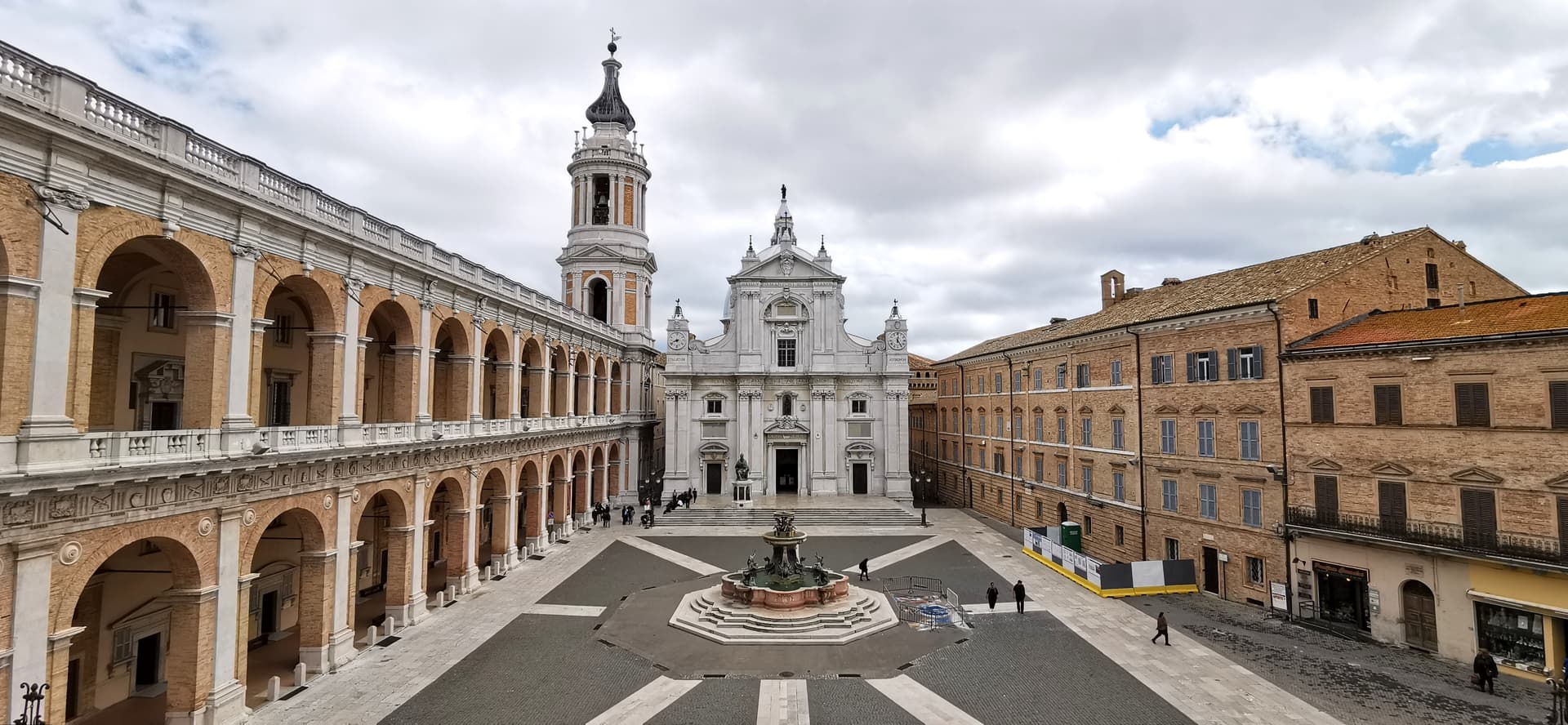
The statue stands within the Holy House, which is at the center of the Basilica della Santa Casa nave in Loreto.
Context and lineage
The original statue's date and creator are uncertain, though it is generally attributed to the medieval period. Over centuries of veneration, the face and hands darkened from exposure to oil lamp and candle smoke and the alteration of original pigments. This gradual transformation produced the Black Madonna of Loreto, an image that attracted particular devotion. On February 23, 1921, a fire destroyed the original.
The replacement was carved by Leopoldo Celani from a cedar of Lebanon taken from the Vatican Gardens, and was deliberately finished in dark tones to maintain the venerated appearance.
The Madonna di Loreto is one of the most widely venerated Marian images in the Catholic world. Copies and replicas exist in shrines across Europe and the Americas. The Litany of Loreto, associated with this devotion, has become universal in Catholic practice.
Pope Benedict XV
Declared Our Lady of Loreto patroness of air travelers
Leopoldo Celani
Sculptor of the replacement statue
Traditions and practice
Veneration of the image, recitation of the Litany of Loreto, prayers for travelers. The feast day (December 10) coincides with the Feast of the Translation of the Holy House.
Continued daily veneration. Prayers for air travelers. The statue remains the focal point of devotion within the Holy House.
Approach the statue within the context of the Holy House visit. The Litany of Loreto, if familiar, creates a direct connection to the centuries of prayer offered before this image. For those traveling by air, the patronal connection adds a personal dimension.
Roman Catholicism
ActiveOne of Europe's most venerated Marian images. Patroness of air travelers. Associated with the Litany of Loreto.
Veneration, prayer, Litany of Loreto, feast day observance
Perspectives and open questions
The Madonna di Loreto invites interpretation as devotional image, as Black Madonna within a broader European tradition, and as a symbol of continuity through destruction.
Scholarly perspective
Art historians note the statue within the broader European Black Madonna phenomenon. The deliberate maintenance of dark coloring after the 1921 fire reflects the devotional significance that the appearance had acquired independent of its original cause.
Living and traditional perspectives
Catholic devotion understands the Madonna di Loreto as the image of Mary in her own home, the house of the Annunciation. The dark coloring is accepted as part of the image's sacred identity.
Alternative interpretations
Scholars of comparative religion connect Black Madonnas to pre-Christian goddess traditions, seeing in the dark feminine figure echoes of Isis, Cybele, or earth-mother archetypes. The Song of Solomon's declaration 'I am black but beautiful' provides a biblical framework.
Open questions
The original statue's date and creator remain uncertain. The full significance of the Black Madonna phenomenon within Christian spirituality and its relationship to older religious traditions continues to be debated.
Plan your visit
Access and arrival
Within the Holy House
See Santuario della Santa Casa di Loreto
Respectful visit
See Holy House entry
See Holy House entry
Candles, votive offerings
See Holy House and basilica entries
The statue is within the Holy House and shares its etiquette requirements. The space can be emotionally intense.
Current practical details
Address
Corso Traiano Boccalini, 60, 60025 Loreto AN, Italy
Hours
Hours, fees, and access can change — verify on the official source before you travel. Practical details last checked Jun 2026.
Location
Map loads as you approach this section.
Pilgrim reflections
A portrait of encounter, not a score
Pilgrims describe what they felt, how present they could become, and whether the place would shape a journey. There are no stars and no ranking of traditions.
No reviewed reflections yet
The first pilgrims can help describe the character of being here.
Share a reflection
Available after an account-backed “Been there.” Every reflection is reviewed before publication.
Dates and observances
Upcoming festivals, feast days, and pilgrimages connected to this place. Add any to your calendar, or browse the full observance calendar.
- Add to calendar
Feast of Our Lady of Loreto
Thu, Dec 10, 2026Feast day
The feast of the Translation of the Holy House (Dec 10), marking the traditional 1294 arrival of the house of the Virgin Mary in Loreto, centered on the Holy House within the basilica.
- Add to calendar
Feast of Our Lady of Loreto
Fri, Dec 10, 2027Feast day
The feast of the Translation of the Holy House (Dec 10), marking the traditional 1294 arrival of the house of the Virgin Mary in Loreto, centered on the Holy House within the basilica.
Nearby sacred places
Explore other sacred places in the region. Proximity does not establish access or travel time; check each place’s guidance.


References
Sources consulted for this page. Source categories describe the publication, not a guarantee that every claim is verified. Traditional accounts and outside interpretations may differ.
- 01The Black Madonna of Loreto - Interfaith Mary Page — Interfaith Mary PageSource contextInterfaith perspective on Black Madonna traditions
- 02Basilica della Santa Casa - Wikipedia — Wikipedia contributorsencyclopediaIncludes statue history
- 03Black Madonnas in Italy and around the world — Holyart.comSource contextOverview of Black Madonna traditions
- 04Black Madonna - Wikipedia — Wikipedia contributorsencyclopediaGeneral context on Black Madonna traditions
Photo gallery
6 curated photos
Share a photo
Help visitors recognize Madonna di Loreto. Every submission is reviewed before publication.