Santa Casa di Loreto
InsideSantuario della Santa Casa di Loreto
Three ancient walls where tradition says the angel spoke to Mary
Understand sacred places, explore living traditions, and learn how to engage respectfully with Pilgrim Map.
Access has not been verified. Check current local guidance before planning a visit.
Loreto, Ancona, Italy
Read the sources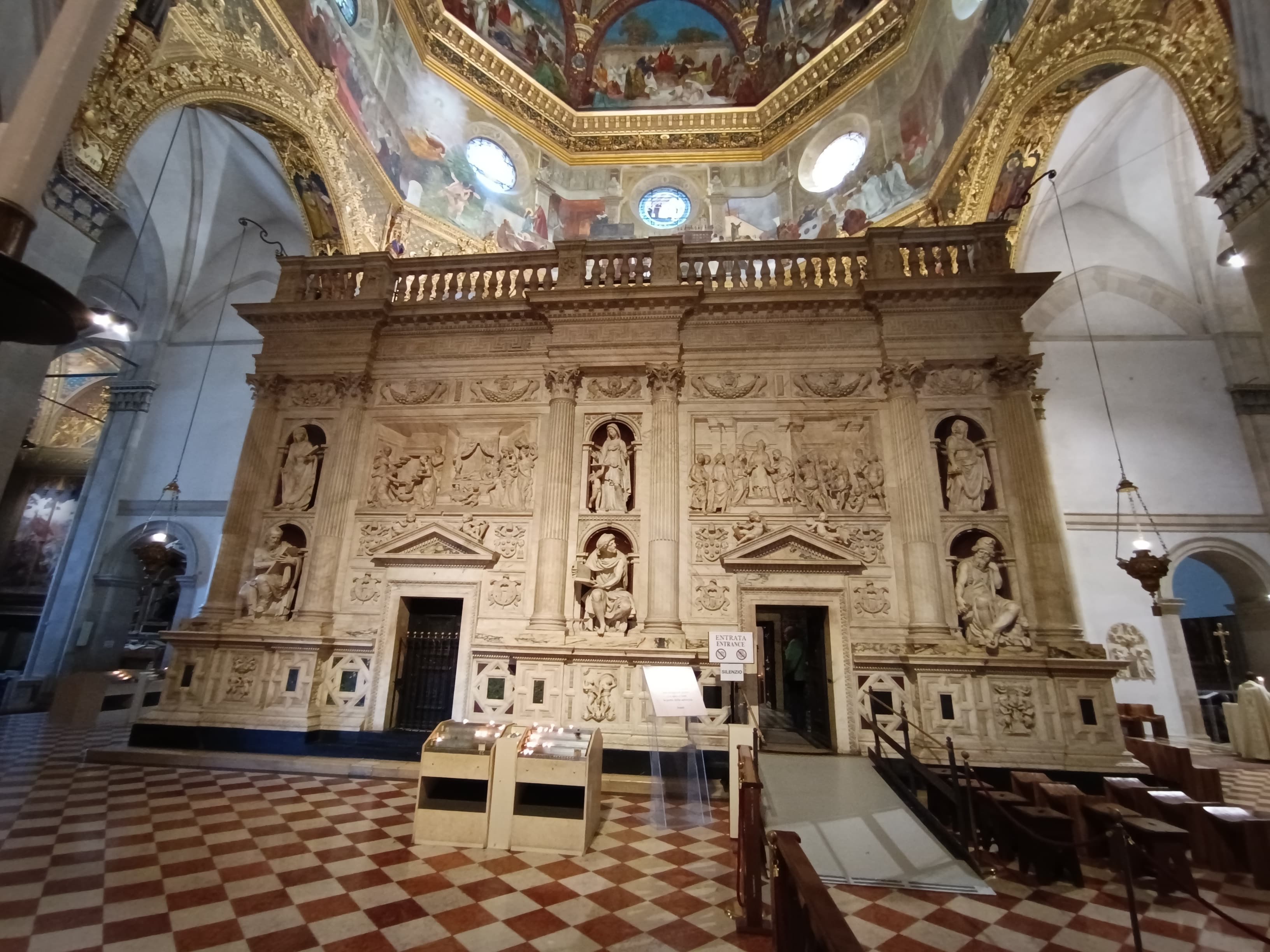
Image of Santa Casa di Loreto. Image source · CC-BY-SA-4.0
Visit essentials
A quick read before you go
- Duration
- 15-30 minutes within the Holy House; longer if attending Mass at the interior altar
- Access
- At the center of the Basilica della Santa Casa nave, enclosed within the marble screen.
Overview
The Santa Casa is the reason Loreto exists: three small stone walls, claimed since the late thirteenth century as Mary's dwelling, where she received the message of the angel Gabriel, stand at the geographic and spiritual center of the basilica built to protect them. Their rough domestic scale gives the Holy House its power. In Christian understanding, these ordinary walls may have witnessed the infinite enter the finite, making the Incarnation tangible without turning faith into archaeological certainty.
The stones are not native to the Recanati area, accord with first-century Palestinian materials and building techniques, and correspond to the front of the house whose grotto remains in the Church of the Annunciation in Nazareth, but whether Crusader-era Christians or angels brought them to Loreto remains debated. Inside, the Lebanese-cedar Black Madonna replaces a statue destroyed by fire in 1921, maintaining its dark coloring amid candles and centuries of prayer.
Bramante's Renaissance marble screen surrounds a space that returns pilgrims to something human and domestic.
Sites inside
Why this place is sacred
What makes the Holy House thin is the convergence of material evidence and devotional tradition in a space of extraordinary intimacy. These are not monumental temple walls. They are the walls of a house, scaled to the daily life of a family. The tradition claims that within these walls, the most consequential conversation in Christian theology took place: an angel told a young woman that she would bear a child who would be called the Son of the Most High.
The stones themselves carry evidence of their claimed origin. Their composition is Palestinian. Their construction technique is consistent with first-century practice. They fit the known perimeter of the Nazareth grotto. These facts do not prove the tradition, but they make it plausible in a way that sustains the devotional response.
Seven centuries of pilgrimage have added their own thinness. The walls have been touched by the hands of at least 150 canonized saints and over fifty popes. The Litany of Loreto, prayed in this space since the medieval period, has become one of the most widely recited Marian prayers in the world. The accumulated devotion is itself a form of sacredness, layered over whatever original holiness the walls may carry.
Traditional: the dwelling of the Holy Family in Nazareth, site of the Annunciation
Transported to Loreto c. 1294. Enclosed within Bramante's marble screen from 1507. Original Madonna statue destroyed by fire 1921, replaced with Lebanese cedar replica maintaining dark coloring.
Experience and orientation
The approach to the Holy House passes through Bramante's marble screen, an architectural masterwork commissioned by Julius II in 1507 that simultaneously protects and frames the ancient walls. The screen's Renaissance elegance prepares the visitor for something of comparable grandeur. What they find instead is simplicity.
The interior of the Holy House is small and dark. The walls are rough stone, worn smooth in places by centuries of hands. Candles provide the primary illumination, their light flickering across surfaces that may be two thousand years old. The Black Madonna statue stands at one end, dark against the darker stone. The air carries the mingled scent of wax, incense, and old stone.
The experience of contrast is central. Outside, the basilica is a monument to Renaissance art and papal ambition. Inside the Holy House, everything returns to the scale of a dwelling. This is the point: the Incarnation, in Christian understanding, did not occur in a temple or a palace but in a house. The Holy House makes that theological claim physical.
Pilgrims often kneel or stand in silence. Some touch the walls. Some weep. The emotional intensity of the space is heightened by its intimacy; there is no distance between the visitor and the sacred, no barrier of nave or altar rail. You stand inside the walls themselves.
The Holy House stands at the center of the Basilica della Santa Casa nave, enclosed within Bramante's marble screen. It consists of three walls; the fourth side, originally the entrance to the grotto, is open.
Context and lineage
The traditional account holds that these walls formed the front portion of the house where the Virgin Mary lived in Nazareth, the house where the Annunciation occurred. The rear portion, a natural grotto, remains in Nazareth. In the 1290s, as Crusader presence in the Holy Land collapsed, the walls were reportedly transported first to Tersatto in Croatia (1291) and then to their present location (1294). Whether this transport was accomplished by angels or by human agency remains debated.
The Holy House is the central relic of the Pontifical Sanctuary of Loreto. Its claimed connection to Nazareth links it to the earliest Christian sacred geography.
Virgin Mary
Traditional inhabitant of the house
Donato Bramante
Designed the marble screen enclosing the Holy House
Traditions and practice
Pilgrims have entered the Holy House to pray, touch the walls, and venerate the Madonna since at least the fourteenth century. The Litany of Loreto, prayed within this space, became one of the Catholic Church's most important Marian prayers.
Mass is celebrated at the altar within the Holy House. Individual prayer continues throughout the day. Eastern Orthodox communities have received permission to celebrate Divine Liturgy here.
Enter quietly. Allow the shift from basilica to house to register before moving deeper into the space. If the Litany of Loreto is familiar, its recitation here connects you to a centuries-old chain of the same prayer in the same place. Touch the walls if moved to do so; you join a line of pilgrims stretching back seven hundred years.
Roman Catholicism
ActiveClaimed dwelling of the Holy Family and site of the Annunciation. One of the most important relics in Christendom.
Prayer, wall touching, kneeling, Litany of Loreto, Mass at interior altar
Perspectives and open questions
The Holy House invites interpretation as relic, as archaeological anomaly, as theological symbol, and as living place of prayer.
Scholarly perspective
Material analysis confirms the Palestinian origin of the stones and their compatibility with first-century construction. The correspondence between the three walls and the Nazareth grotto perimeter has been documented. Scholarly debate focuses on the mechanism and circumstances of transport rather than the origin of the materials.
Living and traditional perspectives
Catholic tradition holds these walls as the actual dwelling of the Annunciation, making the Holy House one of the most sacred physical objects in Christianity.
Alternative interpretations
The Holy House draws interest from those studying the phenomenon of translated sacred spaces, Black Madonna traditions, and the material culture of pilgrimage. The deliberate maintenance of the dark Madonna coloring connects to broader questions about the relationship between European Christian art and pre-Christian divine feminine traditions.
Open questions
The logistics of the transport, the identity of those responsible, and the precise relationship between the Loreto walls and the Nazareth grotto remain open questions.
Plan your visit
Access and arrival
At the center of the Basilica della Santa Casa nave, enclosed within the marble screen. Entered through openings in the screen.
See Santuario della Santa Casa di Loreto
Respectful visit
Modest dress: shoulders and knees covered.
Photography may be restricted within the Holy House. Check current guidelines. No flash under any circumstances.
Candles available outside the Holy House.
Silence | No flash photography | Restricted during certain liturgical celebrations | Respect the prayer of others
The space is small and can become crowded. Others may be in deep prayer. Maintain silence and awareness.
Current practical details
Address
Piazza della Madonna, 1, 60025 Loreto AN, Italy
Phone
Hours
Hours, fees, and access can change — verify on the official source before you travel. Practical details last checked Jun 2026.
Location
Map loads as you approach this section.
Pilgrim reflections
A portrait of encounter, not a score
Pilgrims describe what they felt, how present they could become, and whether the place would shape a journey. There are no stars and no ranking of traditions.
No reviewed reflections yet
The first pilgrims can help describe the character of being here.
Share a reflection
Available after an account-backed “Been there.” Every reflection is reviewed before publication.
Nearby sacred places
Explore other sacred places in the region. Proximity does not establish access or travel time; check each place’s guidance.



References
Sources consulted for this page. Source categories describe the publication, not a guarantee that every claim is verified. Traditional accounts and outside interpretations may differ.
- 01The Holy House from Nazareth to Loreto — Santuario LoretoofficialOfficial sanctuary account of the Holy House history
- 02CATHOLIC ENCYCLOPEDIA: Santa Casa di Loreto — New AdventencyclopediaDetailed analysis of the Holy House claims
- 03Basilica della Santa Casa - Wikipedia — Wikipedia contributorsencyclopediaIncludes details on the Holy House itself
- 04Holy House of Loreto - Sacred Destinations — Sacred DestinationsguideVisitor-focused information
- 05The Black Madonna of Loreto - Interfaith Mary Page — Interfaith Mary PageSource contextInterfaith perspective on the Black Madonna tradition
Share a photo
Help visitors recognize Santa Casa di Loreto. Every submission is reviewed before publication.