Santiago de Compostela
Where the Camino ends and the apostle is embraced
Santiago de Compostela, Galicia, Spain
Plan this visit
Practical context before you go
Allow at least two to three hours for the cathedral interior, crypt, and museum. A full day to include the rooftops and the surrounding Old Town. Pilgrims who have walked the Camino often rest in Santiago two to three days to integrate the journey before continuing to Finisterre or returning home.
Centre of Santiago de Compostela, Galicia. Santiago–Rosalía de Castro airport (SCQ) is about 13 km from the cathedral with regular bus and taxi connections. RENFE operates high-speed and regional trains from Madrid, A Coruña, and Vigo into Santiago station, a 25-minute walk from the cathedral. The Old Town is pedestrian; arrive on foot.
Modest dress, silence during prayer and Mass, no flash photography during liturgies, no large bags. The cathedral is both a tourist destination and a working sanctuary; the second role takes precedence.
At a glance
- Coordinates
- 42.8806, -8.5446
- Suggested duration
- Allow at least two to three hours for the cathedral interior, crypt, and museum. A full day to include the rooftops and the surrounding Old Town. Pilgrims who have walked the Camino often rest in Santiago two to three days to integrate the journey before continuing to Finisterre or returning home.
- Access
- Centre of Santiago de Compostela, Galicia. Santiago–Rosalía de Castro airport (SCQ) is about 13 km from the cathedral with regular bus and taxi connections. RENFE operates high-speed and regional trains from Madrid, A Coruña, and Vigo into Santiago station, a 25-minute walk from the cathedral. The Old Town is pedestrian; arrive on foot.
Pilgrim tips
- Shoulders and knees covered. Hats removed by men inside the cathedral. Walking clothes are acceptable; pilgrims arrive in what they have walked in.
- Permitted without flash in the nave outside Mass. Not permitted during Mass or during the Botafumeiro ceremony in many circumstances. Avoid photographing pilgrims in private prayer or tears.
- Photography is restricted during liturgies and during the Botafumeiro ceremony. Large backpacks are not permitted inside; the Oficina del Peregrino keeps left-luggage. Photography of pilgrims at their most private moments — kneeling at the crypt, weeping in the plaza — should be avoided as a basic courtesy.
Overview
For more than a thousand years the granite squares of Santiago have been the final paving stones of a journey that begins in dozens of European countries. Pilgrims arrive on foot at the cathedral's western façade, where the apostle James is said to lie, and where the long road becomes a doorway.
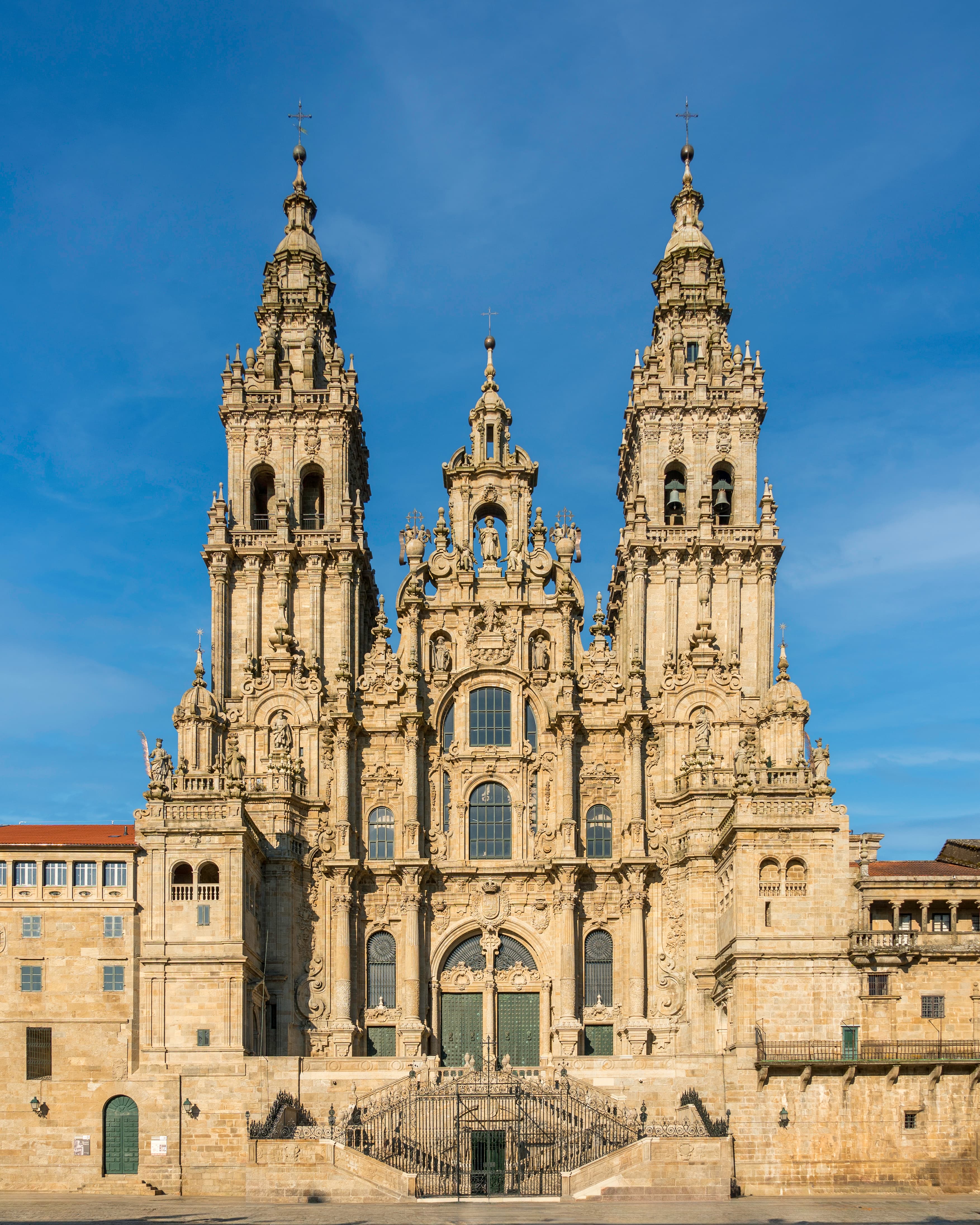
The Catedral de Santiago de Compostela is the terminus of one of the great pilgrimage routes of the world — the Camino de Santiago, walked continuously since the ninth century. Built over a Roman-era necropolis where the apostle James the Greater is believed to have been laid, the cathedral grew from a small basilica raised by Alfonso II of Asturias around 814 into the present Romanesque masterpiece, consecrated in 1211. Its Baroque Obradoiro façade, completed in 1740, rises over the granite plaza where pilgrims arrive after weeks or months of walking from Roncesvalles, Le Puy, Lisbon, or further. Master Mateo's Pórtico de la Gloria, completed in 1188, was the doorway through which generations of pilgrims first crossed; its 200 polychromed Romanesque figures were uncovered by a decade-long conservation campaign concluded in 2018. The cathedral remains a working seat of the Archdiocese, with the daily Pilgrim's Mass and the swinging of the great Botafumeiro censer at major feasts. UNESCO inscribed the Old Town in 1985 and the Camino routes themselves in 1993, extended in 2015 (WHL #347 and #669). Roughly 446,000 Compostela certificates were issued in 2023 and 499,000 in 2024 — the highest year on record.
Context and lineage
Tradition holds that after the martyrdom of James the Greater in Jerusalem around AD 44, his body was carried by his disciples by sea to Galicia and buried in a marble ark. The tomb was lost for centuries. Around 813, the hermit Pelagius (Pelayo) saw lights over a wood — the Campus Stellae, 'Field of the Star,' from which Compostela may take its name. Bishop Theodemir of Iria Flavia investigated and identified the grave. King Alfonso II of Asturias walked from Oviedo to venerate it, becoming, by tradition, the first pilgrim. A chapel was raised on the spot, then Alfonso III's larger basilica. In 997 the city was sacked by the Cordoban general Almanzor, who carried the cathedral bells back to Córdoba on the shoulders of Christian captives but spared the relics. The present cathedral was begun in 1075 under Bishop Diego Peláez and consecrated in 1211 under Diego Gelmírez, the prelate who turned Santiago into a metropolitan see and an international pilgrimage centre.
Roman Catholic, Latin Rite. Cathedral church of the Archdiocese of Santiago de Compostela, one of the few metropolitan sees of Spain. The cathedral is administered by the Cabildo (cathedral chapter).
Why this place is sacred
Thin places are usually described in terms of geography: a mountain, a spring, a cave where the membrane between worlds wears through. Santiago is a thin place of a different kind. It is thin because of what has been done here, again and again, for more than a thousand years. The convergence of dozens of historic routes from across Europe — Le Puy, Vézelay, Arles, Tours, the Northern Coast, the Portuguese Way — into a single granite plaza in front of a single cathedral creates a sacred geometry of attention. Every Camino path narrows to this door. Pilgrims who arrive on foot consistently describe the moment they step into the Plaza do Obradoiro as one of involuntary tears, of physical release, of the journey becoming visible to them only as it ends. Inside, the threshold experience continues: the embrace of the apostle's gilded statue above the high altar, the descent to the silver casket in the crypt, the slow swing of the Botafumeiro through the transept vault. The cathedral is built to be entered, not merely seen.
Funerary basilica raised over the rediscovered tomb of the apostle, then the seat of the Archdiocese of Santiago and the gathering point of medieval Christian pilgrimage in the Iberian Peninsula.
The first chapel raised by Alfonso II around 814 was replaced by Alfonso III's larger basilica, sacked by Almanzor in 997 (the relics spared), and rebuilt as the present Romanesque cathedral from 1075. The Baroque Obradoiro façade was completed in 1740. The Pilgrim's Mass continues twice daily; the Holy Door is opened in Compostelan Holy Years when the feast of Saint James falls on a Sunday — most recently 2021–2022 (extended), next in 2027.
Traditions and practice
The Pilgrim's Mass is celebrated daily at 12:00 (in Spanish, the principal pilgrim service) and 19:30. Arriving pilgrims' nationalities and starting points are read aloud. The Abrazo al Apóstol — climbing the narrow stair behind the high altar to embrace the gilded thirteenth-century statue of Santiago from behind — is the central tactile act. Pilgrims then descend to the crypt to pray before the silver reliquary casket containing the relics traditionally identified as James and his disciples Theodorus and Athanasius. The Botafumeiro, swung by eight tiraboleiros pulling on a counterweighted rope, fills the transept with incense at major feasts; at other times groups may sponsor it for a donation.
The Holy Compostelan Year (Año Santo Jacobeo) falls when 25 July — the feast of Saint James — lands on a Sunday. The Holy Door (Puerta Santa) on the east side of the cathedral is opened only in Holy Years, and crossing it carries a plenary indulgence in Catholic practice. The next Holy Years are 2027 and 2032. The Compostela certificate is issued at the Oficina del Peregrino to those who walked the last 100 km or cycled the last 200 km with religious or spiritual motivation; a Certificado de Distancia is available for any motivation.
If you have walked the Camino, allow yourself to arrive slowly. Do not rush from the plaza to the next thing. Sit on the paving for a while. Enter the cathedral once at noon for the Pilgrim's Mass — the reading of arrivals frequently includes one's own starting point — and once at dawn or late evening when the nave is nearly empty. The embrace and the crypt visit are best done outside Mass hours when the queue moves freely. If you have not walked, do not rush either: the cathedral is meant to be encountered after stillness.
Roman Catholicism
ActiveOne of the three great medieval Christian pilgrimage centres alongside Jerusalem and Rome; reputed burial place of Saint James the Greater, apostle of Christ; seat of the Archdiocese of Santiago de Compostela.
Daily Pilgrim's Mass with the reading of arriving pilgrims' nationalities; embrace of the apostle's statue above the high altar (Abrazo al Apóstol); veneration of the silver reliquary casket in the crypt; the swinging of the Botafumeiro at major liturgies; opening of the Holy Door (Puerta Santa) in Compostelan Holy Years.
Experience and perspectives
The approach is the first part of the experience. Pilgrims walk in from the east through narrow Old Town streets, hearing their own footsteps on stone, sometimes following bagpipers playing at the threshold of the plaza. They emerge into the wide granite expanse of the Obradoiro and stop. Many sit down on the paving stones, looking up. The Baroque façade — Fernando de Casas Novoa's masterwork — is the postcard image, but the older Romanesque structure stands behind it, and behind that the rediscovered tomb. Entering, most visitors are routed first through the Pórtico de la Gloria — Master Mateo's twelfth-century doorway, recently restored to reveal its original polychrome. The Pilgrim's Mass at noon and 19:30 reads out the nationalities and starting points of pilgrims who have arrived that day. The Botafumeiro, a 1.5-metre, 80-kilogram silver-plated censer, is swung across the transept by eight tiraboleiros at major liturgies, arcing high enough to brush the vault. The embrace of the apostle behind the altar and the descent into the crypt to stand before the silver reliquary casket are the two embodied acts most pilgrims complete. Confession and pastoral counsel are widely available in multiple languages.
Enter from the Plaza do Obradoiro on the west or the Praza das Praterías on the south. The Oficina del Peregrino, two minutes downhill from the cathedral, issues the Compostela certificate to those who have walked at least 100 km or cycled 200 km. The cathedral itself is free; the museum, rooftops, crypt access, and Pórtico de la Gloria require tickets that can be booked at catedraldesantiago.es.
The cathedral holds simultaneously a documented archaeological past, a tradition that no scholarship can verify, and a living pilgrimage that has not paused for twelve centuries. Each perspective is best held alongside the others.
Excavations beneath the cathedral in the twentieth century revealed a Roman-period necropolis (first to fourth century AD). The identification of one of those burials as James the Greater is a matter of religious tradition rather than archaeological proof. The Romanesque cathedral is one of the supreme achievements of European medieval architecture, and the Pórtico de la Gloria is among the finest sculptural ensembles of its century.
Catholic tradition holds that James preached in Hispania, was martyred in Jerusalem under Herod Agrippa around AD 44, and that his remains were translated by his disciples to Galicia. The 813 rediscovery by the hermit Pelagius and the subsequent foundation by Alfonso II are the foundational narratives of the cathedral and, through it, of the Camino.
Some authors connect Compostela to pre-Christian astral cults (the 'Field of the Star' etymology, the alignment of the Camino with the Milky Way) or to older Galician sacred geography. These are popular and literary readings rather than scholarly consensus.
Whose body lies in the silver reliquary casket cannot be settled historically. The cathedral's gravitational pull on pilgrims has never depended on the question being answerable.
Visit planning
Centre of Santiago de Compostela, Galicia. Santiago–Rosalía de Castro airport (SCQ) is about 13 km from the cathedral with regular bus and taxi connections. RENFE operates high-speed and regional trains from Madrid, A Coruña, and Vigo into Santiago station, a 25-minute walk from the cathedral. The Old Town is pedestrian; arrive on foot.
Santiago has the densest concentration of pilgrim hostels (albergues) in Spain, ranging from municipal dormitories to private rooms. Pilgrim accommodations and the parador on the Obradoiro both book heavily in summer; reserve ahead in July and August. Many religious houses also offer pilgrim hospitality.
Modest dress, silence during prayer and Mass, no flash photography during liturgies, no large bags. The cathedral is both a tourist destination and a working sanctuary; the second role takes precedence.
Shoulders and knees covered. Hats removed by men inside the cathedral. Walking clothes are acceptable; pilgrims arrive in what they have walked in.
Permitted without flash in the nave outside Mass. Not permitted during Mass or during the Botafumeiro ceremony in many circumstances. Avoid photographing pilgrims in private prayer or tears.
Candles and small donations are welcome. The Botafumeiro can be sponsored by a group for a donation, requested in advance through the Cabildo. No particular offering is expected from any visitor.
No large backpacks inside. Silence during liturgies. The crypt, museum, rooftops, and Pórtico de la Gloria require tickets — book at catedraldesantiago.es. Holy Door access only in Compostelan Holy Years.
Plan your visit
Address
Santiago de Compostela, Municipality of Santiago de Compostela, A Coruña, Spain
Hours, fees, and access can change — verify on the official source before you travel. Practical details last checked Jun 2026.
Dates and observances
Upcoming festivals, feast days, and pilgrimages connected to this place. Add any to your calendar, or browse the full observance calendar.
- Add to calendar
Feast of Saint James (Día de Santiago)
Sat, Jul 25, 2026Feast day
Patronal feast of Saint James the Great, the culmination of the Camino de Santiago; celebrated with the botafumeiro and processions at the cathedral.
- Add to calendar
Feast of Saint James (Día de Santiago)
Sun, Jul 25, 2027Feast day
Patronal feast of Saint James the Great, the culmination of the Camino de Santiago; celebrated with the botafumeiro and processions at the cathedral.
Nearby sacred places
Sacred places within a half-day’s reach. Pilgrims often visit them together: walk one, stay for the other.

References
Sources consulted when researching this page. Independent verification by readers is welcome.
- 01Santiago de Compostela (Old Town) — UNESCO World Heritage Centre — UNESCO World Heritage Centrehigh-reliability
- 02Routes of Santiago de Compostela: Camino Francés and Routes of Northern Spain — UNESCO — UNESCO World Heritage Centrehigh-reliability
- 03Catedral de Santiago de Compostela — Official Cathedral Site — Cabildo de la S.A.M.I. Catedral de Santiagohigh-reliability
- 04Estadísticas — Oficina del Peregrino de Santiago de Compostela — Oficina de Acogida al Peregrinohigh-reliability
- 05Santiago de Compostela Cathedral — Wikipedia — Wikipedia contributorshigh-reliability
- 06Pórtico da Gloria — Wikipedia — Wikipedia contributorshigh-reliability
- 07Santiago de Compostela | Spain, History, & Cathedral — Britannica — Encyclopædia Britannicahigh-reliability
- 08Programa Catedral de Santiago — Restauración del Pórtico de la Gloria — Fundación Barriéhigh-reliability
- 09Walking the Camino de Santiago — Smithsonian Magazine — Smithsonian Magazine editorial
Key questions
What pilgrims usually ask
- Why is Santiago de Compostela considered sacred?
- Romanesque cathedral over the reputed tomb of Saint James and the endpoint of the Camino de Santiago. Pilgrim's Mass, Botafumeiro, Pórtico de la Gloria.
- What should I wear at Santiago de Compostela?
- Shoulders and knees covered. Hats removed by men inside the cathedral. Walking clothes are acceptable; pilgrims arrive in what they have walked in.
- Can I take photos at Santiago de Compostela?
- Permitted without flash in the nave outside Mass. Not permitted during Mass or during the Botafumeiro ceremony in many circumstances. Avoid photographing pilgrims in private prayer or tears.
- How long should I spend at Santiago de Compostela?
- Allow at least two to three hours for the cathedral interior, crypt, and museum. A full day to include the rooftops and the surrounding Old Town. Pilgrims who have walked the Camino often rest in Santiago two to three days to integrate the journey before continuing to Finisterre or returning home.
- How do you visit Santiago de Compostela?
- Centre of Santiago de Compostela, Galicia. Santiago–Rosalía de Castro airport (SCQ) is about 13 km from the cathedral with regular bus and taxi connections. RENFE operates high-speed and regional trains from Madrid, A Coruña, and Vigo into Santiago station, a 25-minute walk from the cathedral. The Old Town is pedestrian; arrive on foot.
- What offerings are appropriate at Santiago de Compostela?
- Candles and small donations are welcome. The Botafumeiro can be sponsored by a group for a donation, requested in advance through the Cabildo. No particular offering is expected from any visitor.
- What etiquette should visitors follow at Santiago de Compostela?
- Modest dress, silence during prayer and Mass, no flash photography during liturgies, no large bags. The cathedral is both a tourist destination and a working sanctuary; the second role takes precedence.
- What is the history of Santiago de Compostela?
- Tradition holds that after the martyrdom of James the Greater in Jerusalem around AD 44, his body was carried by his disciples by sea to Galicia and buried in a marble ark. The tomb was lost for centuries. Around 813, the hermit Pelagius (Pelayo) saw lights over a wood — the Campus Stellae, 'Field of the Star,' from which Compostela may take its name. Bishop Theodemir of Iria Flavia investigated and identified the grave. King Alfonso II of Asturias walked from Oviedo to venerate it, becoming, by tradition, the first pilgrim. A chapel was raised on the spot, then Alfonso III's larger basilica. In 997 the city was sacked by the Cordoban general Almanzor, who carried the cathedral bells back to Córdoba on the shoulders of Christian captives but spared the relics. The present cathedral was begun in 1075 under Bishop Diego Peláez and consecrated in 1211 under Diego Gelmírez, the prelate who turned Santiago into a metropolitan see and an international pilgrimage centre.