Pena Molexa
A granite moon balanced on a stone boat, aligned with a lunar cycle that repeats every nineteen years
Understand sacred places, explore living traditions, and learn how to engage respectfully with Pilgrim Map.
Access has not been verified. Check current local guidance before planning a visit.
Narón, A Coruña, Spain
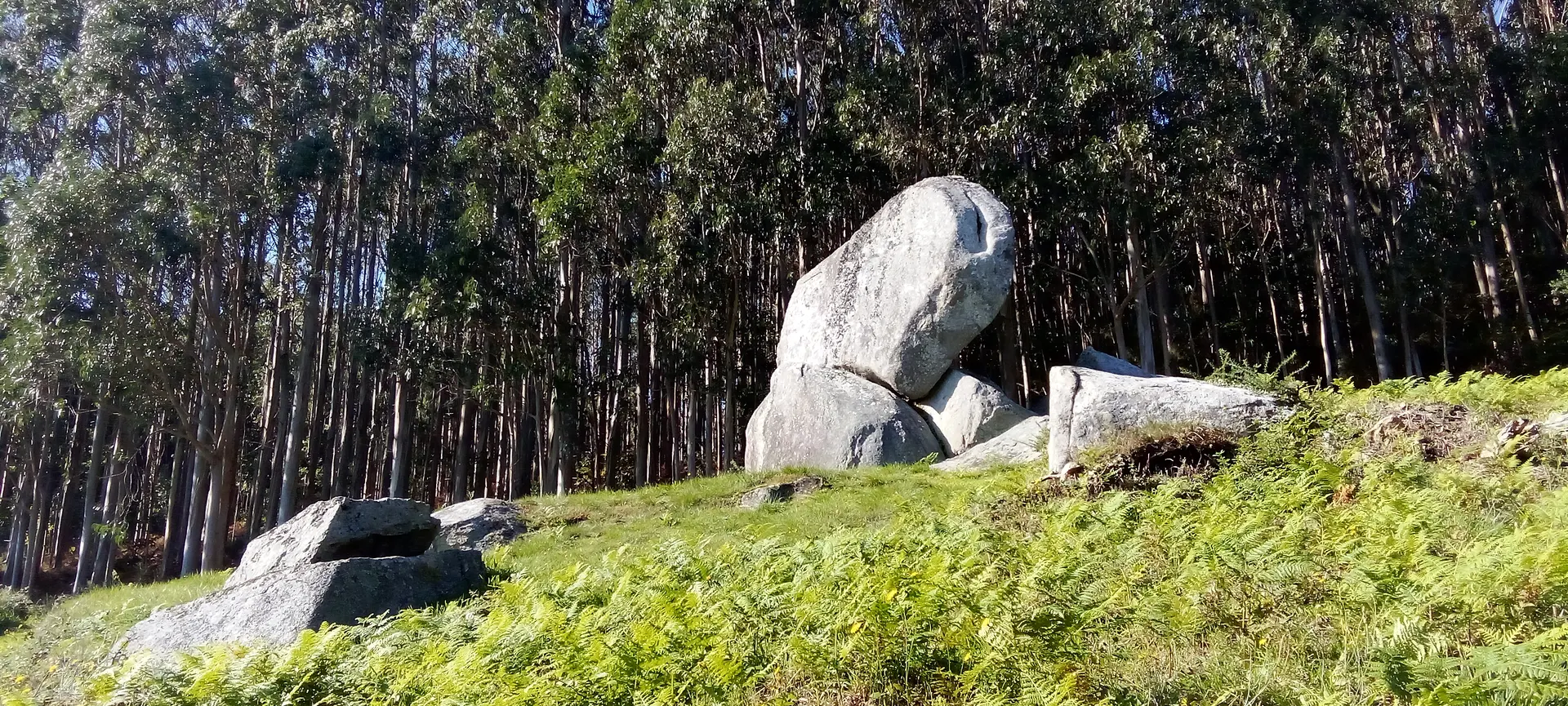
Image of Pena Molexa. Image source · CC-BY-SA-4.0
Visit essentials
A quick read before you go
- Duration
- Allow two to three hours for the hike to the monument and back via the Pena Molexa - Monte da…
- Access
- Parish of Santa Maria Maior do Val, municipality of Naron, province of A Coruna.
Overview
On a windswept Ferrolterra hillside, Pena Molexa appears as a disc-shaped granite boulder balanced on supporting stones shaped like a boat. Whether wholly human-placed or a natural feature ritually enhanced by prehistoric communities remains unresolved. Five legends converge here around the Moura, a supernatural woman who emerges on the night of San Xoan to test treasure-seekers' worthiness.
Historian and archaeologist Andre Pena Grana, Dean of the Galician Institute for Celtic Studies, interprets the monument as a trebo-pala, a tribal altar for the first sacrificial banquet and the solemn enthronement of the king of the treba. In his analysis, the Moura preserves the Celtic Mother Goddess and sacred sovereignty, granting legitimate rule through a test of character.
Every nineteen years, the summer-solstice full moon rises in exact alignment with the formation, a rare convergence of lunar and solar cycles that suggests deliberate siting. Each San Xoan, the O Val community gathers in period costume to reenact the Moura's emergence and the petrified king's awakening.
Why this place is sacred
The thinning at Pena Molexa happens through accumulation. Five distinct legends converge at this single formation, each addressing the boundary between worlds. The Moura emerges from beneath the stone. The petrified king and his warriors awaken for one night. Three golden mules carry treasure into the darkness. Each story describes a threshold crossed, a boundary dissolved.
The astronomical alignment deepens the thinning. The Metonic cycle repeats every nineteen years, meaning that the full moon rises at the same point on the horizon on the summer solstice only once in nearly two decades. The builders of Pena Molexa oriented their monument to this rare event. To witness the alignment is to stand at a moment when earth, stone, moon, and sun arrive at the same intersection simultaneously.
The boat shape of the supporting stones adds another layer. Across Atlantic European megalithic cultures, the boat symbolizes passage between worlds. If the builders intended this form, then the monument is not merely an altar or an observatory but a vessel, a ship of stone waiting for the dead to embark on their celestial journey.
The annual San Xoan recreation performed by the community of O Val creates a contemporary thinning. When neighbors dress as the Moura and the petrified warriors, the legends become briefly corporeal. The boundary between past and present, between stone and flesh, between myth and community, dissolves for one night under the solstice sky.
The monument's original function is debated. Interpretations include a funerary site associated with passage to the otherworld, a tribal altar for enthronement ceremonies, and a lunar observatory marking the Metonic cycle.
From its prehistoric origins, possibly spanning the Neolithic through the Bronze Age, the monument accumulated layers of Celtic mythological association, medieval folk tradition, and modern community celebration. The annual San Xoan recreation, organized by the Concello de Naron and the Asociacion de Vecinos Os Irmandinhos, represents the latest layer of meaning deposited on these stones.
Experience and orientation
The Pena Molexa sits within the natural area of Monte da Lagoa, accessed via a marked hiking route from the parish of O Val in Naron. The path leads through the characteristic Galician landscape of eucalyptus and pine, with Atlantic wind carrying the scent of the sea from the nearby coast.
The monument itself is not signposted with the infrastructure of a major heritage site. It retains its wildness. When you find it, the scale registers first: the multi-ton disc of granite balanced between its supporting stones with a precision that seems to defy geology. Walk around the formation. Note the boat shape of the lower stones. Consider the lunar disc above.
The surrounding landscape opens to panoramic views of the Ferrolterra region and, on clear days, the Atlantic coastline. The Castro de Vilasuso, an Iron Age hillfort, lies adjacent, likely the settlement whose community maintained the monument and performed ceremonies at its stones.
If your visit coincides with the annual San Xoan recreation in late June, attend. The community of O Val transforms the legends into theatrical performance, with neighbors in costume enacting the Moura's emergence and the awakening of the stone warriors. The event includes traditional music, shared food, and the particular warmth of a Galician community gathering.
The monument is in the parish of Santa Maria Maior do Val, municipality of Naron, A Coruna province. Access via the Pena Molexa - Monte da Lagoa hiking route, beginning near Vilasuso. The Castro de Vilasuso lies adjacent.
Context and lineage
According to the legends of O Val, a Moura of supernatural beauty resides beneath the great stone. On the night of San Xoan, she emerges to display a treasure of golden coins, jewels, collars, diadems, and weapons of ancient warriors. She challenges young men to choose the most valuable piece. Those who reach for the heaviest gold find the Moura vanishing and the gold turning to coal in their hands.
Andre Pena Grana interprets this as a survival of the Celtic concept of sacred sovereignty: the Moura tests whether the candidate is worthy to receive the power of the land, and those motivated by greed fail.
The monument belongs to the Atlantic European megalithic tradition, with possible connections to the broader Celtic cultural complex that included sacred kingship, mother goddess worship, and astronomical observation. The nearby San Andres de Teixido pilgrimage tradition, where it is said that 'to San Andres goes in death whoever did not go in life,' reflects the continuity of pre-Christian sacred landscape traditions in northern Galicia.
Andre Pena Grana
Historian, archaeologist, archivist of Naron, and Dean of the Galician Institute for Celtic Studies. The leading scholar on Pena Molexa's significance within Celtic institutional archaeology.
Traditions and practice
Andre Pena Grana's research reconstructs Celtic enthronement ceremonies at the site, where the candidate king presented himself at the sacred stone and the Moura, representing the Goddess of Sovereignty, tested his worthiness. Funerary rites associated with the boat-shaped monument may have symbolized passage to the otherworld. Lunar observation ceremonies aligned with the nineteen-year Metonic cycle are inferred from the monument's orientation.
The annual San Xoan theatrical recreation at Vilasuso brings the legends to life with costumed performances, traditional music, gastronomic tastings, and community celebration. The marked hiking route through Monte da Lagoa brings year-round visitors. Academic study by Andre Pena Grana and the Galician Institute for Celtic Studies continues to deepen understanding of the site's significance.
Walk the Pena Molexa - Monte da Lagoa route, allowing two to three hours for the full experience. At the monument, sit with the formation and let its shape register: the disc, the boat, the balance. If you carry knowledge of the Metonic cycle, consider which phase the moon is in and what this stone alignment meant to people who tracked lunar cycles across generations. If visiting near the summer solstice, attend the San Xoan recreation at Vilasuso.
Celtic Mother Goddess and Sacred Kingship (Trasancos Territory)
HistoricalAndre Pena Grana identifies Pena Molexa as the cradle of the concept of Celtic sacred kingship in Atlantic Europe. The monument concentrated five legends relating to the Matres (mother deities), consecration, enthronement, and the funerals of the king, functioning as a tribal altar where sovereignty was conferred through the sacred marriage of ruler and land.
Enthronement ceremonies where the candidate king presented himself at the sacred stone and the Moura, representing the Goddess of Sovereignty, tested his worthiness. Funerary rites for kings. Ceremonies timed to the nineteen-year Metonic cycle lunar alignment.
Galician Moura Folk Tradition and San Xoan Community Celebration
ActiveThe Moura legends of Pena Molexa are among the most detailed and best-preserved examples of the pan-Galician Moura tradition. Each year on the night of San Xoan, the community of O Val performs a theatrical recreation of the legends, keeping the cultural patrimony alive through participatory performance rather than museum display.
Annual theatrical recreation at Vilasuso with costumed performances of the Moura and petrified king legends, accompanied by traditional music, gastronomic tastings, and community celebration. Year-round hiking and heritage visits.
Perspectives and open questions
Pena Molexa invites interpretation through Celtic institutional archaeology, megalithic astronomy, Galician folk tradition, and the study of how communities sustain meaning across millennia.
Scholarly perspective
Formal scholarly consensus on Pena Molexa is limited. The most detailed treatment comes from Andre Pena Grana, who interprets the site within the framework of Celtic institutional archaeology as a trebo-pala central to enthronement and funerary ceremonies. His work, while well-reasoned and based on comparative Celtic studies, represents a specific theoretical approach not universally accepted in mainstream Iberian archaeology. The astronomical alignment with the Metonic cycle is noted by multiple sources but has not been verified through published archaeoastronomical survey.
No formal excavation reports or radiocarbon dating exist for the monument itself.
Living and traditional perspectives
Within the living folk tradition of O Val and the broader Trasancos region, Pena Molexa is understood as an enchanted place where the boundary between human and supernatural worlds thins on the night of San Xoan. The Moura is not merely a fairy-tale figure but a representative of the land's consciousness, the guardian of its treasures and the tester of human worthiness. The petrified king and warriors who awaken once a year embody ancestral protection.
These legends are actively performed by the community as cultural identity and continuity.
Alternative interpretations
Some visitors approach Pena Molexa as an energy site, connecting it to ley-line theories and geomantic traditions. The boat symbolism is sometimes interpreted through shamanic journeying frameworks. Within the modern Celtic revivalist movement in Galicia, the site serves as a touchstone for claims of deep Celtic identity in the region.
Open questions
The fundamental questions remain open. Who placed the boulder, and when? Was the formation entirely human-made or a natural feature ritually enhanced? The claimed age of eight thousand years lacks published scientific basis. Whether the Metonic cycle alignment is intentional has not been determined by formal archaeoastronomical study. The monument remains as mysterious as it is compelling.
Plan your visit
Access and arrival
Parish of Santa Maria Maior do Val, municipality of Naron, province of A Coruna. Access via the AC-116 highway connecting Ferrol and Naron with Cedeira, turning toward Redondo and Vilasuso. The hiking route is marked and begins near Vilasuso. Approximate coordinates: 43 degrees 34 minutes N, 8 degrees 13 minutes W. Naron is approximately 15 km from Ferrol, which has rail and bus connections. A Coruna airport is approximately 60 km south. No entry fee. Year-round access.
No facilities at the site.
No accommodation near the monument itself. Naron and Ferrol (approximately 15 km) offer a full range of options. A Coruna provides additional choices at approximately 60 km.
Respectful visit
Sturdy footwear and weather-appropriate clothing for hiking. The terrain is natural and uneven. Waterproof layers are advisable in all seasons.
Photography is permitted and encouraged. The monument is in the open air with no restrictions.
No traditional offering practice is documented. Do not leave objects at the site.
Do not climb on or disturb the stones. Do not remove any material from the archaeological area.
The site is in an exposed location and can be windy at any time of year. Galicia receives significant rainfall; bring waterproof clothing. Trails may be muddy in winter. There are no facilities at the monument. Bring water and supplies.
Current practical details
Address
Lugar Vilasuso, 5, 15541 Narón, A Coruña, Spain
Hours
Hours, fees, and access can change — verify on the official source before you travel. Practical details last checked Jun 2026.
Location
Map loads as you approach this section.
Pilgrim reflections
A portrait of encounter, not a score
Pilgrims describe what they felt, how present they could become, and whether the place would shape a journey. There are no stars and no ranking of traditions.
No reviewed reflections yet
The first pilgrims can help describe the character of being here.
Share a reflection
Available after an account-backed “Been there.” Every reflection is reviewed before publication.
Nearby sacred places
Explore other sacred places in the region. Proximity does not establish access or travel time; check each place’s guidance.


Share a photo
Help visitors recognize Pena Molexa. Every submission is reviewed before publication.