Monastery of Santo Toribio de Liébana, Camaleno, Spain
A mountain monastery guarding what may be the largest fragment of the True Cross
Understand sacred places, explore living traditions, and learn how to engage respectfully with Pilgrim Map.
Access has not been verified. Check current local guidance before planning a visit.
Camaleño, Cantabria, Spain
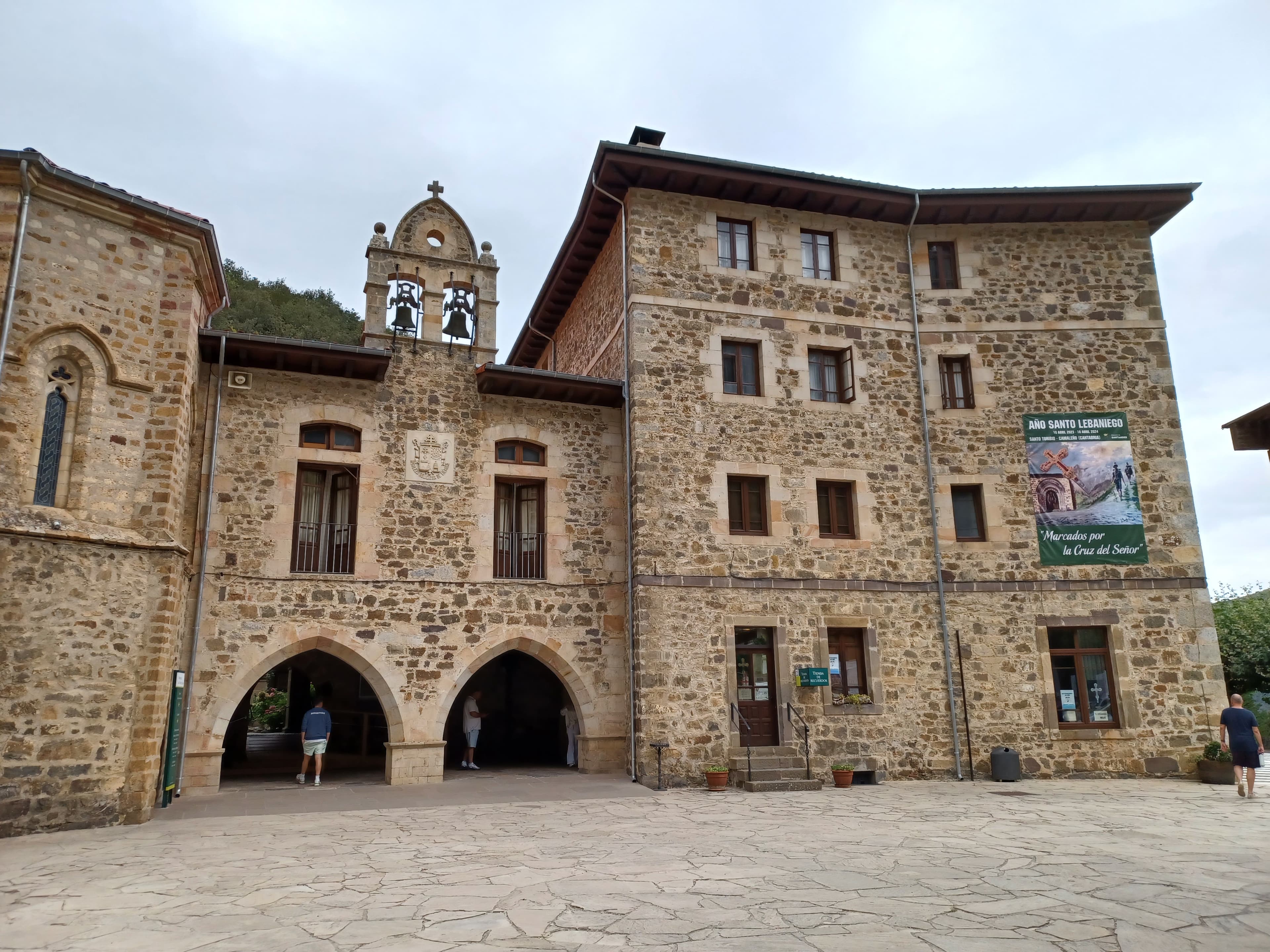
Image of Monastery of Santo Toribio de Liébana, Camaleno, Spain. Image source · CC-BY-SA-4.0
Visit essentials
A quick read before you go
- Duration
- One to two hours for the church, relic chapel, and cloister.
- Access
- Located 3 km west of Potes in the Liebana valley.
Overview
The road to Santo Toribio winds through the Hermida Gorge, one of the deepest limestone canyons in Europe, before opening into the Liebana valley where walnut trees and vineyards soften the mountain severity. The monastery sits three kilometers west of the market town of Potes, on a hillside where the Picos de Europa rise to the north and west.
The claim is direct: this monastery holds the largest surviving fragment of the cross on which Jesus Christ was crucified. According to tradition, Saint Turibius of Astorga, Custodian of the Holy Places in Jerusalem, obtained a portion of the True Cross and brought it to his cathedral in Astorga. In the 8th century, during the Moorish invasion, the relic was carried to this remote mountain valley for safekeeping.
Scientific analysis by the Forestry Institute of Research and Experimentation of Madrid confirmed the wood as Cupressus sempervirens, Mediterranean cypress native to Palestine, aged over 2,000 years. The chain of custody from the actual crucifixion to Astorga to Liebana spans six centuries with limited documentation. The gap between the scientific fact (ancient Palestinian wood) and the devotional claim (the instrument of Christ's death) is the space where faith operates.
But Santo Toribio is more than its relic. In the late 8th century, a monk named Beatus of Liebana worked in this monastery, composing the Commentary on the Apocalypse that would be copied and illuminated for centuries. The approximately 30 surviving Beatus manuscripts represent a pinnacle of Mozarabic art. Beatus also championed the doctrine that Saint James evangelized Spain, contributing to the theological foundation of the Santiago de Compostela pilgrimage.
From this remote mountain valley, a monk shaped the spiritual imagination of medieval Europe.
Pope Julius II recognized the monastery's significance in 1512 by granting it the privilege of a Jubilee Year whenever April 16 falls on a Sunday. This places Santo Toribio in the company of only four other sites: Rome, Jerusalem, Santiago de Compostela, and Caravaca de la Cruz. The Camino Lebaniego, a 72-kilometer pilgrimage route from the Cantabrian coast, brings walkers through increasingly dramatic mountain landscape to the monastery's door.
Why this place is sacred
The thinness of Santo Toribio operates through reduction rather than amplification. Unlike the great cathedral reliquaries of Europe, with their gold and jewels and theatrical display, the Liebana monastery is small, quiet, and modest. The Franciscan community that has maintained it since 1961 embodies simplicity as a spiritual practice. The encounter with the Lignum Crucis happens not in grandeur but in intimacy.
The Gothic church, begun in 1256, is a rectangular three-aisle plan without soaring vaults or flying buttresses. The proportions are human-scaled. The Baroque chapel that houses the Lignum Crucis adds gilded decoration to the relic's enclosure, but the overall effect remains contained rather than overwhelming.
The thinning happens in the gap between what the wood is and what the wood may be. The scientific analysis is public: 2,000-year-old Palestinian cypress. The devotional claim is equally public: the cross of Christ. The monastery does not attempt to resolve this gap through argument. It offers the encounter and trusts the visitor.
The mountain setting amplifies the contemplative quality. The Liebana valley, surrounded by the Picos de Europa, creates a natural cloister. The journey to reach the monastery, whether by car through the Hermida Gorge or on foot along the Camino Lebaniego, involves progressively leaving the everyday world behind. The landscape narrows, the mountains rise, and the sense of approaching something set apart deepens with each kilometer.
Beatus of Liebana adds an intellectual dimension to the thinning. In this same place, thirteen centuries ago, a monk contemplated the end of time and produced illuminated visions of the Apocalypse that still disturb and inspire. The juxtaposition is striking: the relic of the central event of Christian salvation history, and the manuscripts contemplating its final chapter, coexisting in the same mountain valley.
The Camino Lebaniego pilgrims who arrive on foot after three or four days of walking carry a different thinness: the gradual dissolution of daily routine through physical effort and changing landscape. For them, the encounter with the Lignum Crucis is prepared by the body as well as the mind.
The monastery was established as a Visigothic monastic community, possibly as early as the 6th century. The arrival of Saint Turibius's remains and the Lignum Crucis in the 8th century transformed it into a relic shrine. Beatus's scholarly work in the late 8th century made it an intellectual center.
From a Visigothic foundation through its medieval flowering under Benedictine rule to the Gothic church begun in 1256, the monastery developed as both pilgrimage destination and intellectual center. The 1512 Jubilee Year grant elevated its status. The 1837 disentailment led to abandonment, and Franciscan re-establishment in 1961 restored monastic life. The Camino Lebaniego has grown as a pilgrimage route, particularly during Jubilee Years.
Experience and orientation
Approach from Potes, driving the three kilometers west through the Liebana valley. The road climbs gently through woodland before the monastery appears on the hillside. Parking is available nearby.
Enter the Gothic church. The interior is simple and well-proportioned, with three aisles and polygonal apses. Light enters through windows that illuminate the stone without dramatic effect. The Franciscan aesthetic favors clarity over ornament.
Move to the Baroque chapel where the Lignum Crucis is displayed behind glass in an ornate gilded reliquary. The fragment of wood, larger than many visitors expect, is immediately visible. Stand close. The wood is dark, aged, and unadorned. The gap between this plain material and what it claims to be generates its own quality of attention.
After the relic chapel, explore the cloister. The 17th-century arcades surround a garden courtyard. Current exhibitions focus on the Beatus Commentaries on the Apocalypse, displaying reproductions of the illuminated manuscripts that made this monastery famous across medieval Christendom. The vivid imagery of apocalyptic beasts, heavenly cities, and angelic combat is unexpectedly powerful in this quiet setting.
If time permits, walk the 500 meters uphill to the Ermita de San Miguel, a 13th-century hermitage chapel with panoramic views of the Liebana valley and the Picos de Europa. The view from here places the monastery in its landscape context: a small human settlement nested within vast mountain geography. The Ermita de Santa Catalina, 600 meters further, offers an even broader panorama.
The free guided tours, offered at 11:00 and 16:00 on weekdays in Spanish, provide historical depth. The Pilgrim's Mass at noon is open to all and adds a liturgical dimension to the visit.
The monastery complex is compact. The church, relic chapel, and cloister are the primary interior spaces. The hermitages of San Miguel and Santa Catalina are reached by short uphill walks. Potes, 3 km east, provides restaurants and services.
Context and lineage
According to tradition, Saint Turibius of Astorga, who served as Custodian of the Holy Places in Jerusalem, obtained a portion of the True Cross and brought it to his cathedral in Astorga. In the 8th century, as Moorish forces advanced through the peninsula, the relic was carried to the remote mountain monastery in Liebana for safekeeping, along with the saint's remains. The relic's survival through this perilous journey is understood by devotees as providential.
Beatus of Liebana, working in the monastery in the late 8th century, produced the Commentary on the Apocalypse that would be copied and illuminated across medieval Europe. He also defended orthodox Catholic teaching against the Adoptionist heresy and championed Saint James's evangelization of Spain, contributing to the theological foundation of the Santiago pilgrimage.
Santo Toribio belongs to the tradition of major Christian relic shrines while occupying a distinctive position as one of only five sites worldwide with the privilege of a Jubilee Year. The Beatus manuscripts connect it to the broader tradition of monastic scholarship and illuminated manuscript production that preserved and transmitted knowledge through the early Middle Ages.
Saint Turibius of Astorga
5th-century bishop whose remains and the Lignum Crucis were transferred to the monastery
Beatus of Liebana
Monk and theologian who composed the Commentary on the Apocalypse
Pope Julius II
Granted Jubilee Year privileges in 1512
Traditions and practice
Veneration of the Lignum Crucis is the central devotional practice. Pilgrims approach the relic in its gilded chapel for prayer and contemplation. During Jubilee Years, the Holy Door (Puerta del Perdon) is ceremonially opened, and pilgrims who pass through it receive a plenary indulgence.
The Camino Lebaniego, marked with red arrows, follows a 72-kilometer route from San Vicente de la Barquera on the coast through three to four stages of increasingly mountainous terrain. Walking pilgrims receive a credencial (credential) that is stamped at stages along the way.
Daily Mass and liturgical prayer are maintained by the Franciscan community. The Pilgrim's Mass at noon is open to all visitors. Free guided tours are offered at 11:00 and 16:00 on weekdays. The cloister hosts exhibitions on the Beatus manuscripts. Pilgrim credential stamping is available for Camino Lebaniego walkers.
If arriving by car, consider walking the final three kilometers from Potes to approach the monastery on foot, creating at least a brief pilgrimage experience. Attend the Pilgrim's Mass at noon for a liturgical framing of the visit. Spend time with the Lignum Crucis in its chapel before moving to the cloister and the Beatus exhibitions. Walk to the Ermita de San Miguel for the valley panorama that places the monastery in its mountain context.
Devotion to the True Cross (Lignum Crucis)
ActiveThe Lignum Crucis is believed to be the largest surviving fragment of the True Cross. Scientific analysis confirmed it as 2,000-year-old Palestinian cypress. The 1512 Jubilee Year privilege places Santo Toribio among the five holiest sites in Catholic geography.
Daily veneration in the Baroque chapel; Pilgrim's Mass at noon; Jubilee Year celebrations with the opening of the Holy Door; plenary indulgence for Jubilee pilgrims; pilgrimage via the Camino Lebaniego.
Beatus of Liebana Intellectual Legacy
HistoricalBeatus's Commentary on the Apocalypse, composed here in 776-786, produced approximately 30 surviving illuminated manuscripts that represent a pinnacle of Mozarabic art. His championship of Saint James's evangelization of Spain contributed to the Santiago de Compostela pilgrimage.
The cloister currently hosts exhibitions on the Commentaries, preserving this intellectual tradition in educational form. The manuscripts themselves are held in major libraries worldwide.
Franciscan Monastic Life
ActiveSince 1961, the Friars Minor have restored monastic life after more than a century of abandonment following the 1837 disentailment.
Daily liturgical prayer, hospitality to pilgrims, guided tours, maintenance of the monastery and relic.
Perspectives and open questions
Santo Toribio invites interpretation through Catholic theology, art history, the science of relics, and the phenomenology of pilgrimage. The convergence of the Lignum Crucis and the Beatus manuscripts in a single mountain monastery creates an unusually rich field of meaning.
Scholarly perspective
Historians recognize Santo Toribio as a significant early medieval monastery. The Gothic church is architecturally documented. The Beatus manuscripts are among the most studied medieval texts. The Lignum Crucis has been scientifically confirmed as ancient Palestinian cypress, though the provenance chain from the True Cross remains unverifiable. The monastery's role in early medieval Spanish intellectual life, particularly through Beatus's influence on the Santiago cult, is well established.
Living and traditional perspectives
Within Catholic tradition, the Lignum Crucis is a direct material link to the central event of Christian salvation. The relic's journey from Jerusalem through Astorga to Liebana is understood as providential protection. The Jubilee Year brings the full weight of papal authority to this claim. Beatus's vision of the Apocalypse adds a prophetic dimension: the monks who guarded the True Cross also contemplated the end of all things.
Alternative interpretations
The monastery's position in a mountain valley surrounded by the Picos de Europa has attracted attention from those who note pre-Christian associations of mountain landscapes with sacred power. The concentration of spiritual intensity in the Liebana valley, including multiple hermitages and the Lignum Crucis, is sometimes read as evidence of geomantic significance independent of Christian monuments.
Open questions
The true origin of the Lignum Crucis remains unverifiable. The chain of custody from the crucifixion to Liebana spans six centuries with limited documentation. How and why this fragment ended up in one of the most remote mountain valleys of northern Spain remains an open question. The pre-Romanesque remains beneath the Gothic church hint at an earlier structure whose nature is archaeologically uncertain.
Plan your visit
Access and arrival
Located 3 km west of Potes in the Liebana valley. By car via N-621 from Santander (approximately 120 km) or via the Hermida Gorge from the coast. Buses connect Santander to Potes; the monastery is a 3 km walk or taxi from Potes. Free parking. Contact: +34 942 730 828. Hours: 10:00-13:00 and 16:00-18:00 daily.
Potes offers a range of hotels and rural guesthouses. The Liebana valley has numerous casas rurales. During Jubilee Years, book well in advance.
Respectful visit
Modest attire inside the church: shoulders and knees covered. The mountain location recommends comfortable walking shoes and layers for changeable weather.
Photography is generally permitted in the monastery grounds and cloister. Restrictions may apply near the Lignum Crucis and during services. Check with the community on current policy.
Candle lighting is available. Monetary donations support the Franciscan community. The souvenir shop offers religious items and monastery products.
The Lignum Crucis is behind glass. The monastery is a functioning religious community with specific visiting hours. Respectful silence inside the church.
Mountain weather can change rapidly. The monastery has specific opening hours (10:00-13:00 and 16:00-18:00) that should be respected. Winter access may be affected by weather conditions on the mountain roads.
Current practical details
Address
Monasterio de Santo Toribio de Liébana, 39570 Camaleño, Cantabria, Spain
Phone
Hours
Hours, fees, and access can change — verify on the official source before you travel. Practical details last checked Jun 2026.
Location
Map loads as you approach this section.
Pilgrim reflections
A portrait of encounter, not a score
Pilgrims describe what they felt, how present they could become, and whether the place would shape a journey. There are no stars and no ranking of traditions.
No reviewed reflections yet
The first pilgrims can help describe the character of being here.
Share a reflection
Available after an account-backed “Been there.” Every reflection is reviewed before publication.
Nearby sacred places
Explore other sacred places in the region. Proximity does not establish access or travel time; check each place’s guidance.


Photo gallery
3 curated photos
Share a photo
Help visitors recognize Monastery of Santo Toribio de Liébana, Camaleno, Spain. Every submission is reviewed before publication.