Sanctuary of the Lord of Sacromonte
Where Tlaloc's cave became Christ's tomb, and the supine Lord grows too heavy to move without permission
Understand sacred places, explore living traditions, and learn how to engage respectfully with Pilgrim Map.
Access has not been verified. Check current local guidance before planning a visit.
Amecameca, Mexico, Mexico
Read the sources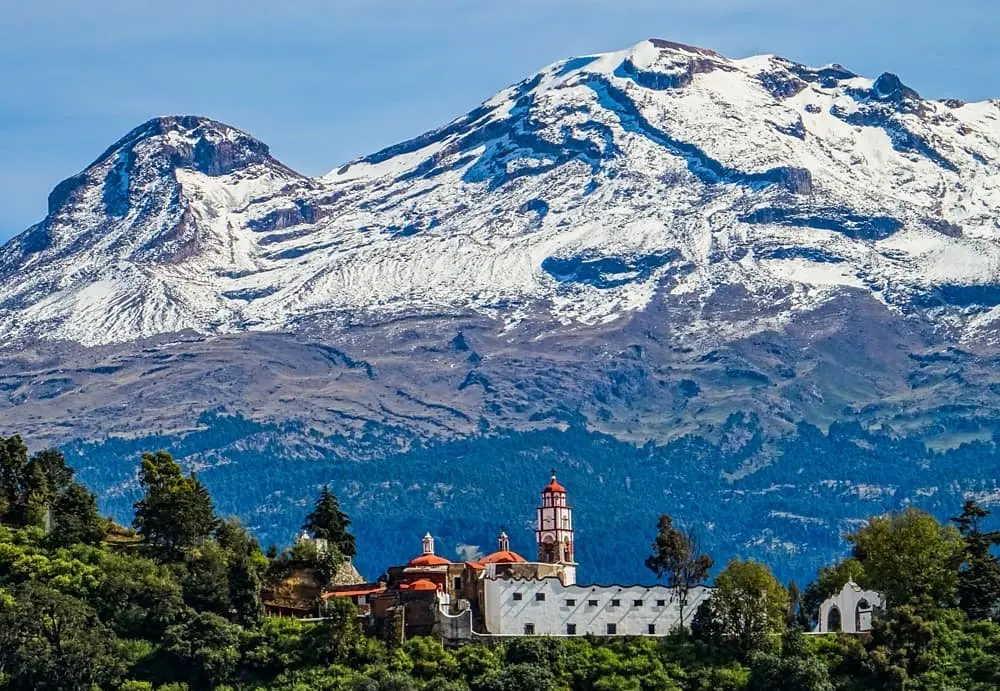
Image of Sanctuary of the Lord of Sacromonte. Image source · CC-BY-4.0
Visit essentials
A quick read before you go
- Duration
- 1-2 hours for full visit including climb and contemplation.
- Etiquette
- Approach as pilgrims approach: with reverence for the Black Christ, respect for the sacred…
Overview
Sacromonte rises above Amecameca, overlooking Popocatepetl smoking and Iztaccihuatl sleeping—the volcanic lovers within a sacred landscape older than its church. The cave once held Tlaloc, god of rain and agricultural necessity, while Tezcatlipoca also had a shrine here. In 1583 Dominicans established the Santo Entierro cult upon pre-Hispanic pyramidal foundations.
The supine Black Christ in the cave is cornstalk paste, light for procession, yet legend says he becomes impossibly heavy if moved without permission. Indigenous people trying to restore their god reportedly found him immovable. Each Holy Week, permission must therefore be asked before he consents to leave for the town chapel. The ritual gives the Christ who replaced Tlaloc an old autonomy.
Petitioning communities from Puebla, Morelos, and eastern Mexico State seek blessing with respect for power beyond human command.
Architecture sustains this negotiation. The Ex-Convent of the Assumption served as an evangelization school beside the older sacred hill; the Catholic cave image occupies a place continuous with Mesoamerican cave worship, while the volcanoes hold both within the larger landscape.
Four weekends before Ash Wednesday, the Festival del Senor del Sacromonte begins. Guilds process with staffs and offerings, chirimia sounds, and new mayordomos assume sacred responsibility for another year. The dead Christ remains the center of regional devotion shaped through both faiths.
Why this place is sacred
What makes Sacromonte thin is the explicit presence of what came before within what replaced it. This is not a site where Christianity erased pre-Hispanic worship but one where the older faith persists in Christian form, creating thickness of meaning that any single tradition would lack.
The cave is the threshold's clearest expression. In Mesoamerican cosmology, caves served as entrances to the underworld, places of emergence and return where contact with chthonic powers became possible. Tlaloc received worship in this cave because caves were appropriate for rain gods—the waters that emerge from earth's depths, the mystery of what happens beneath the surface.
The Black Christ who now occupies this space inherits the cave's meaning: he too lies within the earth, emerged from death, connected to powers that operate below visibility.
The permission ritual literalizes divine autonomy. Each Holy Week, before the Christ can be carried to the chapel in Amecameca, permission must be formally requested. The legend that he became immovably heavy when indigenous people tried to restore Tlaloc establishes that this Christ has absorbed something of the old god's independence. He decides. He must be asked. The relationship is not unilateral.
The views of Popocatepetl and Iztaccihuatl situate the sanctuary within broader sacred landscape. The smoking warrior and sleeping woman watch from the horizon, their own stories of transformation and loss echoing through the Holy Week observances. The Black Christ who represents death within death—the burial of God—occupies space between volcanic lovers who themselves embody death transformed into permanence.
The research documenting this site reveals that 'cosmoteist cults of pre-Hispanic origin have survived and coexist to this day' alongside Catholic devotion. The chirimia music at festivals, the guild processions, the cargo system organizing community responsibility—these carry forward practices that the church adapted rather than eliminated. The thinness at Sacromonte comes from this honest coexistence, the acknowledgment that multiple traditions have found power here and that honoring both serves the faithful better than pretending only one exists.
Pilgrims arrive from three Mexican states, their regional network preceding Christianity and continuing beyond it. They come because this hill has always been sacred, because the cave has always offered contact with what lies beneath, because the gods who dwell here—under whatever name—have demonstrated capacity to respond.
The hill served as ceremonial site for worship of Tlaloc (rain god) and Tezcatlipoca before Spanish arrival, with cave and pyramid structures supporting pre-Hispanic religious practice.
Dominican establishment of Santo Entierro cult in 1583; construction of sanctuary on pyramidal foundations; development of regional pilgrimage network; recognition as one of central Mexico's four most important sanctuaries.
Experience and orientation
Approach Amecameca understanding what the town overlooks. To the east rise Popocatepetl and Iztaccihuatl, volcanic lovers frozen in their legend. The Sacred Hill where you will climb has watched these peaks since before humans named them, and the sanctuary at its summit positions you within their story.
The climb begins behind the Municipal Palace, a stairway with shrines marking the ascent. Take it slowly; let the physical effort create appropriate transition. You are leaving the town below and entering space that has been sacred under multiple names, served multiple gods, and drawn pilgrims from multiple states for longer than recorded history can confirm.
At the summit, the sanctuary complex reveals its layered nature. The church and Ex-Convent of the Assumption stand on what were once pyramidal foundations—you walk on pre-Hispanic stone repurposed for colonial devotion. The architecture does not hide this layering; the sanctuary is built from both traditions.
Enter the church and find your way to the cave. Here the Black Christ lies in the posture of burial, a supine figure made of cornstalk paste, too light for its weight in legend. The darkness of the cave, the stillness of the figure, the knowledge of what was worshipped here before—these create contemplative intensity. Spend time with the Lord of Sacromonte in his resting place.
Emerge and survey the landscape. The volcanoes dominate the eastern horizon; Amecameca spreads below; the Valley of Mexico extends beyond sight. This is sacred geography, the kind of positioning that cultures worldwide have recognized as significant. The hill is not accidentally sacred; its views explain its power.
If you visit during the Festival del Senor del Sacromonte—the weeks containing Ash Wednesday, between February and March—you will encounter the site in its full ceremonial context. Guilds of peasants, trementineros, and faroles carry out religious and political activities including the change of staffs for the Senor del Sacromonte. Chirimia music fills the air. The regional network that this sanctuary organizes becomes visible in the crowds who gather to honor the Black Christ in his cave.
Located 1.2 km west of Amecameca center, behind the Municipal Palace. Stairway with shrines leads to summit. The cave with the Black Christ is within the sanctuary complex. Open daily 8:00 AM - 6:00 PM.
Context and lineage
Before the Dominicans arrived, Sacromonte—the Sacred Hill—earned its name through different devotion. A cave sheltered worship of Tlaloc, rain god whose favor meant agricultural survival. Nearby stood a shrine to Tezcatlipoca, the Smoking Mirror whose transformative power the Aztecs both feared and revered. Pyramidal structures supported these cults, creating ceremonial complex that dominated Amecameca's sacred geography.
The Dominicans who established Christian presence in 1583 followed colonial strategy: they built upon what they found. The cult of the Santo Entierro—the Holy Burial—replaced the pre-Hispanic worship, placing a Black Christ in the cave where Tlaloc had received offerings. But replacement was not simple erasure.
Legend emerged to encode what continued. Indigenous people, the story says, tried to restore their god by removing the Christ. But the figure—made of light cornstalk paste—became impossibly heavy, refusing to move. Since then, permission must be asked each Holy Week before the Lord of Sacromonte will consent to leave his cave. The Christ who replaced Tlaloc absorbed something of the old god's autonomy; he must be properly approached, properly requested, properly honored.
The sanctuary became one of central Mexico's four most important pilgrimage sites, drawing communities from Puebla, Morelos, and eastern Mexico State. The Ex-Convent of the Assumption served as evangelization school while the cave drew pilgrims who understood—consciously or not—that what Tlaloc offered, the Black Christ somehow continued. Researchers have documented that 'cosmoteist cults of pre-Hispanic origin have survived and coexist' at this site, making Sacromonte explicit in its syncretic nature.
Today the sanctuary maintains its regional significance. The Festival del Senor del Sacromonte fills the weeks before Ash Wednesday with guild processions, chirimia music, and the change of mayordomos that transfers sacred responsibility. The Black Christ still lies in his cave, still must be asked permission to move, still draws those who need what this hill has offered since before memory can reach.
Pre-Hispanic ceremonial site; Dominican evangelization (1583); cargo system and regional pilgrimage network; contemporary syncretic practice.
The Lord of Sacromonte (Santo Entierro)
Black Christ image
Tlaloc
Pre-Hispanic rain deity
Traditions and practice
Pre-Hispanic practices included offerings to Tlaloc and Tezcatlipoca at cave and pyramid sites. Colonial-era devotion established Holy Week observances and the permission ritual.
Festival del Senor del Sacromonte (weeks before Ash Wednesday) features guild processions, chirimia music, and change of mayordomos. Holy Week includes the permission ritual and procession of the Black Christ to Amecameca. Year-round pilgrimage from Puebla, Morelos, and Mexico State maintains the regional devotional network.
Climb the sacred hill with awareness of its layered history. Spend contemplative time with the Black Christ in his cave. If visiting during the festival, participate in processions and observe the cargo system in action. Let the volcanic views situate your experience within broader sacred geography.
Mexican Syncretic Catholicism
ActiveThe Sanctuary of Sacromonte explicitly combines Catholic devotion with surviving pre-Hispanic practices, creating living example of how indigenous and European faiths have interpenetrated in Mexico.
Veneration of Black Christ, permission ritual for Holy Week procession, festival celebrations with guild processions and chirimia music, cargo system organization, regional pilgrimage network.
Perspectives and open questions
Sacromonte can be understood as example of colonial religious replacement, as site of indigenous spiritual persistence, as evidence of successful syncretism, or as sacred geography that outlasts any single tradition's claim.
Scholarly perspective
Researchers have documented the coexistence of 'cosmoteist cults of pre-Hispanic origin' alongside Catholic devotion at this site. The sanctuary provides evidence for understanding how indigenous populations maintained spiritual practices through adaptation.
Living and traditional perspectives
For communities who pilgrimage here, the Lord of Sacromonte is simply powerful—capable of responding to petition, requiring proper approach, demonstrating autonomy through the permission ritual. Questions of origin matter less than demonstrated efficacy.
Alternative interpretations
Some note that the cave's sacredness predates both Christ and Tlaloc, suggesting that certain locations possess inherent power that various traditions recognize and claim.
Open questions
The full extent of pre-Hispanic ceremonial activity on the hill remains partially documented. The precise circumstances of Christian-indigenous negotiation during the cult's establishment are not fully recorded.
Plan your visit
Access and arrival
Accommodations available in Amecameca. Full services in nearby Mexico City.
Respectful visit
Modest dress appropriate for Catholic churches. Comfortable shoes for the climb.
General photography permitted; respect those in prayer. Ask permission before photographing devotees or ceremonies.
Candles and prayers are traditional. Participate in the offering traditions if invited.
Respect the cave space as particularly sacred. Do not touch the Black Christ image.
The festival period draws large crowds. The syncretic nature of the devotion may surprise those expecting conventional Catholic practice. Respect both the Catholic and pre-Hispanic elements as legitimate expressions of faith.
Current practical details
Address
Prol. Aldama 36, Amecameca, 56765 Amecameca de Juárez, Méx., Mexico
Hours
Hours, fees, and access can change — verify on the official source before you travel. Practical details last checked Jun 2026.
Location
Map loads as you approach this section.
Pilgrim reflections
A portrait of encounter, not a score
Pilgrims describe what they felt, how present they could become, and whether the place would shape a journey. There are no stars and no ranking of traditions.
No reviewed reflections yet
The first pilgrims can help describe the character of being here.
Share a reflection
Available after an account-backed “Been there.” Every reflection is reviewed before publication.
Nearby sacred places
Explore other sacred places in the region. Proximity does not establish access or travel time; check each place’s guidance.
References
Sources consulted for this page. Source categories describe the publication, not a guarantee that every claim is verified. Traditional accounts and outside interpretations may differ.
- 01Amecameca - WikipediaSource context
- 02Cristo de Sacromonte Ex-Voto - SmarthistorySource context
- 03Misterios y Rituales del Cerro del Sacromonte - ProcesoSource context
- 04Amecameca Tourist Information - Mexican RoutesSource context
- 05Santuario del Senor del Sacromonte - Secretaria de Cultura y TurismoSource context
- 06Conchero's Sanctuaries and Pilgrimages - Foot Prints in MexicoSource context
Share a photo
Help visitors recognize Sanctuary of the Lord of Sacromonte. Every submission is reviewed before publication.