Sanctuary of Monti-Sion
A hilltop sanctuary and Latin schoolhouse above Porreres
Understand sacred places, explore living traditions, and learn how to engage respectfully with Pilgrim Map.
Access has not been verified. Check current local guidance before planning a visit.
Porreres, Balearic Islands, Spain
Read the sources
Visit essentials
A quick read before you go
- Duration
- A short visit for the chapel, cloister, and viewpoint can take well under an hour; the on-site…
- Access
- The sanctuary sits off the road between Porreres and Campos, reached by a paved hillside road…
Overview
The Santuari de Monti-Sion crowns Puig de Monti-Sion, a low hill in farmland southeast of Palma whose name recalls Jerusalem's Mount Zion. A stone cross raised in 1497 and a Marian oratory recorded the following year mark the hilltop's earliest known religious use; today's chapel grew from that oratory.
In 1530 Porreres established a Latin grammar and rhetoric school here. For three centuries the hill served as shrine and schoolhouse—one of Mallorca's three rural colleges and the final preparation for university study in Palma. Secularization closed the school in 1835; after disrepair, restoration began late in the 19th century under future bishop Pere Joan Campins i Barceló.
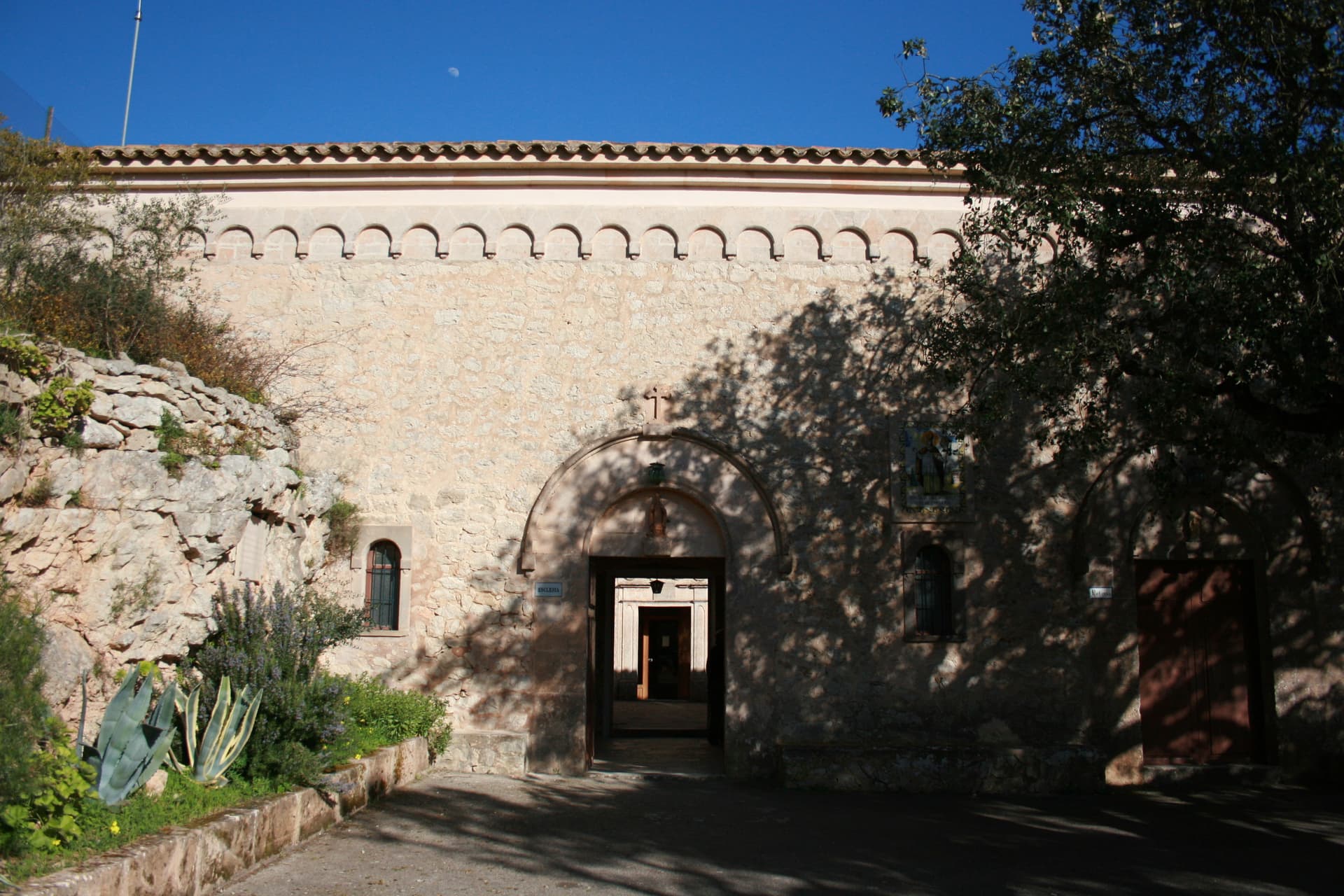
The working sanctuary retains a Gothic chapel with a 15th- or 16th-century marble Virgin and Child, Mallorca's only pentagonal cloister, and a terrace overlooking the southern plain.
Why this place is sacred
What makes Monti-Sion distinctive is not a single dramatic origin but an accumulation: a cross raised on the hilltop in 1497, an oratory to Our Lady recorded in 1498, and then, within a generation, the arrival of a grammar college that would train generations of Porreres boys for university in Palma.
The name itself does the work of a founding legend — Monti-Sion draws directly on the biblical Mount Zion, casting this modest Mallorcan hill as a Marian counterpart to Jerusalem's sacred high ground, though no source consulted records why this specific hill, rather than another, received the name.
The seven pairs of Gothic pillars that once lined the approach road, each carved with a Joy or Sorrow of the Virgin, extended that Marian narrative into the physical act of climbing toward the sanctuary — a devotional geography built into the walk itself, of which five weathered pillars still stand.
A Marian shrine from its earliest recorded use (1497-1498), joined within a generation by a Latin grammar and rhetoric school (founded 1530) that operated on the same hilltop for roughly three centuries.
Secularization-era reforms closed the grammar school in 1835 and the sanctuary fell into disrepair; restoration beginning in the 1880s-90s under future bishop Pere Joan Campins i Barceló brought the buildings back into active religious use, and a road built by the townspeople of Porreres in a single day in 1954 opened the hilltop to easier pilgrim and visitor access. Today the site continues as an active place of worship and pilgrim lodging rather than a school.
Experience and orientation
The approach is part of the experience: a narrow road climbs the Puig de Monti-Sion from the Porreres–Campos road, a route that villagers rebuilt themselves on 14 January 1954 in a single day, as reported by several independent sources, as a gesture of devotion to the sanctuary above.
Along the way stand the remaining Gothic pillars from the site's Seven Joys and Seven Sorrows sequence, weathered but still legible as markers of a walk once treated as a small pilgrimage in itself. At the top, the hill opens onto views that sources describe as reaching Santanyí, Campos, Felanitx, the Sanctuary of Sant Salvador, the Castell de Santueri, and — on clear days — as far as the island of Cabrera offshore.
Inside, the unusual pentagonal cloister and the single-nave, rib-vaulted chapel offer a smaller, more enclosed counterpoint to that openness, with the marble Virgin and Child standing at the heart of the space.
Arrive expecting a working sanctuary rather than a museum — the site combines an active chapel, a historic cloister and schoolroom, and, per the diocesan pilgrimage-lodging network, guest accommodation and a restaurant, so visitors share the hilltop with pilgrims staying overnight and with the descendants of the grammar-school tradition.
Context and lineage
Independent sources place the earliest religious marker on the hill at 1497, when a stone cross was raised on the summit, with a Marian oratory recorded the following year (1498). The chapel visitors see today grew out of that oratory.
One tourism source states that Franciscan monks founded the sanctuary outright in 1551, but this conflicts with the earlier oratory date given by Catalan Wikipedia and the official Porreres municipal website, and is treated here as a lower-confidence claim rather than settled fact.
In 1530, Porreres' town authorities established a Latin grammar and rhetoric college on the same hilltop, intended to prepare local students for university entry in Palma — one of only three such rural grammar schools on Mallorca, alongside Santa Magdalena and Randa. Records cited by one heritage source note roughly a hundred students enrolled between 1664 and 1670. The school closed in 1835 amid Spain's broader wave of secularization, and the buildings deteriorated until restoration began in the 1880s-90s.
The sanctuary sits within Mallorca's broader network of rural hilltop sanctuaries and Marian devotion sites, and is listed today among the island's 'sanctuaries of welcome' for pilgrims, alongside places such as the Sanctuary of Sant Salvador and the Monastery of Santa Llúcia.
Traditions and practice
Sources describe an 18th-century Way of the Cross leading to the sanctuary, complemented by the older sequence of Gothic pillars depicting the Virgin's Seven Joys and Seven Sorrows — a devotional walk built directly into the ascent. During the grammar school's three centuries of operation, the site would also have held the daily and liturgical rhythms of a residential college, though no source consulted details that routine.
The main living tradition documented is the annual Angel Sunday celebration — the first Sunday after Easter — when Porreres holds a procession up to the sanctuary accompanied by Mass, music, and traditional dancing; one source also mentions Catalan-language book vendors as part of the day.
Walking the access road on foot rather than arriving directly by car preserves something of the pillar-marked approach that shaped the original devotional experience of the hill.
Roman Catholic Christianity (Marian devotion)
ActiveDedicated to Our Lady of Monti-Sion, whose 15th/16th-century marble image anchors the chapel; the site's name deliberately evokes Mount Zion, framing this Mallorcan hilltop as a Marian counterpart to Jerusalem's sacred high ground.
Annual Angel Sunday procession, Mass, and festivities from Porreres; historic Way-of-the-Cross and Seven Joys/Seven Sorrows pillar walk along the approach road.
Perspectives and open questions
Monti-Sion is read differently depending on which of its two histories a visitor foregrounds — the Marian shrine or the rural grammar school — and sources do not fully agree on how the two began.
Scholarly perspective
Regional heritage and municipal sources treat the 1498 Marian oratory and the 1530 grammar-school foundation as the site's two well-attested starting points, and describe the surviving pentagonal cloister as architecturally unique within Mallorca.
Living and traditional perspectives
Within Porreres, the sanctuary is remembered as much through the 1954 communal road-building as through its earlier religious history — a modern act of collective devotion that sits alongside the older stone pillars and Marian statue as evidence of the hill's ongoing significance to the town.
Open questions
Why the hill came to be named for Mount Zion, and whether the sanctuary's founding is better dated to the 1498 oratory or a later, possibly 1551, Franciscan involvement, remain open questions across the sources consulted.
Plan your visit
Access and arrival
The sanctuary sits off the road between Porreres and Campos, reached by a paved hillside road that the people of Porreres built in a single day on 14 January 1954. Sources give the round trip from Porreres as roughly a few kilometers; the road passes the surviving Gothic 'Seven Joys and Seven Sorrows' pillars en route to the summit.
The sanctuary itself operates as pilgrim lodging within the Mallorca Peregrina network, with guest rooms (reported capacity around 22) and a restaurant serving traditional Majorcan food; one listing states the facility is unavailable in August.
Respectful visit
As a functioning chapel and pilgrim lodging rather than a purely secular monument, ordinary church etiquette — quiet voices, modest dress, and discretion during any Mass or private prayer — is the reasonable default in the absence of site-specific published guidance.
Location
Map loads as you approach this section.
Pilgrim reflections
A portrait of encounter, not a score
Pilgrims describe what they felt, how present they could become, and whether the place would shape a journey. There are no stars and no ranking of traditions.
No reviewed reflections yet
The first pilgrims can help describe the character of being here.
Share a reflection
Available after an account-backed “Been there.” Every reflection is reviewed before publication.
Nearby sacred places
Explore other sacred places in the region. Proximity does not establish access or travel time; check each place’s guidance.


References
Sources consulted for this page. Source categories describe the publication, not a guarantee that every claim is verified. Traditional accounts and outside interpretations may differ.
- 01Santuari de Monti-sion de Porreres — Viquipèdia — Wikipedia contributorsencyclopediaCatalan Wikipedia entry; provides coordinates (39°29'46"N 3°01'01"E), founding chronology from 1498 oratory through 1954 road construction, and architectural summary.
- 02Monti-sion — Ajuntament de Porreres — Ajuntament de Porreres (Porreres Town Council)officialOfficial municipal government page; corroborates 1498 chapel date, 1954 road-building event, cloister and grammar-classroom architecture, and 1835 school closure.
- 03Sanctuary Monti-Sion (Mallorca) — Consell de Mallorca / Illes Balears Turisme (official tourism board)officialOfficial regional tourism board page; details pentagonal cloister, seven Gothic pillars, grammar school history, and panoramic views.
- 04Santuari de Monti-Sion, Peaceful Hilltop Sanctuary — Acces MallorcaguideIndependent Mallorca travel guide; states Franciscan-monk founding in 1551 (flagged as a conflicting/lower-confidence claim) and describes the 1497 stone cross and access route.
- 05Sanctuary of Monti-Sion — Sanctuaries of Welcome — Mallorca Peregrina (Diocesan pilgrimage network listing)spiritualDiocesan/pilgrimage-network page confirming the sanctuary functions as pilgrim lodging within Mallorca's network of welcome sanctuaries; limited theological detail.
- 06Sanctuary of Montision, Porreres — SeeMallorca.comguideIndependent travel guide; describes the Gothic chapel, patio, Marian sculpture, and panoramic views toward Santanyí, Campos, Felanitx and the Sanctuary of Sant Salvador.
- 07The town of Porreres in Majorca — Sanctuary of Monti-sion — Viagallica.comguideDetailed independent heritage/travel site; covers 14th-15th century hermitage origins, 1858 state confiscation, 1887-1893 restoration under future bishop Pere Joan Campins i Barceló, pentagonal cloister, and the Latin grammar school timeline (1530 founding, ~100 students 1664-1670, closed 1835).
Share a photo
Help visitors recognize Sanctuary of Monti-Sion. Every submission is reviewed before publication.