Sacro Monte di Domodossola
Fifteen chapels of the Passion, climbed as a walkable Calvary
Understand sacred places, explore living traditions, and learn how to engage respectfully with Pilgrim Map.
Access has not been verified. Check current local guidance before planning a visit.
Domodossola, Verbano-Cusio-Ossola, Italy
Read the sources
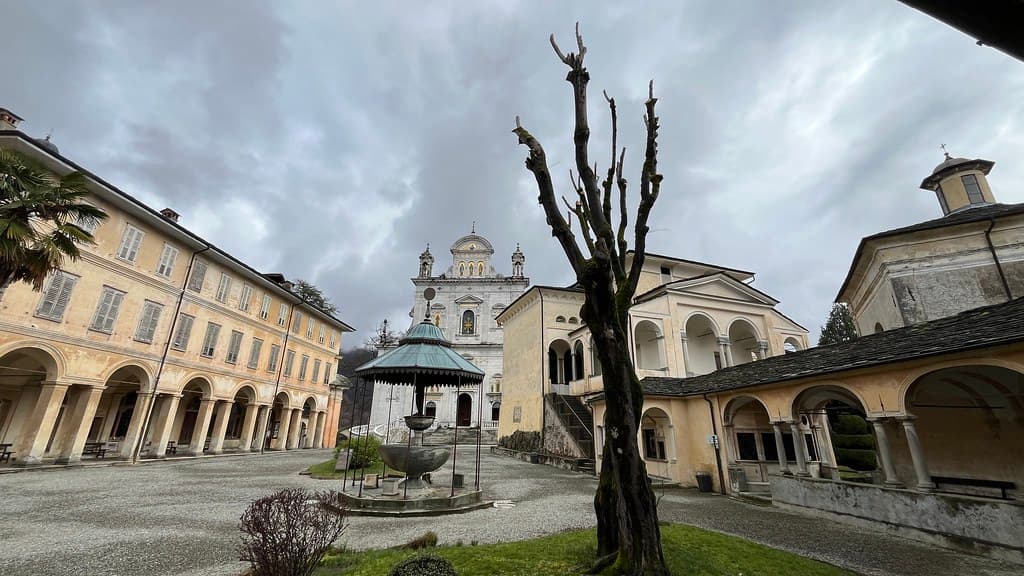
Image of Sacro Monte di Domodossola. Image source
Visit essentials
A quick read before you go
- Duration
- Approximately 30 minutes on foot from the Arco di Pilato to the summit; additional time needed…
- Access
- By train to Domodossola station, with connections to Milan, Lausanne, Geneva, and Locarno; by…
Overview
Domodossola's Sacro Monte is a Calvary built to be walked. In 1656, Capuchin friars Gioacchino da Cassano and Andrea da Rho set crosses along Mattarella hill for a sequence that became fifteen chapels: twelve narrating the Passion along the ascent and three in the summit sanctuary carrying it through the Deposition, Holy Sepulchre, and Resurrection.
Created so pilgrims unable to afford Jerusalem could undertake it in miniature, over more than two centuries it became one of the nine Sacri Monti's most theatrically complete sites. Painted and dressed life-size terracotta and wood figures stage Christ before Pilate, the scourging, and the road to Calvary.
Older layers include Roman and Lombard remains and a sixth-century headstone reused in a medieval castle destroyed in 1415, though no record links them directly to the Capuchins' choice. After Napoleonic suppression scattered the original community in the early nineteenth century, the Rosminian Fathers assumed stewardship in 1828 and continue it, keeping this one of the more continuously active Sacri Monti rather than mainly a monument.
Why this place is sacred
Unlike sites that accrue sanctity around a vision or a miracle, Domodossola's Sacro Monte was sacred by design from its first placed cross.
The Capuchin friars who conceived it in 1656 were responding to a practical problem of their era — pilgrimage to the Holy Land had become difficult and expensive for most European Catholics — and their solution was architectural and narrative rather than miraculous: build the Passion here, at a scale and sequence a local population could actually walk.
No apparition story or discovered relic anchors the site's origin in available sources; its spiritual weight comes instead from the cumulative effect of fifteen life-size tableaux experienced in order, each one a fixed moment in Christ's condemnation and death, building toward resurrection at the summit.
That the hill had already been inhabited for over a millennium before the friars arrived — Roman and Lombard material, a sixth-century headstone, a medieval castle destroyed in 1415 — adds a layer of accumulated human presence to the site without altering why it became sacred in the seventeenth century specifically.
To give pilgrims unable to travel to Jerusalem a localized, physically walkable reenactment of the Passion, condensing a geography of suffering and resurrection into a single Piedmontese hillside.
From a line of crosses placed in 1656 to mark future chapel sites, to a consecrated summit sanctuary by 1690, to a full sequence of fifteen chapels built and decorated over more than two centuries — interrupted by Napoleonic-era suppression of religious orders (1810–1828) and revived under Rosminian stewardship from 1828 onward — the complex now functions as both an active pilgrimage route and a protected UNESCO monument within a natural reserve.
Experience and orientation
The climb begins in Domodossola itself, at the Arco di Pilato, so the transition from town to sacred ground is immediate rather than eased by a long approach. From there the cobblestone path rises through beech and chestnut woods, each of the twelve ascending chapels holding its own frozen scene — dramatic, sometimes startling in how close the life-size figures come to a viewer standing at the threshold.
The sequence has a narrative pull that most Sacri Monti share but Domodossola executes with particular density: rather than pausing between stations, the path keeps moving, so grief and violence accumulate scene by scene before the walker reaches the relief of the summit. There, three further chapels carry the story past the crucifixion into deposition, entombment, and resurrection, and the wooded slope gives way to open views over the Ossola Valley and the town below.
A mobile app with audio narration and panoramic imagery exists for those walking alone, though the physical ascent itself — thirty minutes at an ordinary pace, longer with stops at each chapel — remains the core of the experience regardless of how it's guided.
Expect a compact but steep cobblestone ascent, sequential rather than freely explorable chapels, and a shift from dense woodland to open valley views only near the top.
Context and lineage
In 1656, Capuchin friars Gioacchino da Cassano and Andrea da Rho placed a cross on Mattarella hill above Domodossola, along with further crosses marking the intended route of what would become the Via Crucis complex. The first stone of the Calvary was laid on 8 July 1657, and the summit sanctuary was consecrated by 1690. Construction and decoration continued in phases into the early twentieth century, funded and built with labor from the Ossola Valley community.
The project was disrupted by Napoleonic suppression of monastic orders between 1810 and 1828; afterward, the religious community founded by Antonio Rosmini took over stewardship and revived active use of the site, a role the Rosminian Fathers continue today.
Domodossola belongs to the Counter-Reformation-era Sacri Monti building movement, following the precedent set by the earlier and larger complex at Varallo; its Capuchin origins tie it to the wider Franciscan role in popularizing Via Crucis devotion, while its post-1828 Rosminian stewardship marks a distinct second chapter in its institutional history.
Gioacchino da Cassano
Capuchin friar who co-founded the site in 1656, placing the first crosses marking the future chapel route
Andrea da Rho
Capuchin friar who co-founded the project alongside Gioacchino da Cassano
Dionisio Bussola
Sculptor who carved the crucifix installed in 1662, among the site's earliest major statuary commissions
Giuseppe Rusnati
Sculptor responsible for later statue groups, including works from 1710 such as the 'Cristo è spogliato' scene
Antonio Rosmini
Founder of the Institute of Charity (Rosminian Fathers), whose community took over stewardship of the sanctuary from 1828 and continues to administer it
Traditions and practice
Communities historically funded and built the chapels through collective labor, and Capuchin friars promoted the Via Crucis as parish devotion from the site's earliest years; processions to the Sacred Mount date from this period and were interrupted, then resumed, around the Napoleonic suppression.
Parish processions to the site resumed after 1828 under Rosminian stewardship and continue today. The Rosminian Fathers host spiritual exercises and retreats at the sanctuary, and the Via Crucis itself remains open for devotional walking independent of organized events, forming part of the broader cross-border CoEur devotional path network.
A visitor without prior familiarity with the Stations of the Cross might use each chapel's threshold as a deliberate pause — stopping fully before moving to the next — rather than treating the ascent as a continuous walk with occasional points of interest.
Roman Catholicism
ActiveThe Sacro Monte di Domodossola is devoted entirely to the Passion, Death, and Resurrection of Christ, built as a walkable substitute for pilgrimage to the Holy Land when travel to Jerusalem grew difficult for most European Catholics; it remains an active diocesan sanctuary under Rosminian stewardship.
Walking the Via Crucis from the Arco di Pilato to the summit sanctuary, venerating the life-size polychrome statue groups in each chapel, and taking part in parish processions and Rosminian-led retreats and spiritual exercises.
Perspectives and open questions
Domodossola's Calvary is read consistently across sources as a deliberate, documented act of devotional architecture rather than a site defined by legend, which leaves relatively little interpretive disagreement compared to Sacri Monti with contested origin stories.
Scholarly perspective
Art and heritage historians treat Domodossola as a clear instance of the Counter-Reformation-era Sacri Monti phenomenon: an immersive, sculpted substitute pilgrimage built to bring the Passion narrative to a population that largely could not travel to the Holy Land, reflecting the Capuchin order's broader role in popularizing Via Crucis devotion across Piedmont and Lombardy.
Living and traditional perspectives
Within Roman Catholic devotional practice, the site's authority rests on continuous institutional stewardship — first the Capuchin friars, then the Rosminian Fathers since 1828 — rather than on any distinct folk tradition or apparition narrative separate from the mainstream Passion devotion the chapels depict.
Alternative interpretations
No alternative or esoteric interpretive tradition was identified in sources consulted; the site's meaning is consistently framed within mainstream Catholic devotional and art-historical contexts.
Open questions
The exact original scope of Gioacchino da Cassano and Andrea da Rho's 1656 vision, versus what later community contributions and centuries of rebuilding added or changed, is not fully documented. The relationship, if any, between the hill's earlier Roman and Lombard remains — including the sixth-century headstone reused in the medieval castle destroyed in 1415 — and the Capuchins' choice of this specific site is also not established in available sources.
Plan your visit
Access and arrival
By train to Domodossola station, with connections to Milan, Lausanne, Geneva, and Locarno; by car via the A26/E62 highway and SS33, following signage for Sacro Monte; on foot via the roughly 30-minute uphill Via Crucis path starting at the Arco di Pilato in central Domodossola. Two parking areas exist at Borgata Sacro Monte. Disabled access is limited overall due to cobblestones, steps, and slopes, though a car with a disabled badge can reach the SS. Crocifisso church.
No information on mobile phone signal at the site was available at time of writing; visitors should check with the Stockalper house information point or the Sacro Monte Calvario website for current details, and note that the nearby town of Domodossola has reliable signal and services if needed.
Respectful visit
No dress code specific to this site was found in available sources; modest coverage typical of Italian church visits is a reasonable default rather than a confirmed rule.
No explicit photography restriction is documented for the chapels or sanctuary.
No specific offering custom is documented beyond the general Catholic practice of votive candles and donations common to active sanctuaries.
Vehicle access to the upper chapel area (numbers eight through fifteen) requires authorization; general pedestrian access along the Via Crucis is otherwise unrestricted.
The upper chapels (roughly numbers eight through fifteen) have limited vehicle access requiring authorization; pedestrian access along the Via Crucis path itself is unrestricted, but visitors should not expect to drive the full route.
Location
Map loads as you approach this section.
Pilgrim reflections
A portrait of encounter, not a score
Pilgrims describe what they felt, how present they could become, and whether the place would shape a journey. There are no stars and no ranking of traditions.
No reviewed reflections yet
The first pilgrims can help describe the character of being here.
Share a reflection
Available after an account-backed “Been there.” Every reflection is reviewed before publication.
Nearby sacred places
Explore other sacred places in the region. Proximity does not establish access or travel time; check each place’s guidance.


References
Sources consulted for this page. Source categories describe the publication, not a guarantee that every claim is verified. Traditional accounts and outside interpretations may differ.
- 01Sacred Mount Calvary of Domodossola — Wikipedia contributorsacademicOverview of construction history, consecration date, Rosmini connection, and UNESCO status.
- 02Sacro Monte Calvario di Domodossola — Wikipedia contributors (Italian)academicItalian-language Wikipedia entry with additional detail on chapels and history.
- 03Sacri Monti of Piedmont and Lombardy — UNESCO World Heritage CentreofficialOfficial UNESCO World Heritage listing (inscribed 2003) covering the nine Sacri Monti complexes, including Domodossola.
- 04122 Sacri Monti (Italy) No 1068 - Nomination Document — UNESCO / State Party ItalyofficialFormal nomination/evaluation document for the Sacri Monti World Heritage series.
- 05Sacro Monte of Domodossola — Sacri Monti del Piemonte e della Lombardia (official consortium site)officialOfficial heritage-body site: founding history, Roman/Lombard archaeological finds on Mattarella hill, access/practical visitor information, disabled access notes.
- 06Sacro Monte "Calvario" di Domodossola — Diocesi di NovaraofficialDiocesan source confirming active worship, Rosminian Fathers' stewardship, parish processions, spiritual exercises, and current religious function.
- 07Sacro Monte Calvario di Domodossola — Piemontesacro.itSource contextRegional heritage/tourism site with descriptive detail on the chapels and Via Crucis route.
- 08The Sacred Mount Calvary of Domodossola - UNESCO World Heritage site — VisitOssola (local tourism board)Source contextLocal tourism authority page describing the 15 chapels, Via Crucis route, and the Arco di Pilato starting point.
- 09Sacro Monte Calvario — Sacro Monte Calvario / Rosminian FathersofficialSite-specific web presence maintained in connection with the Rosminian community managing the sanctuary.
- 10Domodossola and the Sacro Monte Calvario — Roving Sun (travel blog)Source contextIndependent travel account; used only for general visitor-experience color, not as sole factual basis.
Share a photo
Help visitors recognize Sacro Monte di Domodossola. Every submission is reviewed before publication.