Binissafullet
A Menorcan settlement whose taula enclosure preserves evidence of communal ritual
Understand sacred places, explore living traditions, and learn how to engage respectfully with Pilgrim Map.
Access has not been verified. Check current local guidance before planning a visit.
Sant Lluís, Balearic Islands, Spain
Read the sources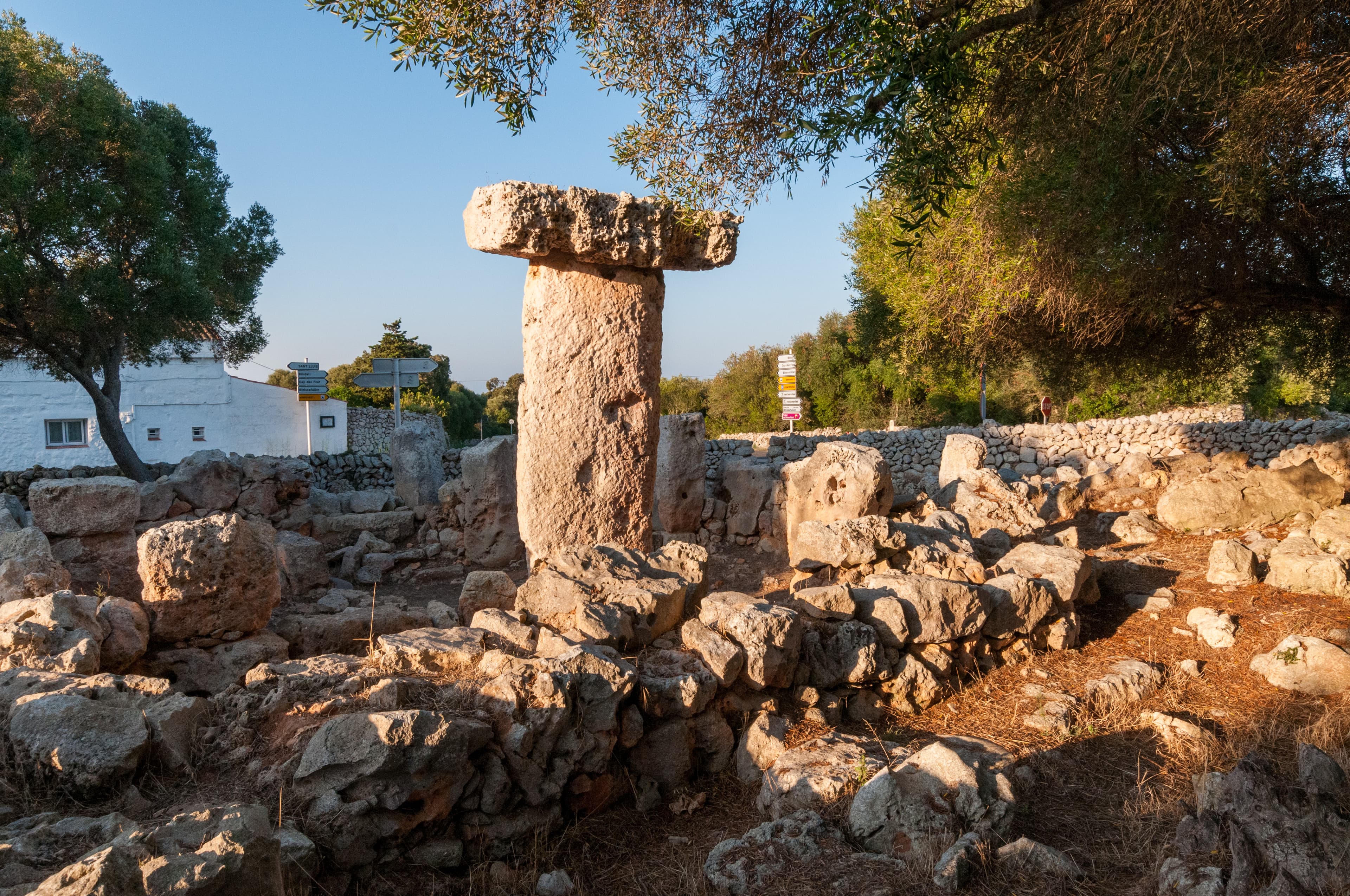
Image of Binissafullet. Image source · CC BY-SA 4.0
Visit essentials
A quick read before you go
- Duration
- No official visit duration is published; allow enough time to read the panels and examine the…
- Access
- Use the official Me-10 kilometre 2.3 and Binissafullet Vell directions.
Overview
Binissafullet brings domestic and ceremonial archaeology into one small settlement. The talayot, dwellings, hypostyle space, silos, and taula enclosure show that this was not a single isolated monument. Within that settlement, the T-shaped taula and its enclosure mark the area that Menorca's heritage authority interprets as a cult space.
Excavation found imported wine-amphora fragments, hearth evidence, and bones from sheep and goats. The official interpretation connects these finds with ritual consumption and with concerns such as fertility or prosperity. Those conclusions are archaeological readings, not a recovered liturgy: no named deity, priesthood, prayer, or complete ceremonial sequence is securely documented for Binissafullet.
The enclosure was excavated and restored in 1990 after the site was cleared in 1988. The taula visible today was repositioned during that work, an important part of understanding what is ancient fabric and what reflects modern conservation. Binissafullet is now encountered as an archaeological place under heritage stewardship, not as a site of continuing Talayotic worship.
Why this place is sacred
The taula is the visual center of Binissafullet, but it should not be treated as a free-standing symbol detached from the settlement. Its base, shaft, and capital differ structurally from many Menorcan taulas set directly into bedrock. Around it, excavated traces of fire, pottery, and animal consumption provide the strongest evidence for ceremonial gathering.
Archaeologists can compare that evidence with other taula enclosures and propose patterns of cult activity. They cannot recover the private experience of the participants or confidently name the beings they addressed. A respectful visit therefore makes room for both interpretation and absence. The modern re-erection of the taula also reminds visitors that conservation shapes the present view.
A settlement containing domestic, storage, communal, and defensive or representative architecture, with a taula enclosure interpreted as a cult space for communal ritual activity.
Occupation began during the Talayotic period and continued into the Roman era; later Islamic-period material indicates subsequent use of the area. Modern clearance in 1988 was followed by excavation and restoration of the taula enclosure in 1990.
Experience and orientation
Binissafullet is compact enough that its relationships can be seen without rushing. Begin with the scale of the talayot and the spread of the settlement rather than going directly to the taula for a photograph. At the enclosure, look for the T-shaped stone, the wall that defines the space, and the setting in which pottery, bone, and hearth deposits were excavated.
The archaeological evidence supports quiet attention but not reenactment. Do not place food, wine, candles, stones, or other offerings in the enclosure. The site is unstaffed, and absence of supervision does not make unstable or protected areas open.
The official heritage guide places the site off the Me-10 between Sant Lluis and Binissafuller, reached from the Binissafullet Vell road. Use current official directions rather than the conflicting approximate third-party map point preserved among the legacy sources.
Context and lineage
No named founder or traditional origin narrative survives. Archaeology places the settlement's development within Talayotic Menorca, with its principal activity extending through the later prehistoric centuries and into contact with Punic and Roman worlds. Imported vessels and local animal remains document exchange and consumption but do not provide a written account of belief.
The relevant historical tradition is the Talayotic Culture of Menorca. Present stewardship belongs to archaeological and heritage institutions; it should not be described as a continuous survival of ancient worship.
Traditions and practice
Amphora fragments, hearth deposits, and sheep and goat bones are interpreted as remains of ritual consumption. A possible connection with fertility or prosperity is an official archaeological interpretation, while the exact prayers, sequence, participants, and divine focus remain unknown.
Contemporary engagement consists of heritage conservation, archaeological interpretation, and careful public visitation. The ancient taula was repositioned during restoration, so present appearance should be understood through that conservation history.
Observe how the enclosure differs from nearby domestic and storage areas, read the official panels, and reflect on what material evidence can and cannot reveal about communal ritual.
Talayotic Culture
HistoricalThe settlement and its taula enclosure preserve archaeological evidence of Talayotic domestic, communal, and interpreted cult activity.
Communal consumption of wine and animal foods is inferred from the excavated assemblage; exact ceremonial actions are unknown.
Perspectives and open questions
Binissafullet can be described confidently as a Talayotic settlement with a taula cult enclosure while leaving its unwritten theology open. The page separates official archaeological interpretation, modern heritage stewardship, and personal response.
Scholarly perspective
The strongest interpretation comes from the taula enclosure's form and excavated assemblage. Comparative archaeology supports ritual consumption and possible fertility or prosperity concerns, but the meaning of the taula itself and the identities of any divine recipients remain debated or unknown.
Living and traditional perspectives
No living community is documented as transmitting Binissafullet's ancient rites. Talayotic Culture here names an archaeological society and its material tradition, not a modern religion whose beliefs can be summarized from contemporary testimony.
Alternative interpretations
Claims about extraterrestrial builders, energy portals, universal goddess worship, or precise astronomical ceremonies are not supported by the reviewed site-specific evidence.
Open questions
The builders' language, names for the enclosure and taula, divine focus, ritual calendar, participant roles, and the full meaning of the deposits are not recoverable from the present evidence.
Plan your visit
Access and arrival
Use the official Me-10 kilometre 2.3 and Binissafullet Vell directions. Do not rely on the conflicting Mapcarta point in the legacy source list; parking, mobile coverage, and emergency access were not verified.
Use established services in Sant Lluis or elsewhere on Menorca; no accommodation is associated with the archaeological site.
Respectful visit
Wear footwear suitable for uneven open ground and clothing appropriate for sun, wind, and changing weather; no ritual dress requirement is documented.
No site-specific photography rule was found. Use handheld personal photography without touching or climbing the remains, and verify any drone or commercial-photography permissions separately.
No living visitor offering practice is documented. Leave no food, drink, candles, coins, flowers, stones, or other objects.
The official guide reports no parking area or reduced-mobility access. Current signs, barriers, land-management instructions, and closures take precedence.
Do not invent or perform a Talayotic ceremony, leave offerings, light flames, pour liquids, climb the taula, or move stones.
Location
Map loads as you approach this section.
Pilgrim reflections
A portrait of encounter, not a score
Pilgrims describe what they felt, how present they could become, and whether the place would shape a journey. There are no stars and no ranking of traditions.
No reviewed reflections yet
The first pilgrims can help describe the character of being here.
Share a reflection
Available after an account-backed “Been there.” Every reflection is reviewed before publication.
Nearby sacred places
Explore other sacred places in the region. Proximity does not establish access or travel time; check each place’s guidance.


References
Sources consulted for this page. Source categories describe the publication, not a guarantee that every claim is verified. Traditional accounts and outside interpretations may differ.
- 01Talayotic settlement of Binissafullet — Consell Insular de Menorca / menorcatalayotica.infoofficialOfficial Talayotic Menorca heritage guide. Confirms location on Me-10 road at km 2.3 between Sant Lluís and Binissafúller, occupation until Roman era with later Islamic-period remains, taula structural distinctiveness (base, shaft, capital stone vs. bedrock-set taulas elsewhere), interpretation of finds as fertility-ritual evidence, free public access with interpretive panels, partially collapsed talayot, taula reconstructed/repositioned in 1990, no parking or reduced-mobility access.
- 02Darreres investigacions sobre els recintes de taula de la Menorca Talaiotica — Agencia Menorca TalaioticaofficialOfficial research synthesis interpreting taula enclosures, explicitly including Binissafullet, as cult spaces used for ritual activity; accessed 2026-09-04.
- 03Decision 45 COM 8B.24: Prehistoric Sites of Talayotic Menorca — UNESCO World Heritage CommitteeofficialUNESCO's 2023 inscription decision and official property name. It supports the serial property's status but is not used alone to infer sacred function or an exact component identifier.
- 04Binissafullet — Wikipedia — Wikipedia contributorsacademicConfirms occupation timeline (10th century BC, peak 4th-3rd century BC), site features (talayot, taula enclosure, hypostyle hall, dwellings, silos), 1988 deforestation, 1990 excavation/restoration of taula enclosure, Punic amphorae and faunal remains findings, artifacts held at Museum of Menorca, inclusion in 32-site Talayotic Menorca UNESCO nomination series.
- 05Poblat talaiòtic de Binissafúller — Viquipèdia — Viquipèdia contributorsacademicCatalan-language Wikipedia entry corroborating site name, location within Sant Lluís municipality, and Talayotic-culture classification.
- 06Aggregated GPS coordinate reference for Binissafullet archaeological site — Multiple mapping/heritage aggregators (approximate)Source contextApproximate GPS position for the site cluster: latitude 39.848964, longitude 4.216332. Used as best-available coordinate source; not independently verified against a primary cadastral or academic source.
Share a photo
Help visitors recognize Binissafullet. Every submission is reviewed before publication.