Rila
Bulgaria's holiest monastery, where a hermit's cave became the ark of a nation's soul
Understand sacred places, explore living traditions, and learn how to engage respectfully with Pilgrim Map.
Access has not been verified. Check current local guidance before planning a visit.
Kyustendil, Bulgaria
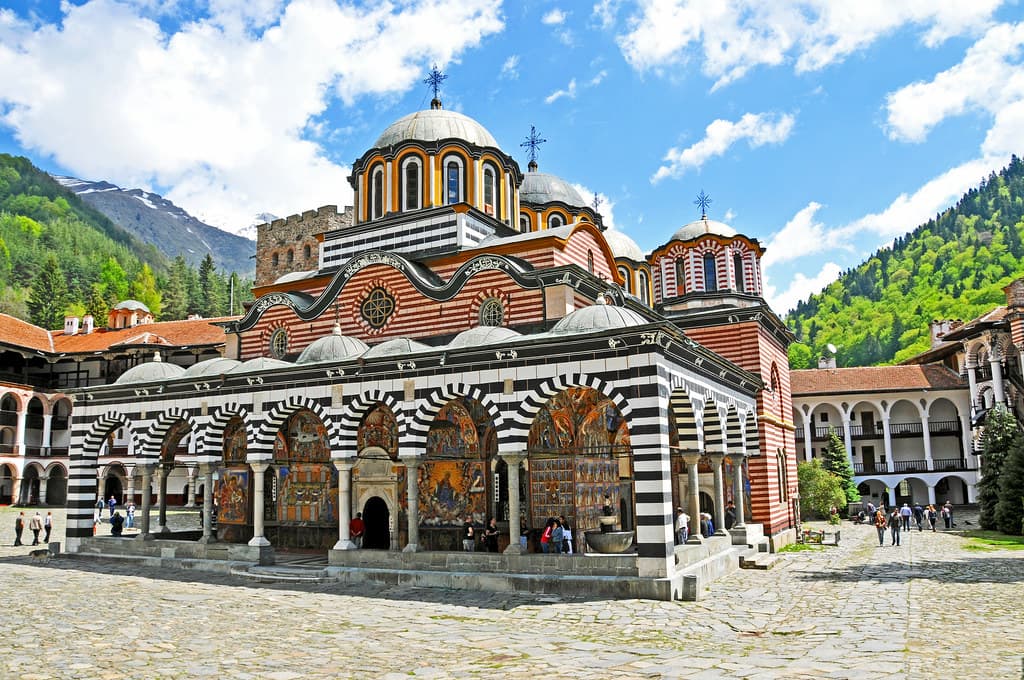
Image of Rila. Image source
Visit essentials
A quick read before you go
- Duration
- Two to four hours for a visit including the church, museum, and courtyard.
- Etiquette
- Modest dress required for an active Orthodox monastery and UNESCO World Heritage Site.
Overview
In the 10th century, a man withdrew into a cave in the Rila Mountains to pray. Ivan Rilski, later known as St. John of Rila, sought nothing but silence and communion with God. Disciples found him anyway. They built a monastery near his hermitage, and around that monastery, a tradition of prayer accumulated that would outlast every empire that tried to suppress it.
The monastery that stands today is largely a 19th-century reconstruction. A devastating fire in 1833 destroyed most of the medieval complex. What survived was the 14th-century Hrelyova Tower and the determination to rebuild. Between 1834 and 1862, master builders and painters created the current complex: a fortress-like pentagon of four-story residential wings surrounding a courtyard dominated by the Church of the Nativity of the Virgin.
Zahari Zograf and other painters covered the church interior with over 1,200 square meters of frescoes, creating an immersive visual theology that is among the finest expressions of the Bulgarian National Revival.
But Rila's significance transcends architecture. During nearly five centuries of Ottoman rule, when Bulgarian identity was under systematic pressure, the monastery served as the keeper of the Bulgarian language, its manuscripts, and its Orthodox faith. Monks copied texts in Bulgarian when Bulgarian was being pushed from public life. They educated when education was restricted. They prayed when churches across the country were closed or repurposed. The monastery became, as UNESCO's inscription acknowledges, the symbol of Bulgarian resilience.
The relics of St. John of Rila lie in the main church. Transferred from the medieval capital of Tarnovo in 1469, their arrival at the monastery was an event of national significance that galvanized Bulgarian consciousness. Today, the relics draw pilgrims who venerate them in a church alive with candlelight and chanting. The monks maintain the cenobitic rule. The liturgical cycle continues. What St.
John sought in his cave, the community he unwittingly founded continues to practice, eleven centuries and counting.
Why this place is sacred
Enter the courtyard through the main gate. The fortress-like exterior gives way to a space that contradicts it. Where the outside is defensive and austere, the inside is vivid and welcoming. The Church of the Nativity of the Virgin rises from the center of the courtyard, its five domes drawing the eye upward, its exterior walls carrying the first taste of the painted surfaces that explode inside.
Step into the church. The frescoes surround you completely. Over 1,200 square meters of painted surface: saints, prophets, scenes from the life of Christ, the Virgin, and the apostles, executed in colors that a century and a half have not dimmed. The effect is not decorative but theological. Every surface teaches. Every image participates in a comprehensive visual argument about the nature of God, salvation, and the communion of the living with the dead.
At the center of this painted universe, the relics of St. John of Rila rest in their reliquary. Pilgrims approach with a concentration that belongs to a different register of attention than tourism. They cross themselves, bow, kiss the reliquary, and pray. The relics have been here since 1469, when their transfer from Tarnovo was experienced as a national event. The presence of the saint's physical remains gives the theological claims of the frescoes a material anchor.
But the deeper thinness requires time. If you can stay overnight in the monastery guesthouse, attend the early morning Divine Liturgy. The church before dawn, lit by candles, the monks' chanting filling the painted space, the mountain cold pressing against the walls outside: this is the experience the monastery was built to produce. The frescoes are the scenery. The liturgy is the event. The thousand years of continuous prayer are the accumulated charge.
Afterward, walk outside. The Rila Mountains press close, forested slopes rising toward peaks above 2,000 meters. The monastery sits in a valley at 1,147 meters, and the mountain air carries a quality of silence that the liturgy continues in a different key. The hermit's cave where St. John lived is a few hours' hike above. The monastery began there, with one man and silence and stone.
St. John of Rila withdrew to a cave in the Rila Mountains seeking solitary communion with God. Disciples gathered near his hermitage and established the first monastic community in the 10th century.
The monastery grew from a small hermitage into Bulgaria's largest and most important monastic institution. It survived Ottoman invasion, though it suffered periods of decline and damage. The 1833 fire destroyed most medieval structures. The 1834-1862 reconstruction created the current complex. UNESCO inscription came in 1983. The monastery remains an active community under the Bulgarian Orthodox Church.
Experience and orientation
The road from Sofia climbs steadily through forested mountain terrain. The town of Rila appears at the base of the valley, and the road continues into narrowing landscapes that heighten the sense of approaching something hidden. The monastery complex materializes in the valley like a small fortified city, its walls rising four stories from the mountain floor.
Pass through the main gate. The transition is abrupt. The defensive exterior, designed to resist the incursions of five centuries, gives way to a courtyard alive with architectural detail: striped stone arches, wooden balconies, and at the center, the Church of the Nativity of the Virgin. The Hrelyova Tower, built in 1334-1335 by the feudal lord Hrelyo, stands nearby, the only structure to survive the 1833 fire. Its medieval walls carry a different weight than the reconstructed buildings around it.
Enter the church. The frescoes are not gentle. They are vivid, comprehensive, and unrelenting in their theological ambition. Every surface is painted. Saints gaze from the walls. The Last Judgment unfolds across an entire section. The Nativity, the Crucifixion, the Resurrection cascade through the visual field. The Zahari Zograf school of painting worked in the tradition of Byzantine iconography but with a confidence and color palette that belonged to the Bulgarian National Revival.
The result is an interior that overwhelms without exhausting.
Approach the reliquary of St. John of Rila. Observe the pilgrims. Their reverence is not performative. It arises from a relationship with the saint that the monastery has cultivated for over a thousand years. If you wish to venerate the relics, follow the lead of those who know the tradition.
Visit the museum and library. Over 250 manuscripts, including some of the oldest texts in the Bulgarian language. The kitchen, with its massive chimney, speaks to the communal life that sustained the monastery through centuries. The courtyard itself, with its rhythm of arches and levels, invites circular walking and contemplation.
If time allows, hike to St. John's cave hermitage, a three to four hour round trip above the monastery. The cave is small, the setting wild, and the contrast between the hermit's solitary beginning and the institution that grew from it is the deepest lesson the site offers.
Enter through the main gate into the central courtyard. The Church of the Nativity of the Virgin is the central building. The Hrelyova Tower is in the courtyard. The museum and library are in separate buildings. The monastery guesthouse is within the complex. St. John's cave hermitage is a 1.5-2 hour hike above the monastery.
Context and lineage
Ivan Rilski was born around 876 AD and orphaned young. He became a monk, then sought something deeper: complete solitary withdrawal into the mountains. He found a cave in the Rila range and lived there, eating wild plants, praying without ceasing.
The tradition holds that his holiness attracted attention despite his solitude. Disciples found him and gathered near his cave. A monastic community formed, not because John planned it but because the quality of his prayer drew others. After his death in 946, his body was found incorrupt, confirming his sanctity in the Orthodox understanding.
The monastery grew over centuries into a fortified complex, accumulating manuscripts, icons, and the attention of Bulgarian rulers who saw in it a spiritual center for their kingdom. When the Ottoman conquest dismantled the Bulgarian state in the late 14th century, Rila Monastery stepped into a role no one had planned for it: guardian of Bulgarian identity itself.
In 1469, the relics of St. John were transferred from the fallen capital of Tarnovo to the monastery. The procession was experienced as a national event, a reassertion of Bulgarian spiritual sovereignty in a time of political subjugation. The relics have remained at the monastery since, a physical anchor for the faith the community preserves.
Rila Monastery belongs to the Eastern Orthodox monastic tradition, specifically the cenobitic (communal) rule. St. John of Rila is venerated as the founder of Bulgarian monasticism. The monastery's role as guardian of Bulgarian culture during Ottoman rule places it in a lineage of institutions that preserved national identity through spiritual practice. The frescoes connect the monastery to the Bulgarian National Revival movement. UNESCO recognition situates it within the global heritage of humanity.
St. John of Rila (Ivan Rilski)
Founder and patron saint
Hrelyo Dragovol
Medieval patron
Zahari Zograf
Master painter
Pavel Ioanov
Master builder
Traditions and practice
The monastery follows the cenobitic monastic rule: communal prayer, communal meals, individual cells. The daily cycle includes Orthros, Divine Liturgy, Vespers, and Compline. The relics of St. John are venerated daily. The feast of St. John of Rila (October 19) and the feast of the Translation of Relics (July 1) are the most important annual celebrations. The 100 km pilgrimage walk from Sofia is an annual expression of devotion.
Daily Divine Liturgy at approximately 7:30 AM. Vespers in the late afternoon. The monastery museum and library are open to visitors during posted hours. Overnight accommodation in the monastery guesthouse allows pilgrims and visitors to attend services and experience the rhythm of monastic life. The monks maintain the complex and welcome visitors.
Attend the morning Divine Liturgy. The experience of the painted church before dawn, by candlelight, with the monks chanting, is the monastery's deepest offering. If an overnight stay is not possible, time your arrival for the morning service. Venerate the relics of St. John of Rila. Light a candle. Visit the museum to see the manuscripts that preserved Bulgarian language and faith. If you have a full day, hike to St. John's cave hermitage.
The contrast between the hermit's beginning and the institution that grew from it is profoundly instructive.
Eastern Orthodox Christianity (Bulgarian)
ActiveRila is the largest and most important monastery in Bulgaria, the spiritual heart of the Bulgarian Orthodox Church for over a thousand years. The monastery preserved Bulgarian language, literature, and faith during nearly five centuries of Ottoman rule. St. John of Rila is the patron saint of Bulgaria. The monastery's relics, manuscripts, and continuous worship make it the nation's holiest place.
Daily Divine Liturgy and the full cycle of canonical hours. Veneration of the relics of St. John of Rila. Annual feast days (October 19, July 1). Pilgrimage walk from Sofia. Monastic life under the cenobitic rule. Icon veneration, candle lighting, commemorative prayers.
Perspectives and open questions
Rila Monastery invites reading as Bulgaria's holiest site, as a masterpiece of National Revival sacred art, as a symbol of national resilience during five centuries of foreign rule, and as a living monastic community continuing a tradition of prayer begun by a hermit in a mountain cave.
Scholarly perspective
UNESCO recognizes Rila as 'a symbol of the Bulgarian Renaissance' and its role in preserving Bulgarian cultural identity during Ottoman rule. Art historians consider the Zahari Zograf frescoes masterworks of the National Revival period. The monastery's library of over 250 manuscripts is an invaluable repository of Bulgarian literary heritage. Historians study the institution as a case study in how religious communities preserve national identity under imperial occupation.
Living and traditional perspectives
For Bulgarian Orthodox Christians, Rila is the holiest site in the nation, inseparable from Bulgarian identity. St. John of Rila is the patron saint of Bulgaria. The monastery's survival through fire, invasion, and foreign domination is understood as evidence of divine protection. The annual pilgrimage from Sofia is a living expression of national devotion.
Alternative interpretations
The nearby Seven Rila Lakes are a pilgrimage destination for the White Brotherhood, the spiritual movement founded by Peter Deunov. While distinct from the Orthodox monastery, this tradition sees the Rila Mountains as an area of heightened spiritual energy. Some visitors describe the monastery's mountain valley as possessing an unusual quality of peace.
Open questions
The full extent of St. John's early hermitage and the original 10th-century structures remains archaeologically uncertain. The mechanisms by which the monastery preserved Bulgarian culture during the darkest periods of Ottoman rule, when many monasteries were destroyed, are still being studied. Some scholars believe underground networks between monasteries played a greater role than is commonly documented.
Plan your visit
Access and arrival
The monastery guesthouse offers overnight accommodation for pilgrims and visitors. Rooms are simple. Early morning service attendance is the reward. The town of Rila and nearby villages offer additional lodging. Sofia provides full accommodation for day-trip visitors.
Respectful visit
Long trousers or skirts. Covered shoulders. Headscarf for women in chapel areas. No shorts, swimwear, or revealing clothing.
Exterior photography permitted. Interior church photography generally restricted, especially during services. No flash. Museum photography may require a fee.
Candles may be purchased and lit before icons. Monetary donations welcome. Visitors may write names for commemorative prayers.
Silence in the church and during services. Do not enter monastic quarters. Remove hats (men). No food in the church. Large groups should arrange visits in advance.
The monastery is Bulgaria's most popular tourist attraction, and midday visits in summer involve significant crowds. Tour buses arrive from late morning onward. For the most contemplative experience, stay overnight or arrive before 8 AM. Winter visits may be affected by snow on the access road.
Location
Map loads as you approach this section.
Pilgrim reflections
A portrait of encounter, not a score
Pilgrims describe what they felt, how present they could become, and whether the place would shape a journey. There are no stars and no ranking of traditions.
No reviewed reflections yet
The first pilgrims can help describe the character of being here.
Share a reflection
Available after an account-backed “Been there.” Every reflection is reviewed before publication.
Nearby sacred places
Explore other sacred places in the region. Proximity does not establish access or travel time; check each place’s guidance.

Cave of Saint John of Rila
Rila Monastery, Kyustendil Province, Bulgaria
3.1 km away

Lozen Monastery of Saint Saviour
Lozen / Sofia, Sofia City Province, Bulgaria
52.7 km away

Dragalevtsi Monastery
Sofia, Sofia City Province, Bulgaria
54.2 km away
Boyana Church
Sofia, Sofia City Province, Bulgaria
57.2 km away
Photo gallery
3 curated photos
Share a photo
Help visitors recognize Rila. Every submission is reviewed before publication.