Horizont tumulus, Kozi Gramadi
The only Thracian heroon with a Greek colonnade, threshold between two civilizations and two worlds
Understand sacred places, explore living traditions, and learn how to engage respectfully with Pilgrim Map.
Access has not been verified. Check current local guidance before planning a visit.
Plovdiv, Bulgaria

Visit essentials
A quick read before you go
- Duration
- One to two hours for the heroon.
- Etiquette
- Standard archaeological site rules.
Overview
Ten Doric columns stand at the Horizont Tumulus near Starosel even though Thracians built tumuli—underground chambers beneath earthen mounds—not colonnades. Odrysian builders or Greek collaborators instead announced a hero-shrine in Greek architectural language, creating an unprecedented Thracian sacred space. Dating to the mid-4th century BC, the heroon emerged amid the Odrysian kingdom's complex, sometimes hostile relations with Greeks and rising Macedon.
Its buried ruler, possibly connected to King Amadocus II, received bronze arrowheads, silver beads, and golden plates; a sacrificed horse accompanied the passage from mortal to divine status, accomplished through Orphic rites in the chamber behind the colonnade. Above and east, Kozi Gramadi fortress stands at 1,200 meters with walls up to three meters thick. King Cotys I founded this seat of Odrysian power around 384-359 BC.
Lead sling bullets bearing names of Philip II of Macedon's generals attest a siege in 341 BC, while valley tumuli including Horizont served rulers on the peak. The heroon is a threshold between Greek and Thracian architecture, living and dead, mountaintop power and underground transformation; its entrance was meant to be crossed once by a ruler who would not return unchanged.
Why this place is sacred
Stand before the colonnade. Ten columns, early Doric in style, arranged in a configuration that no Greek architect would have designed for a Greek purpose. These columns were not supporting a temple to Apollo or Athena. They were framing the entrance to a Thracian hero-shrine, a place where a dead king was being transformed into something more than human.
The borrowing is itself significant. The Odrysian Thracians were not imitating Greek culture for the sake of prestige. They were incorporating Greek monumental forms into their own theological project. The colonnade announces the importance of what lies behind it in a visual language that Greek visitors would have understood, while the underground chamber behind the columns operates according to Thracian sacred logic: descent, enclosure, darkness, transformation.
Enter the chamber. A horse was buried here alongside the ruler, sacrificed to carry the deified king on a journey that required physical transport even in death. Gold, silver, and bronze accompanied them. These were not wealth displays but ritual necessities, provisions for the transition from human to divine existence.
Now look upward, toward the peak where Kozi Gramadi sits. The fortress at 1,200 meters was where the living king ruled. The tumulus in the valley below was where the dead king was remade. Between them, the landscape itself became sacred geography, a vertical axis connecting earthly authority with the underground realm of the gods.
The Horizont heroon is the hinge point of that axis, the place where the direction of travel reversed from downward in the earth to upward toward divinity.
The thinness here is architectural and intentional. The colonnade is literally a threshold, and the chamber behind it was built to accomplish metaphysical work. Twenty-four centuries later, the structure still communicates its purpose.
The heroon served as the burial and deification site for a high-ranking Odrysian Thracian, possibly a king or royal family member. Orphic funerary rites performed in the underground chamber were intended to transform the deceased into an anthropodemon, a being of divine status.
The heroon was sealed after the burial and covered by an earthen tumulus. It remained undisturbed for over two millennia until Georgi Kitov's team discovered it in the early 2000s. The site now functions as an archaeological monument with visitor access via a marked walking track.
Experience and orientation
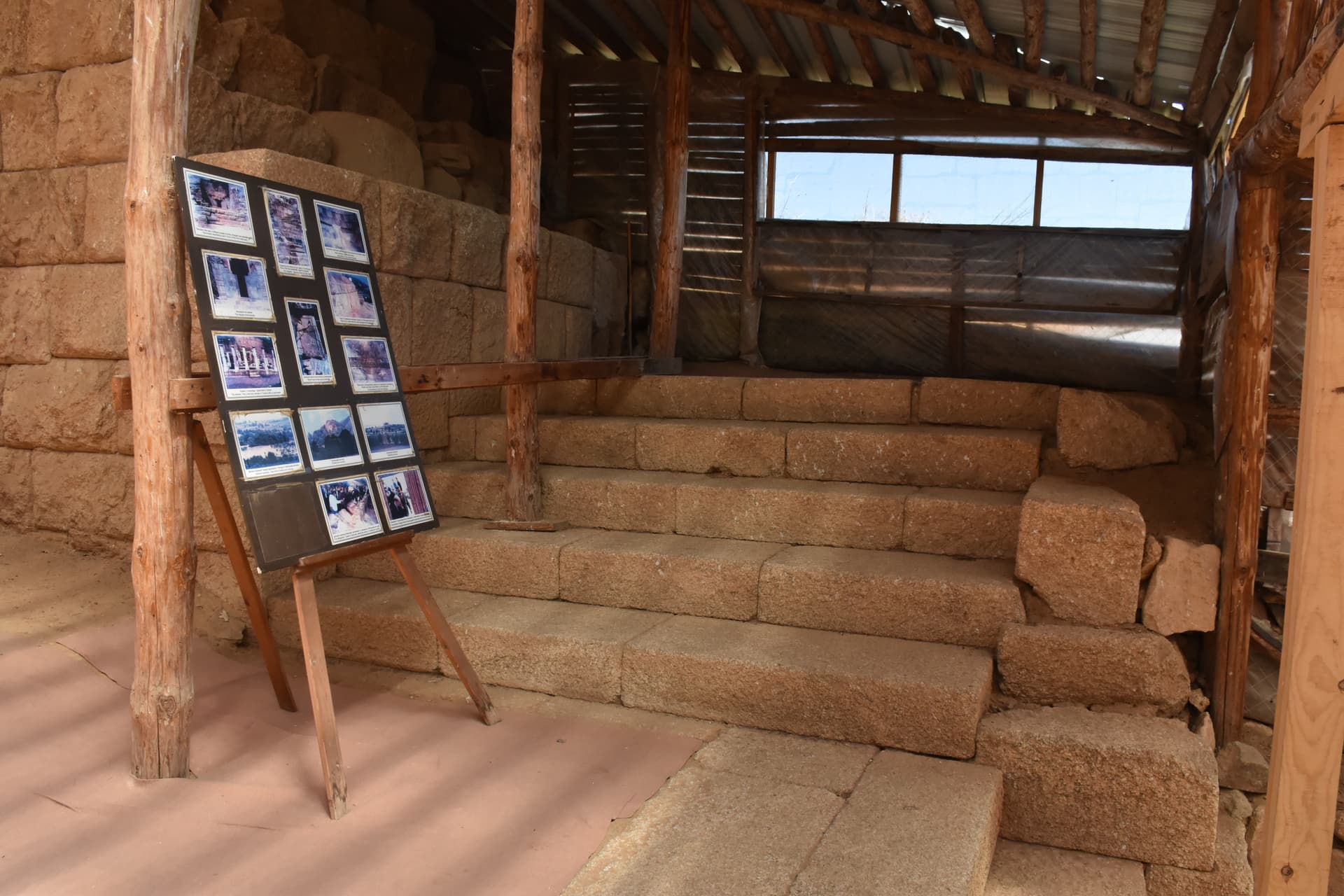
The walk from the parking area takes fifteen to twenty minutes through countryside that has changed less than you might expect in two and a half millennia. The path is marked and maintained. The tumulus appears as a mound in the landscape, and then the colonnade becomes visible, ten columns standing where the Thracian world met the Greek.
Approach the columns. They are modest by the standards of Greek monumental architecture, but their context transforms their meaning. These are not columns in a city. They are columns on a hillside in the Bulgarian countryside, framing an entrance to an underground chamber where a king was meant to become a god. The early Doric capitals show a style that suggests the columns were carved either by Greek craftsmen or by Thracian builders who had studied Greek forms closely.
If the chamber is accessible, enter. The transition from sunlight to darkness, from open air to enclosed stone, mirrors the transition the heroon was built to facilitate. The chamber is not large. It held one burial, one horse, and the grave goods that accompanied the transformation. Stand in the space and consider that the last person to stand here before the archaeologists was the priest who performed the Orphic rites, twenty-four centuries ago.
Emerge and look toward Kozi Gramadi. The fortress on the peak above, at 1,200 meters, commanded the same view you are taking in now. The living ruler looked down from his walls at the valley where his predecessors had been buried and deified. When his time came, he would descend from the peak to join them. The landscape organized the relationship between life and death, power and transcendence.
The site is quieter and less visited than the larger Chetinyova Mogila complex nearby. Use the relative solitude. The heroon communicates best in silence.
Park at the designated area and follow the walking track to the tumulus. The colonnade faces outward from the mound. The burial chamber is behind the colonnade. Informational signage provides context. The broader Starosel area, including Chetinyova Mogila, is accessible by car from the same base.
Context and lineage
The Odrysian kingdom reached its peak in the 4th century BC, ruling the largest domain in the Balkans while maintaining complex relationships with the Greek city-states and the rising Macedonian power. King Cotys I established a royal fortress at Kozi Gramadi, a peak at 1,200 meters that dominated the surrounding landscape. In the valley below, at Starosel, the rulers of this kingdom built their tombs.
The Horizont heroon represents a moment of cultural openness. Someone in the Odrysian court, perhaps the king himself, decided that a Thracian hero-shrine should be announced with a Greek colonnade. Whether this reflected diplomatic alliance, cultural admiration, or the practical availability of Greek architects working in Thracian territory, the result was unique. No other Thracian heroon has a colonnade. The synthesis happened once, at this site, for reasons that may never be fully understood.
In 341 BC, Philip II of Macedon besieged Kozi Gramadi. Lead sling bullets found at the fortress bear the names of his generals. The siege represents the moment when Macedonian expansion began to consume the Odrysian world. The heroon in the valley below, built in the preceding decades, may have been among the last great expressions of an independent Thracian sacred architecture.
The Horizont heroon belongs to the Odrysian Thracian tradition of royal burial and deification through Orphic rites. Its colonnade represents a unique moment of Greek-Thracian synthesis. The site is connected to the broader Starosel complex (including Chetinyova Mogila) and to the Kozi Gramadi fortress, forming a sacred landscape that linked political power to underground transformation.
Georgi Kitov
Archaeologist
Ivan Hristov
Archaeologist
Cotys I
Founder of Kozi Gramadi
Traditions and practice
Orphic funerary rites were performed at the heroon to deify the buried ruler. These included the sacrifice of a horse, the placement of gold, silver, and bronze as grave offerings, and secret mystery rituals whose content was orally transmitted and is now lost.
The site functions as an archaeological monument. Informational signage and the walking track provide visitor interpretation. No organized events occur regularly.
Approach the colonnade on foot and pause before entering. Notice how the columns create a visual frame that distinguishes what lies behind them from the surrounding landscape. If the chamber is accessible, enter slowly and allow your eyes to adjust. Sit in the silence if the space permits. After visiting the heroon, look toward the Kozi Gramadi peak and consider the vertical relationship between the mountaintop fortress and the underground burial.
If time and transport allow, visit Kozi Gramadi itself to complete the spatial understanding.
Ancient Thracian religion (Orphism)
HistoricalThe heroon served as a site for Orphic deification rituals. The unprecedented colonnade represents the only known Greek-Thracian architectural synthesis in a Thracian sacred context.
Orphic funerary and deification rites, horse sacrifice, burial with gold and silver grave goods.
Archaeological research
ActiveOngoing excavation and research since Georgi Kitov's discovery and Ivan Hristov's work at Kozi Gramadi continue to refine understanding of the Starosel complex.
Excavation, survey, publication, and visitor interpretation.
Perspectives and open questions
The Horizont heroon invites reading as a unique moment of Greek-Thracian cultural synthesis, as the architectural threshold of Orphic transformation, and as a node in a vertical sacred landscape connecting the Kozi Gramadi fortress to the underground world of the deified dead.
Scholarly perspective
Archaeologists recognize the heroon as uniquely significant for its unprecedented colonnade. The 10 Doric columns are interpreted as evidence of deep Greek-Thracian cultural exchange during the 4th century BC. The burial goods and horse sacrifice are consistent with documented Thracian royal funerary practices. The lead sling bullets from Kozi Gramadi provide rare physical evidence of the Macedonian campaign of 341 BC.
Living and traditional perspectives
No living tradition exists. The site contributes to Bulgarian national identity as evidence of Thracian civilizational sophistication.
Alternative interpretations
The site attracts visitors interested in ancient mystery traditions. The synthesis of Greek and Thracian sacred architecture at a single monument is interpreted by some as evidence of a trans-cultural mystery tradition. The underground chamber and colonnade are seen as an initiatory threshold.
Open questions
The precise identity of the buried individual remains uncertain. Why the colonnade was adopted, whether through Greek influence, diplomatic alliance, or imported craftsmen, is debated. The specific Orphic rites performed at the heroon are unrecoverable. The relationship between the ten or more tumuli in the Starosel area has not been fully established.
Plan your visit
Access and arrival
Hisarya (20 km) offers spa hotels. Plovdiv (50 km) provides full accommodation range. No lodging at the site.
Respectful visit
No dress code. Sturdy walking shoes recommended. Weather-appropriate outdoor clothing.
Photography permitted throughout the site.
Not applicable. Do not leave objects at the site.
Do not touch, climb on, or remove archaeological material. Stay on marked paths. Follow posted instructions.
The site is outdoors with limited shade. The walking track may be uneven. Check locally for current accessibility of the burial chamber. Sturdy footwear recommended.
Current practical details
Address
4175 Карлово, Bulgaria
Hours
Hours, fees, and access can change — verify on the official source before you travel. Practical details last checked Jun 2026.
Location
Map loads as you approach this section.
Pilgrim reflections
A portrait of encounter, not a score
Pilgrims describe what they felt, how present they could become, and whether the place would shape a journey. There are no stars and no ranking of traditions.
No reviewed reflections yet
The first pilgrims can help describe the character of being here.
Share a reflection
Available after an account-backed “Been there.” Every reflection is reviewed before publication.
Nearby sacred places
Explore other sacred places in the region. Proximity does not establish access or travel time; check each place’s guidance.


Share a photo
Help visitors recognize Horizont tumulus, Kozi Gramadi. Every submission is reviewed before publication.