Rakni Burial Mound
Scandinavia's largest burial mound, raised in defiance of a winter that nearly ended a world
Understand sacred places, explore living traditions, and learn how to engage respectfully with Pilgrim Map.
Access has not been verified. Check current local guidance before planning a visit.
Jessheim, Akershus, Norway
Read the sources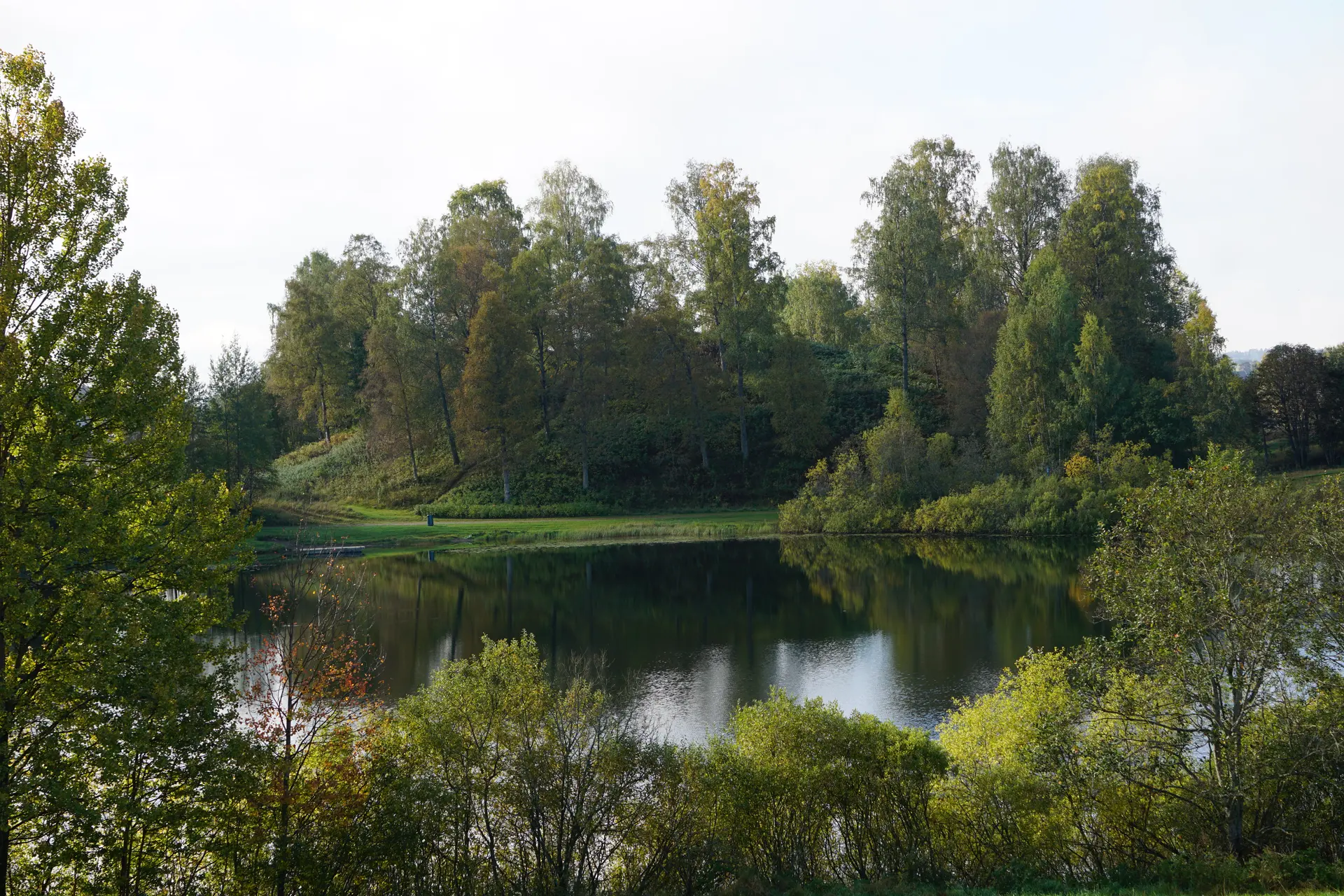
Image of Rakni Burial Mound. Image source · CC-BY-SA-4.0
Visit essentials
A quick read before you go
- Duration
- One hour to walk to the mound, circle the base, climb to the summit, read information plaques,…
- Access
- Located at Ljogodtvegen, 2067 Jessheim, Ullensaker municipality, Akershus, Norway.
Overview
Thirty thousand trees. Eighty thousand cubic metres of earth. An estimated five hundred labourers working through a summer that followed one of the harshest winters in recorded history. Raknehaugen, the largest burial mound in Scandinavia, is not merely a grave. It is evidence of a society's response to catastrophe, a monument raised when the world seemed to be ending.
Dendrochronology places construction between 533 and 551 CE, coinciding with the climate crisis of 536 when volcanic dust veils blocked sunlight across the Northern Hemisphere, triggering crop failures and famine. Some scholars connect this period to the Norse myth of Fimbulwinter, the endless winter that precedes Ragnarok. Whether or not the builders consciously enacted myth, they committed extraordinary communal resources to honouring a single cremated individual whose identity has never been established.
The mound stands in Ullensaker municipality, a place whose very name derives from Ullinshof, the Temple of Ullr, suggesting deep roots of sacred significance in this landscape. At seventy-seven metres across and fifteen metres high, the mound dominates the surrounding agricultural plain. Legend names its occupant as King Rakni, a sea-king from the Prose Edda, buried in full armour with a white horse. The archaeological record can neither confirm nor refute this.
What it does confirm is the scale of devotion: an entire community, in a time of existential crisis, chose to build something that would outlast them all.
Why this place is sacred
Thin places, in the Celtic understanding later adopted more broadly, are locations where the distance between the ordinary world and something deeper narrows. At Raknehaugen, that narrowing operates through scale and time. The mound is so large that standing at its base, the summit seems impossibly distant for a hand-built structure. Climbing it, the perspective shifts. The surrounding landscape flattens and extends. The airport at Gardermoen becomes visible to the northeast. Farmland stretches in every direction.
The mound becomes a vantage point, a place set apart from the ordinary plane of existence.
The temporal dimension deepens this quality. Fifteen hundred years of continuous presence have worn the mound smooth. Grass covers what was once raw earth piled over a core of stacked logs. The construction that required an entire community's labour for months now appears almost natural, as if the land itself rose up.
This transformation from human effort to landscape feature mirrors the larger mystery the mound embodies: someone of immense importance died, was cremated, was honoured with the greatest burial monument their society could produce, and then was forgotten. The name we attach to the mound, Rakni, comes from legend, not from historical record.
The Fimbulwinter connection adds another layer. The volcanic climate crisis of 536 CE brought darkness, cold, and famine to Northern Europe. Recent scholarship proposes that this period may have given rise to the Ragnarok myth, the Norse apocalypse preceded by three years of winter. If this is correct, then Raknehaugen was built by people who may have believed they were living through the end of the world.
The mound becomes not just a grave but an act of defiance, a statement that even as the world collapsed, the dead would be honoured and the community would endure.
The municipality name Ullensaker, derived from Old Norse Ullinshof meaning Temple of Ullr, places the mound within a landscape already marked as sacred in pre-Christian understanding. The proximity of Hovin Church, built on the site of an earlier stave church less than a kilometre away, suggests continuity of sacred use spanning the transition from Norse religion to Christianity. The mound stands at a crossroads of temporal and spiritual thresholds.
Archaeological consensus, established by Dagfinn Skre's 1997 re-examination of the original excavation notes, holds that Raknehaugen was a cremation burial. Human skull fragments from an individual aged twenty to thirty-five were found within the mound's core, along with a carbon layer consistent with cremation. The internal structure consists of three cone-shaped layers of approximately seventy-five thousand stacked logs, topped with sand, clay, and soil excavated from surrounding trenches.
Dendrochronological analysis revealed that ninety-seven percent of the logs were felled in a single winter, indicating extraordinary planning and coordination. No grave goods were found, only wooden construction tools, spades and a bar, which is unusual for an elite burial of this period and may indicate a distinct ritual approach or later disturbance.
The mound's interpretation has evolved significantly over time. Local legend, recorded by archaeologist Jan Petersen in 1927, identified the occupant as King Rakni, a sea-king from the Prose Edda, buried with armour and a white horse. Amateur excavations in the 1860s and 1870s disturbed portions of the mound. Sigurd Grieg's major excavation beginning in 1939 uncovered the internal log structure, bone fragments, and carbon layers, though interpretation remained uncertain.
The second season of Grieg's excavation was conducted by unemployed young men during wartime, with the two entry shafts named the East Front and West Front in wry reference to the military situation. Carbon-14 dating in 1956-57, the first use of the technique in Norway, provided an initial date range of 440-625 CE. Later dendrochronology narrowed construction to 533-551 CE, linking it definitively to the climate crisis period.
Skre's 1997 reanalysis settled the long-running debate about whether the mound was a burial, a cenotaph, or a thing-place. Most recently, Andreas Ropeid Saebo's 2025 research has reframed the mound as evidence of collective cooperation during crisis, interpreting monumental construction as both political demonstration and communal religious response.
Experience and orientation
The first encounter with Raknehaugen often involves recalibration. Photographs cannot convey the scale. The mound is seventy-seven metres across, roughly the length of a football pitch, and rises fifteen metres above the surrounding plain. From a distance it appears as a large hill, unremarkable in profile. Only on approach does the realization form that this is entirely artificial, that every particle of earth was carried and placed by human hands.
The walk from the parking area at Hovin school takes roughly ten minutes along a well-marked path of approximately eight hundred metres. The route passes through agricultural landscape that has been farmed for millennia. Ard marks, traces of prehistoric ploughing, were found beneath the mound itself, indicating that productive farmland was deliberately chosen for this monument. The approach is gentle, accessible to most fitness levels, and allows time for the mound to grow in the visitor's awareness.
At the base, information plaques provide archaeological and legendary context. A playground and picnic area nearby indicate the site's role in community life, not solely as heritage attraction but as a place where families gather. This ordinariness is itself part of the experience. The largest burial mound in Scandinavia stands in a landscape that has never stopped being used, never been cordoned off from daily life.
Climbing the mound is permitted and rewarding. The ascent takes only a few minutes but changes the relationship to the surrounding landscape entirely. From the summit, the Romerike plain extends in all directions. On clear days, the expanse is considerable. The elevation creates a sense of removal from the ordinary ground plane, a quality the original builders almost certainly intended.
Standing on the summit, you stand on fifteen centuries of accumulated presence, on the labour of hundreds, on the remains of thirty thousand trees and one unnamed person.
The surrounding landscape contains additional burial mounds, smaller and less prominent, which according to legend hold the warriors of King Rakni. These have not been fully investigated archaeologically, leaving open the question of whether the immediate area constitutes a broader funerary landscape connected to the central monument.
Visitors frequently note the peaceful quality of the site. Despite proximity to the Oslo Airport corridor and the growing town of Jessheim, the mound retains a sense of stillness. The grass absorbs sound. The elevation provides perspective. The questions the site raises, about identity, community, crisis, and memory, tend to quiet rather than agitate the mind.
Raknehaugen is located at Ljogodtvegen, 2067 Jessheim, in Ullensaker municipality, approximately forty kilometres north of Oslo and fifteen minutes by car from Oslo Airport Gardermoen. Free parking is available at Hovin school. The walk to the mound follows a well-marked path of roughly eight hundred metres across easy terrain. The site is freely accessible year-round with no entrance fee. Information plaques at the base provide context. A playground and picnic tables are available near the mound.
No visitor centre, refreshments, or toilet facilities exist on-site. The nearest services are in Jessheim town centre.
Context and lineage
Local oral tradition, recorded by archaeologist Jan Petersen in 1927, identifies the burial occupant as King Rakni, a sea-king known from skaldic poetry and the Prose Edda. According to this tradition, King Rakni was killed in battle in the seventh century and buried in full armour with a white horse, his warriors interred in surrounding smaller mounds.
A ghost tradition accompanies the legend: local girls reportedly saw a large dark figure at the mound one night, interpreted as the spirit of King Rakni, angered by disturbance of his barrow. The name Rakni may be equivalent to Ragnar, though this connection remains unverified. Archaeological dating places the mound's construction at least a century earlier than the legendary account suggests, and no armour or horse remains were found during excavation.
The legend nonetheless preserves a community memory of the mound as a place of royal burial and uncanny power, a memory that persisted through centuries of Christianity.
The lineage connecting the mound's original purpose to the present is layered and discontinuous. The Norse pre-Christian tradition that produced it ceased with Christianisation. The legendary tradition of King Rakni persisted through oral transmission until Jan Petersen recorded it in 1927. The archaeological tradition began with amateur excavations in the 1860s and 1870s, was formalised by Grieg's 1939 excavation, advanced through carbon-14 dating in the 1950s and dendrochronology thereafter, and continues through ongoing scholarly reinterpretation.
The pilgrimage tradition is the most recent layer: Raknehaugen's inclusion as an interest point on the Pilegrimsleden, Norway's St. Olav Ways pilgrimage network, connects the pre-Christian burial monument to a medieval Christian pilgrimage tradition still walked today. Each layer adds meaning without erasing what came before.
The Unknown Cremated Individual
King Rakni
Sigurd Grieg
Dagfinn Skre
Andreas Ropeid Saebo
Traditions and practice
The original burial involved cremation of the deceased and construction of a layered wooden and earthen monument of extraordinary scale. In Norse pre-Christian tradition, cremation was understood to release the spirit from the body, with the funeral pyre serving as a transformative threshold. Burial mounds in Norse culture were not merely graves but dwelling places of the dead, locations where the deceased continued to exert influence over the living landscape.
The practice of utiseta, sitting out on a mound to receive wisdom or visions from the dead, is documented in Norse sagas and may have been practised at significant mounds like Raknehaugen. Seasonal blot ceremonies, communal sacrificial feasts, may have been performed at or near important burial sites. The absence of grave goods at Raknehaugen is unusual for an elite burial and may indicate a distinctive ritual approach, though the possibility of antiquarian disturbance cannot be excluded.
No established spiritual communities maintain regular practice at Raknehaugen. The site functions as a protected cultural heritage monument, a point of interest on the Pilegrimsleden pilgrimage trail, and a recreational area for the local community. Ullensaker Municipality occasionally hosts cultural events related to the site's heritage. Modern pilgrims walking the St. Olav Ways may stop at Raknehaugen as a contemplative waypoint, reading informational plaques and reflecting on the continuity of sacred expression in the Norwegian landscape.
Begin at the base. Read the information plaques to ground yourself in the archaeological and legendary context. Then walk slowly around the mound's perimeter, allowing its circumference to register physically. Seventy-seven metres across means a walk of roughly two hundred and forty metres around the base. Notice how the mound relates to the surrounding landscape, the flatness of the Romerike plain that makes the fifteen-metre height so prominent.
Climb to the summit. The ascent takes only minutes but shifts your relationship to the ground. From the top, look outward in every direction. Consider the landscape as the builders saw it, farmed and familiar, a place they chose to mark permanently. Consider that beneath your feet lie the remains of thirty thousand trees, felled in a single winter by people who may have believed the world was ending.
Sit if you are moved to. The grass is usually dry enough in summer. Let the questions the mound raises settle rather than seeking answers. Who was this person, honoured with such extraordinary effort? Why were no grave goods placed with them? Was this monument a gesture of hope or of grief? The mound does not answer. It endures.
Before leaving, walk to observe the surrounding smaller mounds in the landscape. These satellite burials have not been fully excavated, and their relationship to the central monument remains an open question. The legendary tradition holds that these contain the warriors of King Rakni. Whether or not this is so, they extend the site's contemplative reach, suggesting that Raknehaugen was not an isolated monument but the centre of a broader sacred landscape.
Norse/Germanic Pre-Christian Burial Tradition
HistoricalRaknehaugen represents the supreme expression of Migration Age Norse funerary tradition. Its monumental scale, seventy-seven metres in diameter and fifteen metres in height, requiring seventy-five thousand logs from thirty thousand trees and an estimated four hundred and fifty to six hundred labourers, demonstrates the extraordinary resources committed to honouring the dead in sixth-century Scandinavian society. The cremation burial is consistent with Norse belief that fire released the spirit from the body. Construction during or immediately after the catastrophic Fimbulwinter climate crisis of 536 CE suggests the mound may have served as a communal religious response to existential threat.
The burial involved cremation of the deceased, construction of a three-layered wooden core of stacked logs, and the heaping of approximately eighty thousand cubic metres of earth. In broader Norse tradition, burial mounds served as dwelling places of the dead where ancestor veneration could be practised, including utiseta, the practice of sitting on a mound to receive wisdom from the deceased. Seasonal blot ceremonies may have been performed at or near significant mounds.
Norse Legendary Tradition
HistoricalLocal oral tradition identifies the mound's occupant as King Rakni, a sea-king from the Prose Edda and skaldic poetry. This tradition, recorded by Jan Petersen in 1927, preserves community memory of the mound as a place of royal power spanning centuries of Christianity. The associated ghost tradition, in which Rakni's spirit appears angered by disturbance of his barrow, reflects the Norse understanding of burial mounds as charged locations where the dead remain present.
The legendary tradition describes a royal warrior burial with full military honours including armour and a sacrificed horse, practices consistent with documented Norse elite burial customs. The ghost sighting tradition suggests ongoing folk awareness of the mound as a place where the boundary between living and dead remained permeable.
Pilegrimsleden (St. Olav Ways) Pilgrimage
ActiveRaknehaugen is registered as an interest point on the Pilegrimsleden, Norway's network of pilgrimage trails leading to Nidaros Cathedral in Trondheim. This inclusion bridges pre-Christian and Christian sacred geography, recognising the mound as a culturally significant waypoint that deepens the pilgrim's experience of Norway's spiritual landscape.
Modern pilgrims walking the St. Olav Ways stop at Raknehaugen as a contemplative rest point, reading informational plaques and reflecting on the continuity of spiritual expression across millennia. The pilgrimage tradition frames the mound not as a destination but as a waypoint, a place of passage that enriches the larger walk.
Archaeological and Conservation Stewardship
ActiveRaknehaugen has been the subject of continuous archaeological investigation since the 1860s, including Grieg's landmark 1939 excavation, Norway's first carbon-14 dating in 1956-57, Skre's 1997 reinterpretation, and Saebo's 2025 research on crisis and collective construction. This ongoing scholarly tradition has progressively deepened understanding of the mound's construction, dating, and cultural context.
The site is protected under Norwegian cultural heritage law as an automatically listed cultural monument. Ullensaker Municipality maintains the site for public access, including paths, information plaques, and recreational facilities. Academic research continues to generate new interpretations, most recently connecting the mound to the broader phenomenon of crisis-driven monumental construction in sixth-century Scandinavia.
Perspectives and open questions
Raknehaugen invites multiple readings, and none of them can be fully confirmed. The mound is too large and too old for simple answers. Scholars, legend-keepers, and contemporary interpreters each bring frameworks that illuminate certain aspects while leaving others in shadow. The honest response to this monument is to hold these perspectives simultaneously, letting them deepen rather than resolve each other.
Scholarly perspective
Archaeological consensus, established through over a century of investigation, identifies Raknehaugen as a cremation burial dating to the mid-sixth century CE. Dendrochronology and carbon-14 dating place construction between 533 and 551 CE, with ninety-seven percent of the approximately seventy-five thousand logs felled in a single winter. Dagfinn Skre's 1997 re-examination of Sigurd Grieg's 1939 excavation notes confirmed the presence of human skull fragments from an individual aged twenty to thirty-five, along with a carbon layer consistent with cremation.
No grave goods were recovered, only wooden construction tools.
The construction date places the mound within the period of the 536 CE climate crisis, when volcanic eruptions produced atmospheric dust veils that blocked sunlight, triggering severe cooling and agricultural failure across the Northern Hemisphere. Recent scholarship by Andreas Ropeid Saebo interprets the mound as evidence of collective cooperation during crisis, arguing that monumental construction served both as political demonstration of elite power and as communal religious response to existential threat.
Earlier scholars had debated whether the mound was a cenotaph, a thing-place for assemblies, or a true burial. Skre's work resolved this in favour of the burial interpretation.
Ard marks, traces of prehistoric ploughing, were discovered beneath the mound during the original excavation but not recognised as such until the 1990s. This indicates that productive agricultural land was deliberately chosen for the monument, an investment that underscores the extraordinary importance attributed to the burial.
Living and traditional perspectives
Norse oral tradition, recorded by archaeologist Jan Petersen in 1927, identifies the mound's occupant as King Rakni, a sea-king known from the Prose Edda and skaldic poetry. According to this tradition, Rakni was killed in battle and buried with full military honours, including armour and a sacrificed white horse. His warriors were interred in the surrounding smaller mounds.
The tradition carries an element of the uncanny: local girls reportedly saw a large dark figure at the mound, understood as the ghost of King Rakni, angered by disturbance of his barrow.
These traditions cannot be verified archaeologically. The dating evidence places the mound at least a century earlier than the legendary account, and no armour or horse remains were found. Yet the legend's persistence through centuries of Christianity speaks to the mound's enduring hold on local imagination. In Norse understanding, burial mounds were not inert monuments but dwelling places of the powerful dead, locations where ancestral presence continued to shape the living world.
Alternative interpretations
The temporal coincidence between Raknehaugen's construction and the climate crisis of 536 CE has inspired interpretations connecting the mound to the Ragnarok myth. In Norse mythology, Fimbulvetr, the great winter, precedes the destruction and renewal of the world. Some popular writers propose that the sixth-century crisis was the historical seed of this myth, and that Raknehaugen represents a society's attempt to enact cosmic restoration through monumental ritual action.
The municipality name Ullensaker, derived from Ullinshof, Temple of Ullr, has led some to speculate about connections to the god Ullr, who in some traditions is associated with winter and with oaths sworn on sacred rings. These interpretations, while not supported by direct archaeological evidence, offer frameworks through which contemporary seekers engage with the monument's mystery.
Open questions
Substantial questions remain genuinely unresolved. The identity of the cremated individual, honoured with the largest burial monument their society could produce, is unknown and likely unknowable. The absence of grave goods in such a monumental burial has no satisfactory explanation. Whether the construction was a direct response to the 536 CE climate crisis or was already planned before the crisis struck cannot be determined from available evidence.
The precise relationship between the legendary King Rakni and the actual burial occupant remains an open question. The function of the surrounding smaller mounds has not been established through excavation. Why ninety-seven percent of the thirty thousand trees were felled in a single winter, whether this reflects logistical efficiency or ritual requirement, is debated.
And the ard marks beneath the mound raise the question of why a community chose to sacrifice productive farmland for this monument, at a time when agricultural land was presumably at a premium due to climate-driven crop failures.
Plan your visit
Access and arrival
Located at Ljogodtvegen, 2067 Jessheim, Ullensaker municipality, Akershus, Norway. GPS coordinates: 60.14698 degrees north, 11.13719 degrees east. Free parking at Hovin school. The walk to the mound is approximately eight hundred metres on well-marked, easy terrain. The site is approximately fifteen minutes by car from Oslo Airport Gardermoen and forty kilometres north of Oslo city centre. Public transport reaches Jessheim via train from Oslo, with local buses connecting to the Hovin area. No entrance fee.
No visitor centre, toilet facilities, or refreshments on-site. Picnic tables and a playground are available near the mound base.
Jessheim, the nearest town, offers hotels and guesthouses serving both the local community and travellers using Oslo Airport Gardermoen. The airport itself has multiple hotels within minutes of the site. Oslo, forty kilometres south, provides the full range of accommodation options. Camping is available at various sites in the Romerike region.
Respectful visit
No specific dress code. Comfortable walking shoes are recommended for the path from the parking area and for climbing the mound. Weather-appropriate clothing is advisable; conditions can change at this latitude even in summer.
Photography is permitted and encouraged. The mound photographs well from both base and summit perspectives. The surrounding landscape provides context that helps convey the monument's scale.
Leaving offerings is not documented as part of any tradition at this site. General respect for the burial is expected. Do not leave items that could be mistaken for litter or that might compromise the heritage fabric.
Do not dig, remove soil or materials, or use metal detectors. Any damage to the mound is a criminal offence under Norwegian cultural heritage law. No other formal restrictions apply. The site is accessible year-round during daylight hours.
As an automatically protected cultural monument under Norwegian law, any damage to Raknehaugen is a criminal offence. Do not dig, remove soil, or disturb the mound's surface in any way. Leaving offerings is not part of the site's tradition and could compromise the heritage fabric. The mound surface can be slippery in wet conditions. Winter visits may involve snow and ice on the ascent.
Current practical details
Address
Ljøgodtvegen, 2067 Jessheim, Norway
Hours
Hours, fees, and access can change — verify on the official source before you travel. Practical details last checked Jun 2026.
Location
Map loads as you approach this section.
Pilgrim reflections
A portrait of encounter, not a score
Pilgrims describe what they felt, how present they could become, and whether the place would shape a journey. There are no stars and no ranking of traditions.
No reviewed reflections yet
The first pilgrims can help describe the character of being here.
Share a reflection
Available after an account-backed “Been there.” Every reflection is reviewed before publication.
Nearby sacred places
Explore other sacred places in the region. Proximity does not establish access or travel time; check each place’s guidance.


References
Sources consulted for this page. Source categories describe the publication, not a guarantee that every claim is verified. Traditional accounts and outside interpretations may differ.
- 01Rakni's Mound - Visit Norway — Visit NorwayofficialOfficial Norwegian tourism authority listing with visitor information and description
- 02Raknehaugen - Pilegrimsleden (St. Olav Ways) — PilegrimsledenSource contextOfficial Norwegian pilgrimage trail listing recognizing Raknehaugen as a point of interest on the St. Olav Ways
- 03Monuments as active cooperation: Crisis, mound construction, and society in Scandinavia in the 6th century AD — Andreas Ropeid Sæbøacademic2025 peer-reviewed article examining Raknehaugen in context of 6th-century crisis and collective mound construction in Scandinavia
- 04The Fimbulwinter theory and the 6th century crisis in the light of Norwegian archaeology — Various scholars (ResearchGate)academicAcademic paper linking Raknehaugen to the Fimbulwinter/536 CE climate crisis and interpreting monumental mound building as religious coping
- 05The long, harsh Fimbul winter is not a myth - Science Norway — Science NorwaynewsScience journalism article on the archaeological and dendrochronological evidence for the Fimbulwinter climate crisis
- 06Raknehaugen - Ullensaker Kommune — Ullensaker MunicipalitySource contextOfficial municipal page for the heritage site
- 07Hovin Church - Pilegrimsleden — PilegrimsledenSource contextInformation on Hovin Church, 790m southwest of Raknehaugen, the nearest sacred neighbor
- 08Rakni's Mound - Wikipedia — Wikipedia contributorsencyclopediaComprehensive article with detailed construction data, archaeological history, legends, and references to primary scholarly sources
- 09Raknehaugen Map - Mapcarta — Mapcarta / OpenStreetMapSource contextGPS coordinates: 60.14698°N, 11.13719°E
- 10Raknehaugen - Visit Greater Oslo — Visit Greater OsloofficialRegional tourism listing with visitor information
- 11Rakni's Mound - TripAdvisor Reviews — TripAdvisor contributorsguideVisitor reviews with practical access information, descriptions of parking, walkability, and atmosphere
Share a photo
Help visitors recognize Rakni Burial Mound. Every submission is reviewed before publication.