Møllerstufossen Rock Carvings
Six-thousand-year-old elk carvings beside a Norwegian waterfall, rendered in x-ray vision
Understand sacred places, explore living traditions, and learn how to engage respectfully with Pilgrim Map.
Access has not been verified. Check current local guidance before planning a visit.
Dokka, Innlandet, Norway
Read the sources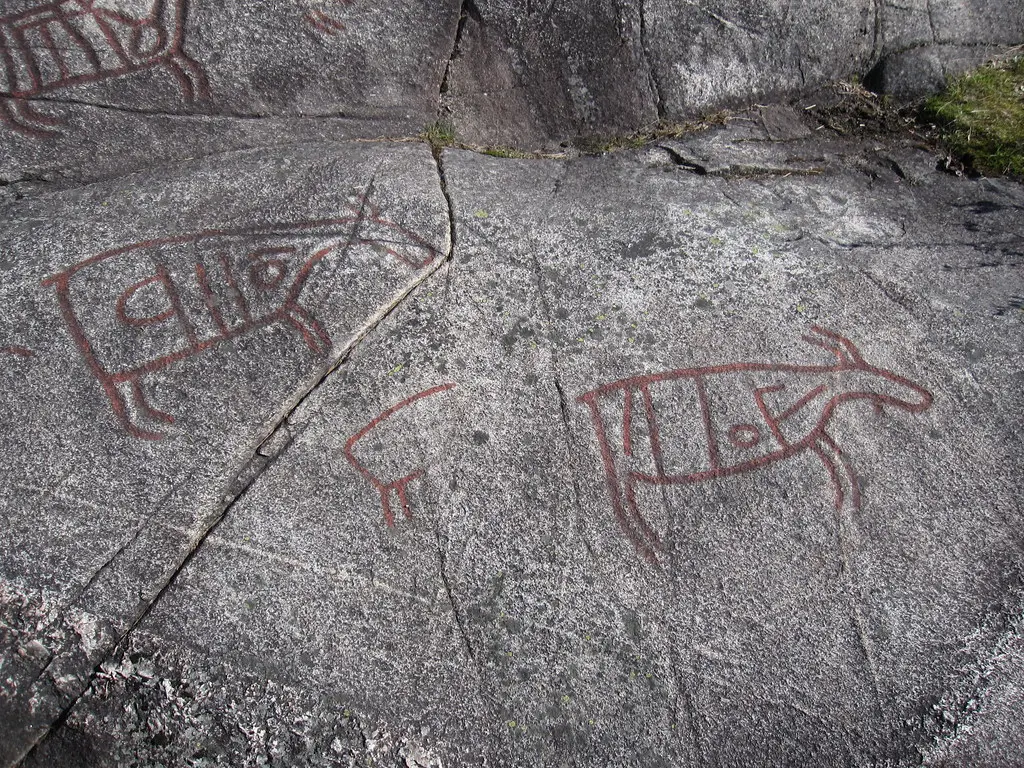
Image of Møllerstufossen Rock Carvings. Image source
Visit essentials
A quick read before you go
- Duration
- One hour to engage thoroughly with the carvings, explore the waterfall area, and absorb the…
- Access
- The site is located alongside county road fv33, approximately twelve kilometres west of Dokka in…
Overview
At Møllerstufossen, the Etna river narrows through rapids and cascades beside a rock face in Nordre Land, Innlandet. Its carvings predate the pyramids by three millennia, Stonehenge by two, and written language entirely. About eight thousand years ago, Mesolithic hunter-gatherers placed eleven elk, a beaver, an unidentified mammal, and two small human figures across roughly twenty square metres of stone.
Their sophistication is as arresting as their age. Archaeologists call the elk depictions x-ray style because internal organs appear inside their outlines, rendering animals from the inside out; the largest, a massive-antlered bull elk, spans ninety centimetres. The panel belongs to Scandinavia's veideristninger, or hunter's rock-art tradition, distinct from later southern Bronze Age agricultural carvings. For its makers, elk were survival and sustenance, not scenery, and perhaps more than symbol.
The older waterfall remains beside images likely to outlast the present civilisation too.
Why this place is sacred
Thin places, in the Celtic tradition that coined the term, are locations where the distance between the visible and invisible worlds narrows. Møllerstufossen was not named by Celts, but the concept translates. The Mesolithic people who carved here chose this specific rock face beside this specific waterfall, and scholars have long asked why.
Water is one answer. Across Northern European prehistory, waterfalls, springs, and river confluences served as liminal locations, boundaries where the land yielded to something else. The sound of Møllerstufossen fills the valley, a constant white noise that blankets thought and creates a particular kind of attention. Standing beside the carvings, you hear the water before you see the images. The sound establishes the atmosphere before the eyes engage.
The x-ray style itself suggests a kind of seeing that goes beyond ordinary perception. To depict an elk with its internal organs visible is to claim knowledge of what lies beneath the surface, to assert that the true nature of a creature is not its hide and antlers but the organs that sustain its life.
Whether this reflects practical knowledge gained through butchering, shamanic vision attained in altered states of consciousness, or some understanding that does not map onto modern categories, the effect is the same: these images insist that reality has layers, that what is visible is not all there is.
The temporal depth contributes its own quality of thinness. To stand before marks made by human hands six to eight thousand years ago is to confront the scale of human presence on this landscape. The carvers are gone, their language unrecoverable, their beliefs a matter of scholarly interpretation. Yet their images remain, still legible, still communicating something across a gulf of time that defies ordinary comprehension.
The carvings are older than agriculture in this region, older than metallurgy, older than any surviving mythological tradition. They persist from a world we cannot access except through what it left on stone.
The precise purpose of the carvings remains debated. Gutorm Gjessing's 1936 classification placed them within the veideristninger tradition, hunter's rock art created by communities dependent on wild game. The dominant interpretation for much of the twentieth century was sympathetic hunting magic: by depicting prey animals, the carvers sought spiritual influence over the hunt.
More recent scholarship has moved toward nuanced readings involving totemism, where animals served as clan symbols or spiritual guardians, and shamanic practice, where the carvings may record visionary experiences during altered states of consciousness. The waterfall setting has been interpreted as significant in itself, a place of power and transition where the boundary between human and spirit worlds thinned.
The carvings were discovered in 1961 during log driving operations on the Etna river, when workers noticed the figures on the exposed rock face. Before that modern rediscovery, the images had been weathering in silence for millennia, unseen by anyone who could read them as their makers intended. Following discovery, Norwegian conservation authorities painted the carved lines to enhance visibility, a standard practice for Scandinavian rock art that makes the images accessible to non-specialist visitors.
Wooden walkways were installed to allow viewing while protecting the rock surface from foot traffic. The site transitioned from forgotten archaeological survival to protected cultural heritage monument and outdoor recreation destination.
Experience and orientation
You arrive along county road fv33, roughly twelve kilometres west of Dokka. The car park sits approximately thirty metres from the carvings, separated by a short footpath. There is no long approach, no pilgrimage walk. The transition from car to carvings is swift, which makes the temporal dislocation all the more jarring. One moment you are in the twenty-first century; the next you are standing before images from the sixth millennium BCE.
The waterfall announces itself first. Møllerstufossen is not a single dramatic drop but a series of rapids and cascades where the Etna river narrows and accelerates. The sound is constant, ranging from a low rumble to a higher rush depending on the season and water level. In summer, when the site is most visited, the river also draws swimmers and families to natural rock slides in the pools below the falls.
The sacred and the recreational share the same stretch of riverbank.
The carvings themselves occupy an exposed rock face covering approximately twenty square metres. They have been painted in red by conservation authorities, a practice common across Scandinavian rock art that renders the carved lines visible to the untrained eye. Without the paint, many visitors would pass the rock face without noticing anything. With it, the figures emerge with startling clarity: elk after elk, most facing the same direction, their bodies filled with lines and shapes representing internal anatomy.
The wooden walkways allow close approach. You can stand within a metre of carvings made by hands that last touched this stone eight thousand years ago. The largest elk, a bull with antlers spread wide, measures ninety centimetres from nose to rump. Its body contains rendered organs, a heart perhaps, or lungs, the precise identification debated but the intent unmistakable. This animal was understood from inside as well as outside.
Two small human figures appear among the animals. Their presence raises questions that no one has answered. Are they hunters depicted alongside their prey? Shamans in relationship with animal spirits? Figures from a narrative we cannot reconstruct? Their smallness relative to the elk is notable. Whatever story these images tell, the animals are its main characters.
The beaver is an unexpected companion to the elk. Its inclusion suggests the carvers documented more than their primary prey, perhaps recording the full community of creatures that shared this river landscape. The relationship between the different species depicted remains one of the site's open questions.
Visitors consistently describe two qualities: the strangeness of encountering images so old in such an accessible setting, and the way the waterfall's sound creates an immersive atmosphere that separates the viewing experience from ordinary sightseeing. The carvings reward patience. Spend time with individual figures rather than scanning the whole panel. Notice how the x-ray lines within each elk body suggest not just anatomy but a way of knowing the animal that modernity has largely lost.
The site lies alongside county road fv33, approximately twelve kilometres west of Dokka in Nordre Land Municipality, Innlandet county. Free parking is available roughly thirty metres from the carvings. An information board at the parking area provides historical context. Wooden walkways lead to the viewing platforms. Benches and tables are available near the site. The carvings are at river level, so the approach is flat and short. Coordinates: 60.837127 degrees north, 9.839630 degrees east.
Context and lineage
No origin narrative survives for the Møllerstufossen carvings. The people who made them left no written records and spoke languages that vanished millennia before anyone thought to document them. What can be reconstructed comes from the carvings themselves and from their archaeological context.
Following the retreat of the Scandinavian ice sheet, the inland valleys of Norway became habitable. Forests of pine and birch spread into the newly exposed landscape, followed by elk, deer, beaver, and the predators that pursued them. Human communities followed, moving into the river valleys that provided both travel routes and hunting grounds. The Etna river valley was one such corridor, connecting the lowlands near present-day Dokka with the highland plateaus to the west.
Sometime around 6000 BCE, members of one of these communities began carving images into the rock face beside the waterfall. Why they chose this location, what prompted the first mark on stone, what they intended by rendering animals with visible internal organs, all this belongs to a world that existed before mythology as we know it.
The carvings predate the Norse gods by at least five thousand years, predate the agricultural revolution in Scandinavia by roughly two thousand, predate any surviving cultural tradition in the region. They come from a time so distant that even the concept of tradition may not apply in any way we would recognise.
The lineage connecting these carvings to any living tradition is broken beyond recovery. The Mesolithic communities who created them have no known descendants maintaining their specific cultural practices. The veideristninger tradition itself represents a worldview that predates every extant Scandinavian spiritual tradition by millennia. The Norse religion that later dominated the region arrived thousands of years after the carvings were made, and the Christianity that followed the Norse tradition later still.
The modern scholarly tradition that studies the carvings constitutes a different kind of lineage, one of interpretation rather than practice. From Gjessing's 1936 classification through ongoing academic research, scholars have built a framework for understanding what the carvings meant within their original cultural context. This interpretive lineage continues to evolve, with recent work emphasising shamanic and animistic readings over the older hunting-magic hypothesis.
In a broader sense, the carvings participate in the universal human lineage of making meaning through images. The impulse to render the world in permanent form on stone connects Møllerstufossen to rock art traditions spanning every inhabited continent, a thread of artistic and spiritual expression that runs through the entire span of human culture.
Mesolithic hunter-gatherer communities of inland Scandinavia
Gutorm Gjessing
Log drivers on the Etna river
Norwegian conservation authorities
Traditions and practice
The rituals performed at this site in the Mesolithic period remain unknown in their specifics. Scholars have proposed several frameworks based on comparative analysis of veideristninger across Scandinavia. The hunting-magic hypothesis, dominant for much of the twentieth century, suggests the carvings served pre-hunt ceremonies in which depicting prey animals invoked spiritual influence over the outcome of the hunt. The totemic interpretation proposes that different animal species represented clan or kinship identities, with the carvings marking group affiliation and territorial presence.
The shamanic reading, which has gained prominence in recent decades, suggests the x-ray style depictions may record visionary experiences during altered states of consciousness, with the visible internal organs representing shamanic sight that penetrated beyond ordinary perception. The waterfall setting supports this interpretation, as the sound of rushing water has been documented cross-culturally as a facilitator of trance states.
The two small human figures among the animal depictions may represent practitioners rather than hunters, figures in relationship with the animal spirits rather than merely pursuing prey.
No established spiritual community maintains regular practice at Møllerstufossen. The site is catalogued in modern pagan registries as a significant prehistoric sacred location, and individual practitioners of earth-based spirituality may visit with spiritual intent. However, no organised rituals or ceremonies are documented at the site. The primary contemporary use is cultural heritage appreciation and outdoor recreation, with the waterfall and river pools attracting swimmers and families alongside those interested in the petroglyphs.
Approach the carvings slowly, allowing the sound of the waterfall to settle into your awareness before you engage with the images. The water was here before the carvings and has been the site's constant companion through every millennium since. Let it establish the acoustic frame.
On the wooden walkways, pause before each figure rather than scanning the full panel. The x-ray style rewards individual attention. Trace the lines within an elk's body with your eyes, noticing how the carver rendered what lies beneath the skin. Consider what it means to depict an animal this way, not as surface appearance but as a being whose inner life mattered enough to record in stone.
The two human figures are easy to overlook among the larger animal forms. Find them. Their scale relative to the elk says something about how these carvers understood the relationship between humans and the animal world. Whether that relationship was one of dependence, reverence, kinship, or something outside modern categories, these figures suggest it was not one of dominance.
If you visit in summer, the river below the carvings draws swimmers and children. The juxtaposition of ancient sacred imagery and contemporary recreation is not a contradiction but a continuation. People have been coming to this waterfall for eight thousand years. The reasons change. The draw persists.
Spend time with the sound. The waterfall creates a white noise that quiets internal dialogue and creates space for a different quality of attention. Some visitors find that sitting near the carvings, simply listening, produces a contemplative state that purely visual engagement does not. The Mesolithic carvers chose a site defined as much by sound as by stone.
Prehistoric Scandinavian animism
HistoricalThe Møllerstufossen carvings represent one of the oldest surviving expressions of human spiritual life in inland Norway. Created by Mesolithic hunter-gatherer communities approximately eight thousand years ago, they belong to a worldview in which the boundaries between human, animal, and spirit realms were understood as permeable. The x-ray style, with its depiction of internal organs visible through the animal's form, suggests a relationship with the natural world that went beyond the practical necessities of hunting to encompass a spiritual understanding of animal life force and essence.
Specific practices at this site remain unknown. Comparative analysis of veideristninger across Scandinavia suggests the tradition encompassed pre-hunt rituals invoking spiritual influence over prey, totemic ceremonies affirming kinship between human communities and specific animal species, and shamanic practices in which practitioners entered altered states of consciousness to communicate with animal spirits. The waterfall setting may have played a role in these practices, with the sound and energy of falling water serving as a facilitator of spiritual states.
Veideristninger scholarly tradition
ActiveThe academic study of Norwegian hunter's rock art constitutes an ongoing tradition of interpretation and preservation that has shaped how the Møllerstufossen carvings are understood and presented to the public. Since Gutorm Gjessing's foundational classification in 1936, scholars have developed increasingly nuanced frameworks for understanding what the carvings meant within their original cultural context.
Active research continues into the dating, interpretation, and conservation of veideristninger sites across Norway. This includes comparative studies with rock art traditions in other parts of Scandinavia and the circumpolar north, investigation of the relationship between site locations and environmental features, and ongoing debate about the relative importance of hunting-magic, totemic, and shamanic interpretive models. Conservation work at Møllerstufossen includes the maintenance of painted enhancement on the carvings and the upkeep of visitor infrastructure.
Heritage conservation and public interpretation
ActiveSince the carvings' discovery in 1961, Norwegian heritage authorities have maintained the site as a protected cultural monument. The conservation tradition encompasses both physical preservation of the rock art and public interpretation through information boards, walkways, and inclusion in regional heritage trails.
Conservation practices include the application of red paint to the carved lines for public visibility, monitoring of weathering and erosion, maintenance of wooden walkways and visitor facilities, and integration of the site into regional cultural heritage programming. The site balances heritage preservation with outdoor recreation use, reflecting Norway's tradition of allemannsretten, the right of public access to nature.
Neopagan interest
ActiveThe site appears in modern pagan registries as a significant prehistoric sacred location in Scandinavia. For contemporary practitioners of earth-based spirituality, the carvings represent evidence of pre-Christian European spiritual traditions connected to animism, shamanism, and reverence for the natural world.
No specific modern pagan rituals are documented at Møllerstufossen. The site's significance within neopagan circles is primarily symbolic and inspirational rather than the focus of organised practice. Individual practitioners may visit with spiritual intent, but no regular ceremonies or gatherings are established.
Perspectives and open questions
The Møllerstufossen carvings resist simple interpretation. They were made by people who left no texts, no oral traditions that survived to the present day, no explanatory framework except the images themselves. Every reading is therefore a projection backward across eight thousand years, informed by evidence but shaped by the interpreter's own assumptions. This honest uncertainty does not diminish the carvings.
It situates them in a space where multiple meanings can coexist without resolution, which may be precisely the kind of space they were always meant to occupy.
Scholarly perspective
Archaeological consensus places the carvings firmly within the veideristninger tradition, Scandinavia's hunter's rock art, dating to the Mesolithic period around 6000 to 5600 BCE, though some sources extend the range to 4000 BCE. The classification system established by Gutorm Gjessing in 1936 remains the standard framework. Gjessing distinguished the veideristninger from the later jordbruksristninger, agricultural rock art of the Bronze Age, based on differences in subject matter, style, and geographic distribution.
The scholarly community has shifted significantly in its interpretation of the carvings' purpose. The hunting-magic hypothesis, which dominated twentieth-century discussion, drew on Sir James Frazer's theories of sympathetic magic and proposed that depicting animals gave the carver spiritual power over prey. This reading has fallen from favour as overly simplistic.
Contemporary scholarship emphasises multiple possible functions operating simultaneously: totemism, in which animal species served as markers of clan identity and spiritual relationship; shamanic practice, in which the carvings record visionary experiences during altered states of consciousness; and narrative, in which the panels tell stories whose content we cannot recover.
The x-ray style has drawn particular scholarly attention. Parallels exist in rock art traditions from Siberia to Aboriginal Australia, suggesting either deep cultural connections or independent development of similar perceptual frameworks by hunting peoples worldwide. The visible internal organs have been interpreted as reflecting both practical anatomical knowledge, gained through the butchering process, and a spiritual understanding that an animal's essence resided in its inner organs rather than its outward form.
The waterfall setting remains significant for archaeological interpretation. Research across Scandinavian rock art sites has established that many veideristninger were placed near water features, suggesting these locations held particular significance within the cosmology of Mesolithic hunting communities.
Living and traditional perspectives
No indigenous oral tradition connects to these specific carvings. The Mesolithic communities who created them predate the arrival of Sámi peoples in this particular region of southern Norway, and no subsequent tradition adopted the site or transmitted knowledge of its original meaning. The carvings exist in a cultural vacuum, their significance lost with the people who made them.
This absence of traditional knowledge is itself significant. The carvings predate every surviving spiritual tradition in Scandinavia. They come from before the Norse cosmology of Odin and Thor, before the agricultural fertility cults of the Bronze Age, before any framework that historical or ethnographic research can access. They represent a spirituality, if that is the right word, that belongs to a world we know only through its material traces.
Alternative interpretations
Some contemporary practitioners of earth-based spirituality view the Møllerstufossen carvings as evidence of a deep-rooted European shamanic tradition predating organised religion by millennia. In this reading, the x-ray style represents genuine shamanic perception, the ability to see into the essence of other beings during altered states of consciousness. The waterfall setting is understood as a power place where natural forces facilitated spiritual work.
The site is documented in modern pagan registries as a significant prehistoric sacred location. Some practitioners of Scandinavian-inspired spiritual paths view it as a place where the original European spiritual relationship with the natural world can be contacted or honoured.
Parallels drawn between the Møllerstufossen x-ray style and similar artistic traditions in Siberian and Australian Aboriginal rock art have led some alternative researchers to propose shared prehistoric spiritual knowledge spanning vast distances. Mainstream archaeology remains cautious about such claims, noting that similar artistic solutions can develop independently in cultures facing similar ecological conditions.
Open questions
What remains unknown is substantial, and honesty requires acknowledging this. The precise meaning of the x-ray style is debated: were the internal organs depicted to show practical hunting knowledge, to record shamanic visions, to express a cosmological principle about the nature of animals, or for reasons that do not map onto any modern interpretive category? The question remains open.
The identity and significance of the two small human figures among the animal depictions is unclear. Their scale relative to the elk has been interpreted as depicting spiritual hierarchy, social role, or narrative positioning, but no consensus exists.
Why the carvers chose this specific rock face beside this specific waterfall is not known with certainty. The assumption that the waterfall held spiritual significance is reasonable but unprovable. Whether the carvings were made in a single campaign or accumulated over centuries remains undetermined. The relationship between the beaver and the elk depictions, both biological and symbolic, has not been satisfactorily explained.
Perhaps most fundamentally, we do not know what the experience of making or viewing these carvings was like for the people who created them. We can stand where they stood, hear the same waterfall, look at the same images. But the consciousness that gave these images meaning, the web of beliefs, stories, and relationships in which they were embedded, is gone. What remains is the stone, the water, and the marks.
Plan your visit
Access and arrival
The site is located alongside county road fv33, approximately twelve kilometres west of Dokka in Nordre Land Municipality, Innlandet county, central-eastern Norway. Free parking is available approximately thirty metres from the carvings. The walk from car park to carvings is short and relatively flat, following footpaths with wooden walkways at the viewing area. An information board at the parking area provides historical context. Coordinates: 60.837127 degrees north, 9.839630 degrees east.
The site is reachable by car from Oslo in approximately two and a half hours via the E16 and regional roads.
Accommodation is available in Dokka, the administrative centre of Nordre Land Municipality, approximately twelve kilometres east of the site. Options include hotels and guesthouses. The surrounding area offers camping facilities and cabin rentals typical of Norwegian outdoor recreation infrastructure. The town of Gjøvik, on the shore of Lake Mjøsa, provides a wider range of accommodation approximately fifty kilometres to the southeast.
Respectful visit
No specific dress requirements. Sturdy footwear is advisable as rocks near the waterfall can be slippery. In summer, many visitors combine viewing the carvings with swimming, so appropriate clothing for both activities is practical. Rain gear is sensible at any season in this part of Norway.
Photography is permitted and encouraged throughout the site. The red-painted carvings are most legible in diffused light; bright sunlight can create glare on the rock surface. Morning and late afternoon light tends to work well. The waterfall and river provide natural framing for the carving panels.
Not applicable. As a heritage monument, the site is not a place for offerings or ritual deposits. Leaving objects at the site is discouraged to preserve its integrity and cleanliness.
Do not touch or trace the carved rock surfaces. Stay on the wooden walkways at all times when near the carvings. Do not add markings, paint, or any material to the rock face. Respect the natural environment along the river. Take all litter with you.
The site is a protected heritage monument. Do not touch the carved surfaces or attempt to trace the carvings with fingers or implements, as this accelerates erosion. Stay on the wooden walkways to prevent damage to the rock face and surrounding vegetation. The red paint applied by conservation authorities is a preservation measure and should not be altered. Rocks near the waterfall can be slippery, particularly when wet. Exercise caution near the river edge, especially with children.
Current practical details
Address
Nordsinni 1353, 2870 Dokka, Norway
Hours
Hours, fees, and access can change — verify on the official source before you travel. Practical details last checked Jun 2026.
Location
Map loads as you approach this section.
Pilgrim reflections
A portrait of encounter, not a score
Pilgrims describe what they felt, how present they could become, and whether the place would shape a journey. There are no stars and no ranking of traditions.
No reviewed reflections yet
The first pilgrims can help describe the character of being here.
Share a reflection
Available after an account-backed “Been there.” Every reflection is reviewed before publication.
Nearby sacred places
Explore other sacred places in the region. Proximity does not establish access or travel time; check each place’s guidance.

References
Sources consulted for this page. Source categories describe the publication, not a guarantee that every claim is verified. Traditional accounts and outside interpretations may differ.
- 01The Rock Art of Norway - JSTOR — Various scholarsacademicAcademic volume on Norwegian rock art traditions and interpretations
- 02Introduction to the Rock Art of Scandinavia - Bradshaw Foundation — Bradshaw FoundationacademicComprehensive overview of Scandinavian rock art traditions, dating, and cultural context
- 03Rock carvings at Møllerstufossen - Wikipedia — Wikipedia contributorsencyclopediaEnglish Wikipedia article with basic facts and references
- 04Møllerstufossen Helleristninger - The Megalithic Portal — The Megalithic Portal contributorsofficialCoordinates (60.837127°N, 9.839630°E), condition ratings, detailed description of carved figures
- 05Møllerstufossen rock carvings - Pagan Places — Pagan PlacesofficialCategorized under Prehistoric paganism, location details
- 06Rock carvings at Møllerstufossen - Outdooractive — OutdooractiveguideHiking route details, visitor facilities, access information
- 07Rock carvings in Central Norway - Wikipedia (with academic refs) — Wikipedia contributorsacademicContext on veideristninger tradition, hunting magic vs shamanic interpretations
- 08Helleristningene ved Møllestufossen - Enjoy — Enjoy.lyacademicBooking/tourism platform listing for the site
Share a photo
Help visitors recognize Møllerstufossen Rock Carvings. Every submission is reviewed before publication.