Borre Mound Cemetery
A Viking royal burial ground where dynasty, mythology, and the Oslofjord converge
Understand sacred places, explore living traditions, and learn how to engage respectfully with Pilgrim Map.
Access has not been verified. Check current local guidance before planning a visit.
Horten, Vestfold, Norway
Read the sources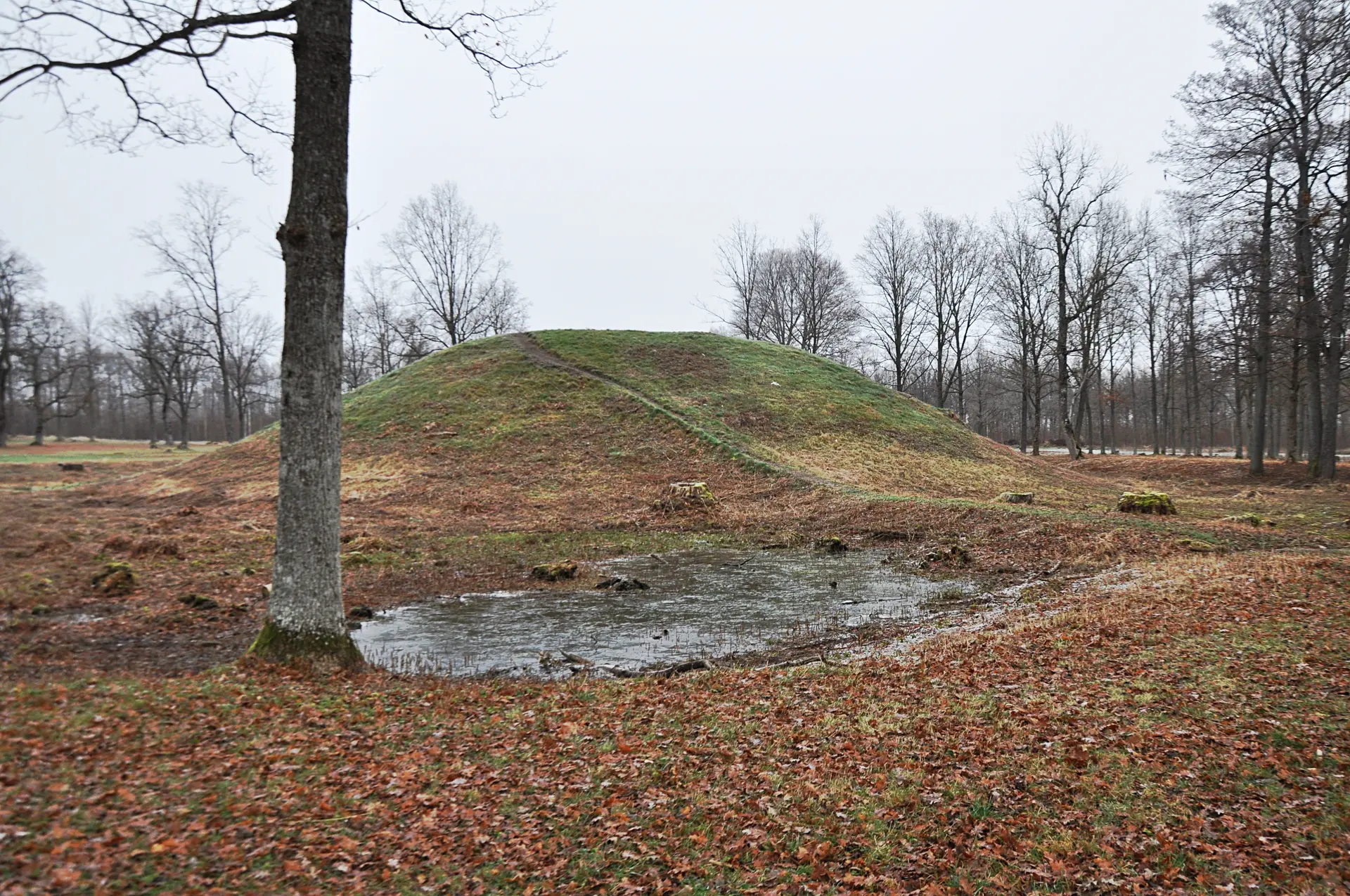
Image of Borre Mound Cemetery. Image source · CC-BY-SA-2.0
Visit essentials
A quick read before you go
- Duration
- Half a day to explore the mounds thoroughly, visit the Midgard Viking Centre exhibitions, and…
- Access
- Located at Birkelyveien 9, 3182 Borre, Horten Municipality, Vestfold og Telemark county, Norway.
Overview
The mounds at Borre do not announce themselves from a distance. They rise gradually from the wooded parkland, their rounded forms half-absorbed into the landscape after more than a thousand years of weathering. Some exceed forty-five metres in diameter and stand six or seven metres high. To walk among them is to move through a geography of the dead, each mound the resting place of someone whose community considered them worthy of monumental commemoration.
According to the Icelandic historian Snorri Sturluson, writing around 1225 in his Heimskringla, these were the burials of the Yngling dynasty, kings who traced their lineage to the god Freyr of the Vanir. Modern DNA evidence complicates this narrative, revealing that several elite families used the cemetery rather than one unbroken royal line.
The truth may be more interesting than the legend: Borre functioned as a royal necropolis for an entire region's ruling class, a shared landscape of power and memory positioned where every ship sailing the Oslofjord could see the mounds of the dead watching from the shore.
The cemetery was in use from approximately 600 AD through the end of the Viking Age around 900 AD. During those three centuries, ship burials, monumental mound construction, and ceremonial feasting in adjacent hall buildings created a dense ritual landscape that scholars now recognise as one of the most significant in Scandinavia. The site gave its name to the Borre art style, the most widespread decorative tradition of the Viking world, found from England to Russia.
Today, Borre sits on Norway's UNESCO Tentative List and serves as a waypoint on the national Pilegrimsleden pilgrim trail.
Why this place is sacred
The Norse did not think of burial mounds as sealed containers. The mounds at Borre were thresholds, places where the boundary between the world of the living and the realm of the dead could be crossed in either direction. The practice of haugbrott, mound-breaking, was not mere grave robbery.
It was a ritual act, sometimes undertaken to retrieve ancestral weapons believed to carry the power of their former owners, sometimes as a form of necromancy through which the living sought counsel from the dead.
This permeability gives Borre its particular atmosphere. The mounds are not ruins in the conventional sense. They are intact, their contents still beneath the surface, their occupants unnamed but present. Folklore reinforces this quality. The isolated mound called Spellemannshaugen, the Fiddler's Mound, stands apart from the main cemetery in a wheat field roughly a hundred metres away.
Local tradition holds that music could be heard emanating from inside it on late summer evenings, as though someone within had not yet finished playing.
The coastal setting compounds the liminality. The Oslofjord stretches below the cemetery, and the mounds were positioned to be seen from the water. In Norse cosmology, the sea was a boundary between worlds, a passage to the unknown. Ship burial, practised at Borre, literalised this understanding. The dead were placed in vessels as though setting out on a final voyage. The mounds rose above them like waves frozen in earth.
The discovery of three large hall buildings adjacent to the cemetery, revealed through ground-penetrating radar surveys between 2007 and 2013, deepened understanding of the site as a place where worlds overlapped. These were not domestic structures. They were feasting halls, consistent with the halls described in Norse sagas where the living honoured the dead with ritual meals. The proximity of hall and mound, the living and the dead sharing the same ground, created a landscape designed to hold both simultaneously.
Today, the annual Midgardsblot festival opens with a blot ritual among the mounds, a contemporary acknowledgment that the site's spiritual charge has not dissipated. The pagan news outlet The Wild Hunt refers to Borre as the Blot-Mounds, recognising an identity older than the national park designation.
Borre functioned as a royal necropolis and power centre from approximately 600 AD through 900 AD. Archaeological consensus holds that it served the elite families of the Vestfold region, who used monumental mound burial as an assertion of legitimate authority and divine ancestry. The adjacent hall buildings suggest the site also served as an assembly and ceremonial feasting ground, where political and ritual life converged in the presence of the honoured dead.
The cemetery evolved over three centuries, with nine great mounds constructed between the Merovingian period and the end of the Viking Age. At least one mound contained a ship burial, discovered in 1852 when road-builders partially destroyed it. The artifacts recovered, particularly finely decorated bronze harness fittings, defined the Borre art style. After the Viking Age, the site passed out of active use. Medieval literary sources, particularly Snorri Sturluson's Heimskringla, preserved the site's association with the Yngling dynasty.
The first archaeological excavation in 1852 by Nicolay Nicolaysen marked the beginning of modern engagement. Ground-penetrating radar surveys in 2007, 2008, and 2013 revealed the hall buildings. In March 2019, archaeologists discovered what appears to be a buried Viking-era ship. The site became a national park and is now part of a UNESCO Tentative List nomination. Since 2015, the Midgardsblot festival has introduced periodic ceremonial use, and the site features on Norway's Pilegrimsleden pilgrim trail network.
Experience and orientation
The park opens around you gradually. The mounds do not stand in isolation but emerge from among the trees, their forms so large and so integrated into the terrain that it takes a moment to register what you are seeing. These are not natural hillocks. Each was built deliberately, earth heaped over the remains of someone whose community invested enormous labour in their commemoration. The largest exceed forty-five metres across and rise six or seven metres above the surrounding ground.
Walking among them, you become aware of the cemetery's geography. The mounds are positioned along the Oslofjord shore, oriented so that anyone approaching by sea would have seen them silhouetted against the sky. In the Viking Age, this was not merely aesthetic. It was a political statement written in earth: these were the graves of kings, and the coastline belonged to them.
The atmosphere shifts depending on the time of day and season. Summer evenings bring a particular quality of light across the fjord, and the park's relative emptiness on weekdays allows the kind of solitude in which the site's age becomes palpable. Winter visits, when snow covers the mounds and the short northern daylight gives the landscape a grey compression, evoke conditions closer to what the original builders knew.
The Midgard Viking Centre, located at the park's edge, serves as the primary interpretive facility. Exhibitions provide archaeological context for the burials, the Borre art style, and the broader Vestfold Viking landscape. Guided tours of the mound cemetery are available through the centre. The reconstructed Gildehall, a Viking feast hall near the mounds, gives physical form to what the ground-penetrating radar revealed: that the living gathered in large timber structures steps away from where their dead lay beneath the earth.
During the annual Midgardsblot festival in August, the site transforms. Thousands gather for a programme that combines extreme metal and folk music with Viking reenactments, a reconstructed Viking village called Folkvangr, lectures on Norse heritage, and most significantly, a blot ritual that opens the festival. For those who attend, the experience of hearing drums and horns among the ancient mounds, with the Oslofjord as backdrop, collapses the distance between centuries in a way that quiet contemplation cannot.
Borre Mound Cemetery lies at Birkelyveien 9, 3182 Borre, in Horten Municipality, approximately one hour south of Oslo by car. The park is freely accessible with excellent disabled access; vehicles can drive to the site perimeter. The Midgard Viking Centre at the park entrance serves as the visitor centre, offering exhibitions, guided tours, and group activities. The reconstructed Gildehall is within walking distance of the mounds.
Those arriving during the Midgardsblot festival in August should plan for larger crowds and book accommodation well in advance.
Context and lineage
According to Snorri Sturluson's Ynglinga Saga, the opening section of his Heimskringla composed around 1225, the Yngling dynasty descended from the god Freyr, also called Yngve, one of the Vanir gods. The saga narrates how Odin led his people from the legendary Asgard to Scandinavia, where the Ynglings inherited the right to rule through divine ancestry.
The mounds at Borre were said to be where these semi-divine kings were laid to rest, establishing the cemetery as a nexus between the human and divine realms. Snorri specifically names Halfdan Svarte, Halfdan the Black, as having been buried near Borre around 860 AD. Modern scholarship approaches these narratives with appropriate caution. Snorri wrote three centuries after the Viking Age, drawing on oral traditions that blended mythology with history.
DNA testing of remains from the Vestfold region has shown that the individuals buried at sites like Borre belonged to several distinct elite families, complicating any single-dynasty narrative. The historical reality may have been more complex than the literary tradition allows: a shared royal necropolis where competing families asserted their legitimacy side by side.
The lineage at Borre operates on two levels. The archaeological lineage runs from the Merovingian-period elite families who first constructed mounds here around 600 AD, through the Viking Age kings whose burials continued for three centuries, to the medieval literary preservation by Snorri Sturluson, to the modern archaeological investigations beginning with Nicolaysen in 1852 and continuing through the 2019 ship discovery. The spiritual lineage is more fractured.
Norse paganism did not survive the Christianisation of Scandinavia in the 10th and 11th centuries as an unbroken tradition. Modern Norse and heathen practitioners, including those who gather at Midgardsblot, draw on the literary and archaeological record to reconstruct practices rather than continuing an inherited tradition. This distinction matters, though it does not diminish the contemporary engagement. The site's inclusion on Norway's Pilegrimsleden pilgrim trail acknowledges a broader spiritual significance that transcends any single tradition.
The Yngling Dynasty
Halfdan Svarte (Halfdan the Black)
Snorri Sturluson
Nicolay Nicolaysen
Bjorn Myhre
Traditions and practice
Viking Age funerary practices at Borre included ship burial with rich grave goods. The 1852 excavation recovered weapons, riding equipment, and decorated bronze harness fittings from within a mound that had contained a clinker-built vessel. Monumental mound construction served dual purposes: honouring the dead and asserting the political authority of surviving kin.
The three hall buildings discovered through ground-penetrating radar surveys indicate that ceremonial feasting took place adjacent to the burials, consistent with Norse saga descriptions of erfi, funerary feasts where the living ate and drank in the company of the dead. The practice of haugbrott, mound-breaking, suggests that later generations returned to the mounds to retrieve sacred heirlooms or to engage in necromantic communication.
Blot, sacrificial offering to the gods and ancestors, would have formed part of the broader ritual calendar observed at this site.
The annual Midgardsblot festival, held each August since 2015, opens with a blot ritual conducted among the burial mounds. The festival combines extreme metal and folk music with Viking cultural programming including reenactments, a reconstructed Viking village called Folkvangr, a market called Kaupangr, documentary screenings, and lectures on Norse heritage and spirituality. The reconstructed Gildehall near the mounds hosts ceremonial gatherings.
The Midgard Viking Centre offers year-round exhibitions, guided tours, activity days, and group programming including traditional crafts, cooking, and archery. Borrehaugene also serves as a waypoint on Norway's Pilegrimsleden pilgrim trail, welcoming walkers engaged in a longer practice of reflective travel.
Begin at the Midgard Viking Centre to establish historical context before entering the mound field. Walk slowly among the mounds, allowing their scale to register fully. The largest are over forty-five metres across, but their gradual slopes can make them seem smaller than they are until you stand beside one and look up. Notice how the mounds are positioned relative to the Oslofjord: the builders wanted them seen from the water.
Stand at the southern edge of the cemetery and look toward the fjord, imagining the view from an approaching longship. The mounds would have risen against the sky like a statement no traveller could miss.
If the Gildehall is open, step inside and consider the scale of the space. Then step back outside and look at the mounds. The living and the dead occupied neighbouring structures. The separation between feast hall and burial mound was a matter of metres, not metaphor.
Evening visits in summer, when the light softens over the Oslofjord, offer a particular quality of stillness. The park empties of most visitors by late afternoon, and the mounds take on a different character in low, angled light.
If you find yourself drawn to the isolated Spellemannshaugen, the Fiddler's Mound standing alone in a wheat field roughly a hundred metres from the main cemetery, you are following in the footsteps of generations who wondered why it was built apart from the others.
Norse Paganism (Historical)
HistoricalBorre was the royal burial ground of Norse elite families from approximately 600 to 900 AD, traditionally associated with the Yngling dynasty said to descend from the god Freyr. The monumental mounds functioned as assertions of divine-right kingship, positioned along the Oslofjord to be visible from the water. The cemetery was not merely a place of interment but a landscape of power where ancestor veneration, funerary cult, and political authority converged. Ship burial, haugbrott, and ceremonial feasting in the adjacent halls all formed part of a rich ritual life centered on the relationship between the living and the dead.
Ship burial with rich grave goods including weapons, riding equipment, and finely decorated harness fittings. Monumental mound construction as both funerary rite and political assertion. Ceremonial feasting in great halls adjacent to the cemetery. Haugbrott, the ritual breaking into mounds to retrieve ancestral relics or commune with the dead. Blot, sacrificial offering to gods and ancestors, as part of the broader Norse religious calendar.
Modern Norse/Heathen (Asatru/Forn Sed)
ActiveBorre is recognised by contemporary Norse and heathen practitioners as sacred ground, a site where the weight of Viking Age history and mythology creates a living spiritual landscape. The annual Midgardsblot festival, held since 2015, brings together thousands for a ceremonial acknowledgment of the site's heritage. The festival's opening blot ritual represents the most visible contemporary spiritual practice at the site.
Annual blot ritual at the opening of Midgardsblot festival. Viking reenactments and cultural activities including demonstrations of ancient ritual practices. Lectures and discussions on Norse heritage and spirituality. Ceremonial gatherings in the reconstructed Gildehall. Individual practitioners may visit for personal devotion or meditation among the mounds outside of festival time.
Archaeological and Heritage Stewardship
ActiveBorre has been a site of active archaeological investigation since 1852, when Nicolay Nicolaysen's excavation defined the Borre art style. Ongoing research, including the 2007-2013 ground-penetrating radar surveys and the 2019 ship discovery, continues to reveal new dimensions of the site. Heritage management ensures the preservation of fifty-four protected cultural monuments across the park.
Archaeological excavation and ground-penetrating radar survey. Conservation and management of protected monuments. Public interpretation through the Midgard Viking Centre. Academic publication, including the 2020 Antiquity paper on the hall buildings. Nomination processes for UNESCO World Heritage inscription.
Pilgrimage (Pilegrimsleden)
ActiveBorrehaugene is listed as an official point of interest on Norway's Pilegrimsleden pilgrim trail network, which connects sites of historical and spiritual significance across the country. While the site is pre-Christian, its inclusion in the pilgrim network acknowledges a broader cultural and spiritual heritage that transcends any single tradition.
Walking pilgrimage along the Pilegrimsleden trail, with Borrehaugene and the Midgard Viking Centre serving as a waypoint for reflection, historical engagement, and rest.
Perspectives and open questions
Borre Mound Cemetery sits at the intersection of archaeology, mythology, and living tradition. The physical evidence of the mounds, the excavated artifacts, and the ground-penetrating radar discoveries provide one layer of understanding. The literary tradition of Snorri Sturluson and the Norse sagas provides another, richer in narrative but further from verifiable history. Contemporary Norse and heathen practitioners bring a third perspective, engaging with the site as sacred ground rather than heritage site. These perspectives do not always agree.
Holding them in relationship, without forcing resolution, allows the site's full complexity to emerge.
Scholarly perspective
Archaeological consensus identifies Borre as one of the most significant Late Iron Age and Viking Age burial sites in Scandinavia. The cemetery was in use from the Merovingian period, approximately 600 AD, through the Viking Age to around 900 AD. Nine monumental mounds were constructed during this period, with the entire field encompassing fifty-four protected cultural monuments across forty-five acres.
The 1852 ship burial finds defined the Borre art style, dating to approximately 840 to 970 AD, which was the most widespread Scandinavian decorative style and the earliest Viking style found outside Scandinavia, from England to Russia. The 2020 publication in Antiquity confirmed three large hall buildings adjacent to the cemetery, discovered via ground-penetrating radar, interpreted as high-status assembly or feast halls.
DNA testing has shown that multiple elite families used the cemetery, suggesting it functioned as a regional royal necropolis rather than a single dynasty's burial ground. The site is part of the Vestfold concentration of monumental burials, recognised as the densest in Viking Scandinavia. A buried Viking-era ship was identified in March 2019, though full results have not yet been published.
Living and traditional perspectives
The primary traditional narrative comes from Snorri Sturluson's Heimskringla, composed around 1225. His Ynglinga Saga identifies Borre as the burial ground of the Yngling dynasty, kings who traced their ancestry to the god Freyr. Snorri wrote three centuries after the Viking Age, drawing on oral traditions that interwove mythology and history. His account reflects genuine Norse understandings of the sacred significance of royal burial mounds and their connection to divine kingship. Local folklore enriches the narrative.
The story of Spellemannshaugen, the Fiddler's Mound where music was said to rise from within on summer evenings, belongs to a broader Norse tradition of mound-dwelling spirits. The concept of draugr, restless dead who inhabited their burial places, was widely associated with such sites. These are not quaint legends but expressions of a worldview in which the dead remained present and active in the landscape of the living.
Alternative interpretations
Some modern Norse and heathen practitioners regard Borre as one of the most spiritually potent sites in Scandinavia. The Midgardsblot festival's self-description as taking place on sacred land and its opening blot ritual reflect a contemporary spiritual engagement that treats the site not as a museum but as a living sacred space. The characterisation of Borre as the Blot-Mounds in pagan media suggests an identity that predates and supersedes its heritage designation.
Some visitors report a felt quality to the landscape that goes beyond its visual impressiveness, though such accounts are subjective and individual.
Open questions
Substantial questions remain open at Borre. The exact identities of most individuals buried in the mounds are unknown. The Yngling dynasty connection rests on literary rather than archaeological evidence. The full results of the 2019 buried ship discovery have not yet been published. The precise function and dating of the three hall buildings discovered via ground-penetrating radar await further excavation for confirmation.
Why Spellemannshaugen was built separately from the main cemetery, approximately a hundred metres away in open farmland, has no established explanation. The relationship between the Borre cemetery and the broader network of Vestfold power centres, including Oseberg, Gokstad, and Kaupang, continues to be investigated. How many additional features, ships, buildings, and smaller burials may remain beneath the surface of the park and surrounding farmland is unknown.
Plan your visit
Access and arrival
Located at Birkelyveien 9, 3182 Borre, Horten Municipality, Vestfold og Telemark county, Norway. Coordinates: 59.3826 degrees North, 10.4724 degrees East. Approximately one hour south of Oslo by car via the E18. The park offers free access with excellent disabled access, as vehicles can drive to the site perimeter. The Midgard Viking Centre at the park entrance provides visitor facilities.
Borre is part of the Viking Trail in Vestfold, a route connecting the major Viking sites in the region, and a waypoint on the Pilegrimsleden pilgrim trail.
Horten, the nearest town, offers a range of hotels and guesthouses. Tonsberg, approximately 20 km south, provides additional accommodation options. During Midgardsblot, camping areas are available near the festival site. Booking well in advance is advisable for the festival period.
Respectful visit
No dress code applies for general visits to the park. Comfortable outdoor footwear is recommended as the ground can be uneven. During Midgardsblot, many attendees wear Viking-inspired or metal and alternative attire, but this is not required.
Photography is permitted and encouraged throughout the park and at the Midgard Viking Centre.
The mounds are protected archaeological features. Do not leave offerings, tokens, or objects on or near them. During the Midgardsblot blot ritual, participants may make symbolic offerings as part of the organised ceremony.
Do not climb on, dig into, or otherwise disturb the burial mounds. Spellemannshaugen stands in cultivated farmland and may not be accessible depending on crop conditions. Dogs should be kept on lead in the park area.
During the Midgardsblot festival, the blot ritual is ceremonial; approach it with the respect due any religious ceremony. Spellemannshaugen lies in cultivated farmland and may not be accessible, depending on crop conditions.
Current practical details
Address
Birkelyveien 9, 3182 Borre, Norway
Phone
Hours
Hours, fees, and access can change — verify on the official source before you travel. Practical details last checked Jun 2026.
Location
Map loads as you approach this section.
Pilgrim reflections
A portrait of encounter, not a score
Pilgrims describe what they felt, how present they could become, and whether the place would shape a journey. There are no stars and no ranking of traditions.
No reviewed reflections yet
The first pilgrims can help describe the character of being here.
Share a reflection
Available after an account-backed “Been there.” Every reflection is reviewed before publication.
Nearby sacred places
Explore other sacred places in the region. Proximity does not establish access or travel time; check each place’s guidance.



References
Sources consulted for this page. Source categories describe the publication, not a guarantee that every claim is verified. Traditional accounts and outside interpretations may differ.
- 01Midgard Viking Centre - Follow The Vikings — Follow The Vikings / Council of Europe Cultural RouteguideOfficial Follow The Vikings cultural route information; visitor details for Midgard Viking Centre
- 02Halls at Borre: the discovery of three large buildings at a Late Iron and Viking Age royal burial site in Norway — Christer Tonning, Vibeke Lia, Roland Filzwieser, Mario Wallner, Knut PaascheacademicPeer-reviewed paper published in Antiquity (2020, vol. 94, issue 373, pp. 145-163); documents discovery of three hall buildings via GPR surveys in 2007-2008 and 2013
- 03Viking Monuments and Sites / Vestfold Ship Burials and Hyllestad Quernstone Quarries - UNESCO World Heritage Centre — UNESCOofficialOfficial UNESCO Tentative List entry; Borre is one of three Vestfold Ship Burial sites (with Oseberg and Gokstad)
- 04Borrehaugene - Visit Vestfold — Visit VestfoldSource contextOfficial regional tourism page for Borrehaugene
- 05Midgard Viking Centre - Visit Norway — Visit NorwaySource contextOfficial national tourism listing for the Midgard Viking Centre
- 06Midgardsblot Official Website — Midgardsblot FestivalofficialOfficial festival website with event details and cultural programming
- 07Viking Heritage Recommended for UNESCO List — Museum of the Viking Age / University of OslonewsInformation about the recommendation of seven ship burial mounds including Borre for UNESCO nomination
- 08Pilegrimsleden - Midgard Viking Centre and Borrehaugene — Pilegrimsleden (The Pilgrim's Trail)Source contextBorrehaugene listed as a point of interest on Norway's official pilgrim trail network
- 09The Viking Trail in Vestfold — Visit VestfoldSource contextThe Viking Trail route connecting Borre with Oseberg, Gokstad, Kaupang, and other Viking sites in Vestfold
- 10Borre mound cemetery - Wikipedia — Wikipedia contributorsencyclopediaComprehensive English-language overview with references to archaeological publications; covers history, excavations, GPS surveys, and the 2019 ship discovery
- 11Borre [Borrehaugene] Barrow Cemetery - The Megalithic Portal — The Megalithic Portal contributorsofficialCoordinates (59.382856°N, 10.472417°E), condition and access ratings, description of the site as a park
- 12Borre burial mounds - Pagan Places — Pagan PlacesofficialCategorizes Borre as a pagan site connected to the Yngling dynasty; notes burial places of supposed Ynglinger kings
- 13Borre, Norway: Where Viking Kings Rest and Midgardsblot Comes Alive — Norse Imports LLCblogDetailed article on Borre's royal necropolis status, draugr folklore, haugbrott practices, Midgardsblot festival, and DNA testing results showing multiple elite families
- 14The Borre Viking Mounds, Mead Hall, & More — A Newbie in NorwayguideFirst-person visitor account with practical details about visiting the mounds and Gildehall
- 15Borre - Viking Art Styles — Viking Archaeology (archeurope.com)Source contextDetailed description of the Borre art style characteristics, dating (c. 840-970 AD), and distribution
- 16Midgardsblot - Wikipedia — Wikipedia contributorsencyclopediaOverview of the annual Midgardsblot metal and folk music festival held at Borre since 2015
- 17Midgardsblot 2025: Return to the Blot-Mounds — The Wild HuntnewsPagan news outlet covering the 2025 festival; refers to the site as 'the Blot-Mounds'
Share a photo
Help visitors recognize Borre Mound Cemetery. Every submission is reviewed before publication.