Scupi
The largest Roman colony in the region — nine times the size of nearby Bargala — lying largely forgotten on the edge of modern Skopje
Understand sacred places, explore living traditions, and learn how to engage respectfully with Pilgrim Map.
Access has not been verified. Check current local guidance before planning a visit.
Greater Skopje, North Macedonia
Read the sources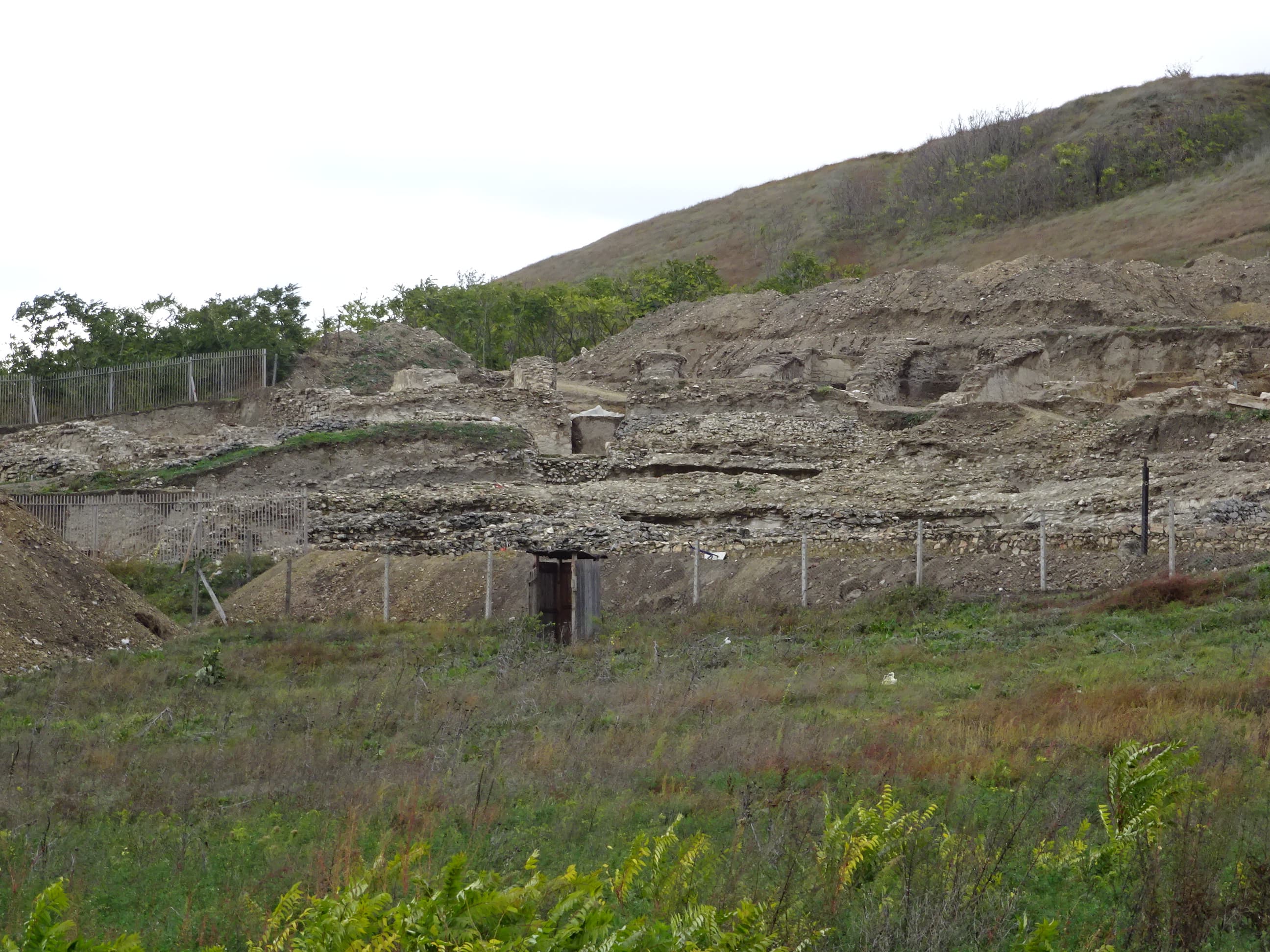
Image of Scupi. Image source
Visit essentials
A quick read before you go
- Duration
- 1–2 hours for a thorough exploration of the excavated areas and careful reading of the…
- Access
- Located 3 km north of central Skopje, near the villages of Bardovci and Zlokukani.
Overview
The city beneath the city is not a metaphor at Scupi. Three kilometers north of central Skopje, between Rabbit Hill and the Vardar River, lie the foundations of the largest Roman settlement in the region: a colonial city twice the size of Stobi, five times Heraclea Lyncestis, nine times Bargala.
Colonia Flavia Scupinorum was established by Emperor Domitian in the late 1st century CE as a veteran colony — a city of retired legionnaires from Rome's armies, given land and status in exchange for their service. Those veterans brought with them the full apparatus of Roman civic and religious life: the cult of the emperor, the ritual baths, the theater, the gods of diverse legions gathered from across the empire.
A pre-Roman Dardanian community had lived here first; the Romans built their colony on an already-inhabited site in the pattern common across the Balkans. A late 5th-century earthquake and a Christian basilica with baptistery mark the last chapter of the city's organized religious life, before the catastrophic 518 CE earthquake ended occupation. Then Scupi was buried, and above it, over centuries, the city now known as Skopje grew.
What makes Scupi compelling today is partly its scale — the Roman theater's inscribed seats are visible, the basilica foundations can be walked — and partly its quality of being genuinely half-forgotten. There is no entrance fee. There is no café. The site sits between residential development and farmland, with bilingual interpretive signs that reward careful reading. It is the kind of place that repays the visitor who arrives with patience and curiosity rather than expectation.
Why this place is sacred
Scupi was not accidentally sacred. The site between Rabbit Hill and the Vardar River was chosen by the Dardanians before the Romans arrived, and chosen again by the Romans for reasons that included its proximity to water, its strategic elevation, and its position on routes between the Danube and the Aegean. These were the same practical-cosmological considerations that governed sacred site selection across the ancient Balkans: control of movement, access to water, visibility.
The veteran legionnaires who settled Colonia Flavia Scupinorum under Domitian were not a homogeneous group. They came from legions drawn from across the empire — the religious practices they carried ranged from traditional Roman cult to mystery traditions, Mithraic worship, and the diverse religious identities of Rome's provincial soldiers. A colony of veterans was, in this sense, a cosmopolitan sacred community: multiple traditions coexisting in a single urban form, organized by the overarching framework of Roman civic religion.
The late 5th-century Christian basilica and baptistery represent the final layer of organized religious life at Scupi. The baptistery in particular — a space specifically designed for the ritual of Christian initiation, the symbolic death and rebirth of immersion — connects the site to the universally human practice of transformation.
That this space was built here, in the largest Roman city in the region, at the moment when the Roman world was becoming the Christian world, gives Scupi's sacred history its completeness.
Pre-Roman Dardanian settlement on a strategic Vardar riverside position; transformed into Rome's primary colonial city in the region under Emperor Domitian; site of early Christian baptismal and liturgical practice in the late 5th century CE.
From Dardanian Iron Age settlement through Roman military camp to colonial city of veteran legionnaires (Domitian, 81–96 CE), to early Christian basilica community, ending with the 518 CE earthquake. The city was gradually absorbed into what became Skopje, with systematic archaeological investigation beginning between the World Wars and continuing today. Designated a cultural heritage site of exceptional significance in 2016.
Experience and orientation
Scupi is a working excavation at the edge of residential development, not a curated archaeological park. Bilingual signs in Macedonian and English are its primary visitor infrastructure; there is no visitor center or café and no clearly posted hours.
This quality — the site's refusal to make itself convenient — is not a deficiency. It creates an encounter with the scale of Roman urban ambition in its unmediated form. The Roman theater, whose inscribed seats once read 'Colonia Scupi Aelia,' gives the clearest sense of urban scale: a theater in a city of this size served thousands.
The basilica foundations from the civilian period and the early Christian basilica with its documented baptistery are visible for those who approach with the interpretive signs as a guide.
Walk the perimeter of the site before examining its details. The relationship between the elevated terrain of Rabbit Hill, the flat ground of the former city, and the Vardar River below communicates the logic of the site's original selection. Then move slowly through the excavated areas, reading each sign. The bilingual interpretation is the primary available guide; it is sufficient for an attentive visitor.
The active excavation areas — if workers are present — create an unusual encounter. Archaeology in progress is a different experience from archaeology completed: the city is still being uncovered. What is underfoot has not yet been seen.
Located 3 km north of central Skopje near Bardovci and Zlokukani.
Context and lineage
The ground that would become Scupi was Dardanian before it was Roman. The Dardanians, an ancient Balkan people whose territory extended across what is now Kosovo and northern North Macedonia, had established a settlement at this Vardar riverside location before Roman contact. When Rome established a military camp here in the 2nd century BCE, it was building on an already-inhabited site.
The decisive transformation came under Emperor Domitian (81–96 CE), who established Colonia Flavia Scupinorum as a veteran colony — a formal Roman colonial city settled by retired legionnaires from the empire's armies. This act gave Scupi its distinct character: not an organic provincial town but a deliberately planted colony, populated by men who had spent careers in Rome's military and carried the religious practices of diverse legionary traditions.
The theater's inscribed seats, identified as 'Colonia Scupi Aelia,' suggest a subsequent connection to Emperor Hadrian's Balkan tour.
The early Christian basilica with baptistery, constructed in the late 5th century CE, represents the city's integration into the expanding Christian network of the late Roman Balkans. Radoslav Gruić's discovery of the basilica in 1925 was one of the major early archaeological finds at the site. The earthquake of 518 CE, which also damaged Stobi and Heraclea, effectively ended Scupi's urban life.
Scupi represents the foundational Roman layer of modern Skopje — the city beneath the city, predating the medieval Kale Fortress, the Byzantine period, and the Ottoman city that shaped Skopje's current character. Its Dardanian foundation reaches back before recorded history in the region. The early Christian basilica connects it to the broad late-antique Christian network of the Balkans, a tradition continued in the Orthodox churches and monasteries of the surrounding area.
Traditions and practice
Scupi's religious character as a veteran colony was determined by its founders: retired legionnaires from Rome's diverse armies brought the religious practices of their service, which ranged from traditional Roman civic cult to Mithraic worship, mystery traditions, and the varied devotional lives of soldiers drawn from Spain, Gaul, Syria, and the Danubian provinces.
The imperial cult organized this diversity into a shared civic framework: the theater hosted religious festivals, the thermae structured ritual daily life, and the civic ceremonies of the colony honored the emperor as divine.
The Christian basilica of the late 5th century, with its documented baptistery, represents a more specific practice: the rite of Christian initiation. Baptism in the early Church was a complete ritual of death and rebirth — full immersion in water, symbolic drowning of the old self, emergence into the new life of the Christian community.
That this specific practice was conducted here, in the largest Roman city in the region, connects Scupi to the most fundamental act of Christian religious transformation.
No active religious practice at the site. Ongoing archaeological excavation continues under the designation as a cultural heritage site of exceptional significance (2016).
The theater is the appropriate starting point — not because it is the most sacred element of the site but because it communicates scale. A Roman theater for a city of Scupi's size served thousands; its presence establishes that this was not a minor provincial settlement but a major urban center. Establish that fact before moving to the basilica.
At the early Christian basilica foundations, locate the baptistery. The physical form of an early Christian baptistery — usually cruciform or circular, sunken below floor level — was designed to make the metaphor of death and rebirth physically real: you descended into water, disappeared beneath it, and rose into a new identity. Even as foundations, this space repays attention.
Think of the number of individuals who experienced that transformation here, in this specific place, before the earthquake of 518 CE ended the city's life.
For the contemplative visitor, the most affecting dimension of Scupi may be its proximity to and concealment by modern Skopje. The largest Roman city in the region lies three kilometers from the capital, largely unvisited, freely accessible, waiting. Walking from the excavated areas toward the modern residential edge of the site and back, the layering of time becomes palpable: Dardanian, Roman colonial, early Christian, and now the everyday life of a 21st-century city, all on the same ground.
Dardanian Pre-Roman Settlement
HistoricalThe pre-Roman Dardanian community at Scupi represents the foundational layer of human occupation at this site. Dardanian religious practices, though not well-documented here, were part of the broader Iron Age Balkan sacred tradition.
Dardanian religious customs (undocumented in detail at this site); local sacred practices preceding Roman contact.
Roman Military and Colonial Religion
HistoricalScupi's establishment as a veteran colony under Domitian created a cosmopolitan religious community — legionnaires from across the empire bringing diverse religious practices under the organizing framework of Roman civic and imperial cult. The theater and thermae were its primary civic-religious spaces.
Imperial cult worship; civic sacrifices; theater religious festivals; legionary religious observances from diverse traditions; thermae ritual bathing.
Early Christian Basilica Worship
HistoricalThe late 5th-century Christian basilica with baptistery represents Scupi's integration into the expanding Christian network of late antique Balkans. The baptistery attests to the practice of Christian initiation — a ritual of symbolic death and rebirth — at the largest Roman site in the region.
Christian liturgy; baptism (baptistery physically documented); congregational worship until the 518 CE earthquake.
Archaeological and Heritage Research
ActiveThe largest Roman site in the North Macedonia region; designated cultural heritage site of exceptional significance in 2016. Excavations began between the World Wars; ongoing research continues. Its proximity to modern Skopje both constrains excavation and creates a unique urban-archaeological context.
Ongoing archaeological excavation; public interpretation with bilingual signage; free-access policy to encourage engagement; heritage designation research.
Perspectives and open questions
Scupi is viewed primarily through archaeological and urban history lenses; its spiritual dimensions are inferred from the civic-religious framework of Roman colonialism and the early Christian presence documented in the basilica.
Scholarly perspective
Scupi is recognized by archaeologists as the largest Roman settlement in North Macedonia — a fact established by comparative site analysis and confirmed by excavation. Its scale relative to Stobi, Heraclea, and Bargala suggests a dominant role in Roman provincial administration that has not been fully reflected in popular historical consciousness, largely because the site is overshadowed by modern Skopje. The 2016 designation as a cultural heritage site of exceptional significance reflects growing institutional recognition.
Ongoing excavation continues to expand knowledge of the site's full extent, constrained by the proximity of modern development.
Living and traditional perspectives
Local Macedonian communities have historically been more focused on Skopje's medieval and Ottoman layers than its Roman foundation. The recognition of Scupi as exceptional in scale is relatively recent; its integration into Skopje's civic identity as a founding layer is an ongoing cultural process.
Alternative interpretations
No significant esoteric or alternative spiritual traditions are specifically associated with this site. The baptistery's ritual function — immersive initiation as death and rebirth — connects to universal themes of transformation that resonate across traditions.
Open questions
The full extent of Scupi remains unexcavated due to modern residential development. The nature of Dardanian religious practice before Roman conquest is poorly documented from this site. The full character of the late antique transition from Roman civic religion to Christian practice — and how it unfolded specifically in a veteran colonial community — has not been reconstructed. The circumstances of the 518 CE earthquake and the fate of any surviving population are not established.
Plan your visit
Access and arrival
Located 3 km north of central Skopje, near the villages of Bardovci and Zlokukani. Navigate to 'Colonia Flavia Scupinorum' by GPS for best results. No public transport to the site — private vehicle or taxi from central Skopje recommended. Free admission. No café or water on site — bring supplies. No clearly posted hours; visit during daylight. Mobile phone signal is generally available in the Skopje valley.
If you encounter locked access on any section, contact the City of Skopje tourism office or check the Skupi Archaeological Site page on skopje.mk for current arrangements.
Central Skopje (3 km) offers a full range of hotels, guesthouses, and apartments. Scupi is easily combined with a broader Skopje itinerary.
Respectful visit
No specific dress requirements. Practical footwear for uneven terrain.
Photography is permitted throughout the site.
None appropriate at this site.
Do not disturb active excavation areas or enter open trenches. Do not remove any materials, including surface finds. Do not climb on wall structures or foundations.
The site's lack of clear boundaries means attentiveness is required to distinguish excavated areas from surrounding land.
Location
Map loads as you approach this section.
Pilgrim reflections
A portrait of encounter, not a score
Pilgrims describe what they felt, how present they could become, and whether the place would shape a journey. There are no stars and no ranking of traditions.
No reviewed reflections yet
The first pilgrims can help describe the character of being here.
Share a reflection
Available after an account-backed “Been there.” Every reflection is reviewed before publication.
Nearby sacred places
Explore other sacred places in the region. Proximity does not establish access or travel time; check each place’s guidance.

Mustafa Pasha Mosque
Skopje, Skopje, Skopje Region, North Macedonia
4.2 km away

Monastery of Saint Panteleimon, Gorno Nerezi
Gorno Nerezi, Gorno Nerezi, Skopje, North Macedonia
4.6 km away

Tumba Madžari
Madžari, Madžari, Gazi Baba Municipality, Skopje, North Macedonia
9.8 km away

Church of Saint Nicetas, Banjani
Banjani, Banjani/Gornjane, Čučer-Sandevo Municipality, Skopje Region, North Macedonia
10.1 km away
References
Sources consulted for this page. Source categories describe the publication, not a guarantee that every claim is verified. Traditional accounts and outside interpretations may differ.
- 01Scupi - Wikipedia — Wikipedia contributorsencyclopediaPrimary reference for history, archaeology, and urban development
- 02The Princeton Encyclopedia of Classical Sites: SCUPI — Perseus Digital Library / PrincetonacademicAcademic classical reference
- 03Skupi Archeological Site | Skopje Tourist Portal — City of SkopjeofficialOfficial city tourism description
- 04Roman Scupi - first settlement in the history of Skopje — AlaturkaSource contextOverview of Roman history and archaeological significance
- 05Skupi (Colonia Flavia Scupi) - Journey Macedonia — Journey MacedoniaguidePractical guide and historical overview
- 06Scupi | Skopje Travel Guide — In Your PocketguideVisitor guide with practical access details
- 07Scupi, Skopje, North Macedonia - SpottingHistory — SpottingHistorySource contextHistorical overview with location details
Share a photo
Help visitors recognize Scupi. Every submission is reviewed before publication.